12 June 2022

She is an extremely clever little artist

In September 1935, 13-year-old Judy Garland signed a seven-year contract with MGM at a starting salary of $100 a week. It would take some time, however, before Judy made her first feature film for the studio. Her debut film Pigskin Parade (1936) was on loan-out to 20th Century-Fox and her first MGM appearance was in the musical short Every Sunday (1936) with Deanna Durbin. It wasn't until 1937 that MGM finally put her into her first feature film, Broadway Melody of 1938, starring Eleanor Powell and Robert Taylor. In the film Judy sang You Made Me Love You (I Didn't Want to Do It) to a photograph of Clark Gable, her performance turning her into an overnight success. 

About a year earlier, in June 1936, while still waiting to be cast in her first film, Judy was sent by MGM on a promotional tour to New York City. It was her first visit to the Big Apple, during which she made several appearances on the Rudy Vallee radio show and recorded Stompin' at the Savoy with Decca Records (the first single she ever released). Furthermore, Judy paid a visit to MGM's New York offices, where she met executives like Nicholas Schenck and MGM representative Florence Browning.


Before Judy left for New York, Ida Koverman had given her a letter of introduction to take with her and give to Miss Browning at MGM. Koverman was executive secretary to MGM's boss Louis B. Mayer and is regarded as one of the most powerful women in Hollywood during the 1930s and 40s. She was a big supporter of Judy and was also the one who had convinced Mayer to sign her. Koverman's letter to Browning, in which she has nothing but good things to say about young Judy, is seen below. Also shown is a letter from Judy to Koverman after she had just arrived in New York as well as Koverman's reply. (Incidentally, in her letter to Browning, Koverman said that Judy was twelve years old although she was about to turn fourteen.)


Transcript:

June 1st, 1936

Dear Florence:

This will be presented to you by little Judy Garland, who is under contract to us. 

She is twelve years old and an extremely clever little artist. Her mother, who will be with her, plays her accompaniments, and I hope you will be able to arrange to hear her sing a few numbers. She is really a marvellous child. 

Her agent is taking her East to try to book her in some of the theatres, and I think it would be very wise to have someone connected with our office see the child before she gets into an opposition house. 

She sings very well and is an excellent dancer, and does the Eleanor Powell routines, and is a little genius.

In addition to this she is a dear little thing, and I am devoted to her. I know you will like her too.

Sincerely yours, 


Miss Florence Browning,
Metro-Goldwyn-Mayer Corporation,
1540 Broadway,
New York City.


Transcript: 

June 5, 1936

Dear Mrs. Koverman-

We arrived today in New York. I could hardly wait to write you to tell you how thrilled and dazed I am. 

We were at the M.G.M. offices today and saw Miss Florence, Mr. Rubin, Mr. Schenck and so forth. They were all so lovely to me. 

I hope my singing pleased them. 


Thank you so much for your letter to Miss Florence. It helped me so much and I sincerely appreciate it. 

As you have found out I certainly don't take any medles [sic] for writting [sic]. 

Please forgive it

Nothing else to say except thank you again

Sincerely yours
Judy

P.S Have you Jackie Copper's [sic] address? 

I forgot to get it before I left and he told me to be sure to write to him.

Please, if you have time, answer this.


Transcript:

June 8, 1936

My dear Judy:

I was very glad to get your nice little note, and to know you are having such a thrilling time. I was sure you would like Miss Florence Browning -- she is a very fine person, and I am sure also that your singing pleased them all.

We all miss you very much and certainly will be glad to see you when you return. Do write and let me know all that happens to you.

With kindest regards to your mother and Mr. Rosen [Judy's agent], and much love to yourself, I am 

Sincerely yours,
IRK (signed)

P.S. Jackie Cooper's address is 141 South Grand Avenue, Santa Monica.

Miss Judy Garland
Edison Hotel
47th and Broadway
New York City 

Source letters: Bonhams

Two days late but still — Happy 100th Birthday, Judy!

Ida R. Koverman

8 June 2022

Women do not do any of the creative work

During the National Board of Review awards ceremony in January 2014, Meryl Streep caused quite a stir when she labelled Walt Disney a "gender bigot". To prove her point, Streep had read from a 1938 rejection letter, written by Walt Disney Productions to a female job applicant who was seeking work in animation. "Women do not do any of the creative work in connection with preparing the cartoons for the screen, as that task is performed entirely by young men", the letter read. "For this reason girls are not considered for the training school. The only work open to women consists of tracing the characters on clear celluloid sheets with India ink and filling in the tracings on the reverse side with paint according to directions".

As the letter indicates, women worked in the inking and painting department while men worked in story, art direction and animation. In this pre-feminism era, it was a policy exercised not just by Disney but by every other animation studio in Hollywood. Still, there were women who found jobs at Disney in non-ink-and-paint departments, even as early as the 1930s. 

The women artists who worked at Disney in those early days were mainly story artists, like Bianca Majolie, the first woman to be hired by Disney's story department in 1935. Grace Huntington was employed in 1936 and in her autobiography Please Let me Fly she recalled how reluctant Disney was to hire women. "It takes years to train a good story man", he told her. "Then if the story man turns out to be a story girl, the chances are ten to one that she will marry and leave the Studio high and dry with all the money that had been spent on her training gone to waste as there will be nothing to show for it." For that same reason, Disney also wouldn't hire women as animators. (By contrast, the training period for inkers, painters and stenographers was relatively short, so if these women left the company to get married not much would be lost.) Nevertheless, since Disney valued real talent, Huntington was still hired and soon others followed, like Dorothy Ann Blank and Retta Scott who joined the story department in resp. 1936 and 1938.

Above: Walt Disney chats and laughs with some of the ink-and-paint employees at his studio in August 1939.

The first female animator at Disney was hired some time later, which actually happened by chance. Story artist Retta Scott was working on Bambi (1942) when her male colleagues saw her amazing drawings of hunting dogs. Very impressed by Scott's work, Disney then allowed her to do her own animations. Scott was tutored by animator Eric Larson and soon other women were being trained as well (in various fields). In a company speech from February 1941, Disney acknowledged the importance of women in creative jobs and explained why they were being trained, one of the reasons being World War II. With America possibly joining the war, Disney realised he simply needed women artists in order to keep his business going ("I believe that if there is to be a business for these young men to come back to after the war, it must be maintained during the war. The girls can help here."). Some of the talented women who had started in the inking and painting department were trained to be animators, among them Mildred Rossi and Virginia Fleener.

Other important talented women who were hired by Disney include Mary Weiser (master chemist who established the Walt Disney Studio's Paint Lab in 1935), Sylvia Holland (storyboard artist who was especially known for her work on the 1940 Fantasia) and perhaps the most influential of Disney's female artists Mary Blair (art supervisor and color stylist for films like Cinderella (1950), Alice in Wonderland (1951) and Peter Pan (1953)).

Retta Scott (left) and Mary Blair pictured above


Article in Glamour of Hollywood, May 1941. Source: archive.org


It is clear that, especially in the early days, Disney was not at all eager to hire women in creative jobs. He didn't want to lose his investment once women left the company to start a family and was also worried that women wouldn't survive in a male-dominated workplace. To Grace Huntington Disney had said in March 1936: "It is difficult for a woman to fit in this work. The men will resent you ... If you are easily shocked or hurt, it is just going to be bad". Female artists indeed had a lot to put up with, working in a mostly hostile environment while not receiving the recognition they deserved. Still, despite his own hiring policy, Disney did employ women from time to time, the ones mentioned above and many others (as said, WWII playing an important role). "If a woman can do the work as well, she is worth as much as a man", Disney had said in his 1941 speech to his employees. "The girl artists have the right to expect the same chances for advancement as men, and I honestly believe that they may eventually contribute something to this business that men never would or could".

Seen below is the letter Meryl Streep had read from during the award show, written in 1938 and addressed to Mary Ford. Another rejection letter (almost identical) to Frances Bowen is also shown, this one being from 1939. Both letters were signed by Mary Cleave (secretary?), containing a standard text that was taken from the Disney policy handbook. For how many years thereafter this form letter was used I don't know, the only copies to be found online are these from the late 1930s.
 

Transcript:

June 7, 1938

Miss Mary T. Ford
Searcy,
Arkansas

Dear Miss Ford,

Your letter of recent date has been received in the Inking and Painting Department for reply.

Women do not do any of the creative work in connection with preparing the cartoons for the screen, as that work is performed entirely by young men. For this reason girls are not considered for the training school.

The only work open to women consists of tracing the characters on clear celluloid sheets with India ink and filling in the tracings on the reverse side with paint according to directions.

In order to apply for a position as “Inker” or “Painter” it is necessary that one appear at the Studio, bringing samples of pen and ink and water color work. It would not be advisable to come to Hollywood with the above specifically in view, as there are really very few openings in comparison with the number of girls who apply.

Yours very truly,

WALT DISNEY PRODUCTIONS, LTD.

By:
(signed) 'Mary Cleave'


Transcript:

May 9, 1939

Miss Frances Brewer
4412 Ventura Canyon Avenue
Van Nuys, California

Dear Miss Brewer:

Your letter of some time ago has been turned over to the Inking and Painting Department for reply.

Women do not do any of the creative work in connection with preparing the cartoons for the screen, as that work is performed entirely by young men. For this reason girls are not considered for the training school.

The qualify for the only work open to women one must be well grounded in the use of pen and ink and als of water color. The work to be done consists of tracing the characters on clear celluloid sheets with India ink and filling in the tracings on the reverse side with paint according to directions.

In order to apply for a position as “Inker” or “Painter” it is necessary that one appear at the studio on a Tuesday morning between 9:30 and 11:30, bringing samples of pen and ink and water color work. We will be glad to talk with you further should you come in. 

Yours very truly,

WALT DISNEY PRODUCTIONS

By: (signed) 'Mary E. Cleave' 

2 June 2022

Dear Mr. Wayne

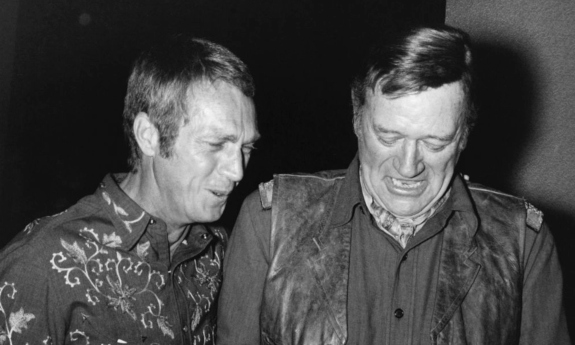
When John Wayne received a letter from ten-year-old Ross Brook who wrote how much he had liked Wayne's performance in the 1968 box-office hit Bullitt, the actor was undoubtedly amused by the boy's mistake. Of course, it wasn't Wayne who had starred in the film but Steve McQueen, Bullitt being one of McQueen's best-known films. Asked by Ross for an autographed picture, Wayne forwarded Ross' note to McQueen, accompanying it with a note of his own. 


Transcript:

Dear Mr. Wanye [sic] 
I love the movie Bulit [sic] and I thought your acting was great. I would like to know if I could have a autographed picture of you. I would like to see you some day.

Sincerely 
Ross Brook
age 10
55 Oak St
Los Altos Ca.
94022

_____


9570 Wilshire Blvd., Suite 400
Beverly Hills, California 90212
September 23, 1977

Mr. Steve McQueen
8899 Beverly Blvd., Suite 501
Los Angeles, California 90048

Dear Steve:
Would you please send him a picture of me from "Bullitt." 
I will be forever grateful.

Sincerely
(signed) Duke


Steve McQueen and John Wayne at an event in Los Angeles in 1969

26 May 2022

I have always been a thoroughly hypnotized admirer of your pictures

After living in Barcelona for five years, recently we (my sister and I) moved to Valencia, Spain's third largest city, which is located about 300 km south of Barcelona. During the years we've lived in Barcelona, we were lucky enough to see about 200 classic (predominantly Hollywood) films on the big screen at the wonderful film theatre Filmoteca. Fortunately Valencia also has a Filmoteca, where currently a small retrospective is dedicated to Orson Welles. As part of the Welles programme we've watched The Lady from Shanghai (1947) and Touch of Evil (1958), the latter film for the first time, and still to come are new-to-me films The Third Man (1949) and The Trial (1962). (Unfortunately I've missed Citizen Kane (1941), which I would have liked to rewatch on the big screen.)

Welles in The Third Man (left) and in Touch of Evil with Charlton Heston

While I enjoyed the Welles films I've seen (I especially love the visual aspects), I am not a Welles fan. Someone who was —and a big one at that— was Peter Bogdanovich, director of such classics as The Last Picture Show (1971), What's Up, Doc? (1972) and Paper Moon (1973). 

The letter for this post was written by Bogdanovich to Welles in January 1962, several years before the two men would actually meet. Bogdanovich, then 22 years old, wrote Welles in connection with a monograph he had written about Welles' work. The previous year, the aspiring film director had been commissioned by the Museum of Modern Art in New York to organise a retrospective on Welles —the first one ever in the USA— and to also write the accompanying monograph. As Welles himself could not attend the event since he was living and working in Europe, a copy of the 16-page monograph (entitled The Cinema of Orson Welles) was sent to him and he reportedly liked it. Nevertheless, Bogdanovich never got an answer to his letter and didn't hear from Welles until 1968, when Welles suddenly phoned him and asked if they could finally meet. The two men immediately hit it off —they eventually became friends— and not before long started having in-depth conversations about Welles' work, which they decided to tape and assemble in a bookThe book, This is Orson Welles, was not published until 1992, seven years after Welles' death.  

Source: Heritage AuctionsDon Quixote, mentioned in the letter, was one of Welles' unfinished film projects and eventually released in 1992.
(from left to right) John Huston, Orson Welles and Peter Bogdanovich during the making of The Other Side of the Wind, which Welles had begun shooting in 1970. The film was another unfinished Welles project. After Welles' death in 1985, shooting was completed and several attempts were made to reconstruct the film. Eventually in 2018, The Other Side of the Wind was released under supervision of Bogdanovich and producer Frank Marshall.


24 April 2022

What I want to know is, is that April Fool?

Often dubbed "First Lady of the American Theatre", Helen Hayes made her Broadway debut in 1909 at age nine and by the time she was twenty, she was well on her way to become a big Broadway star. Throughout the 1920s, Hayes appeared in successful plays like Caesar and Cleopatra (1925) and Coquette (1927) and, as her star rose, it didn't take long for Hollywood to come calling. Hayes declined several studio offers but then the Great Depression hit, causing theatre attendance to drop dramatically. When MGM offered her a lucrative seven-year contract in 1931 —with the possiblity to periodically perform on Broadway— Hayes felt she had little choice but to accept. 

In her 1990 memoir My Life in Three Acts, Hayes wrote that MGM didn't really know what do with her. "I didn't have [Joan] Crawford's bone structure or [Greta] Garbo's mystery. I wasn't sexy like [Jean] Harlow or naughty like Marion [Davies], and I didn't have the figure to carry off clinging white satin like Norma [Shearer]. There were so many things I didn't have or wasn't, that it seemed best for me to quit then and there. But Mr. Mayer had an idea. I would be promoted as "The Great Actress"." 

MGM put Hayes into melodramas and her first film was The Sin of Madelon Claudet (1931), for which she immediately won the Oscar for Best Actress. Next she played in dramas such as Arrowsmith (1931) with Ronald Colman; A Farewell to Arms (1932) with Gary Cooper; and The White Sister (1933) opposite Clark Gable. It was after she had starred in the romantic comedy What Every Woman Knows (1934), with Brian Aherne and Madge Evans, that Hayes made the decision not to stay in Hollywood but to return to the stage.

What Every Woman Knows was based on the 1908 play of the same name by J. M. Barrie and in 1926 Hayes had starred in a Broadway revival of the play. The play was very special to Hayes, her role in it one of her favourite stage roles. She had high hopes for the film version but after reading the script her hopes were immediately crushed. "Barrie's delicate comedy had been torn apart in the most insensitive way", Hayes later said. "I protested, but was told to stick to acting and let others worry about writing and directing." After the film was finished and Hayes saw the preview, it left her devastated. It was then that she decided to leave Hollywood for good.

Above: Brian Aherne, Madge Evans and Helen Hayes in a scene from What Every Woman Knows. Below: (left to right) Hayes in Arrowsmith with Ronald Colman, in A Farewell to Arms with Gary Cooper and Vanessa: Her Love Story with Robert Montgomery.

Wishing to be released from her contract, Hayes went to see Eddie Mannix, MGM's general manager. She thought MGM was glad to be rid of her but Mannix wouldn't let her go. He told her that she still had a contractual obligation to do Vanessa: Her Love Story (1935) and if she refused, MGM would sue her for the $96,000 that was already spent on pre-production. Hayes saw no other option but to make Vanessa, in which she co-starred with Robert Montgomery. 

While Hayes did have a few years left on her contract, MGM had assured her they wouldn't hold her to it. Imagine her surprise then when she received a letter from Eddie Mannix in April 1935, saying that "Metro had renewed [her] option". Clearly annoyed, the actress replied:

Source: Heritage Auctions


Vanessa: Her Love Story  remained Hayes' last film for MGM. Hayes would return to Hollywood but not until 1952 —after a 17-year absence— to star in Leo McCarey's My Son John. Sporadically she accepted other film offers, most notably Anastasia (1956) and Airport (1970). It was for her performance as a stowaway in the latter film that Hayes received her second Oscar, this time for Best Supporting Actress.

Helen Hayes with her Oscar for Best Actress for her performance in the 1931 The Sin of Madelon Claudet .

21 April 2022

Wyler is still up to his old tricks

Director of such classics as The Letter (1940), The Best Years of Our Lives (1946), The Heiress (1949) and Ben Hur (1959), William Wyler was known for his penchant for retakes. Actors mockingly called him "once more Wyler", "40-take Wyler" or even "90-take Wyler". Always looking for the perfect shot and determined to bring out the best in his actors, Wyler had them repeat the same lines, make the same movements or gestures through numerous retakes. His theory was that after a large number of takes actors would become so irritated and exasperated that they would no longer "act" but give the natural performance he was looking for. 

William Wyler and Bette Davis on the set of Jezebel

Bette Davis did some of her best work with Wyler. Their first film together was Jezebel (1938), followed by The Letter (1940) and The Little Foxes (1941). Bette said that prior to working with Wyler she had never done more than two takes in a film. On Jezebel's first day of shooting, howeverWyler let her do as much as forty-five takes. In her first scene with the riding crop, the director felt that Bette's gestures were too theatrical and then made her repeat the scene over and over again until she dropped her mannerisms and gave him the shot he wanted. While his directing style often drove Bette and other actors to exasperation as well as exhaustion, Wyler ultimately got the best performances out of them. Bette won her second Oscar for Jezebel and later gave the director full credit: "It was all Wyler. I had known all the horrors of no direction and bad direction. I now knew what a great director was and what he could mean to an actress".

Wyler watches as Henry Fonda and Bette Davis play a scene in Jezebel

During the filming of Jezebel, it was not only Bette Davis but also leading man Henry Fonda who was forced by Wyler to do numerous retakes (of one scene even forty). A few weeks into production, Fonda's retakes caught the attention of producer Hal Wallis who was worried about going over schedule and over budget. Wallis wondered whether Wyler held a grudge against Fonda over Margaret Sullavan —both men had been married to the actress— and if that was the reason why he made Fonda do so many takes. About the subject Wallis sent a memo to associate producer Henry Blanke in early November 1937. (Actually Fonda and Wyler liked each other and became friends.) A few months later, the producer sent Blanke another memo, seeing that Wyler had not changed his ways and was still shooting multiple takes. 


DATE: November 4, 1937

SUBJECT: "Jezebel"

TO: Blanke

FROM: Wallis

Do you think Wyler is mad at Henry Fonda or something because of their past? It seems that he is not content to okay anything with Fonda until it has been done ten or eleven takes. After all, they have been divorced from the same girl, and by-gones should be by-gones. I wonder if he wouldn't be satisfied to okay a fourth take or a fifth take occasionally. I am sure Fonda is a good actor, and I think if we will try printing up an occasional third or fourth take, after Wyler has okayed a tenth or an eleventh take, you will find that the third or fourth is just as good.

Possibly Wyler likes to see these big numbers on the slate, and maybe we could arrange to have them start with number "6" on each take, then it wouldn't take so long to get up to nine or ten. Will you please talk to Wyler and see if you can influence him a little on this score.

Hal Wallis


_____


DATE: January 8, 1938

SUBJECT: "Jezebel"

TO: Blanke

FROM: Wallis

In spite of hell and high water and everything else, Wyler is still up to his old tricks. In last night's dailies, he had two takes printed of the scene where Donald Crisp leaves the house and Davis comes down the stairs and finds out that Pres [Henry Fonda] is coming. The first one was excellent, yet he took it sixteen times.

Doesn't this man know that we have closeups to break up a scene of this kind, and with all of the care he used in making the closeups, certainly he must expect that we would use the greater portion of the scene in closeup. Yet, he takes the time to make sixteen takes of a long shot. What the hell is the matter with him anyhow — is he absolutely daffy? Is he on the level when he says he is going to speed up and try to get through? If he is, this is a poor indication of it. Will you please tell him I said so.

Hal Wallis 


Source: Inside Warner Bros. (1935-1951) (1985), selected and edited by Rudy Behlmer. 

_____


While the Daily Production Reports showed that there had been an attempt to speed up production, by then the film was already going over budget. Wallis consequently threatened to fire Wyler and bring in William Dieterle to replace him. Bette, who had started an affair with Wyler, wouldn't stand for it and went to studio boss Jack Warner, pleading to let Wyler stay on. She promised to work late every night and start again early in the morning, whatever it took to finish the picture. Warner let Wyler stay but the director wouldn't work any faster and Jezebel eventually went 28 days over its original 42-day schedule. As said, Bette won an Oscar for her performance, and Fay Bainter also won the statuette for Best Supporting Actress. The film itself ended up being both a critical and commercial success. 

Although Wyler didn't receive an Oscar nomination for his direction in Jezebel, he is still the most nominated director in Oscar history with twelve nominations. He ultimately won three Oscars, i.e. for Mrs Miniver (1942), The Best Years of Our Lives (1946) and Ben Hur (1959). Also, under Wyler's direction more actors received Oscar nominations for their performances than with any other director in history, i.e. thirty-six. Fourteen of them actually won the Oscar, which is also a record (among them Audrey Hepburn in Roman Holiday (1953), Olivia de Havilland in The Heiress (1949) and Barbra Streisand in Funny Girl (1968)). Needless to say, those retakes really paid off!

Bette, Henry and Willy while filming Jezebel


14 April 2022

The show must not go on - but you definitely must

On 29 March 1981, the musical Woman of the Year opened at the Palace Theatre on Broadway. Based on the 1942 George Stevens' film of the same name, the musical starred Lauren Bacall in the role of famous tv personality Tess Harding. (When Katharine Hepburn played Tess in the film, she was a newspaper columnist.) While Bacall earned rave reviews and a Tony Award for her role, she didn't stay with the show for its entire two-year run. In June 1982, Bacall left the production and was replaced by Raquel Welch (who had previously filled in for Bacall during her vacation in December 1981) and for the final month of the show Debbie Reynolds took over the role from a pregnant Welch. Woman of the Year eventually closed on 13 March 1983 after a total of 770 performances.

Above: After performing in Woman of the Year at the Broadway Palace Theatre, Debbie Reynolds returns for a curtain call.

On 5 March 1983, after Debbie Reynolds had given 24 performances since taking over the lead in Woman of the Year, she forgot her lines during a matinee show and suddenly fainted on stage. Fifty years old at the time, Reynolds was briefly hospitalised and doctors later said she suffered from a rare form of amnesia. Following the unfortunate incident, the actress/singer received this sweet, supportive note from Lauren (Betty) Bacall. Reynolds went back to work after a few days of rest, but not long thereafter the show was forced to close due to declining ticket sales. 

Source: Worthpoint

Transcript:

Dear Debbie —

Am so very sorry + sad for your bad luck. No matter what the producers might tell you - and as one pro to another- the show must not go on- But you definitely must.

I have been out of town + have heard only terrific things about you in "Woman of the Year". And I know it is not an easy show.

Anyway take care of yourself - get your strength back - Health comes first.

Affectionately —
Betty Bacall

10 April 2022

The Tragic Life and Death of Bella Darvi

Today's letter made me read up on Bella Darvi, an actress I had not heard of before. She had a very brief Hollywood career in the 1950s. This is her (tragic) story.

Bella Darvi was born Bajla Węgier in Poland in 1928. Her parents were Jewish and immigrated to France in the 1930s. As a teenager during WWII Darvi was interned in a concentration camp for several years. She survived, but her brother Robert who was also in a camp died there. In 1950, Darvi married businessman Alban Cavalcade and moved with him to Monaco, where she became addicted to gambling. A year later, she met 20th Century-Fox studio boss Darryl Zanuck and his wife Virginia in Paris. The couple took her under their wing, paid off her gambling debts and eventually brought her to the States.

In 1952, Darvi divorced her husband and went to live with the Zanucks at their house in Santa Monica. She was encouraged to pursue an acting career and, at the suggestion of Mrs Zanuck, changed her last name from Węgier to Darvi (derived from Darryl and Virginia). Darvi took acting lessons and in 1953 signed a long-term contract with 20th Century-Fox. Hedda Hopper called the aspiring actress "an exciting new personality" and predicted that she would not only "make a splash" in her first film but also that she would be one of the "stars of 1954".

Hopper's predictions proved wrong, however. Darvi's debut performance in Samuel Fuller's Hell and High Water (1954) opposite Richard Widmark was poorly received by both the public and critics, with the New York Times stating that she "does not succeed convincingly". Her second role —the part of the courtesan Nefer in Michael Curtiz's The Egyptian (1954)— was not received any better. Darvi "smiles and postures without magnetism or charm", said the NY Times while Variety commented: "A weak spot in the talent line-up is Bella Darvi who contributes little more than an attractive figure". Co-star Jean Simmons was also unimpressed with Darvi, reportedly joking with other cast members that Darvi was "an actress who 'nefer' was". Criticised also for being very difficult to understand due to her heavy accent, Darvi would only make one more film in Hollywood —Henry Hathaway's The Racers (1955) with Kirk Douglas— before moving back to France at the end of 1954.

Darvi's lack of acting talent was not the reason why she eventually left Hollywood. While she was living with the Zanucks, Darvi and Zanuck had an affair and when Mrs Zanuck found out she kicked Darvi out of the house. Totally besotted with his protégé, Zanuck separated from his wife and followed Darvi to Europe. It was when he discovered that she was bisexual that he ended the affair.

In Europe Darvi continued her acting career but only appeared in mediocre French and Italian productions. She also kept gambling, losing huge amounts of money and increasing her debts (as late as 1970, Zanuck was still paying them off). In 1960, Darvi married restaurant waiter Claude Rouas, only to divorce him less than a year later. Suffering from depression, Darvi took an overdose of barbiturates in 1962 and 1968 but recovered. Then on 11 September 1971, she tried to kill herself again by turning on the gas stove in her Monte Carlo apartment. This time the attempt was successful. Darvi died, only 42 years old. Her body was not discovered until ten days later. 

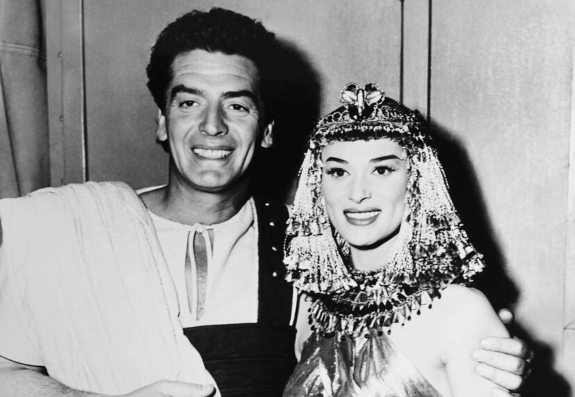
Richard Widmark and Bella Darvi in Hell and High Water (above) and Darvi with co-star Victor Mature on the set of The Egyptian (below). Marilyn Monroe had lobbied to get the part of Nefer in The Egyptian which eventually went to Darvi.

Here is one of the many letters Darvi wrote to Darryl Zanuck during their affair (click on the source beneath the image for more letters, and some of her telegrams to Zanuck can be seen here). She reportedly never recovered from the affair, which may have led or contributed to her suicide.


Transcript:

Darling,

I really didn't think I would ever come to write you such a letter! but I am positive now that this is the right thing to do.

This letter won't be long, and what I will say won't be said in anger! I was angry at you but you know I won't be angry at you for a long time, I love you with all my heart but I realize I can not make you happy and neither can you! It is sad and I am sad too! but I thought it over and over and I want you to agree with me and to call it off!

I don't know what else to say, I only wish you would understand and not go crazy! If I only could write exactly how I feel! Oh sure I wrote you many letters but this one is a tough one and I want it to be so clear!

I am sorry if it makes you unhappy, this is a decision but don't think it makes me happy - I wish I was dead!

It is finished! Please don't answer and tell me things that will upset me, I know you and also know it will be one of your reactions!

Good bye my love -

B.

Above: Darryl Zanuck and his wife Virginia Fox photographed in June 1953; although they separated following Zanuck's affair with Darvi, the couple never legally divorced. Below: Zanuck and Darvi at a party in Ciros, Hollywood in January 1954, held in honour of Zanuck's daughter.

6 April 2022

I personally feel that audiences are waiting to see you in a smart, modern picture

In 1935, while under contract to MGM, David O. Selznick was assigned to produce the next Greta Garbo picture. After being head of production at RKO, Selznick had joined MGM in 1933 and was given his own production unit, alongside the unit headed by Irving Thalberg. Prior to his film with Garbo, Selznick had already produced a string of successful films for MGM, including Dinner at Eight (1933) and David Copperfield (1934).

Greta Garbo was already a star by the time she and Selznick worked together. With her role in Anna Christie (1930) Garbo had made a successful transition from silent films to talkies and other successes soon followed, like Mata Hari (1931) and Grand Hotel (1932). For her project with Selznick the actress wanted to play the titular role in a new film adaptation of Leo Tolstoy's Anna Karenina. Garbo had played Anna in the 1927 silent film Love but, unhappy with the film's tacked-on ending, she was eager to reprise the role in a production that would stay closer to Tolstoy's novel.

Selznick was far from enthusiastic, however, about making Anna Karenina with Garbo. He very much wanted her to play in a contemporary drama and the project he had in mind was Dark Victory, a 1934 play written by George Brewer Jr. and Bertram Bloch, which had starred Tallulah Bankhead on Broadway. Trying to convince Garbo to choose Dark Victory over Anna KareninaSelznick wrote her a letter in January 1935, his impassioned plea ultimately proving fruitless. Garbo didn't like Dark Victory and was intent on doing Anna Karenina. Seeing that her contract gave her the right to decline any project she disliked, Selznick had no choice but to accept Garbo's decision.

Above: Greta Garbo as Anna Karenina and Fredric March as Count Vronsky in David Selznick's production of Tolstoy's famous novel. Below the two actors are pictured on the set, with director Clarence Brown seated.

This is the letter Selznick wrote to Garbo, who at the time was vacationing at La Quinta near Palm Springs. Needing an immediate answer, Selznick had his letter hand-delivered to the actress by her close friend, screenwriter Salka Viertel.


January 7, 1935

Miss Greta Garbo
La Quinta, California

Dear Miss Garbo:

I was extremely sorry to hear this morning that you had left for Palm Springs, because we must arrive at an immediate decision, which, I think, will have a telling effect on your entire career.

As I told you the other day, we have lost our enthusiasm for a production of Anna Karenina as your next picture. I personally feel that audiences are waiting to see you in a smart, modern picture and that to do a heavy Russian drama on the heels of so many ponderous, similar films, in which they have seen you and other stars recently, would prove to be a mistake. I still think Karenina can be a magnificent film and I would be willing to make it with you later, but to do it now, following the disappointment of Queen Christina and The Painted Veil, is something I dislike contemplating very greatly.

Mr. Cukor shares my feeling and it seems a pity that we must start our first joint venture with you with such a lack of enthusiasm and such an instinct of dread for the outcome. If we make the picture, Mr. Cukor and I will put our very best efforts into it and I am sure we could make a fine film, hopefully one excellent enough to dissipate the obvious pitfalls of the subject from the viewpoint of your millions of admirers. But I do hope you will not force us to proceed.

We have spent some time in searching for a comedy and although several have been brought to me, there are none I feel sufficiently important enough to justify the jump into comedy; to say nothing of the difficulty of preparing a comedy in the limited time left to us.  

Therefore, since you feel that you must leave the end of May and cannot give us additional time, we have been faced with the task of finding a subject that could be prepared in time and which might inspire us with a feeling that we could make a picture comparable to your former sensations and one that would, at the same time, meet my very strong feeling that you should do a modern subject at this particular moment in your career. The odds against our finding such a subject were very remote and I was very distressed and felt there was no alternative left to us but to proceed with Karenina. Now, however, I find that if I act very quickly, I can purchase Dark Victory, the owners of which have resisted offers from several companies for many months. The play is at the top of the list at several studios and if we do not purchase it, the likelihood is that it will be purchased at once for Katharine Hepburn. The owner of the play, Jock Whitney, is leaving for New York tomorrow and it would be a pity if we were delayed in receiving your decision concerning it .... Therefore, I have asked Salka to see you and to bring you this letter and to tell you the story— which I consider the best modern woman's vehicle, potentially, I've read since A Bill of Divorcement and which I think has the makings of a strikingly fine film. Mr. Cukor and many others share this opinion .... 

Fredric March will only do Anna Karenina if he is forced to by his employers, Twentieth Century Pictures. He has told me repeatedly that he is fed up on doing costume pictures; that he thinks it a mistake to do another; that he knows he is much better in modern subjects and that all these reasons are aggravated by the fact that Anna Karenina would come close on the heels of the Anna Sten- [Rouben] Mamoulian- [Samuel] Goldwyn picture, We Live Again, from Resurrection [Leo Tolstoy's 1899 novel], a picture which has been a failure and in which March appeared in a role similar to that in Karenina. Mr. March is most anxious to do a modern picture and I consider his judgment about himself very sound. We are doubly fortunate in finding in Dark Victory that the male lead is also strikingly well suited to Mr. March.

For all these reasons, I request and most earnestly urge you to permit us to switch from Anna Karenina to Dark Victory and you will have a most enthusiastic producer and director, respectively, in the persons of myself and Mr. Cukor.

I have asked Salka to telephone me as soon as she has discussed the matter thoroughly with you, and I can say no more than that I will be very disappointed, indeed, if you do not agree with our conclusions. 

Most cordially and sincerely yours, 


Source: Memo from David O. Selznick (1972); selected and edited by Rudy Behlmer.


_____


Selznick purchased the rights to Dark Victory and tried to get Merle Oberon for the female lead after Garbo had turned it down. Oberon was not available, however, and since Selznick was also facing problems with the script he eventually sold the property to Warner Bros in 1938. In the end, Dark Victory (1939) was made with Bette Davis and George Brent in the leads. Directed by Edmund Goulding, the film was a big hit.

Garbo got what she wanted and made Anna Karenina (1935) with Selznick. As her leading man Fredric March was cast, against his own wishes but at the insistence of his studio. (Selznick initially wanted Clark Gable but he was not interested.) Since George Cukor was not keen on doing the project, Clarence Brown was hired to direct. Anna Karenina became both a critical and commercial success. The film is the only collaboration between Selznick and Garbo. 

Above: Selznick in his MGM offices, ca. 1933-1935, photographed by Clarence Sinclair Bull. After doing Anna Karenina, Selznick made one more film for MGM (A Tale of Two Cities) and then quit to found his own production company, Selznick International Pictures. Below: Bette Davis and George Brent in the weepie Dark Victory in roles Selznick had originally envisaged for Greta Garbo and Fredric March. Bette plays the socialite Judith Traherne who suffers from a brain tumour and Brent is Frederick Steele, the doctor she falls in love with.