Showing posts with label Samuel Goldwyn. Show all posts

10 April 2024

Sam, I am frank to say that I don't understand you

David O. Selznick and Samuel Goldwyn were two of Hollywood's most successful independent producers, both with their own group of contract players. Among Selznick's contracted stars were (at one time or another) Joan Fontaine, Ingrid Bergman, Gregory Peck and Joseph Cotten, while Goldwyn had under contract such stars as Gary Cooper, Joel McCrea, David Niven and Danny Kaye. One of the people also under contract to Selznick was British director Alfred Hitchcock, who came to Hollywood in early June 1938 at the invitation of Selznick. 

Before being signed by Selznick, however, Hitch met with Samuel Goldwyn. Goldwyn was also interested in Hitch but made no serious bid to land him. (According to Selznick, Myron Selznick (David's brother and Hitch's agent) could "not get bids for [Hitch] at the time I signed him".) Eventually in mid-July 1938, Selznick and Hitch struck a deal, entering into a seven-year contract. The two worked together only four times, i.e. on Rebecca (1940), Spellbound (1945), Notorious (1946) and The Paradine Case (1947). More often than not, Hitch was loaned out by Selznick to other studios at considerable profits (much to Hitch's resentment as he didn't share in the profits).

Above: Selznick and Hitchcock — the men had a difficult working relationship. Below: At a dinner in Los Angeles in October 1953, (l to r) Goldwyn, Jennifer Jones (Selznick's second wife) and Selznick. The two producers reportedly admired and liked each other.

In late December 1942, Hitch had a meeting with Goldwyn about a production deal. Shooting on Shadow of a Doubt (1943) had already ended and Hitch's next project would be Lifeboat (1944) on loan-out to Twentieth Century-Fox. When Selznick heard about the Hitchcock-Goldwyn meeting, he was furious and next wrote a letter to Goldwyn. With Hitch still having a few years left on their contractSelznick resented Goldwyn for trying to "seduce" Hitch into coming to work for him, and for telling Hitch not to waste his talents on projects like Shadow of a Doubt (which was not produced by Selznick but by Skirball Productions)Ironically enough, Shadow was to become Hitch's personal favourite.


January 6, 1943

Mr. Samuel Goldwyn
1041 North Formosa
Hollywood, California
cc: Mr. O'Shea

Dear Sam:
Recently, you have had a couple of occasions to remind us forcibly that you are a "frank" man, although God knows no reminder was necessary. However, I do hope that you grant to others —such, for instance, as myself— the right to be equally frank: 
Sometimes, Sam, I am frank to say that I don't understand you. You scream and yell about other people's ethics, and then behave in a fashion that makes my hair stand on end with a combination of anger and incredulity.
You recently have sent direct for one of my people, Alfred Hitchcock, and talked with him without so much as either asking us, or even letting us know after the fact. I wonder just how you would behave if I reciprocated in kind — or if any of the big companies did it with your people. I have always maintained that no one is in permanent bondage in this business, and that once a contract has expired, or is soon to expire, every individual in the business should be free to negotiate with anyone he sees fit, without giving offense to the studio to which he or she has been under contract, and regardless of the desire of the original contracting studio to make the bondage permanent. I am not talking about such a case: rather, I am referring to a man who you know full well is still under long-term contract to me. Or if you don't know it, everyone else in the business does, and you ought to know it. The very least you could have done was to find out. Ignorance is no more a defense in these matters, if that be your defense, than it is in the law. 

Hitch has a minimum of two years to go with me, and longer if it takes him more time to finish four pictures, two of which I have sold to Twentieth Century-Fox. And not alone did you try to seduce him, but you tried something which I have never experienced before with any company or individual— you sought to make him unhappy with my management of him. When you told Hitch that he shouldn't be wasting his talents on stories like Shadow of a Doubt, and that this wouldn't be the case if he were working for you, what you didn't know was that Hitchcock personally chose the story and created the script— and moreover that he is very happy about the picture, which I think he has every right to be. Further, that in the years since I brought Hitchcock over here from England (at a time when nobody in the industry, including yourself, was willing to give him the same opportunity...) and established him as one of the most important directors in the world with the production and exploitation of Rebecca, he has never once had to do a story that he was not enthusiastic about. This has always been my attitude about directors, and I happen to know that it has not always been your attitude toward directors under contract to you ...

By contrast with your own behavior, I have for months met criticisms of you with praise for your work, and for your contributions to the business, and for your integrity of production. I have said to literally dozens of people in important positions that you have never received as much recognition in the industry as is your due. And just yesterday, and despite my growing rage with you, I went even further than this with an important magazine writer who is doing an article about you. I not alone sang your praises, but I painstakingly corrected some impressions he had gained elsewhere, taking half an hour out of a very busy day for the purpose. When I hear of you doing the same thing, instead of doing your best (which would appear to be synonymous with your worst) in the opposite direction, I will believe your fine statements, and not before. I regret that I have to write you in this vein, and I do so not because I have any reluctance about rebuking you verbally, for you know from our past relationship that I have never been hesitant about such matters when I felt you to be in the wrong. I write you now, first, because I want it a matter of record, in connection with my future dealings with you; and second, because I have learned from experience that it is impossible to get you to listen to this many words unless they are in writing.

With best wishes for a fine and reformed New Year,

Sincerely yours ,

Source: Memo from David O. Selznick (1972); selected and edited by Rudy Behlmer. 
On the set of Shadow of a Doubt with Hitch (far right, seated) and Shadow's main players (l to r) Joseph Cotten, Teresa Wright and Macdonald Carey. The film was shot on location in Santa Rosa, California. It was  Hitchcock's own favourite of his films because —in Hitch's own words—  it "brought murder and violence back in the home, where it rightly belongs" .


Selznick's most successful achievement was his 1939 Gone with the Wind, and Goldwyn will probably be best remembered for The Best Years of Our Lives (1946). Both films won numerous Oscars, including Oscars for Best Picture.

15 March 2022

It is no use saying one won't get typed - one always is

By the mid-1930s, Basil Rathbone was one of Hollywood's best-paid freelance actors. When Samuel Goldwyn offered him a four-year contract in 1936, the actor had serious misgivings, having worked under contract before (to MGM) and hating it. In a letter from December 1936, Rathbone voiced his objections to Goldwyn about signing with him. Apart from being very unhappy with the billing clause in the contract, Rathbone was not at all interested in playing the heavy in Goldwyn's upcoming film The Hurricane (1937). Ever since he had portrayed the evil Murdstone in David Selznick's production of David Copperfield (1935), the actor had played villains. Afraid of being typecast as a villain, Rathbone rejected The Hurricane ("my part is a cold blooded unaffectionate duty loving bastard"), the role eventually played by Raymond Massey. Incidentally, Rathbone's most famous villain role was yet to come, that of Sir Guy of Gisbourne in The Adventures of Robin Hood (1938).

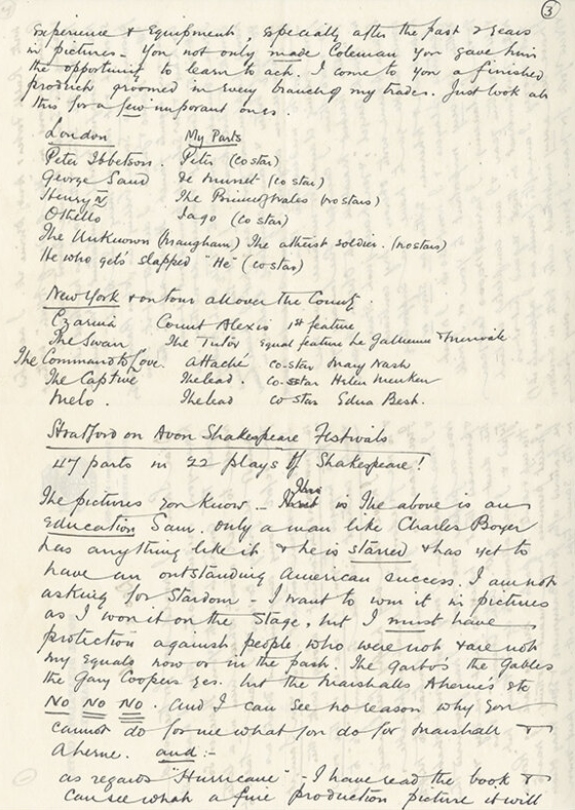
Here is the letter Rathbone wrote to Samuel Goldwyn on 2 December 1936, in which he complains about his billing situation, boasts about his acting achievements and —not wishing to be typed as a villain— suggests several characters he would be interested in playing.
 

Source: Heritage Auctions

Transcript:

Grand Hotel Dunapalota
Budapest

Dec. 2, 1936

Dear Sam, I would not for the world have you misunderstand why I have not signed the contract with you. There is so much to talk about, which even in a letter cannot be fully covered & I want to talk to you before doing anything as drastic as signing a 4 year contract. To you Sam, it is just another contract along with other artists engaged to you. To me it is the one & only contract & it has so many “ifs” to it.

I have been very happy freelancing & to me freedom is almost irreplaceable. Five years ago I was under contract to MGM & I was miserable. I only got just what was on paper & no more. I was promised this & promised that — hope was high one day & in the dust the next. After “[The Last of Mrs.] Cheyney” I was typed & I was allowed to do nothing but “tea cup & white tie parts.” Even as late as “Romeo & Juliet” promises have meant nothing. I was to be featured after John Barrymore & Edna May Oliver in the same type. I was not. I was put down with Ralph Forbes & Andy Devine etc. I accepted Count Anteoni in “The Garden of Allah” without reading the script because David Selznick told me the story & the part as he told it was colourful & vital & important. We came to shoot it & it was nothing. In “Allah” I was promised the same billing as John Barrymore got in Romeo & Juliet. I did not get it. This was my agent’s fault. It was not in the contract & Mr. Selznick pointed out it was not in the contract & would do nothing. So I was bunched down with Tilly Losch, Aubrey Smith & [Joseph] Shildkraut [sic]. I don’t say like things would happen with you Sam, but I have been so badly bitten & I am completely lacking in confidence in anyone. I am sure you must be able to understand this.

Your billing clause for instance gives me no more than I can get freelancing & yet you star Herbert Marshall with [Merle] Oberon & [Fredric] March in “Dark Angel,” & you have just starred Brian Aherne with Oberon. My contract would enable you to have me supporting Marshall & Aherne either as stars or featured players & I won’t do it. I must either be very important to you or I will go on freelancing. I earned $120,000 last year and 140,000 this year & I am completely content with your contract in that regard but it is not money I am after (much as I appreciate it!) I have been a very important actor both in London & New York for years. I bring you a very full experience & equipment, especially after the past 2 years in pictures. You not only made [Ronald] Coleman [sic], you gave him the opportunity to learn to act. I come to you a finished product groomed in every branch of my trade. Just look at this for a few important ones.

LondonMy Parts                                             
Peter Ibbetson—Peter (co star) 
George Sand—de Musset (co star)
Henry IV—The Prince of Wales (no stars)
Othello—Iago (co star) 
The Unknown (Maugham)—the atheist soldier (no stars)
He who gets slapped—“He” (co star) 

New York & on tour all over the Country 
Czarina—Count Alexis, 1st feature
The Swan—The Tutor, equal feature LeGallienne & Merivale
The Command to Love—Attache, co-star Mary Nash
The Captive—the lead, co-star Helen Menken
Melo—the lead, co-star Edna Best

Stratford on Avon Shakespeare Festivals
47 parts in 22 plays of Shakespeare!

The pictures you know. The above is an education Sam. Only a man like Charles Boyer has anything like it & he is starred & has yet to have an outstanding American success. I am not asking for stardom. I want to win it in pictures as I won it on the stage, but I must have protection against people who were not & are not my equals now or in the past. The Garbos the Gables the Gary Coopers yes, but the Marshalls Ahernes etc. NO NO NO. And I can see no reason why you cannot do for me what you do for Marshall & Aherne. and -

as regards “Hurricane” I have read the book & can see what a fine production picture it will make. I don’t know how it is being treated but my part is a cold blooded unaffectionate duty loving bastard! He has a brief moment of humanity at the end but what of it — he’s a horrible person. I played one for Selznick 2 years ago “Murdstone” & then I played Karenin & a part for Fox but no more. I am not against heavies, but I am against men whose wives dislike them, who are unsexed, complex & inhibited. Tybalt, Pontius Pilate & Levasseur (in Capt. Blood) were all heavies but glamorous & full blooded - men, not lily-livered knaves. Such parts as this man in Hurricane & Karenin limit one too much & a career along such lines would soon end. It is no use saying one won’t get typed — one always is & the better one plays the parts the worse it gets. Hurricane as Hurricane doesn’t interest me in a contract unless the contract contains the antidote to such poison. As a freelancer to do Hurricane, yes, perhaps, but with a term contract & nothing else stipulated, NO.

People say “O look at [Charles] Laughton”! Yes look at him. He couldn’t be anything but unpleasant - it’s no argument at all because we have only one thing in common — i.e. we can both act.

And I would be no good to you at all Sam, & so no good to myself unless we were going places untravelled by your other contract players to date. There is a wealth of parts for a man like myself — Casanova, Leonardo da Vinci, Machiavelli, “The Cavalier of the Streets” (Michael Arlen), Charles I, Lafayette & a mass of modern stories I know — all good picture material. In other words anyone taking me on, on a contract must be bold & unconventional. I could be made to box office that way but never as a [Ronald] Coleman [sic] or a [Gary] Cooper or a [WalterHuston or [Clark] Gable. I know myself very well & I will wait until someone wants to be bold with me as Irving Thalberg was going to be had he lived. Ask Frances Marion — she says it is criminal that no one sees how to promote me. She wants to write Leonardo da Vinci for me. Ask John Stahl too. There is a grand story on “Casanova” (by Billy Wilder). Bill Woolfenden has it — Wilder wrote it for me. If you can think along such lines with me, we could & would “go places” together, but just to sign a contract for the same money & billing as I now get freelancing does not make sense. To someone who loves their work, that work & its quality means something more than money can buy. I love my work & am proud of the past. The future must belong to the past & be of its quality & standing. You could do it Sam if you would — will you? Kindest regards & please understand I only write because I would like to be with you — If I did not think we could be happy together I would not write.

Yours very sincerely,
Basil Rathbone

Dec 14-17 – Ritz Paris
Dec 18 Sail “Normandie”
Dec 23 to 28th New York Lombardy Hotel
Jany 1st Home — 5254 Los Feliz Blvd. (Normandie 6140)


_____


The four-year contract with Samuel Goldwyn Productions was never signed. Rathbone kept freelancing and was just a few years away from playing the part he is best known for. Between 1939 and 1946, he would portray Arthur Conan Doyle's iconic detective Sherlock Holmes in 14 films and a radio series. Initially enthusiastic about Sherlock, by 1946 the actor hated the character and refused to renew his film and radio contracts. While afraid of being typed as a villain a decade earlier, he now hated being only identified with Holmes. In a 1938 interview with Bosley Crowther of The New York Times, Rathbone had said that the only thing he dreaded was being typed, whether as a villain or hero. And in his 1962 autobiography In and Out of Character, he said with regards to quitting Sherlock: "I was deeply concerned with the problem of being 'typed', more completely 'typed' than any other classic actor has been or ever will be again. My fifty-two roles in twenty-three plays of Shakespeare, my years in the London and New York Theater, my score of motion pictures, including my two academy award nominations, were slowly but surely sinking into oblivion..." Rathbone left Hollywood in 1946, dedicating his later career to the stage while also doing film and television work and at times appearing in Sherlock Holmes spoofs.

Basil Rathbone as (from left to right) Sherlock Holmes, Sir Guy of Gisbourne in The Adventures of Robin Hood and Murdstone in David Copperfield.


11 October 2019

Book Review: Letters from Hollywood

Letters from Hollywood: Inside the Private World of Classic American Moviemaking is a gem of a book. Compiled and edited by author/producer Rocky Lang and film historian/archivist Barbara Hall, this beautiful-looking hardcover volume contains 137 pieces of classic Hollywood correspondence (letters, notes and telegrams), spanning five decades from the early 1920s through the 1970s. The correspondence not only comes from famous Hollywood stars like Bette Davis, Humphrey Bogart, Greta Garbo or Joan Crawford, but also from people less known to the general public yet important to Hollywood history, e.g. Irving Thalberg, Will Hays and Joseph Breen. (And there are also letter writers and recipients I had never heard of, among them screenwriters and agents.) Introducing the letters, authors Lang and Hall provide ample background information so the reader understands the context in which they were written.

Below: Rocky Lang grew up in the film business having agent-turned-producer Jennings Lang and singer/actress Monica Lewis as parents (here they are photographed in 1968). When a letter from his father to agent H.N. Swanson was discovered, Rocky got the idea for Letters from Hollywood and also included his father's letter in the book.
For three years, Lang and Hall worked on the project, first searching archives and libraries for interesting correspondence and then trying to track down the copyright owners, which proved to be more difficult than they thought. Their hard work eventually resulted in a book that is beautifully designed (lovely book cover, great lay-out and beautiful hi-res images of the original correspondence), with the letters providing chronological snippets of Hollywood history as well as fascinating peeks into the private thoughts of some of Hollywood's biggest stars, directors, producers etc.. Perhaps not surprisingly, I am very excited about this book -- it's basically what I do on the web, but then presented in glorious book form -- feeling it's a must-have for classic Hollywood fans and a great addition to any film book collection.

Some of the letters in the book I was already familiar with, having posted them earlier on this blog. However, most of the correspondence was unknown to me as it was obtained from archives, libraries and private collections and thus hidden from the general public - until now. Not all the letters are equally interesting of course, but there are a lot of gems and to give you an idea, below are excerpts from some of my personal faves.

________


Ronald Colman to studio executive Abe Lehr about the transition to the talkies (August 1928):
With reference to the additional clause to the contract, - I would rather not sign this, at any rate just at present. Except as a scientific achievement, I am not sympathetic to this "sound" business. I feel, as so many do, that it is a mechanical resource, that it is a retrogressive and temporary digression in so far as it affects the art of motion picture acting, - in short that it does not properly belong to my particular work (of which naturally I must be the best judge).

Tallulah Bankhead to David Selznick about the Scarlett O'Hara role in Gone with the Wind (December 1936):
I want you to believe me when I say this letter is not written in any spirit of hurt, arrogance, or bad temper, and if these elements should creep in, it is only because I haven't a sufficient gift of words to express myself clearly. [...] As I see it, your wire to me means one thing- that if no one better comes along, I'll do. Well, that would be all well and good if I were a beginner at my job. It would be a wonderful thing to hope and wait for, but as this is not the case, I cannot see it that way, and I feel it only fair to tell you that I will not make any more tests, either silent or dialogue, for Scarlett O'Hara, on probation.
Hedda Hopper to friend Aileen Pringle about Citizen Kane (January 1941):
I've seen the picture, and it's foul. It doesn't leave Mr. Hearst with one redeeming feature. Nobody but Orson would have dared do a thing like that, and I personally hope it will never be shown on the screen, although they're going right ahead making plans for its release in February. 
Robert Sherwood to Samuel Goldwyn about writing the script for Glory for Me, later renamed The Best Years of Our Lives (August 1945):
I have been thinking a great deal about "Glory for Me" and have come to the conclusion that, in all fairness, I should recommend to you that we drop it. This is entirely due to the conviction that, by next Spring or next Fall, this subject will be terribly out of date. [...] I do not believe that more than a small minority of these men will still be afflicted with the war neuroses which are essential parts of all of the three characters in "Glory for Me", and I, therefore, think that this picture would arouse considerable resentment by suggesting that these three characters are designed to be typical of all returned servicemen.
Gilbert Roland to Clara Bow to whom he was once engaged (December 1949):
How is your Dad? I would like to see him. I always had a warm spot in my heart for him, even though many years ago he refused to let me marry you because I was making seventy-five dollars a week, and you three hundred -- and when I made three hundred, you made a Thousand, and when I made a thousand you made more. ad finitum, and so it goes, and that's the way it is...

Joan Crawford to friend Jane Kesner Ardmore about her meeting Queen Elizabeth and Princess Margaret in the company of Marilyn Monroe and Anita Ekberg (October 1956):
It was one of the most exciting moments I have ever had. Of course, I was not too happy about being presented with that group of people representing the Motion Picture Industry, such as Marilyn you-know-who, and Anita Ekberg. Incidentally, Marilyn and Anita were howled at because of their tight dresses - they could not walk off the stage. It was most embarrassing.

Paul Newman to William Wyler & Ray Stark after having been offered the male lead in Funny Girl (May 1967):
I am grateful for the offer and the interest, and I hope it doesn't seem like an act of arrogance to turn all that affection down, but the truth of the matter is that I can't sing a note, and as for that monster, the dance, suffice it to say that I have no flexibility below the ass at all -- I even have difficulty proving the paternity of my six children.

If you would like to read the entire letters and many more (in their original form) -- you can order a copy of Letters from Hollywood here or here.

Note
Rocky Lang contacted me in January 2018, asking if I knew of any letters that he and Barbara Hall might be able to use for their project. I made several suggestions and some of it ended up in the book. While my input is quite small, I am proud to have contributed to this great, unique book -- and seeing my name in the Acknowledgment section is pretty cool! 

13 March 2018

I hope Mr G. will give me back my old dressing room

When World War II broke out in Europe in 1939, British actor David Niven left Hollywood to rejoin the British Army. (In the early 1930s, Niven had also been in the Army but quit to pursue an acting career.) Back in Britain, Niven was recommissioned as a lieutenant, then later joined the British Commandos and eventually took part in the Normandy invasion in June 1944. Despite public interest in his wartime experiences, Niven never really talked about the war. What he reportedly did say was: "I will, however, tell you just one thing about the war, my first story and my last. I was asked by some American friends to search out the grave of their son near Bastogne. I found it where they told me I would, but it was among 27,000 others, and I told myself that here, Niven, were 27,000 reasons why you should keep your mouth shut after the war." 

From the following letter, written by David Niven to a friend named "Irving" several months after the end of WWII, it is quite clear that Niven wanted to forget all about the war. He was terribly excited to return "home" (i.e. Hollywood) having missed the life and his friends there. Before Niven left for Europe in 1939, he was under contract to independent producer Samuel Goldwyn and now, back from the war, was eager to pick up where he left off. 

As Goldwyn didn't have a project for him right away, Niven (while still in England) was loaned out to British producers Powell and Pressburger to star in their film A Matter of Life and Death (1946). He returned to Hollywood next, where he did a few other loan-outs, i.e. Magnificent Doll (1946), The Perfect Marriage (1946) and The Other Love (1947), before he worked for Goldwyn again. His first post-war film for Goldwyn was The Bishop's Wife (1947) co-starring Cary Grant and Loretta Young. (Production of The Bishop's Wife started in February 1947 and not in January 1946 like Niven said in his letter.) 

Niven and Goldwyn had a difficult relationship, with Niven often complaining about being loaned out to other studios while Goldwyn got the bulk of the loan-out money. In 1949, Niven was released from his Goldwyn contract and, despite the temporary career setback that followed, went on to have a successful film career, even winning the Oscar for Best Actor for Separate Tables (1958). 

source
Transcript:

c/o Boodles Club
St James's Street
London. S.W. 1

4 October

My dear Irving

I am afraid it is quite a while since I last wrote- forgive me.

Well, I am now once more a civilian and after over six years of Active Service believe me I am thoroughly satisfied with my blue suit and felt hat! 

It has been a long haul since I last saw you, and I just have to thank God for letting me come through O.K. without a scratch.

All I want to do now is to draw a heavy veil over the years since 1939 and forget I ever left Hollywood. 

I have missed the life the interest and above all my friends of the Industry so terribly during all this time and now when it seems that in a couple of months time I shall be back again-- I just can't believe it will ever come true!!

"Mr. G" 
I hope Mr. G will give me back my old dressing room-- No 5. I am terribly excited about coming "home" and will be reporting to the Studio a day or two before Xmas. I am supposed to start "Bishops Wife" on 1 Jan. At least that was the last information I had but I expect you know much more about all the arrangements than I do.

Mr Goldwyn has got me on his hands for five years "straight" so we ought to be working together a lot- - I hope so with all my heart. 

Please make certain that you are going to be on my first picture. I shall need all the help and encouragement I can get from my old friends-- I have six years to catch up! 

What is the news of Greg and Mac, Eddie and Ralph? And where is Bob Coburn? Is Bobby Webb still at the studio and will Bob Stephanoff be faced with the insurmountable task of trying to make me look good! Please give any of these old friends my best regards and of course Danny Mandel, Bob McIntyre and Al Evans, not forgetting Julie Heron, Frank Meyer, Eddie [?], Walter Mayo etc and all those great old pals in your department. Joe etc.

We'll have some great days together. Incidentally, I don't believe I was ever the temperamental type but if ever I show any signs of it please remind me of what I was doing exactly one year ago today-- I was working in Antwerp with showers of bloody V.1.s and V.2.s coming down on my head like hail, so compared with that and a lot of other things that have happened since I last saw you, I don't think anything the film industry can do to me will be anything but pure unadulterated heaven! 

While waiting for a boat and, most important, a new arrival in my family I am doing a picture here. A big Technicolor epic called "A Matter of Life and Death". Ray Massey is in it with me and we have laughed a good deal. I am due to sail for N.Y. on 10 Dec. and I am counting the days.

My very best wishes and kindest regards to all of your family. I am longing to see you again.

Yours ever
David Niven

P.S. Don't forget to find out about my dressing room!!


Images of Niven's letter courtesy of Heritage Auctions

Pictured above: David Niven and Kim Hunter in A Matter of Life and Death (1946), and below: Niven with Cary Grant and Loretta Young in The Bishop's Wife (1947).