Showing posts with label HUAC. Show all posts

6 October 2022

Fred Zinnemann's views on "High Noon"

Fred Zinneman's High Noon (1952) was one of Hollywood's first psychological westerns, focusing on character rather than action. The story involves a town marshal (played by Gary Cooper) who faces a gang of notorious gunmen alone, after the townspeople refused to help him. High Noon is often seen as an allegory on the Hollywood blacklist. During production of the film, Carl Foreman —the film's screenwriter who was once a member of the Communist Party— was summoned before the House of Un-American Activities Committee (HUAC), the committee that was investigating communism in the USA in the early 1950s. Foreman refused to name names of his former Party members and was consequently labelled an "unfriendly witness" by HUAC and later blacklisted by the Hollywood studios. Foreman eventually wrote the script of High Noon as a metaphor for his own HUAC experience. Like the film's marshal who ends up standing alone, the screenwriter had found himself shunned by his friends and people in the industry with no one having the courage to back him. Knowing he would no longer be able to work in the USA, Foreman sold his partnership share to production partner Stanley Kramer, moved to England and would not return to the States until 1975. 

In his 1991 autobiography A Life in the Movies, director Fred Zinnemann gave his own point of view on High Noon, feeling Foreman's point of view was "narrow". Zinnemann had not intended his film to be a metaphor for McCarthyism and the Hollywood blacklist. Instead he thought:

There was something timely -and timeless- about it, something that had a direct bearing on life today. To me it was the story of a man who must make a decision according to his conscience. His town -symbol of a democracy gone soft- faces a horrendous threat to its people's way of life. Determined to resist, and in deep trouble, he moves all over the place looking for support but finding that there is nobody who will help him; each has a reason of his own for not getting involved. In the end he must meet his chosen fate all by himself, his town's doors and windows firmly locked against him. It is a story that still happens everywhere, every day.

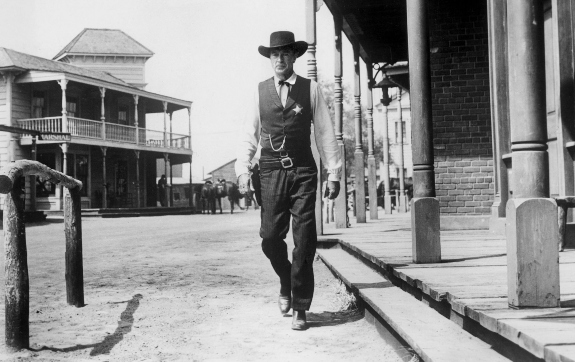
Above: Gary Cooper as Marshal Will Kane walking down the streets of his town while looking for volunteers to help him fight the bad guys. Below: High Noon's director Fred Zinnemann (left) and screenwriter Carl Foreman. 

Three years prior to the publication of his autobiography, Fred Zinnemann had presented his views on High Noon in the following letter to Mr Caparros-Lera, a Spanish professor who worked at the University of Barcelona, Spain. The professor wanted to know what Zinnemann's intention was behind his film. Apart from the blacklist angle, some people believed High Noon was an allegory on the Korean War, a theory Zinnemann also refuted.

Source:  publicacions.ub.es

Note: 
Director Howard Hawks made his western Rio Bravo (1959) in response to High Noon, hating the way High Noon depicted its main character: "I didn't think a good sheriff was going to go running around town like a chicken with his head cut off asking for help, and finally his Quaker wife had to save him." Rio Bravo's leading man John Wayne agreed with Hawks and also hated High Noon, saying that "real cowboys didn't have mental problems, and didn't have time for this couch-work.” A staunch anti-communist and fervent supporter of HUAC, Wayne even found the film "the most un-American thing" and in an interview said he would "never regret having helped run Foreman out of the country". Quite ironically, when Gary Cooper won the Best Actor Oscar for High Noon but was unable to attend the awards ceremony, it was Wayne (a longtime friend of Cooper's) who accepted the Oscar on Cooper's behalf. (Incidentally, Cooper himself had been a "friendly witness" before HUAC but later became an ardent opponent of blacklisting.)
 
On the set of High Noon with Gary Cooper, Fred Zinnemann and Grace Kelly, the latter having her first major role as Cooper's young Quaker bride.

24 November 2020

Groucho Marx and the United Snakes of America

In 1953, the FBI was told by one of its confidential informants that Groucho Marx "contribute[d] heavily to the Communist Party". The Bureau subsequently started to investigate the comedian and during the next decade built a file on him containing numerous pages. The file included evidence of Groucho's pro-communist sympathies, e.g. a 1934 article in the Communist Party newspaper the Daily Worker, saying Groucho had called the communist support for the Scottsboro Boys an inspiration for "Soviet America"; Groucho's attendance at a benefit concert for Soviet war relief in the 1940s; his opposition of Franco's fascist, anti-communist government of Spain; and his membership of the Committee for the First Amendment, which protested the investigations into communism in Hollywood conducted by the HUAC (House Un-American Activities Committee). 

Despite the sizeable file, the FBI ultimately concluded that Groucho was not a member of the Communist Party. The HUAC reached the same conclusion and never even called Groucho to testify. They did, however, summon Jerry Fielding (Groucho's bandleader on the popular tv show You Bet Your Life) to testify in December 1953. Fielding later said that HUAC probably wanted him to name Groucho, but he had refused to name names and was consequently blacklisted. Pressured by his sponsors, Groucho eventually fired Fielding — a decision he would later call "one of the greatest regrets of [his] life".

Among the many documents that can be found in Groucho's FBI file are the following two letters, written by concerned US citizens to FBI director J. Edgar Hoover regarding Groucho's communist leanings. By the time the letters were written, on resp. 17 June 1960 and 23 October 1961, the FBI had already been investigating Groucho for years.


Transcript: 

Mr. J. Edgar Hoover
Federal Bureau of Investigation
Washington, D.C.

Dear Mr. Hoover:

I suggest that the TV entertainer Groucho Marks [sic] be investigated as being a Communist.

Last night on his program both my husband and I understood him to pronounce "The United States" as "The United Snakes".

In his book "Groucho and Me" he speaks quite affectionately of Charlie Chaplin, who is a well known Communist.

By the way, your own book "Masters of Deceit" is a masterpiece. I have bought a copy for myself and four or five copies as gifts. It is simply a wonderful book. Thank you for it. 

Please, Mr. Hoover, investigate Groucho Marks [sic]. 

Sincerely,

[redacted]

Transcript: 

Oct. 23, 1961

PERSONAL

Mr. J. Edgar Hoover
Department of the Federal Bureau of Investigation
Washington, D.C.

Dear Mr. Hoover:

As a loyal citizen of the United States, I am writing to you concerning the TV program entitled "Dupont Show of the Week" which was broadcast last night over NBC.

I am outraged by this show which appeared to be full of Communist propaganda - so much of it that I cannot begin to name it all. It was NOT funny. The Red stench was unmistakable. The program went out of the way to make the automobile industry in our country appear to be silly and the American people weak, incompetent and arrogant. 

As one example among too many to even mention, Groucho Marx said, in speaking of the American people, "They drove around in their ARROGANCE."

I understand that Groucho Marx has strong Red leanings and that he was a member of the Red Front called "Committee for the First Amendment" and that he signed Cablegram of allegiance to Stalin. Please write and let me know if this is correct and what other information I am entitled as a United States citizen to know concerning his Red affiliations, so I can speak with authority when discussing him.

No doubt you have already thoroughly investigated Groucho Marx, but please also investigate the writer or writers of the TV script for the Dupont sponsored show.

Hoping to hear from you soon, I am

Sincerely and gratefully yours,

[redacted]

Both letters via Muckrock.

28 June 2019

Elia Kazan and HUAC: I believe what I did was necessary and right

Despite being one of the great American directors, Elia Kazan will always be remembered for his damaging testimony before the House on Un-American Activities Committee (HUAC) on 10 April 1952, a testimony which would taint his reputation for the rest of his life. During his first testimony earlier that year in January, Kazan had refused to name the names of people who had been members of the Communist Party with him during the 1930s. In order to avoid being blacklisted, however, Kazan testified again a few months later, this time volunteering the names of eight of his old friends (including Clifford Odets and Paula Strasberg), thereby destroying careers.

Kazan decided to cooperate with HUAC so he could continue making films. While he was an established stage director and could have kept working if he had been blacklisted —the blacklist didn't have much effect on Broadway — he didn't want to focus on the stage any longer, wishing to make motion pictures instead. To his close friend, playwright Arthur Miller, Kazan said prior to his testimony: "I hate the Communists and have for many years and don't feel right about giving up my career to defend them. I will give up my film career if it is in the interests of defending something I believe in, but not this".


And so, Kazan escaped the Hollywood blacklist and continued doing what he wanted to do most — make films. He would deliver some of his best work in his post-HUAC period, e.g. East of Eden (1955) and On The Waterfront (1954), the latter film regarded as Kazan's justification for informing. (Before 1952 Kazan had already made films such as A Tree Grows in Brooklyn (1945), Gentleman's Agreement (1947), Panic in the Streets (1950) and A Streetcar Named Desire (1951).)

His naming names cost Kazan several friendships (including his close friendship with Arthur Miller) and made him persona non grata in Hollywood. Even with the passing of time, Kazan remained a controversial figure whose actions could not be forgotten. In 1999 when the Academy of Motion Picture Arts and Sciences decided to honour him with a Lifetime Achievement Award, the decision caused a lot of commotion in Hollywood leaving people clearly divided. While some felt Kazan deserved the Oscar for his body of work, others disagreed refusing to stand up and applaud at the ceremony (watch here).

Kazan never apologised or showed remorse for what he had done. While he admitted to regretting "the human cost" of it, in the end Kazan stood by his actions: "Maybe nobody agreed with me, but I thought that was the right thing to do. Maybe I did wrong, probably did. But I really didn't do it for any reason other than that I thought it was right."

Above: Elia Kazan and Arthur Miller, the latter would be blacklisted in 1957. Below: Marlon Brando as Terry Malloy in On The Waterfront shouting: "And I'm glad what I done to you, ya hear that?"; in 1988 Kazan said:" [... ] that was me saying, with identical heat, that I was glad I'd testified as I had."


And now, the letter!

Eleven days after he had given his HUAC testimony, Elia Kazan wrote to screenwriter Robert E. Sherwood, saying that although his informing was "difficult and painful", it was also "necessary and right".

Sandy Hook, Conn.
April 21, 1952 
Dear Bob:
Your letter meant so much to me that I found it a little hard to answer. What can I say? You have it exactly. It was difficult and painful. No one likes to "tell". And to say that something is difficult and mean it is to face the fact that it can never come out 100% comfortable. It didn't.

I believe what I did was necessary and right. The silence of so many of the House Committee's witnesses had disgusted me. I thought what the nation needed was a sense of proportion about the problem and, for this, cold facts. Yet the first time I was called down, though I answered every question about myself and my own activities, I refused to name other individuals. It was as if 12th. st.* had kept hold of a little piece of my conscience all these years. The Communists had done violence to everything I believed in, and still somehow I stayed silent and shrugged it off and minimized and looked the other way.

Enough of that! I've been trying during these last weeks to let the air in and the light and to take a good fresh look at what's in my damned head. Painful as its been, I'm really glad it all happened.

Most gratefully yours, 
Gadg.

Source: The Selected Letters of Elia Kazan, edited by Albert J. Devlin with Marlene J. Devlin; published in 2014 by Alfred A. Knopf.

Notes
On 12 April 1952 following his HUAC testimony, Kazan took out an ad in the New York Times, defending his actions. Kazan's full statement can be read here.  

*12th st. = 35 East 12th Street, New York City, location of the Communist Party headquarters.

19 November 2017

Lucille Ball's brush with the blacklist

In the early 1950s, Lucille Ball was under investigation by the HUAC, the notorious committee that investigated Communism in Hollywood. The evidence against her consisted, among others, of a 1936 affidavit of registration saying she would vote for the Communist Party, an affidavit revealing she had been a delegate of the State Committee of the Communist Party, her membership of the Committee for the First Amendment and the fact that a communist meeting was held at her home in 1937 (although Ball herself had not been present). With all the evidence against her, Ball was questioned by the HUAC during secret meetings in April 1952 and September 1953. Regarding the 1936 affidavit, Ball said that she had only registered to please her grandfather Fred Hunt, a life-long socialist. The other accusations she denied too, firmly stating that she was no communist and had no ties with the Communist Party.


A few days after Ball's second HUAC interview, well-known radio commentator Walter Winchell made the accusations against Ball public. At the time, Ball's television show I Love Lucy (launched in 1951) was extremely popular, with very high ratings and sponsor Philip Morris having invested $8 million in the show. Despite the considerable evidence against Ball, fans stood by her as did her sponsor, and even FBI director J. Edgar Hoover (a big fan of the show) supported her.

It is generally believed that the show's huge popularity played a decisive role in determining Ball's fate. While a lot of Ball's fellow actors, screenwriters etc. got blacklisted, Ball herself was cleared of the charges. The HUAC accepted her story about her grandfather as well as her explanation regarding the other accusations. In the end, the HUAC investigation had done nothing to dent Ball's popularity. On the contrary-- Ball was more popular than ever, about 50 million people tuned in each week to watch her show. Ball would later acknowledge that she had been very lucky. If the HUAC affair had happened several years earlier, it might have very well ruined her career.

Sept. 1953, Lucille Ball and husband Desi Arnaz give a press conference at their home following the HUAC hearing. Arnaz jokingly said: "The only thing Red about Lucy is her hair. And that's not real either!"


While Lucille Ball enjoyed the support from the majority of the American public, there were also those who didn't believe her explanations. The letters below, written by two angry US citizens to resp. radio commentator Walter Winchell and FBI director J. Edgar Hoover, show just that. The first letter was written in September 1953 and the second letter in December 1955, long after Ball had already been cleared. 

Apart from the letters, also seen below is a FBI document regarding Ball's 1953 testimony before the HUAC. The document shows what Ball had to say in her defense against the accusations. (For the full text of Ball's testimony, click here.)


Transcript: 

Dear Winchell;

What are these bums trying to prove? Lucille Ball defended the UNFRIENDLY TEN as late as 1948 and Granpop was not around to guide her at that time.

Clyne of the Blow Agency knew this dame was on the Pinko side when he signed her for Morris Cigarettes. Now Metro and the Morris people are trying to save what they can out off the mess by pushing aside Winchell and others who had the guts to PORVE [sic] THAT THIS DAME SIGNED WITH THE COMMY PARTY.

Ball is 42 now. In 1936 she was 29-- well over the 21 year old mark and should have had all of her marbles regarding political parties. FIVE YEARS AGO 1948, she STILL SHOULD HAVE HAD ENOUGH BRAINS TO KNOW THAT THE UNFRIENDLY TEN OF HOLLYWOOD WERE STILL COMMY BUMS..... But no she went along with them.

If Walter Winchell had bothered to call Dizzy [Desi Arnaz] he would have handed Winchell the same lies he handed the Herald Express the other day---- namely she never registered as a member of the Communist Party.... WHEN THE HERALD HAD THE SIGNED PROOF RUNNING IN THE PAPER AS DEZIE DENIED IT. I still think the show should be called I LOATHE LUCY and every real American feels that way too. 

[redacted]

Transcript :

Mr. J. Edgar Hoover
Washington 25, D.C.

Dear Mr. Hoover:

I read your interview with Vincent X. Flaherty published in the Los Angeles Examiner, October 22 and 23, (copies enclosed) and I am wondering if there is not a mistake or misquote of some kind since it lists Lucy and Desi among your favorite entertainers who you think set a good example for the youth of America.

Lucille Ball voted for the Communist Party and was appointed as a member of the Central Committee for the Communist Party. She insisted that she did this because her poor old grandfather was ill and that she had no dealings with communists on her own. Yet, ten years later-- with no contact of any kind-- grandpa had passed on-- when a communist speaker who is to make a radio broadcast falls ill-- the communist know exactly where to reach her and that she would be their willing stooge and she takes off from her job to broadcast for them. Again, she says, "I certainly was never in sympathy with the ' Dmytrks', I can't remember any of the other names." Well, in the library there was a book by one of the Hollywood ten-- and it has forewords of sympathy and support by movie stars-- and there is Lucille Ball with her words of sympathy and support.

She has never said she was sorry nor ashamed of these actions.

Since I'm one of the 98% of Americans who think Mr. J. Edgar Hoover is the greatest-- would you mind clarifying this for me.

Sincerely,
[redacted]


Transcript:

12/16/53

DIRECTOR, FBI  (100-400465)
SAC, LOS ANGELES (100-41702)

LUCILLE BALL, was.
SM-C

ReBulet dated 1/18/52 captioned "C.P, U.S.A., DISTRICT 13, Los Angeles Division, IS-C"  and remy-Air-Tel to Bureau 9/11/53 captioned "HOUSE COMMITTEE ON UN-AMERICAN ACTIVITIES".

The subject furnished an executive statement to WILLIAM A. WHEELER, West Coast Representative, House Committee on Un-American Activities, on September 4, 1953, at Hollywood, California. BALL stated that in 1936 she registered to vote as a Communist or intended to vote the Communist Party ticket because her grandfather, FRED HUNT, now deceased, wanted her to register as such.  She stated that FRED HUNT had been a Socialist all his life and she had registered as a Communist to make him happy and to do him a favor. She stated she at no time intended to vote as a Communist.

BALL stated she has never been a member of the Communist Party to "her knowledge"; had never been asked to become a Communist Party member; did not ever attend any meetings which she later discovered were Communist Party meetings;  did not know whether or not any meetings were ever held at her home at 1344 North Ogden Drive;  stated she did not know EMIL FREED and if he had appointed her as a delegate to the State Central Committee of the Communist Party in 1936 it was done without her knowledge or consent; did not recall signing the document sponsoring EMIL FREED for the Communist Party nomination to the office of member of the assembly of the 57th District; and has never heard of the California Conference for Repeal of the Criminal Syndicalism Act, the Southern California Council for Constitutional Rights, or the Committee for the 1st Amendment.

A review of the subject's file reflects no activity that would warrant her inclusion on the Security Index. The subject's file is being maintained in a closed status. On October 30, 1953, the Washington Field Office furnished the Los Angeles Office with a copy of the subject's executive statement which is located in Los Angeles file 100-41702-lal.


Source of all documents: vault.fbi.gov

This post is my contribution to CMBA's Fall Blogathon Banned and Blacklisted. For a list of all the other entries, please click here.

28 October 2016

I'm not insane about Brando for this

When offered the lead role of dockworker Terry Malloy in Elia Kazan's On the Waterfront (1954), Marlon Brando initially rejected it. Brando, who had worked with Kazan before on A Streetcar Named Desire (1951) and Viva Zapata! (1952), didn't want to work with Kazan again due to the director's damaging testimony before the House of Un-American Activities Committee. In April 1952, Kazan had been a "friendly" witness for HUAC, naming names of eight colleagues who were former Communists and thereby ruining their careers. Kazan was heavily criticised for his actions and it is generally believed that On the Waterfront was his way of justifying them (read more here).

Following Brando's rejection, Frank Sinatra (who had just made From Here to Eternity) was approached to play Terry Malloy in September 1953. Sinatra was eager to play the role and made a verbal agreement with producer Sam Spiegel. Elia Kazan, however, had doubts about Sinatra due to his limited availability. Then Brando decided to play the part after all and Kazan went with his first choice, also because casting Brando meant having a bigger budget and more shooting time. Sinatra was extremely upset about not getting the part, and Spiegel then offered him the role of Father Barry which in fact had already been promised to Karl Malden. When Kazan refused to let Malden go in favour of Sinatra, Sinatra sued Spiegel for $500,000 damages. (The matter was later settled out of court.) 


The three letters for this post (or rather, excerpts from letters) were written by Elia Kazan in connection with the casting of Terry Malloy. The first letter is addressed to Budd Schulberg (the film's screenwriter who also named names before HUAC), showing that Kazan wasn't too enthusiastic about Brando at first; Kazan also talks about another alternative to Brando, an actor named Paul Newman who had just made his Broadway debut in Picnic. (Newman did a screentest with Joanne Woodward in the role of Edie, the role that later went to Eva Marie Saint.) In the second letter, written to Marlon Brando, Kazan tried to persuade Brando to take the role, even though he still considered Brando "not right for this part"; noteworthy is that Kazan admits that the script shows parallels with his HUAC experience. And the final letter is addressed to Abe Lastfogel, Frank Sinatra's agent, in which Kazan explains his choosing Brando over Sinatra.

In late July 1953, Elia Kazan wrote Budd Schulberg the following:
I'm not insane about Brando for this. In fact in my opinion he is quite wrong. But he's a fine actor and if he's really excited about it and will work like a beginner trying to get a start, he can be fine. [....] At any rate he arrives in town Sunday the second of August and leaves on the fifth, and it is imperative repeat imperative that he read the script and give us his yes or no. He cannot take the script to Europe with him. Our time is running short and we cannot wait for his majesty to get comfy in Paris and send us an answer when he feels it... If we don't get Brando, and I think it most likely we won't, I'm for Paul Newman. This boy will definitely be a film star. I have absolutely no doubt. He's just as good looking as Brando and his masculinity which is strong is also more actual. He's not as good an actor as Brando yet, and probably will never be. But he's a darn good actor with plenty of power, plenty of insides, plenty of sex. He and Malden are working on two scenes to show to Sam and yourself. I'm for him without seeing more.
Budd Schulberg (l.) and Elia Kazan won Oscars for Best Screenplay and Best Director. On the Waterfront won a total of 8 Oscars, including Best Picture (Sam Spiegel), Best Actor (Marlon Brando) and Best Supporting Actress (Eva Marie Saint). 


Also in late July 1953, Kazan wrote to Marlon Brando:
I cant pretend that its easy or simple to write you. Ultimately, in our little world, everyone hears everything. I will always feel most warmly and devotedly for you, but this does not blot out the things unsaid between us. I will for the time leave them unsaid. I will write you here professionally, and you can behave as you wish from whatever criteria you wish to act from. That's your business and even your problem. I'm sending you the script of a movie in a state of preparation. I'm very very hopeful of the script. I've worked very hard on it, and I'm going to do a lot more work on it. But you're a sensitive person and you will realize its not finished, you will sense its intention and the hope involved in it. Its yet not realized, though its a great deal closer than what you read before. Its meant very seriously. It is taken from living people, though distilled and compacted. The problem which it mirrors still exists and the moral problem it treats - the social responsibility of a citizen as it comes into conflict with his personal allegiances- is one of the oldest and most universal of all problems a man can face. My own point of view towards this problem and Budd's too, is clearly set forth. But the script is more of an involvment in the problem than an exhortation of any kind.  Make no mistake about it, there is a parallel inference to be drawn to the Inquiries into Communist Activities. This parallelism is not the main value of the script. This is the story of a human in torment, and in danger. The first thing I would do if you did become interested would be to take you over [to] HOBOKEN and introduce you to Tony Mike DeVincenzo who went thru exactly what our TERRY goes thru. This is a confrontation which would put flesh and blood on the issue on which our script is built. I've spent three evenings with him and its like being in the presence of a denizen of Dante's Purgatorio. And finally with him and with the whole waterfront of New York Harbor, the issue is not decided, and will probably be in the process of being decided as we shoot the picture.
I dont want to say more about the picture's theme. Just one word about the part. By the common measure which producers and directors use for casting, you are not right for this part. But you weren't right for the Williams Play either and you weren't right for Zapata. This boy is a former fighter, half pure, half hoodlum. He is a boy who has lost his sense of inner dignity or self-worth. At the beginning of our story he doesn't know when he lost it or how. He only discovers that he is behaving like a hoodlum and he has been a contributor to a murder. Slowly thru the unfolding of the incidents of the story and thru his relationship with a girl he discovers the shameful estate to which he has sunken. The body of the story has to do with his effort to find his own dignity and self esteem once more. He's a boy who suffers at the slightest introspection or self examination. He goes thru hell. Finally he acts to make himself respect himself, first putting his life in danger and secondly even going out to meet a violent end, so that he will re-establish himself in the sight of his own inner eye. With this "inside", there is a jaunty exterior which is the pathetic remnant of a career where he was once the white haired boy of the neighborhood, and etc.  There's much more to say, but you can go on from here, if you care to. I think its a giant of a part and a tremendous challenge. 
 [this letter was a draft letter and possibly never sent]


And on 2 November 1953, Kazan wrote to Abe Lastfogel:
Obviously from my point of view the decision to go ahead with Frank was a severe compromise. Not on artistic grounds. I was quite happy that way. Frank would have been fine in the part. Brando was my first choice, but since I could not have him and had completely abandoned hope of having him, Frank was a happy choice for me.... The alternate to Frank was an unknown boy in the cast of PICNIC. His release was a dubious matter. [.....] Then, after Frank was all set, Brando walked in one day, to my complete surprise, and said he wanted to go ahead. I wanted him. Not just Sam. I wanted him. Not that I was unhappy with Frank. But with Brando there would be no time pressure. My guess is that this picture will take 42 days, even possibly a few more. We now have a decent budget.... I dont like to get hurt and I hate to hurt any one. Nor do I feel that the thing was handled well by Sam. Sam says that's the only way he could have done it. I'm not all sure it was. I'm, on the other hand, not sure it wasn't. One thing sure: the change was necessary. We had done something desperate in accepting Frank with 27 days, desperate and foolish. Its terrible and regrettable that Frank had to be hurt. But couldn't the hurt be partially assuaged by having Frank announce that he withdrew because the schedule did not permit. And couldn't another part of his hurt be softened by my writing him and assuring him that the basis of the change WITH ME was time. I had gotten myself in a foolish and desperate (But by me, necessary) spot, and I had to get out of it when I saw a way out. I'm not callous to Frank's feelings. But say this much for us: when we went into it with Frank we went in on complete good faith. In fact our demands were craven. We begged him to give us a few more days. He was unable to, so I got us three more on the phone with Lew. We did not ask him to give up the Fox musical or anything like that. We were beggars. And we begged. But too much work and pain and time from Budd and myself are riding on this thing-- to do anything else than what we allowed Sam to do. I wish Sam had done it differently but Abe I want you to know I'm glad right now that we have Marlon. And make no mistake about that. 
Excerpts taken from The Selected Letters of Elia Kazan, edited by Albert J. Devlin with Marlene J. Devlin; published in 2014 by Alfred A. Knopf.

31 May 2015

Gene Kelly's & Katharine Hepburn's appeal for clemency

On 30 October 1947, screenwriter Ringgold Wilmer "Ring" Lardner Jr. appeared before the House on Un-American Activities Committee (HUAC) that was investigating Communism in Hollywood. During the hearing, Lardner refused to answer questions about his alleged involvement with the Communist Party and told the committee: "I could answer it, but if I did I would hate myself in the morning". Found guilty of contempt of Congress (along with the other members of the Hollywood Ten), he was blacklisted by the studios, fined $1,000 and eventually sentenced to a year imprisonment. After his release from prison, Lardner --still blacklisted-- worked under several pseudonyms, and it wasn't until 1965 that he could write under his own name again (for The Cincinnati Kid). Ring Lardner Jr. was a two-time Oscar winner, receiving the award for Best Original Screenplay for the 1942 Woman of the Year (co-written with Michael Kanin) and Best Adapted Screenplay for MASH (1970).


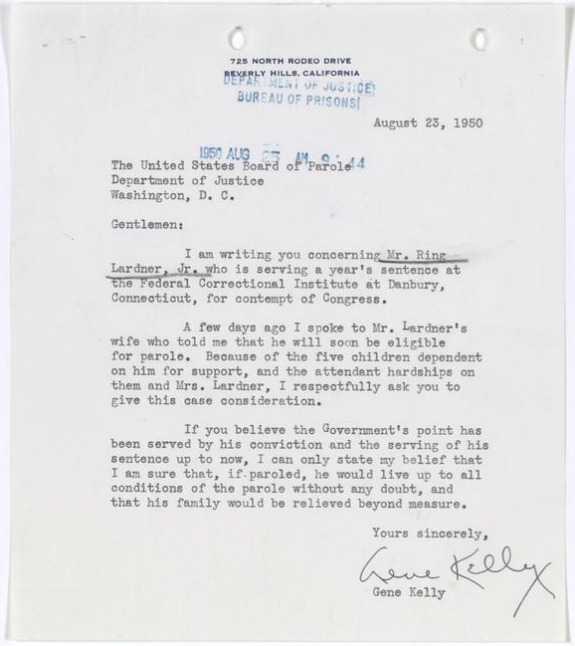
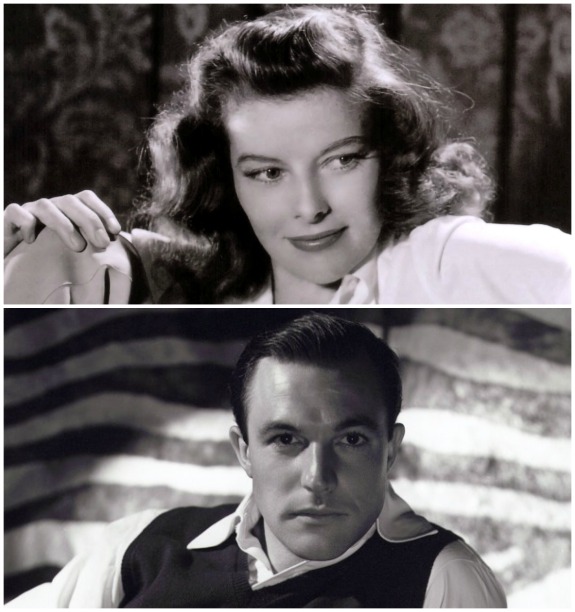
Gene Kelly and Katharine Hepburn had been members of the Committee for the First Amendment, founded in 1947 in defense of the Hollywood Ten and their constitutional rights. In the summer of 1950, both Kelly and Hepburn wrote a letter to the U.S. Board of Parole appealing for parole on behalf of Ring Lardner Jr.. Although parole was denied, Lardner got out of prison 15 days early for "meritorious good behaviour". Below you'll find Kelly's and Hepburn's letters (written at a time when such letters could have ruined their careers), as well as the Board's reaction to Hepburn's letter.


Transcript:

August 23, 1950

The United States Board of Parole
Department of Justice
Washington, D.C.

Gentlemen,

I am writing you concerning Mr. Ring Lardner Jr., who is serving a year's sentence at the Federal Correctional Institute at Danberry, Connecticut, for contempt of Congress. 

A few days ago I spoke to Mr. Lardner's wife who told me that he will soon be eligible for parole. Because of the five children dependent upon him for support, and the attendant hardships on them and Mrs. Lardner, I respectfully ask you to give this case consideration. 

If you believe the government's point has been served by his conviction and the serving of his sentence up to now, I can only state my belief that I am sure that, if paroled, he would live up to all conditions of the parole without any doubt, and that his family would be relieved beyond measure. 

Yours sincerely,

(signed)
Gene Kelly 


Source: u.s. national archives

Transcript:

September 1, 1950

Dr. G.G. Killinger, Chairman
U.S. Board of Parole
Washington, D.C.

Dear Dr. Killinger:

Ring Lardner Jr. is serving a Federal sentence in Danbury, Connecticut, for contempt of Congress because he refused to answer questions regarding his political affiliations. I understand he will soon be eligible for parole.

I have known Ring Lardner Jr. since 1941. To the best of my knowledge he is a respectable, law-abiding citizen and I think his present conflict with the law is entirely conscientious and, however mistaken, should be viewed with charity.

In view of the fact that his wife and five minor children depend on him for support, I trust that the Parole Board will give sympathetic consideration to his case, for I do not believe that he will use his release from custody in any way harmful to his country now that the courts have decided he was wrong.

This letter is written in behalf of an old friend of whose political views I know nothing, but whatever they are I believe they are sincere, although they may differ radically from my own. 

Very respectfully yours,

(signed)
Katharine Hepburn
179 Allyn Street
Hartford, Connecticut


Transcript:

September 13, 1950

Miss Katharine Hepburn
179 Allyn Street
Hartford, Connecticut

Dear Miss Hepburn:

Thank you for your letter of September 1, 1950, with reference to parole for Ring Lardner, Jr.

Mr. Lardner will be accorded a hearing by the Board in support of his application at the meeting soon to be held at Danbury, and you are assured that your letter will have the Board's careful attention at that time.

Appreciating your interest,

Sincerely,

GEORGE G. KILLINGER
Chairman

17 March 2015

I do not believe your trip was "ill-advised, even foolish"

In 1947, the House on Un-American Activities Committee (HUAC) began its investigations into communism in Hollywood and subpoenaed suspected communists to appear before the committee in late October. Scheduled to testify were ten 'unfriendly' witnesses who became later known as the Hollywood Ten. 

In support of the Hollywood Ten and to protest the HUAC investigations, a group of prominent Hollywood figures formed the Committee for the First Amendment (CFA) and flew to Washington on 27 October 1947. The CFA delegation included big names like Humphrey Bogart, Lauren Bacall, John Huston, Ira Gershwin, Gene Kelly and Danny Kaye, and their goal was to defend the First Amendment rights of their accused colleagues. However, what had begun as a hopeful trip ended dramatically. During the hearings it became clear that the Hollywood Ten were indeed communists (a fact unbeknownst to the CFA) and soon CFA members were regarded with suspicion too ("They [the press] thought we must be Communists, or sympathetic to Communism, or incredibly naive. We came home sadder... We had certainly learned a good deal about pressure politics and distortion of our purpose", said Marsha Hunt, a member of the delegation [source]).

In Washington, October 1947-- above: Richard Conte, Humphrey Bogart and Lauren Bacall; below: Bogie and John Huston.
Back in Hollywood, press coverage of the CFA grew increasingly negative and ultimately caused public opinion to turn against them (especially when it became known that one of CFA's members, Sterling Hayden, had been a member of the Communist Party). Consequently, Humphrey Bogart, the biggest star of the delegation, was pressured by his studio Warner Bros. to distance himself from the Hollywood Ten. Furious about everything that had happened and feeling he had been duped into supporting the Ten, Bogie eventually caved and sent a statement to the press saying that the Washington trip had been "ill-advised, even foolish". Bogie's statement and his subsequent article I'm no Communist in Photoplay from March 1948 (read here) earned him much criticism from his liberal friends who felt that he was selling out in order to save his career. It is said that Bogie later regretted his decision to recant and that he never forgave himself.

Below you'll find Bogie's statement to the press along with a letter from Democratic Congressman Chet Holifield to Bogie, written on 9 December 1947 as a reaction to the actor's statement. Two weeks earlier, on 24 November, the Hollywood Ten had been cited for contempt of Congress — they were later blacklisted and sent to jail — and Holifield was one of the 17 congressmen who had voted against the contempt citation. Having stood for his principles, Holifield tells Bogie he shouldn't be ashamed to stand for his and assures him that his trip to Washington was neither ill-advised nor foolish.

"My recent trip to Washington, where I appeared with a group of motion-picture people, has become the subject of such confused and erroneous interpretations, that I feel the situation should be clarified.

I am not a Communist. I am not a Communist sympathizer. I detest communism just as any other decent American does. I have never in my life been identified with any group which was even sympathetic to communism. My name will not be found on any Communist front organization nor as a sponsor of anything communistic.

I went to Washington because I felt fellow Americans were being deprived of their constitutional rights, and for that reason alone.

That the trip was ill-advised, even foolish, I am very ready to admit. At the time it seemed the thing to do.

I have absolutely no use for communism nor for anyone who serves that philosophy. I am an American. And very likely, like a good many of the rest of you, sometimes a foolish and impetuous American."

Source: The Milwaukee Journal from 3 December 1947, one of the newspapers that published Bogie's statement.


Transcript:

December 9, 1947

Mr. Humphrey Bogart,
c/o Warner Brothers Studio,
Hollywood, Los Angeles County,
California.

Dear Humphrey:

The Associated Press news dispatch of December 3rd quotes you in part as saying, "I went to Washington because I thought fellow Americans were being deprived of their constitutional rights, and for that reason alone. That the trip was ill-advised, even foolish, I am very ready to admit. At the time it seemed the thing to do."

Because of the above quotes, which I assume are accurate, I have decided to write you a letter. I do not wish to criticize you for the above statement, as I am not aware of the pressure which may have been brought to bear upon you by your employers, and possibly upon others who joined with you in the Washington trip.  As one who has had quite a bit of political and business experience, I understand how pressure can be applied. From my conversations with you and others in your group, I am sure you believe in the fundamental principles of American justice and fair play. I am also sure that your group is anti-communist. Had I not believed your group was composed of sincere people as qualified above, I would not have given you my time and advice in trying to help you do a fine, courageous and American act. I do not believe your trip was "ill-advised, even foolish". Regardless of the surrender which was concentrated on the movie industry through the dictatorial and abusive procedures of the Committee on Un-American Activities, your trip to Washington received publicity throughout the United States on behalf of the sacred principles of civil liberties contained in the First Amendment. Regardless of the criticism or pressure you received, you stood for great principles and you have nothing of which to be ashamed.

When we fight for that which we believe to be right, we are not contaminated because the blessings preserved by those rights are showered upon the just and unjust alike. When a great principle is involved, it must be decided on the basis of justice regardless of the benefits which may accrue to those who may be unworthy of receiving them.

Seventeen Members of Congress stood alone and dared to fight against the three hundred forty six members who bowed to pressure from many sources. Among those seventeen were Jews, Catholics and Protestants. As fine, loyal Americans who are definitely anti-communist, they placed the welfare of the United States first in their consideration of values. They placed the precious civil liberties which form the basis of our Democratic Constitutional Government as the most important preserving factor in constitutional government. None of us are naive politically. We all realized that political antagonists misconsture [sic] our actions and include us in the red smear which will be the chief weapon in the coming campaign against liberal, progressive, American candidates. We, therefore, placed our political careers, our reputations, and our salaries in jeopardy for the protection of the great principles which are contained in the First Amendment and which we believed to be in jeopardy.

I write this letter to you, not in censure, but in the hope that the brief acquaintance I had with your fine group may be extended into the future. I write for the purpose of re-assuring you that your trip was neither "ill-advised, even foolish". It may have been impetuous, but it was a spontaneous action grounded firmly in the desire to protect the basic principles which mean the difference between any form of totalitarianism and our own beloved Democracy.

Kindly convey my best regards to the members of your group.

Sincerely yours,
(signed)
CHET HOLIFIELD, M.C.

Danny Kaye, June Havoc, Humphrey Bogart and Lauren Bacall at the HUAC hearings. Despite its good intentions, the CFA proved ineffective and disintegrated after the blacklisting of the Hollywood Ten.
Top photos-- left: Congressman Chet Holifield; right: John Huston (standing), Humphrey Bogart and Danny Kaye (and a few others I don't recognise). Bottom photo: Paul Henreid, Lauren Bacall, Kaye and Bogie having just arrived in Washington for the hearings.