Showing posts with label Humphrey Bogart. Show all posts

11 December 2022

I don't know why we can't be friends

Having the power to ruin careers and lives, gossip columnist Hedda Hopper was hated by most actors in Hollywood. Joan Bennett once sent Hopper a live skunk as a valentine after having been "the victim of her nasty remarks" for years, and Spencer Tracy publicly kicked Hopper in the butt due to gossip she had spread about him and Katharine Hepburn. Hepburn herself wasn't a fan of Hopper either, not only because of her damaging gossip but also because of Hopper's political beliefs. A fervent Republican, Hopper was a strong supporter of the House of Un-American Activities Committee (HUAC) and the Hollywood blacklist. Hepburn, by contrast, had been a member of the Committee for the First Amendment, an action group established in September 1947 in support of the Hollywood Ten and in protest against the HUAC hearings.

While Hepburn and Hopper seemed to have little in common, 79-year-old Hopper wrote Hepburn a letter in December 1964, wondering why they couldn't be friends. It was about a year before Hopper would pass away and apparently she was reminiscing and missing the good old days of Hollywood. Having always admired Hepburn, Hopper wrote: "... it's a crime that you're not acting. We have no one fit to kiss your feet". (At the time Hepburn had taken a break from acting, while caring for her life companion Spencer Tracy who was in poor health.) Hepburn responded with a kind letter five days later, first referring to the photograph of her and Humphrey Bogart which Hopper had sent along, and next fondly remembering Bogie and his Oscar win for The African Queen (1951). Then Hepburn went on to say, "You and I are friends, Hedda. Time has seen to that...", while at the same time reminding Hopper that she never approved of Hopper's profession or politics. In this light, Hepburn also mentioned John Foster Dulles, a conservative Republican politician who was, like Hopper, a staunch opponent of communism.

In 1967, Hepburn would return to the big screen and eventually win three more Oscars, for Guess Who's Coming to Dinner (1967), The Lion in Winter (1968), and On Golden Pond (1981). Hopper was not alive to see this, she died in February 1966.

Hepburn (l) and Hopper
Both letters and many more can be found in Letters from Hollywood: Inside the Private World of Classic American Moviemaking (2019) by Rocky Lang and Barbara Hall. 

On location in Africa, Humphrey Bogart and Katharine Hepburn enjoy a break during the filming of The African Queen. 

23 November 2022

Broadway Bogie

Like many Hollywood actors, Humphrey Bogart began his acting career on the stage. He appeared in 18 Broadway productions between 1922 and 1935, making his debut in the play Drifting. Bogie's early Broadway roles were mostly romantic juveniles in drawing-room comedies and he sometimes referred to them as his 'Tennis, anyone?' roles. In a 1948 interview he explained: "I used to play juveniles on Broadway and came bouncing into drawing rooms with a tennis racket under my arm and the line: 'Tennis anybody?' It was a stage trick to get some of the characters off the set so the plot could continue."

When the Great Depression hit and theatre attendance dropped, Bogart tried his luck in Hollywood. His first feature film was Up the River (1930) co-starring Spencer Tracy, followed by Bad Sister (1931) with Bette Davis. The early 1930s saw Bogart shuttling back and forth between Hollywood and the New York stage, and during that period he was also often out of work. 1935 proved a turning point in Bogart's career when he was offered the role of the escaped murderer Duke Mantee in Robert E. Sherwood's play The Petrified Forest. The play, which starred Leslie Howard in the leading role, was a big success, running for 197 performances at the Broadhurst Theatre in New York. The Petrified Forest would be Bogie's final stage appearance.

Warner Bros. bought the rights to The Petrified Forest and wanted Edward G. Robinson for the role of Duke Mantee but Leslie Howard, who held the production rights, wanted Bogie. For that purpose, Howard sent a telegram to Jack Warner which read: "Att: Jack Warner Insist Bogart Play Mantee No Bogart No Deal L.H." Bogart was cast, with the film proving his breakthrough in Hollywood. (The Petrified Forest, directed by Archie Mayo, was released in 1936, with Bette Davis co-starring with Howard and Bogart.) Having been friends with Howard ever since they played together on Broadway and grateful for everything Howard had done for him, in 1952 Bogart named his daughter Leslie Howard Bogart (Bogie's second child with wife Lauren Bacall), in honour of his friend who had died in a plane crash during WWII.

Bogie and Shirley Booth in the Broadway play Hell's Bells (1925)
Bogie and Ruth Gordon in the Broadway play Saturday's Children (1927). Apart from being an actress Gordon was also a successful screenwriter, known mostly for her screenplay of Adam's Rib (1949), co-written with husband Garson Kanin.
Bogie and Judith Anderson on Broadway in The Mask and the Face (1933). While Anderson was a leading stage actress, she is best known for her role as Mrs Danvers in Alfred Hitchcock's Rebecca (1940).

On the Broadway stage in The Petrified Forest (1935), with Bogie (far left) and Leslie Howard (far right).

__________


Humphrey Bogart wrote the following letter sometime in the late 1920s when he was still years away from becoming a famous movie star. At the time he was performing on the New York stage, although I'm not sure which play he was in. His letter is addressed to "Lyman", possibly Lyman Brown; Lyman and his brother Chamberlain were theater agents and producers of Broadway plays.


Transcript:

March 15

Dear Lyman:

Am enclosing the notices for Washington and Boston.  Stopped in to say "Hello" on Monday but you were, as usual, out to lunch.

As far as I know we continue playing after a lay-off Holy Week; but have received no booking as yet.

If the show is as brilliantly handled as it has been so far, will probably play the Century Theatre – Madison Square Garden not being available.

Hope your new play gets over – Ruth Gordon told me she thought it a very funny play – it appears that Gregory and Harpo were going to buy it for her at one time.

Regards and premature Easter Greetings etc.

Humphrey

11 September 2020

I strongly feel that "The Maltese Falcon" is not an important picture

During his career, George Raft had rejected a lot of roles. He seemed to have made a habit of turning down good parts, often in films that turned out to be classics, e.g. Dead End (1937), High Sierra (1941), The Maltese Falcon (1941) and Double Indemnity (1944). (After rejecting Double Indemnity, Raft later said: "I wasn't very intelligent then".)

One of the roles Raft had refused was the role of private investigator Sam Spade in John Huston's The Maltese Falcon. Raft didn't want to work with an inexperienced director the film was Huston's debut and he had no faith in Dashiell Hammett's story as it had been filmed twice before, having flopped both times*. Raft chose to do Raoul Walsh's Manpower (1941) instead, in which he received third billing after Edward G. Robinson and Marlene Dietrich.

*The Maltese Falcon (1931), the first version, was a pre-code starring Ricardo Cortez as Sam Spade. The second version was Satan Met a Lady (1936), a loose comedy adaptation of Hammett's story, starring Bette Davis and Warren William as the detective, renamed Ted Shane. 


The role of Sam Spade eventually went to Humphrey Bogart, turning him into a major star. Bogart had been Huston's first choice from the start and Huston was over the moon when Raft rejected the part. I guess we should be grateful to Raft for considering The Maltese Falcon "not an important picture", as he wrote to his boss Jack Warner in the following letter on 6 June 1941. Had Raft accepted and played Spade instead of Bogie, The Maltese Falcon would most likely not be the classic it is today.

Mr. Jack Warner
Warner Bros. Pictures Inc.
Burbank, California
June 6, 1941
Dear Jack:
I am writing to you personally because I feel any difference of opinion that may have arisen between us can be settled in a most friendly manner. As you know, I strongly feel that The Maltese Falcon, which you want me to do, is not an important picture and, in this connection, I must remind you again, before I signed the new contract with you, you promised me that you would not require me to perform in anything but important pictures  in fact, you told me in the presence of Noll Gurney [agent], you would be glad to give me a letter to this effect. A long time has passed since you made this promise to me and I think you should let me have this letter now.
I understand that you are quite agreeable to use someone else in The Maltese Falcon, provided you get an extension of my time. This I think is only fair....
Very sincerely,
George Raft 
Source: Inside Warner Bros. (1935-1951) (1985), selected and edited by Rudy Behlmer.

21 May 2018

My dear Bogie

In January 1956, Humphrey Bogart was diagnosed with esophageal cancer and a few months later underwent surgery to have his esophagus removed. While in hospital recovering from the surgery, Bogie received the following letter from director George Cukor. Knowing that the two men never made a film together, I browsed the web to see what the connection was between them. While they didn't seem to be friends, I found they did have mutual friends (Spencer Tracy, Katharine Hepburn, Clifton Webb) and probably moved in the same social circlesIn any case, Cukor wanted to cheer up Bogie following his surgery and instead of sending flowers --Bogie hated flowers-- he sent this funny letter.

(Incidentally, the cancer had already spread and neither surgery nor chemotherapy could save Bogie's life. On 14 January 1957, just 57 years old, Bogie died.)

Via: icollector

Transcript:

March 14, 1956

My dear Bogie:

Having known for years from what a fine, old aristocratic New York family you come, and being reminded of that fact from time to time by you, I looked up in my Emily Post what should be done when a classy friend is in the hospital.

Emily says: ".... it's always thoughtful to take a gift of flowers, etc...." I was prepared to go along with this when Mr. Clifton Webb, who comes from a fine, old aristocratic Indianapolis family, as Maybelle [Webb's mother] reminds us archly from time to time, told me that above all things, you loathe flowers.

That did save me three or four bucks right there, but I was perplexed as to what my next move should be. Emily Post hasn't provided what to do in a case of Floraphobe. I decided, what better than to sit right down and write Bogie a Get-Well letter, a real comical one.

First, let me say I was rash when I said all actors were horses' you-know-whats. I should have said all actors-one-doesn't-like are horses' asses. As for those that one happens to like.... well, they have the potential of developing  into first-class H.A.'s.

It might please you, and maybe even surprise you a little, to know with what genuine affection people speak of you. I'd be less than truthful, though, if I didn't add that there's a slight note of surprise as they find themselves uttering these tender sentiments. Even the Old Man of The Sea, who's inclined to be grudging with his praise, became almost lyrical when talking of your many splendid qualities. You'll most likely be awful hard to get along with after all this.

Now a confession. As you know, it was in "Swifty" that I first saw you. I didn't flip. I didn't say, "That kid's got it! .... Stardust!" Blind fool that I was, I wasn't impressed. Never in my born days could I have imagined that you'd turn out to be a great beeg, beeg star-- and a fine actor besides. Be frank, aren't you surprised too?

Yet on that very same Playhouse stage, at a special matinee, I saw another young actor, Leo Mielziner, Jr..... no surprise finish there.

At this point you're probably muttering, "...... what does he mean, comical letter....". Well, I tried.

Go on and get well soon, so's we can all get off this sentimental kick and be our own natural, horrible  selves again.

(signed) George

Mr. Humphrey Bogart
Hospital of The Good Samaritan
1212 Shatto Street
Los Angeles, California  

3 September 2017

If you think I am too silly and too stupid, divorce me but don’t hate me

In early 1941, producer David O. Selznick met young actress Phyllis Lee Isley and was immediately captivated by her. He signed her to a contract, changed her name to Jennifer Jones and began building her career. Before long, Selznick (then married to Irene Mayer, daughter of MGM mogul Louis B. Mayer) and Jones (then married to actor Robert Walker) started an affair which eventually led to marriage in 1949. The marriage lasted until Selznick's death in 1965.


It's safe to say that Jennifer Jones would have had quite a different career if it hadn't been for David Selznick. Selznick controlled Jones' career, making practically every professional decision for her and selecting the roles she played. He chose good roles like the lead in the 1943 The Song of Bernadette (for which Jones won an Oscar), but he also made some bad decisions, for example by turning down Laura (1944) which would later become a noir classic.

Jones trusted Selznick and placed herself completely in his hands. She was a very insecure person, and even after Selznick had made her a star, she remained unsure of herself and emotionally fragileThroughout her life Jones had several nervous breakdowns and even attempted suicide a few times. (Truman Capote once said: "Jennifer Jones was an extremely neurotic girl, and would have twelve nervous breakdowns before rehearsals had hardly started.") 

The following correspondence between Jones and Selznick clearly shows Jones' emotional vulnerability and also gives an insight into the relationship between her and her powerful husband who was 17 years her senior. Jones' fascinating letter to Selznick was written during production of John Huston's Beat the Devil (1954). Jones had a very hard time on the set and speaks of her problems with the director, her inability to understand her character and how she couldn't remember her lines which consequently cost everybody a whole night's work. (Feeling bad about the whole thing, she told co-star Humphrey Bogart she would pay for the costs.) Jones was convinced that the cast and crew thought she was "a great bitch" and was afraid that Selznick might think her awful too ("Anyway scold me or if you think I am too silly and too stupid, divorce me but don’t hate me David"). Selznick responded by telegram, assuring Jones that he still adored her and that she was not to blame in any way, putting the blame entirely on "that four flushing phoney" (i.e. John Huston).

Incidentally, Selznick was not involved with the production of the film --it was produced by Bogart's production company Santana Productions-- but at his suggestion Truman Capote wrote the screenplay when screenwriters Anthony Veiller and Peter Viertel couldn't get the job done. And, judging by his telegram, Selznick had also invested in the film.

Jennifer Jones and Humphrey Bogart in a scene from Beat the Devil (above) and on the set discussing the script with director John Huston (below). 


Darling, 
It was stupid of me to make that fuss on the telephone and I’m terribly ashamed and sorry especially after all you’ve been through. It must have been dreadfully unpleasant all that business and certainly this is a poor time for Mrs. Jones to begin making demands but when I didn’t hear from you I would only think you must have suddenly discovered your nurse was divine or a new secretary or maybe that fourth at Lenore’s for canasta.  
Anyway I was wild with jealousy when I wasn’t wild with rage at John of all of the stupidities of this silly way of making a picture. Your predictions have all come true—he just keeps ahead by minutes and in my case there is no question of performance—my job is solely to remember lines and positions [and] rattle them off as quickly as possible never mind the meaning etc. etc. All the time I think it must be my fault, but really I know it isn’t. John has just decided to make it a three ring circus with an assortment of types behaving in what he hopes is an untypical way but what seems to me only a sordid and completely unrelated one to the other way. Certainly my character has no reality of any kind and whether she is comedy, tragedy, or something “bourgeois” I haven’t a notion. Anyway in the last scene, still unwritten, (as is tomorrow’s scene, of course) John said that “they” should feel sorry for her, this apropos of costume, but this is a confusing clue because unless I appear in rags and tatters there has been nothing in [the] script so far to indicate that she is anything but a silly idiot and how I am to attract audience sympathy of any sort is [a] source of great bewilderment to me. Surely they will feel as I do at this point, that she needs a great solid kick on the bottom. However lest I sound like another Norma Shearer I hasten to add my complaints are not because she is definitely an unsympathetic character but because at least to me she is completely un- understandable. I don’t know what or how to play and John has given for all practical purpose no help whatsoever. 
There was one horrible night, a nightmare of nightmares which shall remain in my memory the rest of my days. It was a scene at the dock before boarding the boat with Dannreuther. To be shot at night. I had received the scene the night before. Carefully studied it . . . in Positano where we had gone with [the] boys the day before. I arrived home in Ravello the afternoon before the night’s shooting to be greeted with an almost entirely new scene which I quickly learned—this was at three o’clock. At six o’clock we left for Salerno where the scene was to be done, as I stepped into the car another scene was handed to me, meaning changed—some of lines from [the] first version, some from the second which I had just learned and then great long additional new ones. It was dark and I couldn’t study until we got to Salerno but I thought oh well, it’s a long scene, it was quite long, there will be several angles, it will be broken up and even with accent problems I shall be all right. But when we arrived John with his fetish for one angle, one take, etc. had arranged to do it all in one. For the first time in my life, David, I couldn’t remember the lines, I blew and blew and blew until 4:30 in the morning. About 2:00 I said, John, please let’s just let this be a rehearsal tonight or break it up, John. I can’t do it, I’m exhausted, the lines are all confused, I need time to study the scene properly, please don’t humiliate me anymore in front of the crew and other actors. Gina and Morley and Peter* and all the others were kept there all night because they walked through the shot in the beginning with no lines and this was most distressing to me. His answer was, forget the strain you are under and act, remember you are paid to act. Said of course with a grim smile and what passes for Huston charm. At 4:30 completely paralyzed with shame and hating myself for being so stupid, I actually couldn’t remember the lines at all, one time one line would be right and another wrong and then another mixed up in a completely unreasonable way. Oh David it was all my bad dreams in one. Anyway he finally realized the senselessness of carrying on and we left for home. The next night of course I was all right and went right through it even though it had become a great stumbling block but Bogie made a couple of mistakes and because the end of the scene was not really good in that angle, John was forced or rather decided to break it up, which if he had done the evening before there would have been no problem. 
Anyway, I felt so badly, so ashamed and so much like an old actor who has as you say learned all the parts of which he is capable that I did a thing which you will probably hate me for and which in retrospect I rather regret except that at the time of my absolute dismay I couldn’t help it. I told Bogie that, and this was before the scene the second night when he was just barely nodding good evening to me, that he needn’t worry, I intended to pay for the last night’s work. Of course he said nonsense, don’t worry about it, but I said that was my intention and then when I told Jack Clayton the same thing, he said not to say it to anyone else as some of the Italian partners might take me up. . . . Now I realize it was stupid but actually David I did cost them a whole night’s work and in a way if we didn’t need the money so badly I would like not to lose any salary for this silly picture. Because I know I have done a bad job even though I am not entirely to blame because circumstances have made it impossible, still as John says I do not understand the character and that is my fault. I would really feel much better about it if we didn’t have to accept their money. Perhaps you don’t understand this and perhaps I can explain it more clearly when I see you, the way I feel I mean. I am prepared for you to think I am the idiot child, but believe me David, whether all this is my fault or not, I am still not sure that I’m not the one to blame, at least I know I have mismanaged myself badly throughout the film, I allowed that stupid but not unkind or ungood Bogie, only rather cheap between you and me, to get under my skin and the foul mouthed Peter and the whole ratty group. Anyway scold me or if you think I am too silly and too stupid divorce me but don’t hate me David. I have mixed up everything badly and for the first time in my life am working in a company, almost all of whom think me a great bitch I am certain. But I don’t want to ruin your life and if you think I am awful too, please know that you are free absolutely and completely.

If you still want it you have all my love,
Jennifer
[*"Gina" is Gina Lollobrigida, "Morley" is Robert Morley, and "Peter" is Peter Lorre]

__________

Dearest darling,
Letter arrived tonight.
With great difficulty I promise to follow your wishes and disregard it but please please understand you are completely not only blameless but outrageously unforgivably victimized.
If that four flushing phoney ever again says you are PAID to act, please tell him for me that firstly, we contracted for script to be delivered last Christmas; secondly, when this [was] not forthcoming we recognized dangers and we have written proof we begged to be released; thirdly, we are not getting paid, we are gambling investors whereas he is paid fully and is without any gamble or investment whatsoeverfourthly, he is paid to deliver script on which shockingly he failed to perform because he was too busy in America publicizing hisself endowed genious [sic] and in Europe playing Casanova to a harem of frustrated women; fifthly, but for our insistent suggestion of Capote they would now be facing complete disaster since Truman is doing the geniuses work for him; sixthly, no actor in history has been asked to go through what you have on this film but you will continue to struggle and hope for best despite incredibly amateur conditions; seventhly, at their urgent request  we donated fifty thousand dollars worth of time for which we could have had a larger claim on them but which we refused when they sought favors for which they expressed verbal gratitude which we have not seen demonstrated in their behavior. 
Please under no circumstances again demean yourself and dignify these fakers by letting them get you down. You simply must tolerantly patronize them which is [the] only way to cope with such untalented pretense. I adore you and hate myself for not being there to tell them off although I am certain these gentlemen heroes are too yellow to behave that way if I were there which thank heaven I shall be soon. Keep this cable with you to show whenever necessary or even when it can spare you either slightest distress or smallest humiliation from such ignorant brutes.
Devotedly
David 

Note
Jones and Selznick had one daughter, Mary Jennifer. She committed suicide in 1976 at age 21. In 1980, Jones founded the Jennifer Jones Simon Foundation for Mental Health and Education in order to help people suffering from mental health problems.

Jones' letter and Selznick's telegram via Vanity Fair
Original source: West of Eden: An American Place by Jean Stein (Random House, 2016)

10 February 2016

Bogie, Chess & Casablanca

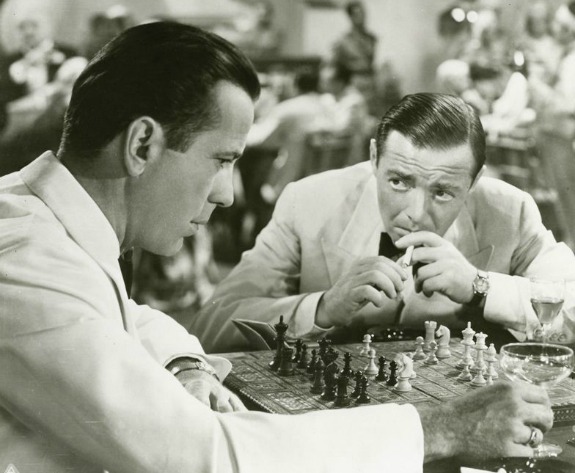
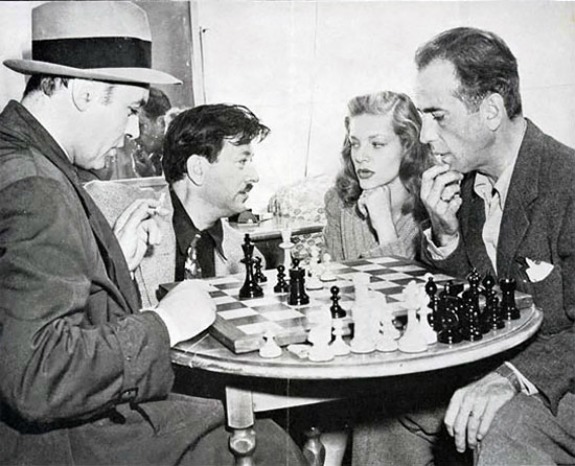
Humphrey Bogart learned how to play chess from his father and eventually became an avid and also expert player. In the early Depression years, he played chess for money in New York City parks, Times Square and Coney Island. Playing for 50 cents a game, he won more games than he lost. More than an average chess enthusiast, Bogart became director of the United States Chess Federation and was active in the California State Chess Association in the 1940s. In 1955, he drew against Grandmaster Samuel Reshevsky in a 70-board simultaneous exhibition. Chess was one of the main interests in Bogart's life. He played almost daily, and during movie breaks he was often seen bent over a chess board playing fellow actors or crew members (his wife Lauren Bacall was a chess enthusiast as well).

It was Bogart who wanted Rick Blaine, his character in Michael Curtiz' famous classic Casablanca (1942), to be a chess player. And so, in the opening scene when Rick is introduced to the viewer, he is shown playing a solitary game of chess. Rick is later joined by Ugarte (Peter Lorre), and we see him making chess moves while he listens to Ugarte talk about the German couriers and the transit letters. The game set up on the board was a real game that Bogart was playing by mail against Irving Kovner, brother of a Warner Bros.' employee. The two men had started the chess game in January 1942, corresponding by postcards and letters to indicate their moves. Bogart eventually sent Kovner a total of 17 postcards and two letters  three of his cards are shown below. 

Filming of Casablanca started on 25 May 1942 and officially wrapped a few months later, on 3 August. The first postcard from Bogart that is shown was written during production and is postmarked 8 June 1942. The chess moves that Bogart executes in the scene with Lorre are mentioned in this card. Bogart's two other cards are from a much later date when filming had already wrapped, postmarked resp. 17 November and 7 December 1942. Apparently the game went on and on... 

(Click here to watch the chess scene from Casablanca.)
Source: bonhams 

Transcript:

Dear Irving Kovner 

You're too hot-headed-- calm down! 
My 6 move a bad one- think should have been BxB. 
Now I'm in a jam.
However
8 knt- knt 5-- Castle Kings side 9?

H. Bogart

Via: iCollector.com (here and here)

Transcript:

Dear Irving

14-------Kt (Kt)-B3
15 Kt - K2- P- Q5
16?

Regards
H Bogart


Transcript:

Dear Irving

14- - - - - P- Q5
15 Knt- B4- - - P- Q6
16?

If I see [??]
you bet I will

Regards 
H Bogart

Bogie and Paul Henreid playing chess on the set of "Casablanca" with Claude Rains looking on. Henreid was reportedly the better player.
 Joan Bennett and Bogie taking a break during the shooting of "We're no Angels" (1955). 
Bogie visits Lauren Bacall on the set of "Confidential Agent" (1945) where he plays her co-star Charles Boyer. The man sitting next to Bacall is chessmaster Herman Steiner who also taught Bogie. Steiner formed a chess club in the 1940s, later known as the Hollywood Chess Group.
Bogie plays chess with his fourth wife Lauren Bacall who was also an excellent player. There's a famous chess game between the two from 1951 that you can follow in an online chart here

28 April 2015

Sell Bogart romantically

During the first part of his career, Humphrey Bogart played mainly one-dimensional gangsters in supporting roles. The best roles all went to Warner Brothers' other contract players such as James Cagney, Paul Muni and George Raft. Even after the immense success of Petrified Forest (1936) -- in which Bogie played an escaped killer, a performance which earned him much praise -- Warners had no intention of turning Bogie into a star. But this all changed in July 1940. Bogie was getting good reviews for his role in They Drive by Night and had also landed his first leading role with High Sierra (after Raft declined). Meanwhile, Paul Muni, one of Warners' greatest stars, left the studio after a contract dispute. Thus, with Muni gone and Bogie's star on the rise, Warners saw in Bogie its new leading man.

On 17 July 1940, S. Charles Einfeld, director of advertising and publicity for Warner Bros., sent a fascinating letter to publicist Martin Weiser, telling him to undo Bogie's gangster image and turn him into a romantic lead. Einfeld told Weiser to give the matter priority, calling Bogie "one of the greatest actors on the screen today". Although Bogie would still play a gangster (with a soft heart) in his next film High Sierra (1941), the film set in motion the undoing of his gangster screen persona. A year and several films later, Bogie would play his first real romantic (and arguably most romantic) role as nightclub owner Rick Blaine. The film, of course, was Casablanca.


Transcript:

July 17 1940

Marty Weiser
Mr. Martin Weiser
Warner Bros. Pictures
1701 Wyandotte Street
Kansas City, Mo.

Dear Marty:

I want you to give the utmost concentration to the building of Humphrey Bogart to stardom in as quick a time as possible.

Bogart has been typed through publicity as a gangster character. We want to undo this. For Bogart is one of the greatest actors on the screen today and has demonstrated this with his parts in "Petrified Forest," "Dark Victory," "It All Came True," and "They Drive By Night." The fellow is a master of technique and can do anything. In "Dark Victory" he showed a type of sex appeal that was unusual and different from that of any other actor on the screen today.

Sell Bogart romantically. Sell him as a great actor. Let us see if within the next two or three months we cannot have the country flooded with Bogart art, --and column breaks lauding Warner Bros. for their recognition of Bogart's talent, and predicting great success for him as a star.

This is one of the most important jobs you have before you in the next few months. I know I can count on you and please let me know how you fare.

Sincerely yours,

S. Charles Einfeld

Director of Advertising and Publicity

Humphrey Bogart in the films mentioned in Einfeld's letter --clockwise from top left: "The Petrified Forest" (1936) with Leslie Howard and Bette Davis; "Dark Victory" (1939) with Bette Davis; "They Drive by Night" (1940) with Ann Sheridan and George Raft and "It All Came True" (1940) with Ann Sheridan.

17 March 2015

I do not believe your trip was "ill-advised, even foolish"

In 1947, the House on Un-American Activities Committee (HUAC) began its investigations into communism in Hollywood and subpoenaed suspected communists to appear before the committee in late October. Scheduled to testify were ten 'unfriendly' witnesses who became later known as the Hollywood Ten

In support of the Hollywood Ten and to protest the HUAC investigations, a group of prominent Hollywood figures formed the Committee for the First Amendment (CFA) and flew to Washington on 27 October 1947. The CFA delegation included big names like Humphrey Bogart, Lauren Bacall, John Huston, Ira Gershwin, Gene Kelly and Danny Kaye, and their goal was to defend the First Amendment rights of their accused colleagues. However, what had begun as a hopeful trip ended dramatically. During the hearings it became clear that the Hollywood Ten were indeed communists (a fact unbeknownst to the CFA) and soon CFA members were regarded with suspicion too ("They [the press] thought we must be Communists, or sympathetic to Communism, or incredibly naive. We came home sadder... We had certainly learned a good deal about pressure politics and distortion of our purpose", said Marsha Hunt, a member of the delegation [source]).

In Washington, October 1947-- above: Richard Conte, Humphrey Bogart and Lauren Bacall; below: Bogie and John Huston.
Back in Hollywood, press coverage of the CFA grew increasingly negative and ultimately caused public opinion to turn against them (especially when it became known that one of CFA's members, Sterling Hayden, had been a member of the Communist Party). Consequently, Humphrey Bogart, the biggest star of the delegation, was pressured by his studio Warner Bros. to distance himself from the Hollywood Ten. Furious about everything that had happened and feeling he had been duped into supporting the Ten, Bogie eventually caved and sent a statement to the press saying that the Washington trip had been "ill-advised, even foolish". Bogie's statement and his subsequent article I'm no Communist in Photoplay from March 1948 (read here) earned him much criticism from his liberal friends who felt that he was selling out in order to save his career. It is said that Bogie later regretted his decision to recant and that he never forgave himself.

Below you'll find Bogie's statement to the press along with a letter from Democratic Congressman Chet Holifield to Bogie, written on 9 December 1947 as a reaction to the actor's statement. Two weeks earlier, on 24 November, the Hollywood Ten had been cited for contempt of Congress — they were later blacklisted and sent to jail — and Holifield was one of the 17 congressmen who had voted against the contempt citation. Having stood for his principles, Holifield tells Bogie he shouldn't be ashamed to stand for his and assures him that his trip to Washington was neither ill-advised nor foolish.

"My recent trip to Washington, where I appeared with a group of motion-picture people, has become the subject of such confused and erroneous interpretations, that I feel the situation should be clarified.

I am not a Communist. I am not a Communist sympathizer. I detest communism just as any other decent American does. I have never in my life been identified with any group which was even sympathetic to communism. My name will not be found on any Communist front organization nor as a sponsor of anything communistic.

I went to Washington because I felt fellow Americans were being deprived of their constitutional rights, and for that reason alone.

That the trip was ill-advised, even foolish, I am very ready to admit. At the time it seemed the thing to do.

I have absolutely no use for communism nor for anyone who serves that philosophy. I am an American. And very likely, like a good many of the rest of you, sometimes a foolish and impetuous American."

Source: The Milwaukee Journal from 3 December 1947, one of the newspapers that published Bogie's statement.


Transcript:

December 9, 1947

Mr. Humphrey Bogart,
c/o Warner Brothers Studio,
Hollywood, Los Angeles County,
California.

Dear Humphrey:

The Associated Press news dispatch of December 3rd quotes you in part as saying, "I went to Washington because I thought fellow Americans were being deprived of their constitutional rights, and for that reason alone. That the trip was ill-advised, even foolish, I am very ready to admit. At the time it seemed the thing to do."

Because of the above quotes, which I assume are accurate, I have decided to write you a letter. I do not wish to criticize you for the above statement, as I am not aware of the pressure which may have been brought to bear upon you by your employers, and possibly upon others who joined with you in the Washington trip.  As one who has had quite a bit of political and business experience, I understand how pressure can be applied. From my conversations with you and others in your group, I am sure you believe in the fundamental principles of American justice and fair play. I am also sure that your group is anti-communist. Had I not believed your group was composed of sincere people as qualified above, I would not have given you my time and advice in trying to help you do a fine, courageous and American act. I do not believe your trip was "ill-advised, even foolish". Regardless of the surrender which was concentrated on the movie industry through the dictatorial and abusive procedures of the Committee on Un-American Activities, your trip to Washington received publicity throughout the United States on behalf of the sacred principles of civil liberties contained in the First Amendment. Regardless of the criticism or pressure you received, you stood for great principles and you have nothing of which to be ashamed.

When we fight for that which we believe to be right, we are not contaminated because the blessings preserved by those rights are showered upon the just and unjust alike. When a great principle is involved, it must be decided on the basis of justice regardless of the benefits which may accrue to those who may be unworthy of receiving them.

Seventeen Members of Congress stood alone and dared to fight against the three hundred forty six members who bowed to pressure from many sources. Among those seventeen were Jews, Catholics and Protestants. As fine, loyal Americans who are definitely anti-communist, they placed the welfare of the United States first in their consideration of values. They placed the precious civil liberties which form the basis of our Democratic Constitutional Government as the most important preserving factor in constitutional government. None of us are naive politically. We all realized that political antagonists misconsture [sic] our actions and include us in the red smear which will be the chief weapon in the coming campaign against liberal, progressive, American candidates. We, therefore, placed our political careers, our reputations, and our salaries in jeopardy for the protection of the great principles which are contained in the First Amendment and which we believed to be in jeopardy.

I write this letter to you, not in censure, but in the hope that the brief acquaintance I had with your fine group may be extended into the future. I write for the purpose of re-assuring you that your trip was neither "ill-advised, even foolish". It may have been impetuous, but it was a spontaneous action grounded firmly in the desire to protect the basic principles which mean the difference between any form of totalitarianism and our own beloved Democracy.

Kindly convey my best regards to the members of your group.

Sincerely yours,
(signed)
CHET HOLIFIELD, M.C.

Danny Kaye, June Havoc, Humphrey Bogart and Lauren Bacall at the HUAC hearings. Despite its good intentions, the CFA proved ineffective and disintegrated after the blacklisting of the Hollywood Ten.
Top photos-- left: Congressman Chet Holifield; right: John Huston (standing), Humphrey Bogart and Danny Kaye (and a few others I don't recognise). Bottom photo: Paul Henreid, Lauren Bacall, Kaye and Bogie having just arrived in Washington for the hearings.

4 November 2014

Bogie always adored you

On 14 January 1957, Humphrey Bogart died of cancer at age 57, leaving behind his wife Lauren Bacall, son Stephen and daughter Leslie. He also left behind a lot of friends, many of whom were his colleagues from the film industry. One of them was Clifton Webb. Webb and Bogie had been friends ever since they starred together in the Broadway play Meet the Wife in the early 1920s. Shortly after Bogie's death, Lauren Bacall sent a note to Webb thanking him for his long and loyal friendship. Bacall's note is quite touching and is shown below.

Left photo: Humphrey Bogart, Clifton Webb and Laurence Olivier in 1933. Right: Bogie and Webb with Marilyn Monroe at Romanoff's in 1954.
Source: heritage auctions/ image reproduced with permission

Transcript:

Darling Clifton-

This is just an inarticulate but truly felt note to try to thank you for your long friendship, loyalty, and love for Bogie- for seeing him when you did and behaving as you did. I know how hard it was for you but you came through in style. Bogie always adored you. You knew him long before I did so I guess you knew that. I envy you for those extra years- you were lucky and so was I. I'm grateful for it all- there's never been a man like Bogie. It won't be the same for us, Cliff- but we have a lot that can never be taken from us and for that I'm grateful. So darling- you are now my good friend and I like that.
Always my love- Betty

Lauren Bacall wrote her message to Clifton Webb on a note card from which she had removed the "Mr. and" part. (Image source: heritage auctions)
Relaxing during a lunch for the Oliviers. In the photo, amongst others, Laurence Olivier, Clifton Webb, Vivien Leigh, Joan Bennett, Humphrey Bogart, Lauren Bacall and in the chair Maybelle Webb, Clifton Webb's mother. (Photo source: heritage auctions)