Showing posts with label Gary Cooper. Show all posts

6 October 2022

Fred Zinnemann's views on "High Noon"

Fred Zinneman's High Noon (1952) was one of Hollywood's first psychological westerns, focusing on character rather than action. The story involves a town marshal (played by Gary Cooper) who faces a gang of notorious gunmen alone, after the townspeople refused to help him. High Noon is often seen as an allegory on the Hollywood blacklist. During production of the film, Carl Foreman —the film's screenwriter who was once a member of the Communist Party— was summoned before the House of Un-American Activities Committee (HUAC), the committee that was investigating communism in the USA in the early 1950s. Foreman refused to name names of his former Party members and was consequently labelled an "unfriendly witness" by HUAC and later blacklisted by the Hollywood studios. Foreman eventually wrote the script of High Noon as a metaphor for his own HUAC experience. Like the film's marshal who ends up standing alone, the screenwriter had found himself shunned by his friends and people in the industry with no one having the courage to back him. Knowing he would no longer be able to work in the USA, Foreman sold his partnership share to production partner Stanley Kramer, moved to England and would not return to the States until 1975. 

In his 1991 autobiography A Life in the Movies, director Fred Zinnemann gave his own point of view on High Noon, feeling Foreman's point of view was "narrow". Zinnemann had not intended his film to be a metaphor for McCarthyism and the Hollywood blacklist. Instead he thought:

There was something timely -and timeless- about it, something that had a direct bearing on life today. To me it was the story of a man who must make a decision according to his conscience. His town -symbol of a democracy gone soft- faces a horrendous threat to its people's way of life. Determined to resist, and in deep trouble, he moves all over the place looking for support but finding that there is nobody who will help him; each has a reason of his own for not getting involved. In the end he must meet his chosen fate all by himself, his town's doors and windows firmly locked against him. It is a story that still happens everywhere, every day.
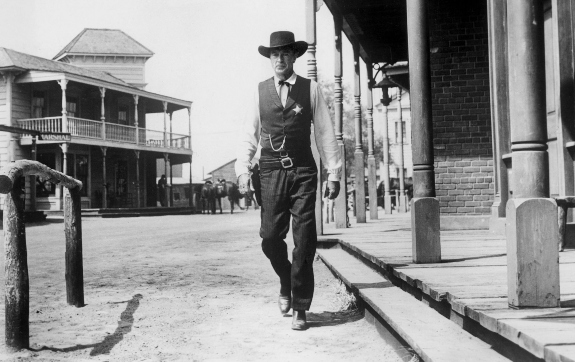
Above: Gary Cooper as Marshal Will Kane walking down the streets of his town while looking for volunteers to help him fight the bad guys. Below: High Noon's director Fred Zinnemann (left) and screenwriter Carl Foreman. 

Three years prior to the publication of his autobiography, Fred Zinnemann had presented his views on High Noon in the following letter to Mr Caparros-Lera, a Spanish professor who worked at the University of Barcelona, Spain. The professor wanted to know what Zinnemann's intention was behind his film. Apart from the blacklist angle, some people believed High Noon was an allegory on the Korean War, a theory Zinnemann also refuted.

Source:  publicacions.ub.es

Note: 
Director Howard Hawks made his western Rio Bravo (1959) in response to High Noon, hating the way High Noon depicted its main character: "I didn't think a good sheriff was going to go running around town like a chicken with his head cut off asking for help, and finally his Quaker wife had to save him." Rio Bravo's leading man John Wayne agreed with Hawks and also hated High Noon, saying that "real cowboys didn't have mental problems, and didn't have time for this couch-work.” A staunch anti-communist and fervent supporter of HUAC, Wayne even found the film "the most un-American thing" and in an interview said he would "never regret having helped run Foreman out of the country". Quite ironically, when Gary Cooper won the Best Actor Oscar for High Noon but was unable to attend the awards ceremony, it was Wayne (a longtime friend of Cooper's) who accepted the Oscar on Cooper's behalf. (Incidentally, Cooper himself had been a "friendly witness" before HUAC but later became an ardent opponent of blacklisting.)
 
On the set of High Noon with Gary Cooper, Fred Zinnemann and Grace Kelly, the latter having her first major role as Cooper's young Quaker bride.

3 January 2018

Projects that never happened

We all know the finished projects, the films that made it to the big screen. But of course, there were also plenty of projects that, for whatever reason, never came about. Interesting collaborations that never happened. 

Here are three letters that speak of such projects.

The first letter is dated 26 February 1963 and is from director George Cukor to Bette Davis. Cukor wrote to Bette because a friend of his, screenwriter DeWitt Bodeen, had plans for a film adaptation of Edith Wharton's novella My Son. Bodeen wanted Cukor to direct the film and Bette and Olivia de Havilland to star in it. The film was never made but the two actresses did eventually play together in Robert Aldrich's Hush... Hush, Sweet Charlotte (1964). 

Cukor and Davis would never make a film together, although they did work together in the theatre in the 1920s. In 1926, Bette joined Cukor's stock company in Rochester, New York, and stayed with the group for only one season. Cukor later remembered: "Her talent was apparent, but she did buck at direction. She had her own ideas, and though she only did bits and ingenue roles, she didn't hesitate to express them." Bette kept insisting for years that Cukor had fired her even though Cukor kept saying that he hadn't. In the letter below, Cukor's remark about the 'Rochester Method' is an obvious reference to his theatre days with Bette. 

Via: we love bette davis (instagram)

Transcript:

AIRMAIL 
SPECIAL DELIVERY

February 26, 1963

Congratulations on your nomination- your tenth, no less*. It certainly proves that the Rochester Method pays off.

I am functioning as a Friend of Friends. One friend, DeWitt Bodeen, is a very nice man and a good screenwriter, whose last effort was "Billy Budd". He is presently negotiating for the rights of a novella by Edith Wharton called "Her Son". I must confess I'd never heard of it before. He has asked me to send it to you, which I am doing under separate cover. He thinks it would make a bangup picture for you and Olivia DeHavilland. The switch is that you would be the Good Woman and Olivia the Doxie.

I called your house yesterday and was told by your sister that you were in New York. Then I spoke to Olivia. She said that no time be wasted in getting the book to you because you were presently making Big Decisions in New York. So here the matter rests.

Every good wish and kindest regards.

signed 'George'

Note* The Oscar nomination was for Bette's role in Robert Aldrich's Whatever Happened To Baby Jane? Anne Bancroft would eventually win the Oscar for her leading role in The Miracle Worker.

Written on 16 January 1957, the second letter is from Kirk Douglas to Gary Cooper. The letter shows that Douglas was quite excited about a film he was planning to make based on the television show The Silent Gun. Douglas wanted to make the film with Gary Cooper and director Charles Vidor and to produce it through his own production company Bryna Productions. Eventually, the film was never made, and Douglas and Cooper would never work together. 


Source: live auctioneers

Transcript:

January 16, 1957

Mr. Gary Cooper
200 Baroda Drive
Los Angeles, California

Dear Gary:

This is the television show, THE SILENT GUN, I spoke to you about on the phone. I'd like you to see it just as a basis for a discussion that we can have when I get back from New York.

We have been in touch with the Colt people, and have worked out wonderful arrangements to use all their museum pieces of guns and old machinery used in the manufacturing of guns, to make this a completely documentary background.

As I told you, Charles Vidor is awfully anxious to do it. From my point of view, I'm completely wide open. I think this film can be made on a surprisingly reasonable budget. And, by the way, I just checked the records and I don't have $30,000 in the story in rough treatment but approximately $22,000.

I think this could be a really exciting one. I hope you think so, too. I'll call you when I get back.

Best regards,
(signed 'Kirk') 
Kirk Douglas

Rare photo of Kirk Douglas and Gary Cooper together, here pictured with Patricia Neal. (Cooper and Neal had an intense love affair while Cooper was married; Douglas had also once dated Neal.)

The third and final letter comes from Cary Grant and is addressed to 'Dick', an associate of silent comedian Harold Lloyd. Grant had just received a script, meant as a possible vehicle for him and a potential new project for Harold Lloyd's production company. After reading it, Grant was not overly enthusiastic; he couldn't picture himself in the story and besides, a similar script had been offered to him once before (which he talks about in an amusing way). 

Grant's letter was written in January 1943, at a time when Harold Lloyd's Hollywood career was practically over. Lloyd would star in only one more film, in Preston Sturges' The Sin of Harold Diddlebock (1947), which became a big flop. As a producer, Lloyd had made two films for RKO in the early 1940s, i.e. A Girl, a Guy, and a Gob (1941) and My Favorite Spy (1942), which had proven unsuccessful too. A deal with Columbia to produce another film was signed in February 1943 but that film was never made. In the end, Lloyd would never produce again and a collaboration between him and Cary Grant never happened.

(Incidentally, while I have tried to find more information on 'Dick', unfortunately I could find nothing.)


Source: leading lights autographs

Transcript:

Jan. 16, 1943
1515 N. Amalfi Dr.
Pacific Palisades
Calif.

Dear Dick:

Many thanks for letting me read this---- I had a most enjoyable evening. It is undoubtedly a very funny and different idea, but with the script in it's [sic] present rough form I find it difficult to visualize completely it's [sic] possibilities as a vehicle for me. Incidentally, if Harold and yourself are keen to put this type of story into production, I think I should tell you that there is a synopsis lying around town, and which was submitted to me some time ago, embodying a similar idea-- though in that story the dog was the supposed reincarnation of the first husband who came back to worry the second husband and his former spouse--- it made for fun in a bed-room on a wedding night for two people and a dog-- you get the idea. I thought you both should know of it's [sic] existence although I have forgotten whether it is owned by a studio.

Hope to see you soon, Dick, and perhaps then we can discuss this story more fully, but in any case I'd be grateful if you would let me know what happens to it and the manner in which it is to be finally developed. Too, if we cannot get together on this one, I do hope I shall have the pleasure and the good fortune to work with you in the near future. Best personal wishes, and regards to Harold.

signed 'Cary'

While Cary Grant and Harold Lloyd never worked together, Grant's comedic performance in Howard Hawks' Bringing Up Baby (1938) was influenced by Lloyd. When Grant didn't know how to play his character (the nerdy paleontologist David Huxley) Hawks suggested Grant look at the films of Harold Lloyd. Grant did, and in Bringing Up Baby he imitates Lloyd's acting style and even wears his trademark black horn-rimmed glasses and ill-fitting suit.

3 August 2017

Mae West and her fight for better prison life

In April 1927, Mae West was sentenced to ten days in prison for having corrupted 'the morals of youth' with the 1926 Broadway play Sex, which she had written, produced, directed and starred in. West was released after eight days for good behaviour, but had seen enough to understand what life in prison was like. Admittedly, West's prison stay wasn't your standard prison stay --she got to dine with the warden and regarded the whole thing as a big publicity stunt-- but she saw what other inmates went through and was determined from then on to do whatever she could to improve prison life. Following her release from Welfare Island prison, West wrote an article for Liberty Magazine about her imprisonment, and her $1,000 earnings she donated to the prison so they could build a better library. Also, having spent a lot of time talking to female inmates, she wanted to help them find jobs once they were released from jail.

Clinton Duffy was the warden at San Quentin State Prison between 1940 and 1952. An opponent of the death penalty, Duffy was a prison reformer and someone whom Mae West greatly admired. West wrote to several people praising Duffy's good work and asking them to support him. To the governor of California Culbert Olson, she reportedly wrote: "I hope your excellency will feel as I do and let Warden Duffy continue making bad men good, while I continue making good men bad— I mean in the movies". 

West also wrote to fellow actor Gary Cooper (her letter to him is shown below), asking him to make a financial contribution to one of Warden Duffy's projects. West felt that they owed something to the "bad boys" for being the inspiration for so much of Hollywood's screen material. Whether Cooper eventually made a donation I don't know, but West herself most likely did and also contributed to one of Warden Duffy's other projects (see the above newspaper clipping, taken from the San Bernardino Daily Sun of 7 Sept. 1941).


Source: scripophily.com

Transcript:

August 26
1941

Mr. Gary Cooper

Dear Friend:

Up at San Quentin Warden Clinton Duffy is doing really wonderful work in prison administration. The men there tell with enthusiasm of the many fine things he is doing with them and for them- the humane changes he has brought about in prison life that have removed the depressing influences of prison and helped them to a new self-respect and the opportunity for education and the learning of useful trades.

At this time, Warden Duffy is preparing to award prizes to the men in prison who prove most worthy of them. The only means the Warden has of obtaining these prizes are by contributions from those outside, and he has called on us for help.

It has been suggested that I let you know about this personally, which I am glad to do informally as we all receive so many formal appeals these days.

At the invitation of Governor Olson I attended the National Congress of the American Prison Association as an appointed delegate from the State of California. I accepted because I felt I owed something to the bad boys- the ones that ge [sic] themselves in prison- since my stage and screen successes have been about the underworld. That has meant money to me as it has to all actors and actresses who have portrayed underworld characters on the stage and screen.

I'm sure you will be glad to find room among your other donations for a contribution for the encouragement of the boys in the "Big House", who have inspired such a lot of our screen material.

The types and kinds of articles that will be given as prizes by Warden Duffy are highly restricted- you know there are certain things they might not want the boys up there to have. So it will be more practical to make a cash donation which the Warden will convert into things that will be good for them. 

You may send your check either to me at the Ravenswood Apartments, Hollywood, or directly to Warden Clinton Duffy, San Quentin Prison,Calif. The deadline for donations is not later than the 3rd of September. Everybody will be very happy if they hear from you by then. So do it now for the boys of dear old San Quentin, as a lot of them are your "fans". And I know they'll say, "Thanks, Pal."   

Sincerely,
Mae West

(signed)

Gary Cooper and Mae West celebrating the end of Prohibition

27 July 2014

The shindig was great!

The Friars Club is a private club with locations in New York and Los Angeles and is probably best known for its celebrity roasts. On 8 January 1961 at the Beverly Hilton Hotel in Los Angeles, a roast was held in honour of Gary Cooper celebrating his 30 years of movie stardom. Amongst the celebrity speakers at the testimonial dinner were Audrey Hepburn, Greer Garson, Dean Martin and Tony Curtis (to listen to the original recordings of Cooper's roast, click here and here). Funds that were raised at the dinner party later went to charities. 

Gary Cooper (flanked by Dean Martin and Tony Martin) having fun at his roast

Gary Cooper with daughter Maria at the party

The Friars Club Roast was one of Cooper's last public appearances. Cooper was having treatment for prostate and colon cancer and found out in February 1961 that the cancer was terminal. Several months later, on 13 May, Cooper passed away. 

The letter for this post was written by Cooper to Peter Lawford a month after the Friars' testimonial. Cooper thanks Lawford for the telegram he received on the occasion of his roast. 


Transcript:

February 9, 1961

Dear Peter:

Belated thanks for your swell wire at the occasion of the Friars' Testimonial for me.

This comes a little late but I went to Sun Valley immediately after to stop my head spinning from the flattery of it all. The shindig was great and I'm glad they made lots of dough for their charities.

Many thanks for making me feel good about it all. 

Sincerely,

(signed)

Gary Cooper

Mr. Peter Lawford
443 Ocean Front
Santa Monica, California


28 March 2014

Charity in Hollywood

The Community Chest was America's most important fund-raising organisation during the 1930s/40s. Collected funds were distributed to various causes, including movie relief organisations that offered assistance to those in need within the film industry. On 2 April 1940, a Special Committee for the Community Chest in Los Angeles (with members such as Frank Capra, Gary Cooper, Norma Shearer and Carole Lombard) wrote a solicitation letter to MGM's vice-president Eddie Mannix, asking for his help in supporting the Community Chest. Judging by the letter, apparently there had been some doubts regarding the Community Chest, but the Committee nevertheless believed that the Chest was "the best means with which to handle the serious problems of those in need". In the following letter the Committee is asking Mannix for his much-needed support.


Source: bonhams/ image reproduced with permission

Transcript:

April 2, 1940

Dear Edward J. Mannix,

Those of us whose names appear in printed form here met the other night to discuss confidentially and fearlessly our relationship to the Community Chest and the problems, doubts and responsibilities arising out of the matter from an industry standpoint. Some of us came to oppose, to fight. During a four hour meeting, with no outside influence present, we learned for the first time Community Chest facts which converted us as one to the cause of this organized charitable distributing agency that makes possible 88 separate charities within our community.

We learned that 94 cents out of every dollar goes into the hands of the needy; that only 6 cents out of each dollar is required for administrative expenses.

We learned we may designate, in giving our contribution to the Community Chest, the charity or charities of the 88 to which we wish our money to go, in full or in part.

We learned this community of which we are a part, is in need of our help and the Chest IS the best means with which to handle the serious problems of those in need.

We learned that an educational program is needed in behalf of the Community Chest so everyone else knows, as we know now, that the Chest truly deserves our support.

We want you to be with us, help us.

It is imperative for some of us to give a little more to make up our $200,000 shortage for the Community Chest.

If there are any questions you would like to ask, won't you please call anyone of us?

Sincerely,

signed by Joel McCrea, William A. Wellman, Ronald Colman, Carole Lombard, Frank Capra, Gary Cooper, Norma Shearer

Top row (from left to right): Eddie Mannix, Frank Capra, and William A. Wellman. Middle row: Charles Boyer, Ronald Colman and Gary Cooper. Bottom row: Carole Lombard, Norma Shearer and Joel McCrea.

21 December 2013

Miss Monroe, thanks for the roses!


Browsing the internet for letters, it's great to find correspondence that is unexpected or surprising. I think the following letter, dated 22 June 1960, falls into that category. It was written by Gary Cooper addressed to Marilyn Monroe. I had no idea these two actors knew each other. Admittedly, judging by the letter they didn't know each other well, but well enough for Marilyn to send Gary Cooper roses when he was in the hospital. In April 1960, Cooper was hospitalised to undergo surgery for prostate cancer. Sadly, the cancer had already spread to his colon and would spread only further. A year later, on 13 May 1961, Cooper would die at the age of sixty.


Transcript:

9441 Wilshire Boulevard
Beverly Hills, California

June 22, 1960

Dear Miss Monroe:

It was your good thoughts, good deed and good wishes that helped me get out of the hospital in record time.

I heard your party was a smasher. I am sorry I couldn't be there because it was my first day out of the hospital. 

The roses were beautiful and I can't tell you how much I appreciate the trouble you went to. I just want to thank you with all my heart.

Sincerely, Gary (signed)