Showing posts with label Gene Kelly. Show all posts

7 February 2021

Clarence Sinclair Bull, Master Portrait Photographer

During Hollywood's Golden Age stars were created by the film studios, with portrait photography playing an essential part in the starmaking process. The portraits taken of the stars were used to promote them and advertise their upcoming films in newspapers and fan magazines. The man who is probably most associated with the Hollywood portrait photography —along with the renowned George Hurrell — is Clarence Sinclair Bull, best known as the man who shot Greta Garbo.

In 1918, 22-year-old Bull arrived in Hollywood and worked for several film studios as assistant cameraman and part-time stills photographer. He was hired in 1920 by Samuel Goldwyn to take publicity stills of Metro stars. After Metro Pictures became Metro-Goldwyn-Mayer in 1924, Bull was appointed chief of MGM’s stills department and held that position until his retirement in 1961.

Besides his management tasks, Bull continued to take portraits of the MGM stars. Of all the stars he had photographed — Bull had estimated the number to be at least 10,000 throughout his career— Greta Garbo was his most photographed subject. Bull had taken over 4,000 individual studies of her during the time they worked together, often using innovative lighting techniques (e.g. some of his dramatic close-ups of Garbo were shot by illuminating her face through the glow of a kerosene lamp). Bull became Garbo's personal photographer as she didn't want to be photographed by anyone else. (In 1930, a then unknown photographer by the name of George Hurrell was hired to shoot Garbo's portraits for the film Romance. He drove her crazy and after two shots she fled the room, later saying of Hurrell: "He was a twittery artistic type. He started hopping around and crawling on the studio floor looking for 'angles'.")

Not only Garbo but also many other stars loved working with Bull. He had a quiet professional manner and quickly succeeded in making his subjects feel at ease. As Bull had worked for MGM his entire career, he became familiar with the studio's stars and maintained both a personal and professional relationship with several of them, including Clark Gable and Johnny Weissmuller. 

While the 1930s were Bull's most productive years, the 1940s and 1950s saw him photograph a whole new generation of stars, including Ava Gardner, Elizabeth Taylor and Grace Kelly. From the late 1940s Bull started to work extensively in colour, after having first experimented with colour photography in the 1930s (his first colour portrait of Garbo dating back to 1936). Bull eventually retired from MGM in 1961. In the late 1970s, he started to work on a limited edition portfolio of his Garbo prints, in collaboration with film historian and collector John Kobal. Before the project was completed, however, Bull died of a heart attack on 8 June 1979, 83 years old.

Just three of the numerous iconic photos taken of Greta Garbo by the great Clarence Sinclair Bull.
Top row, from left to right: Loretta Young, Gary Cooper and Joan Crawford; middle row: Clark Gable, Norma Shearer and Robert Taylor; bottom row: Hedy Lamarr, Fred Astaire and Katharine Hepburn.
Ava Gardner and C.S. Bull in 1945 on the set of The Killers.


One of the many MGM stars who had been photographed by Bull was Gene Kelly. In a letter to a Fred Schmidt dated 8 May 1979, Kelly remembers Bull, describing him as a "real artist" and a "fine gentleman". 
 

Transcript:

May 8, 1979

Fred Schmidt
138 Joralemon Street
Brooklyn Heights, N.Y. 11201

Dear Mr. Schmidt:

I remember Clarence Bull with great fondness, and although I only saw him while doing portraits at the end of each film I completed at M.G.M., I recall vividly his great patience with all of us spoiled actors who had been photographed so many times candidly on the set and tried every trick to get Mr. Bull to hurry through his sittings. They were generally done on our free days. His calmness and almost paternal-like treatment of us would invariably get cooperation and he would always end up making the ones who needed it look better than they were. Clarence Bull was a real artist and very importantly, a fine gentleman.

And needless to say, an important factor in the success of presenting Metro films.

Sincerely yours,
('signed Gene Kelly')
Gene Kelly  


Gene Kelly photographed by C.S. Bull


7 March 2016

George Bush is no Gene Kelly!

On 16 March 2008, Maureen Dowd, journalist for The New York Times, wrote a column about then-president George Bush in which she compared him to Gene Kelly: "The dollar's crumpling, the recession's thundering, the Dow's bungee-jumping and the world's disapproving, yet George Bush has turned into Gene Kelly, tap-dancing and singing in a one-man review called "The Most Happy Fella"."

While reading the column, Patricia Ward Kelly --Gene Kelly's third wife and married to Kelly from 1990 until his death in 1996-- was shocked by the comparison made by Dowd and immediately wrote a letter to the editor.


To the Editor:
Re "Soft Shoe in Hard Times" (column, March 16):
Surely it must have been a slip for Maureen Dowd to align the artistry of my late husband, Gene Kelly, with the president's clumsy performances. To suggest that ''George Bush has turned into Gene Kelly'' represents not only an implausible transformation but a considerable slight. If Gene were in a grave, he would have turned over in it.
When Gene was compared to the grace and agility of Jack Dempsey, Wayne Gretzky and Willie Mays, he was delighted. But to be linked with a clunker -- particularly one he would consider inept and demoralizing -- would have sent him reeling. 
Graduated with a degree in economics from Pitt, Gene was not only a gifted dancer, director and choreographer, he was also a most civilized man. He spoke multiple languages; wrote poetry; studied history; understood the projections of Adam Smith and John Maynard Keynes. He did the Sunday Times crossword in ink. Exceedingly articulate, Gene often conveyed more through movement than others manage with words.
Sadly, President Bush fails to communicate meaningfully with either. For George Bush to become Gene Kelly would require impossible leaps in creativity, erudition and humility. 
Patricia Ward Kelly
Los Angeles, March 16, 2008 
Source: The New York Times

2 February 2016

Dear Club Members

In early 1951, after the completion of An American in Paris, Gene Kelly spent a well-deserved and much-needed vacation in Europe. In the following letter addressed to members of his fan club, Kelly tells them that it was the first real vacation he had in two years and talks about how much he enjoyed Paris, London and skiing in Switzerland (where he was joined by his wife, actress Betsy Blair). Kelly furthermore talks about the preparations for his next project Singin' in the Rain (1952) and how he hoped the film would be well received. (Little did he know then...)

Gene Kelly and his first wife Betsy Blair to whom he was married from 1941 to 1957.
Source: gene kelly fans

Transcript:

March 22, 1951

Dear Club Members:

I'm sorry if this letter has delayed the printing of this current issue of the Journal but I can't say it wasn't worth it. 

My trip to Europe was very successful because I had a nice rest and a change of environment which I sorely needed after working so hard on AMERICAN IN PARIS. It was my first real vacation in two years, all my other trips having been business or semi-business with just a few days off in between. I went to Paris for several days and saw some old friends, and then jumped over to London to see the theatre there. There were many fine plays and it was an extremely worthwhile part of my trip. By this time Betsy had finished her play, RICHARD II, playing the Queen opposite Maurice Evans, and her movie, KING LADY, with Ethel Barrymore and she was ready to join me for the "vacation" part of my trip. Hopping a plane, she met me in Switzerland in a little village called Klosters, and for a month we did nothing but ski around the Alps and got our fill of snow, which is a rarity in Beverly Hills. We met many interesting people and found to our surprise that the Swiss are even bigger movie fans than the French and English. Their favorite picture seems to be THE THREE MUSKETEERS, although as in England, ON THE TOWN went over wonderfully well.

Well, here I am home again and back at work preparing SINGING IN THE RAIN which I am going to co-direct with Stanley Donen as we did on ON THE TOWN. We both hope it will be as well received. We have some great old songs in it and a very funny idea for a premise- but I'm not going to tell you too much about it or maybe you won't even go to see it. Little Debbie Reynolds will be my leading lady and I'm sure you're all going to love her. She's so sweet and nice, a real breath of fresh air on that old movie screen.

And so, until the next Journal I shall be digging away at new dance routines, new jokes, new recordings, and I hope, a new hit.

I want to thank and congratulate all you hard workers and contributors to the last Journal. It was excellent. Dolores Witt did a wonderful cover!

Good luck and

Sincerely,

(signed)

Gene Kelly

Gene Kelly and that "real breath of fresh air" Debbie Reynolds on the set of "Singin' in the Rain".

31 May 2015

Gene Kelly's & Katharine Hepburn's appeal for clemency

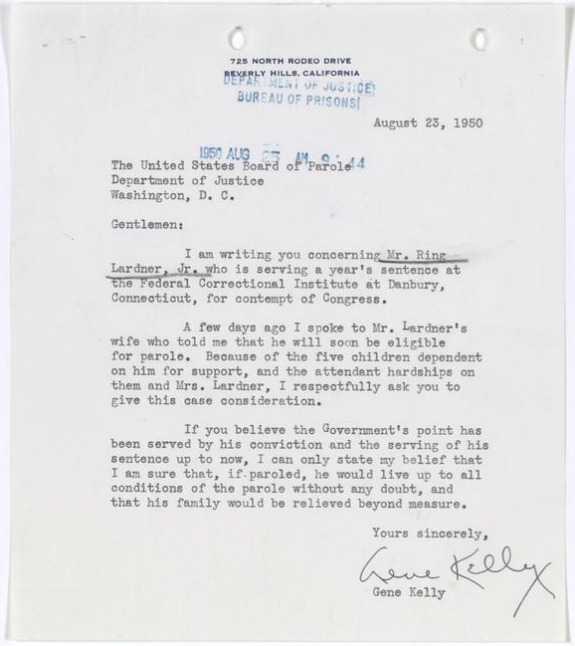
On 30 October 1947, screenwriter Ringgold Wilmer "Ring" Lardner Jr. appeared before the House on Un-American Activities Committee (HUAC) that was investigating Communism in Hollywood. During the hearing, Lardner refused to answer questions about his alleged involvement with the Communist Party and told the committee: "I could answer it, but if I did I would hate myself in the morning". Found guilty of contempt of Congress (along with the other members of the Hollywood Ten), he was blacklisted by the studios, fined $1,000 and eventually sentenced to a year imprisonment. After his release from prison, Lardner --still blacklisted-- worked under several pseudonyms, and it wasn't until 1965 that he could write under his own name again (for The Cincinnati Kid). Ring Lardner Jr. was a two-time Oscar winner, receiving the award for Best Original Screenplay for the 1942 Woman of the Year (co-written with Michael Kanin) and Best Adapted Screenplay for MASH (1970).


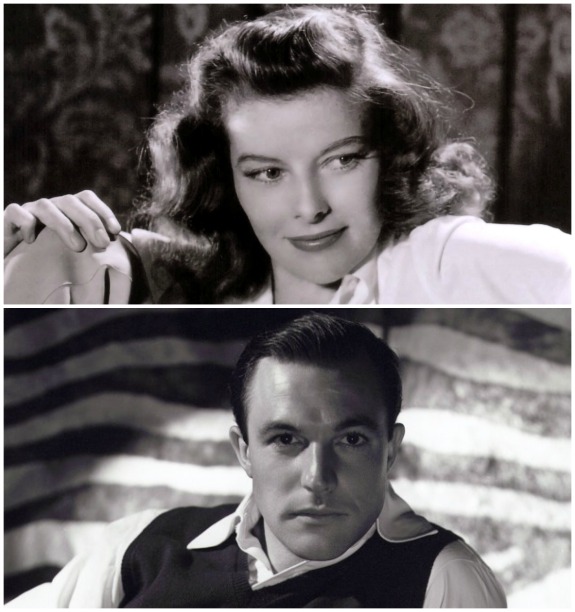
Gene Kelly and Katharine Hepburn had been members of the Committee for the First Amendment, founded in 1947 in defense of the Hollywood Ten and their constitutional rights. In the summer of 1950, both Kelly and Hepburn wrote a letter to the U.S. Board of Parole appealing for parole on behalf of Ring Lardner Jr.. Although parole was denied, Lardner got out of prison 15 days early for "meritorious good behaviour". Below you'll find Kelly's and Hepburn's letters (written at a time when such letters could have ruined their careers), as well as the Board's reaction to Hepburn's letter.


Transcript:

August 23, 1950

The United States Board of Parole
Department of Justice
Washington, D.C.

Gentlemen,

I am writing you concerning Mr. Ring Lardner Jr., who is serving a year's sentence at the Federal Correctional Institute at Danberry, Connecticut, for contempt of Congress. 

A few days ago I spoke to Mr. Lardner's wife who told me that he will soon be eligible for parole. Because of the five children dependent upon him for support, and the attendant hardships on them and Mrs. Lardner, I respectfully ask you to give this case consideration. 

If you believe the government's point has been served by his conviction and the serving of his sentence up to now, I can only state my belief that I am sure that, if paroled, he would live up to all conditions of the parole without any doubt, and that his family would be relieved beyond measure. 

Yours sincerely,

(signed)
Gene Kelly 


Source: u.s. national archives

Transcript:

September 1, 1950

Dr. G.G. Killinger, Chairman
U.S. Board of Parole
Washington, D.C.

Dear Dr. Killinger:

Ring Lardner Jr. is serving a Federal sentence in Danbury, Connecticut, for contempt of Congress because he refused to answer questions regarding his political affiliations. I understand he will soon be eligible for parole.

I have known Ring Lardner Jr. since 1941. To the best of my knowledge he is a respectable, law-abiding citizen and I think his present conflict with the law is entirely conscientious and, however mistaken, should be viewed with charity.

In view of the fact that his wife and five minor children depend on him for support, I trust that the Parole Board will give sympathetic consideration to his case, for I do not believe that he will use his release from custody in any way harmful to his country now that the courts have decided he was wrong.

This letter is written in behalf of an old friend of whose political views I know nothing, but whatever they are I believe they are sincere, although they may differ radically from my own. 

Very respectfully yours,

(signed)
Katharine Hepburn
179 Allyn Street
Hartford, Connecticut


Transcript:

September 13, 1950

Miss Katharine Hepburn
179 Allyn Street
Hartford, Connecticut

Dear Miss Hepburn:

Thank you for your letter of September 1, 1950, with reference to parole for Ring Lardner, Jr.

Mr. Lardner will be accorded a hearing by the Board in support of his application at the meeting soon to be held at Danbury, and you are assured that your letter will have the Board's careful attention at that time.

Appreciating your interest,

Sincerely,

GEORGE G. KILLINGER
Chairman

3 June 2014

Gene's proposal for "Take me out to the ballgame"

I have seen quite a few MGM musicals, but Take me out to the ballgame (1949) is one that I have yet to see. Directed by Busby Berkeley, this musical stars Gene Kelly, Frank Sinatra and Esther Williams. After his collaboration with Frank Sinatra in the musical Anchors Aweigh (1945), Gene Kelly was eager to work with Sinatra again and thought up a story for a new musical with help from Stanley Donen. This story, quite similar to Anchors Aweigh, was eventually made into Take me out to the ballgame after having been sold to MGM for $25,000. Below you'll find Gene Kelly's proposal letter for the film --shown in transcript only-- written to MGM's Roy Myers on 27 July 1946.


July 27, 1946

Mr. Roy Myers
M.C.A. Square
Beverly Hills, California

Dear Roy,

Anent our conversation of last week, I'm putting down on paper, as you asked me to, the general background, environment, and situation ideas of the baseball story that I described to you. I've decided to state here only a few plot ramifications, for until they're written up in detail they won't be as interesting as I'd like them to be on a first reading. However, this will give you a rough idea. To begin with, I tried to think of a story that would do for Sinatra what "Anchor's [sic] Aweigh" did: i.e. to put him in a situation that would make him appear so unequivocally masculine that no male movie-goer could resent him. In "Anchors" this was done well because he was a fighting man in the U.S. navy, and a nice, modest guy. In my story he'll be a helluva 2nd baseman and a nice, modest guy.

Most of it is situation comedy and needs exposition, dialogue, or detailed description for you to get the full flavor. As you know, musical comedy scenes, just like musical numbers, can't be described adequately on paper.

Again, the character of Frankie's love interest is not clearly drawn purposely because her entrance and the details of the gangster's entrance into the plot have only been touched upon. A lot of this is dependent on the girl chosen for Frankie. Personally I feel she should be one with a lot of schmalz. Let it suffice to say that this can all be worked out as the story is worked on in detail. For the same reason, Durante also falls by the wayside. I've only concerned myself at present with the three personalities in "Anchors Aweigh." The obvious substitution, of course, is Durocher for Iturbi.

The gangster business is "old hat", but this kind of stock characterization, I think, is good in musical comedy, because it doesn't worry the audience too much, but gives everybody someone to hiss at. Naturally a million similar gimmicks on which to hang the menace and the trouble could be found. This seems the funniest mainly because of the scene with the lady manager and her ball players raking the bums over, and the laughs that would arise from Sinatra knocking Kelly out and Kelly going after him later.

Anyway, enough of this-- and I think you have what you want. Let me know if it is sufficient.

Best regards,
GENE KELLY

Source: Margaret Herrick Library, Academy of Motion Picture Arts and Sciences

*Note: The role which Gene Kelly suggested Leo Durocher (manager of the Brooklyn Dodgers) should play was eventually played by Jules Munshin. Betty Garrett was cast as Sinatra's love interest and she would also play his love interest in On the town, which was released later that same year (directed by Gene Kelly and Stanley Donen and once again starring Kelly and Sinatra).

Publicity still for "Take me out to the ballgame" with Frank Sinatra, Jules Munshin, Gene Kelly, Esther Williams and Betty Garrett.

27 December 2013

Congrats to Gregory Peck


Well, here's an unusual combination: Gregory Peck and Gene Kelly. To my knowledge, the two men never appeared in a film together, but searching the net I've learnt that they did appear together on the radio. During Hollywood's Golden Age, actors not only played in movies but they also did radio shows. One of those shows was "Cresta Blanca Hollywood Players". The show ran from September 1946 until February 1947 and was sponsored by Cresta Blanca Wines. The episodes (26 in total) were 30-minute adaptations of popular movies, performed by some of the greatest stars in Hollywood. The eight performers for the series were: Claudette Colbert, Joseph Cotten, Bette Davis, Joan Fontaine, John Garfield, Paulette Goddard, Gene Kelly and Gregory Peck (guest performers included 19-year old Janet Leigh). The photo of Gregory Peck and Gene Kelly (above) was most likely taken during the series.

In 1962, the film "To Kill a Mockingbird" (directed by Robert Mulligan) was released and the role of Atticus Finch was played to perfection by Gregory Peck. Peck got the Oscar for Best Actor during the 35th Academy Awards Ceremony, held on 8 April 1963. Eleven days later, Gene Kelly wrote the following letter to congratulate Gregory on winning the Oscar. And I can only imagine he's referring to the "Hollywood Players" when he's talking about the "group".


Via: did you see that one?

Gregory Peck, Sophia Loren, Joan Crawford and Fernando Lamas backstage at the Oscars in 1963