Showing posts with label The Hollywood Ten. Show all posts

31 May 2015

Gene Kelly's & Katharine Hepburn's appeal for clemency

On 30 October 1947, screenwriter Ringgold Wilmer "Ring" Lardner Jr. appeared before the House on Un-American Activities Committee (HUAC) that was investigating Communism in Hollywood. During the hearing, Lardner refused to answer questions about his alleged involvement with the Communist Party and told the committee: "I could answer it, but if I did I would hate myself in the morning". Found guilty of contempt of Congress (along with the other members of the Hollywood Ten), he was blacklisted by the studios, fined $1,000 and eventually sentenced to a year imprisonment. After his release from prison, Lardner --still blacklisted-- worked under several pseudonyms, and it wasn't until 1965 that he could write under his own name again (for The Cincinnati Kid). Ring Lardner Jr. was a two-time Oscar winner, receiving the award for Best Original Screenplay for the 1942 Woman of the Year (co-written with Michael Kanin) and Best Adapted Screenplay for MASH (1970).


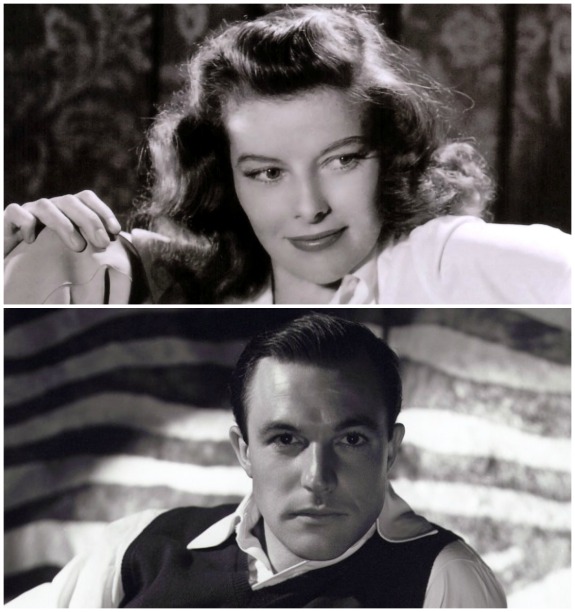
Gene Kelly and Katharine Hepburn had been members of the Committee for the First Amendment, founded in 1947 in defense of the Hollywood Ten and their constitutional rights. In the summer of 1950, both Kelly and Hepburn wrote a letter to the U.S. Board of Parole appealing for parole on behalf of Ring Lardner Jr.. Although parole was denied, Lardner got out of prison 15 days early for "meritorious good behaviour". Below you'll find Kelly's and Hepburn's letters (written at a time when such letters could have ruined their careers), as well as the Board's reaction to Hepburn's letter.
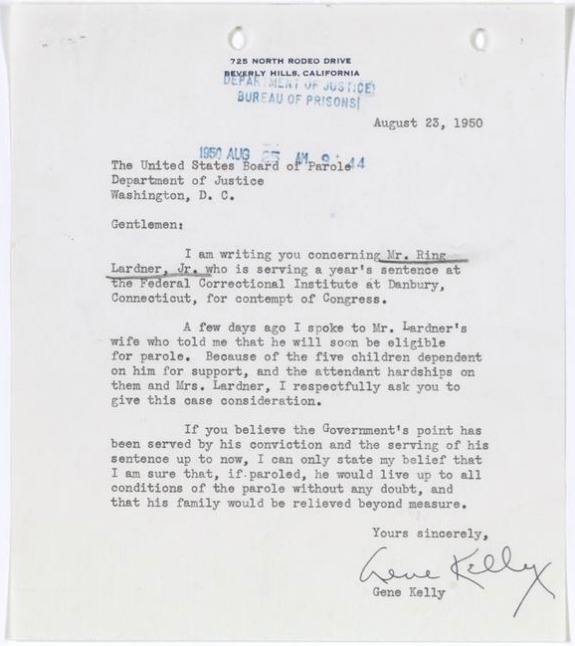

Transcript:

August 23, 1950

The United States Board of Parole
Department of Justice
Washington, D.C.

Gentlemen,

I am writing you concerning Mr. Ring Lardner Jr., who is serving a year's sentence at the Federal Correctional Institute at Danberry, Connecticut, for contempt of Congress. 

A few days ago I spoke to Mr. Lardner's wife who told me that he will soon be eligible for parole. Because of the five children dependent upon him for support, and the attendant hardships on them and Mrs. Lardner, I respectfully ask you to give this case consideration. 

If you believe the government's point has been served by his conviction and the serving of his sentence up to now, I can only state my belief that I am sure that, if paroled, he would live up to all conditions of the parole without any doubt, and that his family would be relieved beyond measure. 

Yours sincerely,

(signed)
Gene Kelly 

Source: u.s. national archives

Transcript:

September 1, 1950

Dr. G.G. Killinger, Chairman
U.S. Board of Parole
Washington, D.C.

Dear Dr. Killinger:

Ring Lardner Jr. is serving a Federal sentence in Danbury, Connecticut, for contempt of Congress because he refused to answer questions regarding his political affiliations. I understand he will soon be eligible for parole.

I have known Ring Lardner Jr. since 1941. To the best of my knowledge he is a respectable, law-abiding citizen and I think his present conflict with the law is entirely conscientious and, however mistaken, should be viewed with charity.

In view of the fact that his wife and five minor children depend on him for support, I trust that the Parole Board will give sympathetic consideration to his case, for I do not believe that he will use his release from custody in any way harmful to his country now that the courts have decided he was wrong.

This letter is written in behalf of an old friend of whose political views I know nothing, but whatever they are I believe they are sincere, although they may differ radically from my own. 

Very respectfully yours,

(signed)
Katharine Hepburn
179 Allyn Street
Hartford, Connecticut


Transcript:

September 13, 1950

Miss Katharine Hepburn
179 Allyn Street
Hartford, Connecticut

Dear Miss Hepburn:

Thank you for your letter of September 1, 1950, with reference to parole for Ring Lardner, Jr.

Mr. Lardner will be accorded a hearing by the Board in support of his application at the meeting soon to be held at Danbury, and you are assured that your letter will have the Board's careful attention at that time.

Appreciating your interest,

Sincerely,

GEORGE G. KILLINGER
Chairman

17 March 2015

I do not believe your trip was "ill-advised, even foolish"

In 1947, the House on Un-American Activities Committee (HUAC) began its investigations into communism in Hollywood and subpoenaed suspected communists to appear before the committee in late October. Scheduled to testify were ten 'unfriendly' witnesses who became later known as the Hollywood Ten. 

In support of the Hollywood Ten and to protest the HUAC investigations, a group of prominent Hollywood figures formed the Committee for the First Amendment (CFA) and flew to Washington on 27 October 1947. The CFA delegation included big names like Humphrey Bogart, Lauren Bacall, John Huston, Ira Gershwin, Gene Kelly and Danny Kaye, and their goal was to defend the First Amendment rights of their accused colleagues. However, what had begun as a hopeful trip ended dramatically. During the hearings it became clear that the Hollywood Ten were indeed communists (a fact unbeknownst to the CFA) and soon CFA members were regarded with suspicion too ("They [the press] thought we must be Communists, or sympathetic to Communism, or incredibly naive. We came home sadder... We had certainly learned a good deal about pressure politics and distortion of our purpose", said Marsha Hunt, a member of the delegation [source]).

In Washington, October 1947-- above: Richard Conte, Humphrey Bogart and Lauren Bacall; below: Bogie and John Huston.
Back in Hollywood, press coverage of the CFA grew increasingly negative and ultimately caused public opinion to turn against them (especially when it became known that one of CFA's members, Sterling Hayden, had been a member of the Communist Party). Consequently, Humphrey Bogart, the biggest star of the delegation, was pressured by his studio Warner Bros. to distance himself from the Hollywood Ten. Furious about everything that had happened and feeling he had been duped into supporting the Ten, Bogie eventually caved and sent a statement to the press saying that the Washington trip had been "ill-advised, even foolish". Bogie's statement and his subsequent article I'm no Communist in Photoplay from March 1948 (read here) earned him much criticism from his liberal friends who felt that he was selling out in order to save his career. It is said that Bogie later regretted his decision to recant and that he never forgave himself.

Below you'll find Bogie's statement to the press along with a letter from Democratic Congressman Chet Holifield to Bogie, written on 9 December 1947 as a reaction to the actor's statement. Two weeks earlier, on 24 November, the Hollywood Ten had been cited for contempt of Congress — they were later blacklisted and sent to jail — and Holifield was one of the 17 congressmen who had voted against the contempt citation. Having stood for his principles, Holifield tells Bogie he shouldn't be ashamed to stand for his and assures him that his trip to Washington was neither ill-advised nor foolish.

"My recent trip to Washington, where I appeared with a group of motion-picture people, has become the subject of such confused and erroneous interpretations, that I feel the situation should be clarified.

I am not a Communist. I am not a Communist sympathizer. I detest communism just as any other decent American does. I have never in my life been identified with any group which was even sympathetic to communism. My name will not be found on any Communist front organization nor as a sponsor of anything communistic.

I went to Washington because I felt fellow Americans were being deprived of their constitutional rights, and for that reason alone.

That the trip was ill-advised, even foolish, I am very ready to admit. At the time it seemed the thing to do.

I have absolutely no use for communism nor for anyone who serves that philosophy. I am an American. And very likely, like a good many of the rest of you, sometimes a foolish and impetuous American."

Source: The Milwaukee Journal from 3 December 1947, one of the newspapers that published Bogie's statement.


Transcript:

December 9, 1947

Mr. Humphrey Bogart,
c/o Warner Brothers Studio,
Hollywood, Los Angeles County,
California.

Dear Humphrey:

The Associated Press news dispatch of December 3rd quotes you in part as saying, "I went to Washington because I thought fellow Americans were being deprived of their constitutional rights, and for that reason alone. That the trip was ill-advised, even foolish, I am very ready to admit. At the time it seemed the thing to do."

Because of the above quotes, which I assume are accurate, I have decided to write you a letter. I do not wish to criticize you for the above statement, as I am not aware of the pressure which may have been brought to bear upon you by your employers, and possibly upon others who joined with you in the Washington trip.  As one who has had quite a bit of political and business experience, I understand how pressure can be applied. From my conversations with you and others in your group, I am sure you believe in the fundamental principles of American justice and fair play. I am also sure that your group is anti-communist. Had I not believed your group was composed of sincere people as qualified above, I would not have given you my time and advice in trying to help you do a fine, courageous and American act. I do not believe your trip was "ill-advised, even foolish". Regardless of the surrender which was concentrated on the movie industry through the dictatorial and abusive procedures of the Committee on Un-American Activities, your trip to Washington received publicity throughout the United States on behalf of the sacred principles of civil liberties contained in the First Amendment. Regardless of the criticism or pressure you received, you stood for great principles and you have nothing of which to be ashamed.

When we fight for that which we believe to be right, we are not contaminated because the blessings preserved by those rights are showered upon the just and unjust alike. When a great principle is involved, it must be decided on the basis of justice regardless of the benefits which may accrue to those who may be unworthy of receiving them.

Seventeen Members of Congress stood alone and dared to fight against the three hundred forty six members who bowed to pressure from many sources. Among those seventeen were Jews, Catholics and Protestants. As fine, loyal Americans who are definitely anti-communist, they placed the welfare of the United States first in their consideration of values. They placed the precious civil liberties which form the basis of our Democratic Constitutional Government as the most important preserving factor in constitutional government. None of us are naive politically. We all realized that political antagonists misconsture [sic] our actions and include us in the red smear which will be the chief weapon in the coming campaign against liberal, progressive, American candidates. We, therefore, placed our political careers, our reputations, and our salaries in jeopardy for the protection of the great principles which are contained in the First Amendment and which we believed to be in jeopardy.

I write this letter to you, not in censure, but in the hope that the brief acquaintance I had with your fine group may be extended into the future. I write for the purpose of re-assuring you that your trip was neither "ill-advised, even foolish". It may have been impetuous, but it was a spontaneous action grounded firmly in the desire to protect the basic principles which mean the difference between any form of totalitarianism and our own beloved Democracy.

Kindly convey my best regards to the members of your group.

Sincerely yours,
(signed)
CHET HOLIFIELD, M.C.

Danny Kaye, June Havoc, Humphrey Bogart and Lauren Bacall at the HUAC hearings. Despite its good intentions, the CFA proved ineffective and disintegrated after the blacklisting of the Hollywood Ten.
Top photos-- left: Congressman Chet Holifield; right: John Huston (standing), Humphrey Bogart and Danny Kaye (and a few others I don't recognise). Bottom photo: Paul Henreid, Lauren Bacall, Kaye and Bogie having just arrived in Washington for the hearings.

17 April 2014

Chaplin's support for The Hollywood Ten

Left photo: John Howard Lawson; right: Charles Chaplin

The late 1940s and early 1950s are often referred to as the darkest years in Hollywood history. During this period, also known as the McCarthy era, anyone suspected of having communist ties was investigated. In 1947, the HUAC (House on Un-American Activities Committee) began its investigations into Hollywood communism through high-profile, public hearings at which people in the film industry were forced to testify. Ten screenwriters and directors, later known as The Hollywood Ten, refused to cooperate with the HUAC and were consequently sent to prison for contempt of Congress and blacklisted. Screenwriter John Howard Lawson was one of The Hollywood Ten, appearing before the HUAC on 29 October 1947 (interesting footage of Lawson's testimony can be seen here). Found guilty of contempt of Congress, Lawson spent a year in prison and was fined $1,000. After his release from prison, he moved to Mexico where he continued to work under pseudonyms. 

Along with The Hollywood Ten, more than 300 artists (actors, directors, but mainly screenwriters) were blacklisted. Charlie Chaplin, known for his communist sympathies since WWII, was one of them. He was forced to settle in Europe after he had gone to England in 1952 and his reentry permit to the U.S. was revoked. On 9 September 1955, having taken up residence in Switzerland, Chaplin wrote a letter to his friend John Howard Lawson. In the letter Chaplin not only praises Lawson for his courageous actions, but also conveys his concern on America's political climate.


Transcript: 

9th September, 1955

This message, John, on your sixtyfirst Birthday, is a small token of appreciation to you as an artist and a man of outstanding courage and integrity; a man who has stood resolute against those who would attempt to control thought and desecrate the true American spirit.
In these days of trumped-up hysteria, I think it is important and essential that the artist and intellectual unite and consolidate against these political forces that have instigated this deplorable police system, which attempts to turn the United States into a nation of informers.
Such morbidity, if allowed to continue, will grow into a cancer that will not only destroy American democracy, but will also destroy the soul of the American people.
Nevertheless, the true American spirit as exemplified in such men as yourself, Paul Robeson, Dalton Trumbo and legions of others, exalts my faith that the eventual outcome will be a victory for those who believe in true Americanism. 
Good health and good luck to you John, and my salutations to everyone present.

Charles Chaplin (signed)

Note: the handwritten address and comment were, judging by the handwriting, not added by Chaplin himself.

The Hollywood Ten with John Howard Lawson in the middle row, second from the left.