Showing posts with label Kirk Douglas. Show all posts

7 February 2020

R.I.P. Kirk Douglas (1916-2020)

Two days ago, Kirk Douglas passed away at the age of 103. While he was never a personal favourite of mine, Douglas was certainly one of Hollywood's most charismatic and accomplished actors, boasting a career spanning several decades. His films include classic gems like Out of the Past (1947), Champion (1949), Ace in the Hole (1951), The Bad and the Beautiful (1952), Paths of Glory (1957) and Spartacus (1960).

Like many other actors, Douglas had started his acting career on Broadway. During WWII he paused his career for three years to join the U.S. Navy and after the war returned to Broadway. At the recommendation of Lauren Bacall (a friend and former classmate of Douglas at the American Academy of Dramatic Arts) producer Hal Wallis went to see one of the plays in which Douglas was performing. Wallis immediately recognised the actor's talent, giving him his first film role in The Strange Love of Martha Ivers (1946) opposite veteran Barbara Stanwyck. Wallis later said: "I knew I was taking a risk putting a newcomer against that powerhouse Stanwyck, but she was extraordinarily considerate and played unselfishly with him in every scene."


Douglas had different memories of his first and only collaboration with Barbara, saying in his autobiography The Ragman's Son (1988): "The crew adored her. They called her 'Missy,' and when she came on the set she went around hugging them, asking about their wives and children by name. But she was indifferent to me. Crew members need attention, but who needs help more than somebody working on his first picture? Several weeks later she noticed me. I could see it happening, like the lens of a camera turning into focus. She looked at me, made eye contact for the first time. She said, 'Hey, you're pretty good.' I said, 'Too late, Miss Stanwyck.' I don't think she knew what I meant. But after that, we became friends."

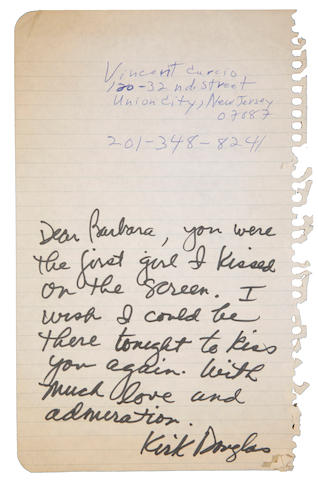
Here is a cute little note from Kirk to Barbara, who was his first on-screen love. According to Bonhams (the auction house that sold the note) it was likely sent before Barbara's 1981 Tribute at Lincoln Center or her 1987 AFI Salute.


Source: Bonhams

Transcript:

Dear Barbara, you were the first girl I kissed on the screen. I wish I could be there tonight to kiss you again. With much love and admiration.
Kirk Douglas

Kirk and Barbara in a scene from The Strange Love of Martha Ivers (above) and during a coffee break on the set (below).

3 January 2018

Projects that never happened

We all know the finished projects, the films that made it to the big screen. But of course, there were also plenty of projects that, for whatever reason, never came about. Interesting collaborations that never happened. 

Here are three letters that speak of such projects.

The first letter is dated 26 February 1963 and is from director George Cukor to Bette Davis. Cukor wrote to Bette because a friend of his, screenwriter DeWitt Bodeen, had plans for a film adaptation of Edith Wharton's novella My Son. Bodeen wanted Cukor to direct the film and Bette and Olivia de Havilland to star in it. The film was never made but the two actresses did eventually play together in Robert Aldrich's Hush... Hush, Sweet Charlotte (1964). 

Cukor and Davis would never make a film together, although they did work together in the theatre in the 1920s. In 1926, Bette joined Cukor's stock company in Rochester, New York, and stayed with the group for only one season. Cukor later remembered: "Her talent was apparent, but she did buck at direction. She had her own ideas, and though she only did bits and ingenue roles, she didn't hesitate to express them." Bette kept insisting for years that Cukor had fired her even though Cukor kept saying that he hadn't. In the letter below, Cukor's remark about the 'Rochester Method' is an obvious reference to his theatre days with Bette. 

Via: we love bette davis (instagram)

Transcript:

AIRMAIL 
SPECIAL DELIVERY

February 26, 1963

Congratulations on your nomination- your tenth, no less*. It certainly proves that the Rochester Method pays off.

I am functioning as a Friend of Friends. One friend, DeWitt Bodeen, is a very nice man and a good screenwriter, whose last effort was "Billy Budd". He is presently negotiating for the rights of a novella by Edith Wharton called "Her Son". I must confess I'd never heard of it before. He has asked me to send it to you, which I am doing under separate cover. He thinks it would make a bangup picture for you and Olivia DeHavilland. The switch is that you would be the Good Woman and Olivia the Doxie.

I called your house yesterday and was told by your sister that you were in New York. Then I spoke to Olivia. She said that no time be wasted in getting the book to you because you were presently making Big Decisions in New York. So here the matter rests.

Every good wish and kindest regards.

signed 'George'

Note* The Oscar nomination was for Bette's role in Robert Aldrich's Whatever Happened To Baby Jane? Anne Bancroft would eventually win the Oscar for her leading role in The Miracle Worker.

Written on 16 January 1957, the second letter is from Kirk Douglas to Gary Cooper. The letter shows that Douglas was quite excited about a film he was planning to make based on the television show The Silent Gun. Douglas wanted to make the film with Gary Cooper and director Charles Vidor and to produce it through his own production company Bryna Productions. Eventually, the film was never made, and Douglas and Cooper would never work together. 


Source: live auctioneers

Transcript:

January 16, 1957

Mr. Gary Cooper
200 Baroda Drive
Los Angeles, California

Dear Gary:

This is the television show, THE SILENT GUN, I spoke to you about on the phone. I'd like you to see it just as a basis for a discussion that we can have when I get back from New York.

We have been in touch with the Colt people, and have worked out wonderful arrangements to use all their museum pieces of guns and old machinery used in the manufacturing of guns, to make this a completely documentary background.

As I told you, Charles Vidor is awfully anxious to do it. From my point of view, I'm completely wide open. I think this film can be made on a surprisingly reasonable budget. And, by the way, I just checked the records and I don't have $30,000 in the story in rough treatment but approximately $22,000.

I think this could be a really exciting one. I hope you think so, too. I'll call you when I get back.

Best regards,
(signed 'Kirk') 
Kirk Douglas

Rare photo of Kirk Douglas and Gary Cooper together, here pictured with Patricia Neal. (Cooper and Neal had an intense love affair while Cooper was married; Douglas had also once dated Neal.)

The third and final letter comes from Cary Grant and is addressed to 'Dick', an associate of silent comedian Harold Lloyd. Grant had just received a script, meant as a possible vehicle for him and a potential new project for Harold Lloyd's production company. After reading it, Grant was not overly enthusiastic; he couldn't picture himself in the story and besides, a similar script had been offered to him once before (which he talks about in an amusing way). 

Grant's letter was written in January 1943, at a time when Harold Lloyd's Hollywood career was practically over. Lloyd would star in only one more film, in Preston Sturges' The Sin of Harold Diddlebock (1947), which became a big flop. As a producer, Lloyd had made two films for RKO in the early 1940s, i.e. A Girl, a Guy, and a Gob (1941) and My Favorite Spy (1942), which had proven unsuccessful too. A deal with Columbia to produce another film was signed in February 1943 but that film was never made. In the end, Lloyd would never produce again and a collaboration between him and Cary Grant never happened.

(Incidentally, while I have tried to find more information on 'Dick', unfortunately I could find nothing.)


Source: leading lights autographs

Transcript:

Jan. 16, 1943
1515 N. Amalfi Dr.
Pacific Palisades
Calif.

Dear Dick:

Many thanks for letting me read this---- I had a most enjoyable evening. It is undoubtedly a very funny and different idea, but with the script in it's [sic] present rough form I find it difficult to visualize completely it's [sic] possibilities as a vehicle for me. Incidentally, if Harold and yourself are keen to put this type of story into production, I think I should tell you that there is a synopsis lying around town, and which was submitted to me some time ago, embodying a similar idea-- though in that story the dog was the supposed reincarnation of the first husband who came back to worry the second husband and his former spouse--- it made for fun in a bed-room on a wedding night for two people and a dog-- you get the idea. I thought you both should know of it's [sic] existence although I have forgotten whether it is owned by a studio.

Hope to see you soon, Dick, and perhaps then we can discuss this story more fully, but in any case I'd be grateful if you would let me know what happens to it and the manner in which it is to be finally developed. Too, if we cannot get together on this one, I do hope I shall have the pleasure and the good fortune to work with you in the near future. Best personal wishes, and regards to Harold.

signed 'Cary'

While Cary Grant and Harold Lloyd never worked together, Grant's comedic performance in Howard Hawks' Bringing Up Baby (1938) was influenced by Lloyd. When Grant didn't know how to play his character (the nerdy paleontologist David Huxley) Hawks suggested Grant look at the films of Harold Lloyd. Grant did, and in Bringing Up Baby he imitates Lloyd's acting style and even wears his trademark black horn-rimmed glasses and ill-fitting suit.

17 May 2017

It could be a very important and constructive film

After reading the Cold War novel Seven Days in May by Fletcher Knebel and Charles W. Bailey II, Kirk Douglas knew it could be made into a great film. He bought the rights to the novel through his production company Joel Productions, teamed up with director John Frankenheimer and put together a cast of wonderful actors like Burt Lancaster and Fredric March (Douglas himself was to play an important role in the film too). Eventually released in 1964, the result was an excellent political thriller, which is still considered one of the best of its kind.

Having heard about Douglas' plans to picturise Seven Days in May, director Stanley Kubrick wrote Douglas a letter on 8 February 1963. Kubrick had been interested in filming the story himself, but now that Douglas was going to film it, Kubrick decided to offer him some unsolicited advice. Douglas wrote back 11 days later, saying he appreciated Kubrick's suggestions and also asked if they could make another movie together ("How about a comedy? I think I'm pretty funny, don't you?"). The two men had previously worked together on Paths of Glory (1957) and Spartacus (1960) and reportedly had a difficult working relationship. Despite Douglas' suggestion that they work together again, in the end they never did.

Kirk Douglas and Stanley Kubrick on the set of their second and last film together, Spartacus (1960). 


source
Transcript:

Mr. Kirk Douglas
707 North Canon Drive
Beverly Hills,
California

February 8th, 1963.

Dear Kirk,

I thought I would be presumptuous enough to drop you a line about your forthcomimg film SEVEN DAYS IN MAY which, as you may know, I had some interest in myself.

I think it's a marvellous story and could be a very important and constructive film. There were a couple of things about it which, in my opinion, detracted from its potential meaning. The most important, I think, is the complete cop-out at the end when the President confronts the Air Force Chairman of the Joint Chiefs of Staff and gets him to admit that if the responsibility were his, he would have done things just in the same way. This is extremely unlikely and takes away from the most important theme in the book, namely the conflict in the Government between intelligent civilian management of the affairs of state versus the driving force of the military-industrial complex. Have you ever seen Eisenhower's famous last speech as President where he warned the country, in a manner extremely untypical for him, of the growing threat of the military-industrial complex - that was his expression.

I think it would be very good if you could dramatise the difficulty a President would have in agreeing to some form of sensible disarmament scheme and how the semi-paranoiac extremists can make great political trouble for him. This is very nicely touched on in the book when the President's Popularity Poll reaches a new low, but I think it's greatly dissipated by the ending. 

I should also prefer to see less physical action undertaken by Senators and high Government officials. There's a bit too much creeping and crawling and slugging and gun-play involving these characters and I think it would be much more realistic if this could be delegated to lower echelon characters.

I hope that John and Rod and Eddie don't resent this letter and I leave it to you to present any of these ideas, if you consider them worthy, in your own charming and inimitable manner. 

In any event, I wish you the best of luck with the film and give my regards to Eddie and Ann.

Best regards,

(signed "Stanley")

Stanley Kubrick

source

Transcript:

February 19, 1963

Dear Stanley,

How nice to hear from you again, and I certainly appreciate your suggestions -- but then you know how we geniuses work. You will be pleased to know that we have been thinking about all the points you mentioned. Your letter has served to give us more confidence about the work we must do in these areas. I think we should have an interesting picture and a pretty good cast.

By the way, what's cooking with your project-- what's happening with your lawsuit versus "Failsafe". If there's any way that I can help I wish you'd call on me. 

In the meantime, my sincere  wishes for the success of your picture. 
Also, I think it's about time we did another picture together. How about a comedy? I think I'm very funny, don't you? 

Let's keep in touch.

Sincerely,

(signed "Kirk")

Kirk Douglas

Mr. Stanley Kubrick
Shepperton Studios
Shepperton, Middlesex
England


Source: Wisconsin Center for Film and Theater Research

Note: During the filming of his Cold War satire Dr. Strangelove (1964), Kubrick learnt that Fail-Safe (1964), directed by Sidney Lumet, was being produced at the same time. Fail-Safe's plot was so similar to Red Alert (the novel by Peter George on which Dr. Strangelove was based) that George filed a lawsuit for plagiarism and later settled out of court. As both films were being produced by the same studio (Columbia Pictures), Kubrick insisted that his film was released first. He got his wish-- Fail-Safe opened eight months later than Dr. Strangelove and as a result performed poorly at the box-office. 

Burt Lancaster, Fredric March and Kirk Douglas-- powerhouse acting in Seven Days in May.

13 February 2016

Let's bring the art of letter-writing back into vogue!

I know that Olivia de Havilland will be celebrating her 100th birthday this year, but I hadn't realised there's another Hollywood legend who will also turn 100. To be honest, I didn't think Kirk Douglas was still alive, but he is and will have lived exactly a century on 9 December of this year. And like Miss De Havilland who is currently working on her autobiography, Douglas announced his plans last year to start a new book too. A book after my own heart, I might add, as it involves his personal correspondence. 

The letter for this post is about letter-writing, and in particular Kirk Douglas' view on it. It's an open letter to readers of The Huffington Post written in April of last year, in which Douglas expresses his longing for the days when people didn't correspond through e-mail, whatsapp or twitter. And so, he urges readers to write physical letters again, preferably by hand. Having saved decades' worth of his own correspondence, Douglas also tells of his plans to publish his letters in a new book (despite his statement a year earlier that his poetry collection Life Could Be Verse: Reflections on Love, Loss, and What Really Matters (2014) was his last book). Of course, I can't wait for this book to come out...


I am closing in on 100. When I reflect on the many satisfactory experiences of my long life, I must include my correspondence with some of the world's most fascinating people. There is a special sensory enjoyment involved in writing a letter, stamping the envelope and sending it on its way. Whether you are getting something off your chest (some letters are indeed written in anger) or writing a love letter (my own favorite), it remains the most personal way to communicate, especially when written by hand.
After my stroke, I had fans who wanted me to tell them about my road to recovery. Answering their letters became part of my therapy, and signing them in my own handwriting part of my pleasure. 
In a world where "everything old is new again," I am amazed to hear that young people are now buying vinyl records. Does this bode well for the return of letter-writing? I hope so.
Despite the convenience of the new technologies, this ancient form of communication remains impactful and should be used more often.
Imagine a child writing to Santa Claus in a letter parents can treasure; a Dear John or Dear Jane letter the recipient can stain with tears and reread when the heart has mended; a New Testament without the Epistles.
While no one doubts the ego-satisfying thrill of the 140-character tweet sent to a multitude of followers or the convenience of emails complete with acronyms that substitute for words and cute little emoticons substituting for feelings, I urge readers to rediscover the pleasure of communicating by what is known today by the derogatory term "snail mail." 
My wife Anne has kept a trove of letters and poems I've written to her over our 60 year marriage. She can even quote from some of them. She can also see in them the man I was and the man I became. Anne has also meticulously archived decades of letters between me and people like my friends Henry Kissinger, Francis Albert Sinatra, Brigitte Bardot and others, as well as colleagues such as Lord Laurence Olivier and Dalton Trumbo. They all attest to a state of mind; they all reflect what was happening in their lives or mine; they all offer insight into the private thoughts and dreams of that moment in time.
I have written 11 books, and I was sure the one published on my 98th birthday would be my last. However, I have been reading through a lot of that saved correspondence and have decided on another book, much more ambitious than a man my age usually contemplates. I have already begun work on my book of "Letters."
Now, here's my challenge to all of you reading this open letter:
Write a letter today to someone you love that can be kept, savored, and passed along to family members when the time is right. Send a handwritten invitation by mail instead of an evite. Receive a gift and handwrite a thank-you note. Express your feelings to a member of government on an issue you care about and put it in a mailbox. Remember, when you sign a letter in your own hand, you are attesting that you and you alone are responsible for its content. I don't think that's possible with an email.
Let me hear from you, preferably not as a comment, but as a real letter between you and me. At first, rediscovering this form of communication may seem strange -- but I promise you, it gets easier the more you use it -- and ultimately more rewarding. 
I hope you will join my crusade to bring the art of letter-writing back into vogue.
Sincerely,
Kirk Douglas
 Source: The Huffington Post

16 May 2015

The Apartment: a favourite (movie-wise)

This post is my contribution to the My Favourite Classic Movie Blogathon in celebration of National Classic Movie Day, hosted by Classic Film and TV Cafe. Click here to check out all the other entries.


I don't really have a favourite movie. There are so many great movies, I find it very difficult to pick just one. But one of the films that has always ranked high on my list of favourites --one that I've seen many times and will certainly watch again-- is Billy Wilder's black comedy The Apartment (1960). There's so much to love about this film. The script by Billy Wilder and I.A.L. Diamond which contains the most brilliant lines ("That's the way it crumbles... cookie-wise", for one); the performances from the entire cast, in particular the leads Jack Lemmon and Shirley MacLaine; the crisp black-and-white cinematography by Joseph LaShelle; the wonderful music score by Adolph Dietsch -- all these elements, masterfully put together by Billy Wilder, make The Apartment a gem from start to finish. 

Back in 1960, the public also loved The Apartment. Audiences went to see the film en masse, making it a box-office hit immediately upon release. But it was not just a commercial success, the film was also lauded by the critics and by Wilder's peers. At the Oscar Ceremony in April 1961, The Apartment was awarded a total of five Oscars, three of which went to Wilder: Best Picture, Best Director and Best Screenplay (the latter he had to share with I.A.L. Diamond). To congratulate Wilder on the film and its success, many colleagues sent him letters and telegrams. Below you'll find some of the correspondence Wilder received, both in 1960 when the film was released and in 1961 after his big Oscar win. The correspondence comes from Sammy Davis Jr., Fred Zinnemann, Kirk Douglas, Alfred Hitchcock, Joan Crawford, John Sturges and Hal Wallis; the letter from Hitchcock has been posted on this blog before, but I thought it was nice to include it here as well.

Transcript: 

1960 MAR 16

BILLIE WILDER, SAMUEL GOLDWYN STUDIOS=

1040 NORTH FORMOSA DLR BY MSGR HOLLYWOOD CALIF=

DEAR BILLIE HAVE JUST SEEN YOUR TRADE AD FOR THE QUOTE APARTMENT UNQUOTE THE INDUSTRY HAS NOTHING TO WORRY ABOUT AS LONG AS THERE ARE PEOPLE LIKE YOU IN IT
MUCH LOVE=
SAMMY DAVIS JR.

Transcript:

1960 MAY 5
BILLY WILDER
1041 NORTH FORMOSA HOLLYWOOD CALIF=

DEAR BILLY: DAN TARADASH AND 19 OTHER PEOPLE HAVE TOLD ME "THE APARTMENT" IS ABSOLUTELY WONDERFUL WARMEST CONGRATULATIONS 
CORDIALLY=
FRED ZINNEMANN.

Note: Daniel Taradash was a screenwriter; his credits include Golden Boy (1939) and From Here to Eternity (1952).

Transcript:

Dear Billy-

I have to tell you again how thrilled I was about seeing your picture this evening. You've certainly eclipsed "Some Like It Hot"- no mean feat.
This is a great example of movie-making --the sharp comments on various phases of American life, the daring juxtaposition of comedy and tragedy, the incisive penetration into the soul of a woman in love with a married man, the direction that led to some magnificent performances all add up to make one of the greatest pictures I've ever seen.

Transcript:

June 29, 1960

Mr. Billy Wilder
10375 Wilshire Boulevard
Los Angeles, California

Dear Mr Wilder,

I saw THE APARTMENT the other day.

I cannot tell you how much I enjoyed it, and how beautifully made. 

I felt this so much that I was impelled to drop you this note.

Kindest regards,

(signed)
Alfred J. Hitchcock

Transcript:

October 10, 1960

Billy dear,

I have just seen "The Apartment". You have done the most adroit, professional, exciting, poignant, delightful film I have seen in years. Thank you for giving the industry the "goose" it needed, and thank you for the joy it has given, not only millions of people, but your friend--

Joan (signed)

Transcript:

April 18, 1961

Dear Billy:

It was a great pleasure to see you scoop up that family of little men. Particularly since the picture was a complete original- a rare and admirable thing.

Please include I.A.L. in my congratulations.

With all the best,

John (signed)

Mr. Billy Wilder
1041 N. Formosa
Hollywood 46, California


Transcript:

April 19, 1961

Dear Billy,

This is getting to be a habit, but I am sure it is one you have no objection to acquiring.

In any event, my fond regards and sincere congratulations on the well deserved Oscars.

Sincerely,

(signed)
Hal Wallis

Images of the telegrams and letters courtesy of Heritage Auctions (here and here).