Showing posts with label James Dean. Show all posts

27 July 2024

Your little monster, Jim

On 8 April 1954, a day after signing his contract with Warner Brothers, James Dean left New York and headed for California to prepare for his first leading role in Elia Kazan's East of Eden (1955). Production of the film was to start at the end of May, and until then Dean would be rehearsing and doing wardrobe and make-up tests. With no place to live in Los Angeles, Dean was initially forced to stay at the house of his father and stepmother, a living arrangement he was not at all happy with. Later Kazan arranged for Dean to rent a cheap, tiny apartment close to the Warner Bros. studio, which he would share with his Eden co-star Richard Davalos. Dean hated LA and missed his beloved New York (read more about it in this previous post). Shooting on Eden ended early August 1954, but the actor wouldn't return to New York until late December that same year.

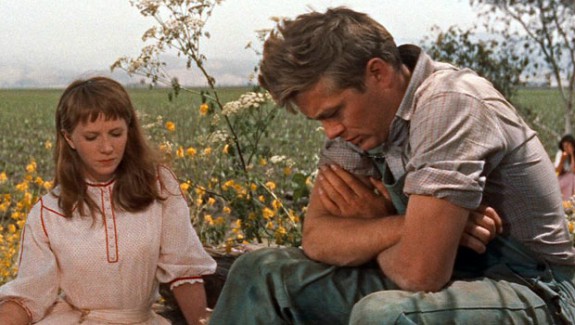
Above: James Dean photographed by Roy Schatt in 1954. Below: Dean doing wardrobe tests for his role as Cal Trask in East of Eden, his performance eventually garnering him a (posthumous) Oscar nomination for Best Actor.

Jane Deacy was Dean's agent in New York City and had signed him as a client around May 1952. As Dean's own mother had died when he was nine years old and he couldn't get along with his stepmother, Deacy was regarded by Dean as a second mother. A woman with a warm personality, she looked out for her client, arranged jobs for him and also handled his personal finances. Deacy had asked the Famous Artists Corporation Agency to represent Dean while he was in LA, not having an office on the US West Coast herself. The Famous Artists Corporation (founded by Charles Feldman) had assigned Dick Clayton, one of the younger agents and a former actor, to handle Dean's affairs. Dean was very happy with the agency, and in particular with Clayton, as he wrote in a letter to Deacy in (circa) mid-April 1954. In the letter, the actor also mentioned the fact that he was "very brown and healthy looking", much to Elia Kazan's satisfaction. During Dean's first week in LA, Kazan thought he looked too pale and tired and subsequently sent him to the desert to get a tan.

Transcript:

Dear Mom, 

Like always I can trust your judgement. I am very happy with the office you chose for me. Dick Clayton is a prince of a guy. Old man [Charles] Feldman is in equal rights a prince. The rest of them are patronizing and nice (think I'm a weird one of course, as always, they will catch on.) If I would louse up the picture Dick would still talk to me.

I haven't quite settled down yet but will soon. Rented a car. Very brown and healthy looking, Kazan is pleased. I love you.

Send Mr. Feldman a copy of my contract so he can see whats up. Please as soon as you can. 

Love 
Your little monster 
Jim

_____


In (circa) late April 1954, Dean sent another letter to Deacy, keeping her informed on several aspects of his life. Strapped for cash, Dean told his agent that he was still waiting for the checks to arrive from Danger, one of several TV shows he had played in. Furthermore, Dean talked about his health, both physical and mental. Regarding the latter, the actor mentioned he was going to look for a therapist after returning to New York. (Since he wouldn't go back to NY until December later that year, Dean reportedly found a psychoanalyst in Los Angeles in late summer/early autumn.)

Transcript:

Dear Jane 

I had a wire sent to my bank (Chase) and their reply to my frantic question was $121.00. Sure went fast. I had to give up the rented car idea. It cost me $138.00 the two weeks that I had it. I hope that I still have the checks from Danger coming. I can't live with my stepmother another minute and I'll have to find a mode of transportation. As you know without a car your [sic] good as dead in Calif. I hate this place anyway. Please tell me that I still have the Danger checks because I love you.

Have found a good dentist after a long and discreet search. Cliffton [sic] Webbs dentist (oh well). Have been going to a throat specialist because of a pigmented tongue [self-portrait drawing]. Too much smoking. Has [sic] stopped completely, also stopped drinking. Taking vitamins also. I was really run-down. I'm fatter now and feel much better. Tear myself up in New York. Build myself up in Calif. (health and maybe career huh?) 

The address at my fathers place is 1667 So. Bundy Drive, L.A. 19, Calif. or write to Dick Claytons office address and tell me that I have still the Danger checks. Returning home after picture to find analyst. (Is that spelled right, doesn't look right). Miss you 

Love 
Jim

August 1953, Walter Hampden, James Dean and Betsy Palmer in the anthology series Danger; the episode was called Death Is My Neighbor.
James Dean photographed in Jane Deacy's office in January 1955; unfortunately I couldn't find a photo of Deacy herself.

On 30 April 1954, Deacy replied to Dean's letter, being mainly concerned with his financial situation. As Dean had spent a lot of cash in a short time —the $700 advance he had received on 7 April, when signing his contract with Warners, was nearly gone— Deacy suggested that he earn some money by doing a television or a radio show while waiting for filming on Eden to start. Dean had already thought of a different way to obtain money, though, having asked Warners for a second advance on his salary. On the same day that Deacy wrote her letter to Dean, the studio agreed to give him another $700 ("... in order that you make take care of certain personal matters"). With part of the money Dean subsequently bought a used MG TD sports car. 

While Deacy was very hopeful about Dean's future, tragedy would strike a year later. On 30 September 1955, Dean was killed in a car crash, driving his newly purchased Porsche 550. He was only 24 years old.

Incidentally, "Lenny", as mentioned in the letter, is probably Leonard Rosenman, Dean's best friend in New York, and composer of the scores for Eden and Rebel Without a Cause (1955).


Source of all letters: Nate D. Sanders Auctions (here, here, and here) (I may share more of Deacy's letters to Dean in a future post.)

4 August 2022

James Dean at UCLA

In May 1949, James Dean graduated from Fairmount High School and then moved back to California to live with his father Winton and stepmother. Until then he had been living with his aunt and uncle, Ortense and Marcus Winslow, on their Quaker farm in Fairmount, Indiana, following the death of his mother when he was nine years old. Back in California, Dean's intention was to enrol at UCLA (University of California, Los Angeles) and study drama. His father didn't approve of his choice, however, and by the end of the summer had persuaded Dean to enrol as a pre-law student at Santa Monica City College. While majoring in pre-law, Dean took as many drama lessons as he possibly could, still determined to become an actor. After a year at Santa Monica College, he transferred to UCLA and finally changed his major to drama ("I wasn't happy where I was. I was studying a field I didn't like, so I transferred to UCLA for a drama major. I figured I might as well pursue this dream now, cause you'll never know if you'll have time to do so later."). During his time at UCLA, Dean was chosen out of a group of 350 actors to play the role of Malcolm in Macbeth and also attended James Whitmore's acting workshop. In 1951, he dropped out of UCLA to fully dedicate himself to his acting career. 

After graduating from high school in May 1949, James Dean wanted to study at UCLA in the fall and also attend the university's summer session. Needing his school records from Fairmount to attend UCLA, in early June Dean wrote the following letter to F. Stanton Galey, Superintendent of Schools in Fairmount. As said, Dean would major in pre-law at Santa Monica City College, like his father wanted, and it still took a year before he enrolled at UCLA and switched his major to drama. Although Dean spent only one semester at UCLA, it marked the beginning of his acting career, eventually leading him to the New York stage and finally to Hollywood.


Transcript:

June 6, 1949

Dear Mr. Galey, 

Well here I am, and I have inquired as to my education at U.C.L.A. (summer session). I hope this reaches you without any detainment because I must have my records or transcripts just as soon as possible. I would appreciate it deeply if you would send them special airmail and then send me the bill for postage. 

I really got a break on the first day. I met Mr. Wooten a Prof. at UCLA. He is from Fairmount and tomarro [sic] he is introducing me to the staff head of the Theatrical Dept. A mister McCowain used to be a director for Fox + Paramount. 

Send to room 10 University of California, Los Angeles 
Administration building

With all due appreciation and respect
Jim Dean

James Dean (right) as Malcolm in UCLA's production of Macbeth. The faculty newspaper criticised his performance: "Malcolm failed to show any growth, and would have made a hollow king."

9 December 2020

James Dean is not an imitation of anybody

Bosley Crowther, famed film critic of The New York Times, was quite critical of James Dean after seeing him in his first big role in Elia Kazan's East of Eden (1955). In his review, published on 10 March 1955, Crowther wrote: "This young actor, who is here doing his first big screen stint, is a mass of histrionic gingerbread. He scuffs his feet, he whirls, he pouts, he sputters, he leans against walls, he rolls his eyes, he swallows his words, he ambles slack-kneed — all like Marlon Brando used to do. Never have we seen a performer so clearly follow another's style. Mr. Kazan should be spanked for permitting him to do such a sophomoric thing. Whatever there might be of reasonable torment in this youngster is buried beneath the clumsy display".

Crowther was not the only one to criticise Dean's acting and Kazan's direction. There were others, among them Lee Rogow of the Saturday Review, who wrote on 19 March 1955 that "Kazan [had] apparently attempted to graft a Brando-type personality and set of mannerisms upon Dean, and the result [was] less than successful". Dean, who idolised Brando, responded to the criticism in Newsweek: "I am not disturbed by the comparison, nor am I flattered. I have my own personal rebellion and don't have to rely upon Brando." 

Elia Kazan seemed more hurt by the criticism. Kazan greatly admired Brando — they had worked together on three films, i.e. A Streetcar Named Desire (1951), Viva Zapata! (1952) and On the Waterfront (1954) — but being accused of encouraging Dean to act like Brando was "really too ridiculous", he thought. In the following letter to Helen Bower of the Detroit Free Press (one of several critics who had written quite favourably about Dean and the film), Kazan defends Dean and with it his own direction. 


[New York]

March 22, 1955

Dear Miss Bower:

Thank you for your letter. The allegation about Dean was not concerted but was made in some rather disturbing places by people whom I felt know better.

Dean actually has a talent all his own and a sizeable one. He doesn't need to imitate anyone and was not imitating anyone. He admires Brando, as do practically all young actors today. In this respect I would say that he had excellent taste. Brando has no doubt influenced Dean to some extent but he has also influenced 100 others, just as Barrymore did 30 years ago, just as Cagney and Spence Tracy did 20 years ago. The thing about my grafting a Brando-like personality and set of mannerisms on Dean is really too ridiculous to answer. I supposed it was a way of speaking rather than a remark meant literally. I actually don't think he's much like Brando. He's considerably more introverted, more drawn, more naked. Whatever he is, though, he's not an imitation of anybody. He's too proud to try to imitate anyone. He has too much difficulty —as does any decent worker in our craft— thinking about anything except playing the part as written. Critics who say he's imitating Brando just reveal a naivete about acting, direction, and production.

I would love to see your review of the picture. I gather you liked it. It meant a lot to me and I was rather upset by Crowther's reaction in New York. The other critics here, however, liked it very much indeed and the picture is doing well.

Sincerely


Source: The Selected Letters of Elia Kazan (2014), edited by Albert J. Devlin  

Note: 
East of Eden was a big commercial success. Both Kazan and Dean were nominated for an Oscar (Dean posthumously) but didn't win. Of the four Oscar nominations the film received only Jo van Fleet won. 
East of Eden also earned the award for Best Motion Picture–Drama at the Golden Globes and Best Dramatic Film at the Cannes Film Festival. 

Elia Kazan and James Dean behind the scenes of East of Eden, below pictured with Julie Harris and Marlon Brando during Brando's visit to the set.

22 September 2020

The friendship of Martin Landau and James Dean

Martin Landau and James Dean got to know each other in the early 1950s when Dean moved from Fairmont, Indiana, to New York City. Landau had been working as a political cartoonist for the New York Daily News since he was seventeen but, like Dean, wanted to pursue an acting career. The two young men both studied at Lee Strassberg's famous and prestigious acting studio in New York and quickly became friends. Landau, who was three years older than Dean, recalled years later: "James Dean was my best friend. We were two young would-be and still-yet-to-work unemployed actors, dreaming out loud and enjoying every moment... We'd spend lots of time talking about the future, our craft and our chances of success in this newly different, ever-changing modern world we were living in."

When asked if his friend had been destined to die young, Landau resolutely answered "no". "Jimmy never talked about dying. Jimmy talked about living. Jimmy's only concern was that he would become an old boy, like Mickey Rooney. When Elia Kazan tested actors for East of Eden, Paul Newman and Jimmy auditioned on the same day. Paul looked like a man when he was 20, whereas Jimmy was still playing high school kids at 23. That bothered him a bit. But Jimmy did not want to die."


Still, Dean died at the much too young age of 24 on 30 September 1955, after he crashed his Porsche trying to avoid a head-on collision with an oncoming car. Shocked and devastated by the loss of his friend, Landau wrote the following letter of condolence to Dean's uncle and aunt, Marcus and Orteuse Winslow (who had raised Dean after the death of his mother in 1940), and his father Winton. The image below is a rough draft of the letter that Landau eventually sent.


Transcript:

Dear Mr. + Mrs. Winslow
+ Mr. Dean,

I feel as though I know you, having been one of Jim's oldest + closest friends in New York. I had heard him speak of you, the farm, and Indiana many, many times, with the greatest admiration, love and respect.

In fact, we almost met in November of 1953, when Jim went home for a visit. He asked me to come along but I was rehearsing a play at the time and was unable to get away. I'm sorry now that I didn't, I would have liked very much to have been able to meet you.

I am writing this letter because I know and understand how much you meant to Jimmy. It is hard to believe that he is gone. Last Christmas night, Jimmy had dinner at home with me + my family. For three years my mother had heard me speak of Jimmy, and although they had spoken to him on the telephone, this was the first time they had ever met him. They practically fell in love with him, as did my entire family, and feel now as though they've lost a son.

The news of Jim's death was a terrible shock to me, I can't begin to imagine what his loss must mean to you who raised him and were closer to him than anyone else in the world. I want you to know how terribly sorry I am.

I wish I were better at expressing my sympathy. This boy had every reason in the world to live. None of the comforting phrases apply. All there is to be grateful for is that, young as he was, he had shown his genius, and that remains, even though a thin substitute for his continuing life.

I am proud and happy to have known Jim, both as a fellow actor and a friend. I am going to miss him very much.

There's really nothing more I can say. I am heartsick for you and for everyone who loved him.

Sincerely -

Marty Landau

Source: Indiana Historical Society
(click on the link to read the Winslows' reply)

James Dean and Martin Landau photographed in a New York City diner in 1955. While Dean's career was tragically cut short, Landau would go on to have a long career. Landau's best-known work includes the tv series Mission: Impossible (1966-1969) as well as supporting roles in Alfred Hitchcock's North by Northwest  (1959), Tucker: The Man and His Dream (1988), Crimes and Misdemeanors (1989) and Ed Wood (1994), the latter film earning him the Oscar for Best Supporting Actor.

22 April 2018

I know it's a hell of a gamble

After reading John Steinbeck's novel East of Eden (1952), director Elia Kazan immediately wanted to turn it into a film. Admittedly, Kazan didn't like the first part of the book and was only interested in filming the latter section which deals with the conflict between Cal, his father Adam and brother Aron. To write the screenplay, Kazan didn't choose Steinbeck --Steinbeck did write the screenplay for Kazan's Viva Zapata! (1952)-- but he chose screenwriter Paul Osborn instead. Kazan felt that East of Eden was the toughest dramatisation job he had ever seen and wanted a professional screenwriter to handle it. While Steinbeck (a good friend of Kazan) was not happy with Kazan's decision, he was busy writing a Broadway musical* so he agreed to Osborn doing the screenplay.

For the principal role of Cal Trask, Kazan briefly considered Marlon Brando with whom he had worked on A Streetcar Named Desire (1951) and On the Waterfront (1954). Brando, however, was 30 at the time and Kazan thought him too old for the role. Paul Osborn then suggested 23-year-old James Dean for the part. (Osborn had seen Dean on Broadway doing a bit part in the play The Immoralist.) While Kazan didn't think much of Dean personally, he felt Dean did have that special quality which made him Cal. Later Dean was introduced to Steinbeck and, despite finding Dean a "snotty kid", Steinbeck also thought Dean wás Cal. 


When it came to the casting of Abra (Aron's girlfriend who later falls for Cal), Kazan chose experienced stage actress Julie Harris, 28 years old at the time. Jack Warner, studio head at Warner Bros, wanted someone younger and prettier than Harris but Kazan insisted on her being cast. Kazan never regretted his decision and later said that on the set Harris had been more important to Dean than he, the director, had been: "I doubt that Jimmy would ever have got through East of Eden except for an angel on our set. Her name was Julie Harris and she was goodness itself with Dean, kind and patient and everlastingly sympathetic. She helped Jimmy more than I did with any direction I gave him."

Other important roles went to Raymond Massey (Adam Trask), unknown actor Richard Davolos (Aron) and Jo Van Fleet (Kate, mother of Cal and Aron).

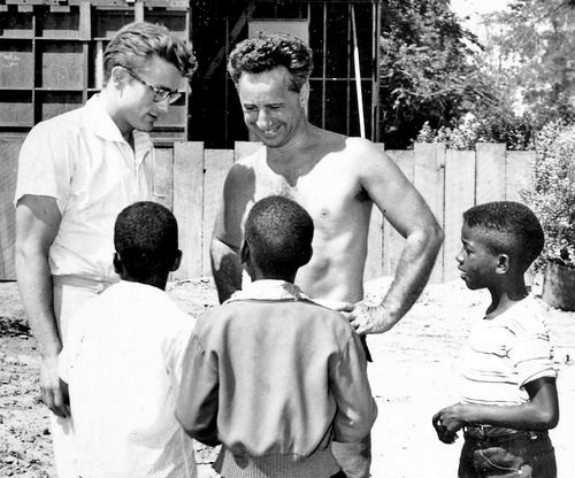
Pictured above: Marlon Brando visiting Elia Kazan, Julie Harris and James Dean on the set of East of Eden (1955); below: Dean and Kazan talking to some children on the set.

And now to the letter!

In March 1954, Elia Kazan wrote to his friend John Steinbeck, talking about the progress he and Osborn had just made with the script and about his wish to cast Jimmy Dean and Julie Harris in the roles of Cal and Abra. Kazan admits to it being "a hell of a gamble", seeing that Jack Warner was hoping for stars, but he was willing to take the risk. Well, as we know, Kazan's gamble paid off eventually. East of Eden was not only the start of what would later become a James Dean cult, but at the time it was also a huge success. The film received four Oscar nominations, i.e. for Kazan (Best Director), Dean (Best Actor), Osborn (Best Adapted Screenplay) and Van Fleet (Best Supporting Actress), with Van Fleet being the only one who took home the Oscar.

*Incidentally, the last paragraph of the letter concerns the Broadway musical which Steinbeck was working on with Rogers and Hammerstein ("R&H"); read more here. And at the bottom of the post I've also included a note from James Dean to a fan regarding East of Eden. 

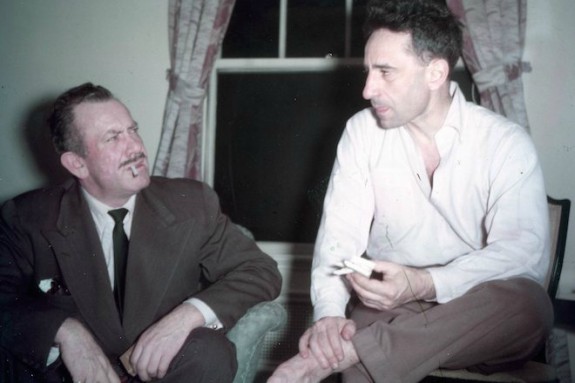
Elia Kazan (pictured right) and John Steinbeck (left) were very close friends. In 1952 after Kazan had given his HUAC testimony, Steinbeck was one of the few people who stood by him. Steinbeck trusted Kazan implicitly and in the end was very happy with the way Kazan's East of Eden (1955) had turned out.


[Sandy Hook, Connecticut] 
[March 1954]
Dear John: 
Give our love to Elaine first of all. We had a hell of a time down there. A lot of new stuff like goggle swimming and all kinds of fishing esp. bone fishing. And esp real hot weather. I liked that. That was very welcome.
Now I'm back, feeling very different. I'm up in the country and Paul and I worked all day yesterday and today on the second draft. Yesterday was bewildering, but today was the day. Today we got somewhere.
We're reconstructing the first forty five odd pages pretty thoroughly. We feel it goes pretty well after that, but the first forty five were very bad. We're finally on a line for Aron. I hope you don't mind: we made him a Wilson (Woodrow, that is) enthusiast. We took out the two historical montages. We had Europe in the war at the beginning. And Aron convinced that we'd never get in, that Wilson would keep us out. Then, the night of the birthday party, Wilson lets him down. And a lot more. The script we had, it turns out, was simply what it was, a first draft. I kept saying that, but it was nevertheless a bit of a shock when it turned out to be what I had been saying: a first draft. We'll be working all this week up here, and then a couple of days in New York. Then I'll go to Salinas and look at your back streets (The ones you told me about). Then I'll go down to Burbank FUCK IT and make the film. I hate to leave N.Y.C. And maybe this will be the last picture I make in Cal. But this one belongs out there, so.  
I looked thru a lot of kids before settling on this Jimmy Dean. He hasn't Brando's stature, but he's a good deal younger and is very interesting, has balls and eccentricity and a "real problem" somewhere in his guts, I don't know what or where. He's a little bit of a bum, but he's a real good actor and I think he's the best of a poor field. Most kids who become actors at nineteen or twenty or twenty-one are very callow and strictly from N.Y. Professional school. Dean has got a real mean streak and a real sweet streak. 
I had an awful time with the girl. Terrible. The young girls are worse than the young boys. My god, they are nothing. Nothing has happened to them or else they're bums. Abra is a great part. I hope you don't die now. I want to use Julie Harris. Do you think I'm nuts? The screen play depends so on her last scene with Adam and on her strength, that I have to have a real, real actress. I couldn't find one aged twenty. They're nothing. Proms, dresses, beaus and all that, but nothing for my last scene. Finally I made a photographic test of Julie and she looks twenty when her face is in movement, I think. I'll just have to keep her face in movement. She's a marvelous actress. She is not Abra the way we saw her, but jeezuz I was stuck. 
One pro thing. She and Jimmy Dean look fine together. They look like People, not actors. I'm real pleased with that part of it. Two people. Dean has the advantage of never having been seen on the screen. Harris, practically.
Meantime WB? Jack esp. are dying. They hoped for stars. But they didn't come up with any names. And I haven't. I know you must be a little shocked with this casting. And I know its a hell of a gamble and all on my shoulders. But I'm delighted to take it. Its the kind of gamble I like. Write me. c/o Warner Bros. Burbank Cal.
I think R&H did fair on the lead casting. And I think Clurman is one of the three or four best directors in the world today. R&H will do the musical part of it. Lots of love to you and Elaine. Have a BALL!

Source: The Selected Letters of Elia Kazan (2014), edited by Albert J. Devlin.

Below: James Dean's letter to a fan, saying he found playing Cal "gratifying". Image of the letter courtesy of Heritage Auctions.

source

15 August 2017

Hedda Hopper & James Dean

When gossip columnist Hedda Hopper saw James Dean for the first time, she was appalled by his unkempt appearance and his bad manners. Such was her disgust with Dean that she wrote in her column the next day: "They've brought out from New York another dirty-shirttail actor. If this is the kind of talent they're importing, they can send it right back so far as I'm concerned." (Quote from Hopper's 1962 autobiography The Whole Truth and Nothing But.)

source
A while later, Hopper received an invitation to attend the preview of East of Eden (1955). Given her bad first impression of Dean, Hopper refused to go. The day after the preview, however, Clifton Webb (who was quite excited about Dean's performance and whose judgment Hopper respected) told her to go see the film, so Hopper arranged a private screening and was immediately enthralled by Dean. She invited Dean to her house for an interview and he soon had her eating out of the palm of his hand. From then on, Hopper was Dean's biggest fan. When he suddenly died in September 1955 after crashing his car, she lobbied hard for a James Dean memorial ánd a posthumous Academy Award. Despite all her efforts, Hopper achieved neither.

Shown below are Hopper's radio statement about James Dean from 5 October 1955 (five days after his death) and a letter written by Hopper to Jimmy Madden (a fan) on 3 January 1956. Madden had contributed $1 for Dean's memorial, but since there would be no memorial (due to the lack of interest in Hollywood) Hopper saw fit to return Madden's money. Also, Hopper writes that she was working on a special Oscar for Dean but, as mentioned, the Oscar never happened. (Incidentally, it wasn't until much later (in 1977) that Dean did get a memorial; read more here.)

Hedda Hopper visits James Dean in his dressing room during the filming of Giant (1956), which was released after his death.

FROM WED. OCT. 5, 1955 COLUMN

"I'm still reeling from the sudden death of Jimmy Dean, one of the greatest acting talents I've ever known. He was a tragic figure. So few understood him. He was reaching out for love and understanding, but got so little. His greatest ambition was to play "Hamlet" on Broadway. Said he, "It should be done only by a young man." The thing he loved most was the thing that killed him-- his racing car. He carried with him in his death the St. Christopher medal Pier Angeli gave him while he was making "East of Eden." He was like quicksilver. He had a sure instinct for drama. He was like the parched earth longing for the rain. Only a few days ago a friend of mine met him in a pet hospital. He had brought a kitten for an innoculation, and the loving care he was giving it was beautiful to look upon. It will be a long time before we see his like again. I loved the boy and always will." 

Source: oscars.org

Source: Hake's Americana & Collectibles

Transcript:


Hedda Hopper's Hollywood
702 Guaranty Building
Hollywood 28, California 

January 3, 1956

Dear Jimmy Madden:

I can't tell you how touched I was by your letter, and how much I appreciated your contribution for a memorial for Jimmy Dean.

It's taken me so long to thank you and to return the money because I have investigated thoroughlu [sic] the Hollywood end of figuring out some suitable memorial for Jimmy. I ran up against a blank wall. There's a great deal of interest here among his friends and much more from his fans. But the people who would have to put up the bulk of the money aren't willing to do so.

I'm still working for a special Oscar to be imbedded in a granite block to be put on his grave. But I won't know whether my plan will be carried out until the night of the Academy Awards. 

I feel as you do about Jimmy. Had he lived he'd have been one of our greatest. I feel he's still with us; I know he is in spirit. He would have been so pleased that so many people from all over the nation have wanted to create a memorial in his name.

My blessings upon you.

(signed)
Hedda Hopper

Mr. Jimmy Madden
2500 University Ave.
Bronx, 68, N.Y.

Enclosure $1

25 January 2016

Casting Oklahoma!

On 21 September 1953, Oscar Hammerstein II wrote a letter to director Fred Zinnemann, expressing his concern over the slow casting process of Oklahoma!. Zinnemann had been hired to direct the film adaptation of Rogers and Hammerstein's successful Broadway show, and Hammerstein —he and Rogers were the film's (uncredited) executive producers— was eager to get the ball rolling. Interested to know how things stood with Paul Newman who was considered for the role of the male protagonist Curly, Hammerstein wrote: "I spoke to Dick Rogers on the 'phone yesterday and I was disappointed to hear that so little had been done since I left, he had no report on the young man in whom we were so interested (was his name Newman?) I hope you, Dick and Arthur will follow this up right away." [read the full letter here]. 

Shortly after receiving Hammerstein's letter, Zinnemann held two days of auditions with Paul Newman and several other actors. One of them was James Dean who, like Newman, was trying to land his first film role as cowboy Curly (admittedly, Dean had appeared in films before but these roles were uncredited). Also tested were Joanne Woodward for the female lead role of Laurey, Rod Steiger for the role of Jud, and a few others. On 30 September 1953, Zinnemann reported back to Hammerstein, informing him about the recently held screen tests. Zinnemann's letter is shown below and is especially noteworthy for his remarks on Newman and Dean. 

James Dean, Paul Newman, Joanne Woodward and Rod Steiger all auditioned for roles in "Oklahoma!", but only the latter was eventually cast.
Oscar Hammerstein II (left) and Fred Zinnemann on the set of "Oklahoma!".
Images letter via: Playbill Vault

Original source: Margaret Herrick Library, Academy of Motion Picture Arts and Sciences

Transcript:

September
30th
1953

Dear Oscar:

We had two full days of tests- Monday and Tuesday. I think that this is as good a time as any to report on my impressions. Arthur and I will not see the rushes until tomorrow, but I feel confident that seeing the rushes will not influence my present reactions. Also, tomorrow will be a very mixed-up day because I will be leaving for the coast and I am afraid that it would be impossible for me to write at that time.

Of the people tested, I was very much impressed with Eli Wallach, Rod Steiger, Joanne Woodward and James Dean (Curly). Wallach, I thought, was exceedingly original and yet he maintained the traditional feeling of "Oklahoma!". He was quite far away from any conventional acting and he got a great many laughs from the crew. I believe he could do extremely well as the Peddler, and I think it will be very difficult to improve on him.

Joanne has a lovely quality. It may be that she is a bit too wistful for the part, and perhaps she doesn't have quite the kind of radiance and vitality required for Laury. However, I was amazed at her ability to play the part believably- as though she were a very young and naive teenager.

Paul Newman is a handsome boy but quite stiff, to my disappointment. He lacks experience and would need a great deal of work. Still, in the long run he may be the right boy for us. He certainly has a most winning personality although I wish he had a little more cockiness and bravado. We were unable to shoot his love scene with Laury because we ran out of time and the kids had to get back to the show. They were not sufficiently up on it anyhow, and the scene would have been quite mediocre and would not have done them justice.

Rod Steiger, I feel, could make an excellent Jud. He has a real grasp of the character. He managed to make Jud an understandable human being. I believe he sets a standard of performance which will not be easy to improve upon.

Barbara Cook and Betty Garde both did quite well. Barbara Cook came off much better than I expected. Betty Garde is OK but does not have that extra quality of warmth and love which Marie Dressler could have given the part. Somehow I feel that we must find that kind of woman to play Aunt Eller. At any rate, we should test quite a few more Ado Annies, Aunt Ellers, Will Parkers and Laurys, not to mention Curlys.

We tested James Dean as Curly with Rufus Smith playing Jud. Dean seems to me to be an extraordinarily brilliant talent. I am not sure that he has the necessary romantic quality. Just the same I shot his scenes with great detail because I felt that with an actor of his calibre a standard of performance would be set up which would later on become very helpful as a reference and comparison. Also, in this scene I tried to work out a film approach to the characterizations of Jud and Curly. I would be very much interested to know what you think of the three characterizations as demonstrated by Wallach, Dean and Steiger after you have seen the rushes.

Before leaving I will see a number of actors Johnny has rounded up for Arthur and me. I understand that Johnny is not too sanguine about any of them, but on the other hand, he has not had a chance to work with them because of the tremendous demands on his time which Arthur and I have made.

I will be in California Friday night (October 2nd). I expect to return east around the 10th, on my way to the Caribbean. I will let you know the details just as soon as I know them.

Very best regards,

Ever,

Fred Zinnemann

FZ/bw

Mr. Oscar Hammerstein II
The Berkeley Hotel,
London, England


Notes

-The role of Curly finally went to Gordon MacRae in March 1954. Just before MacRae was chosen, Frank Sinatra was considered a serious contender. On 12 March, Zinneman wrote to producer Arthur Hornblow Jr.: "Oscar shares my feeling that Sinatra would be the ideal casting. He would like to bend every effort to see that we can get him". I'm not sure what happened with Sinatra, but by the end of the month it was MacRae who got the part. Zinnemann himself initially wasn't too happy with MacRae, as he wrote to casting director Barbara Wolferman on 24 March: "In regard to MacRae, you and I are in the minority and actually I am sure that he will do well and that the material will carry him along. It would have been wonderful to get an electric performance from somebody but I am afraid it is just not in the cards and at this late date we will just have to buckle down and do the best we can." [Zinnemann's full letter can be read here] 

-Despite Eli Wallach's impressive screen test, he did not get the part of Ali the Peddler; it was Eddie Albert who was eventually cast. The roles of Ado Annie and Aunt Eller, which Barbara Cook and Betty Garde auditioned for, respectively went to Gloria Grahame and Charlotte Greenwood. Rod Steiger did get the role of Jud, and it was 20-year-old Shirley Jones who was finally cast as Laurey.

I think that Gordon MacRae and Shirley Jones were good choices for the roles of Curly and Laurey. And nobody could have sung those songs better!

10 April 2015

Eulogy to James Dean

On 8 October 1955, James Dean's funeral service was held at the Back Creek Friends Church in Fairmount, Indiana. It was the largest funeral in the history of Fairmount with 3000 people attending (1000 more than the town's entire population). But except for Jack Simmons -- Dean's good friend and actor who played a bit part in Rebel without a Cause -- hardly anyone of Dean's Hollywood friends or colleagues was there (Elizabeth Taylor, who had collapsed after the tragic news, was in the hospital and had sent flowers). Dean's former high school friends were the ones who carried his coffin and brought him to his last resting place, close to the farm where he had lived with his uncle, aunt and cousins.

James Dean photographed by Sid Avery (above). Below: this may be the last photograph taken of Dean before he crashed his sports car on 30 September 1955.

The document for this post is not a letter but the original eulogy delivered at the funeral by Pastor Xen Harvey; it ends with the prophetic words: "The career of James Dean has not ended, it has just begun."

Image: heritage auctions (reproduced with permission)

Transcript:

The Life of James Dean-- A Drama in Three Acts

I shall always remember the life of James Dean as a drama in 3 acts. Act I was his boyhood and youth. Act II represents the career that gained national prominence. And Act III is the new life into which he has just entered. Here in Fairmount, it was in the very first act of this drama that we learned to love James Dean. We loved him as a small boy in and out of town; we loved him when he was fast breaking with the basketball team; we loved him in the lean, hungry years of his career; and we loved him as he stood on the mountain peak of success.

We loved him so much, it is a bit difficult for us to be understanding with those who, in the emptyness [sic] of their lives, and the littleness of their spirits, have come only out of curiosity, to look and to stare. However, in contrast to this, we appreciate deeply all of you who have come because you, too, learned to love him along the way. We know you came to share our sorrow and we humbly thank you. Also, we find it hard to be charitable with publicity hungry, amateur psychologists, who have entertained themselves psychoanalyzing our boy. Because we knew him as a normal boy, who did the things normal boys do. He was part of a good solid home in the community where understanding people live. He was loved by the members of that home, and he loved them in turn. He was not brooding, or weird, or sullen, or even odd. He was fun loving and too busy living to sulk.

Though he was a normal boy, he had an extra measure of energy and talent. What energy he had! On the basketball court he didn't have the physical equipment to be a basketball star. But what he lacked in stature he made up in fighting spirit. He was one of the teams leading scorers just because of his great energy and drive.

With affection, we remember how he hustled that little English motorcycle around town in high school days. That motorcycle had a rough existence. When Jimmy was riding it, he was always in a hurry. 

When we speak of his talent, we naturally think of the theater. But his talent was not limited to acting. He was interested in all the arts. Much has been said of his interest in bull fighting, but it is only right that you know he was a serious amateur sculptor.  You know of the bongo drums, but you should know he was devoted to the best in classical music. He enjoyed also the best in fine literature and was a student of philosophy. He could discuss intelligently the great philosophers and their schools of thought, Wm. James pragmatism for example.

But for all of his interest in the other arts, the theater was his first love. James Dean was an actor. He was an actor in the noblest meaning attached to the term. He lived with the characters he portrayed. He was so sensitive he suffered when they suffered, brooded when they brooded, and rejoiced when they rejoiced. He was the master of his profession.

Like other masters of his art, he took the values of all good literature and multiplied them time upon time. To some he brought rest and relaxation and to others hope and challenge.

Just a word in regard to the worthiness of his profession. In days gone by when the church was all powerful politically, it would reach out with its long arm of censorship and ban the theater entirely. But the agency that always brought back the theater was the church. It was needed, not only to dramatize that scene that happened so long ago in Galilee, but to make vivid the lessons that the best of literature has to teach.

To those of you who were closest to James Dean, remember that this God of whom we speak, is more than trustworthy and can be trusted with your loved one. The career of James Dean has not ended, it has just begun. And remember, God himself is directing the production.