
Irene Mayer Selznick loved the theatre and after separating from husband-producer David Selznick in 1945, she embarked on a career as a theatrical producer. The first play she produced was Heartsong, which ended up being a big flop. Written by Arthur Laurents, the play premiered in February 1946, only to close again a month later. Heartsong was directed by Phyllis Loughton, a director Laurents had come up with after they couldn't get a "name director". Loughton proved inadequate, however, and was fired in the play's last week and replaced by Mel Ferrer.
Selznick's next production was Tennessee Williams' A Streetcar Named Desire. After seeing the play All My Sons which was directed by Elia Kazan, Williams wanted Kazan for Streetcar and urged his agent Audrey Wood and Selznick to do everything possible to secure him. Selznick also wanted Kazan but the director was initially uninterested. Only after being persuaded by his wife Molly, Kazan accepted the job.
The contract negotiations between Selznick and Kazan didn't go smoothly. According to Selznick, the director demanded to "own a chunk of the show" in addition to his "usual fee and top percentage of the gross" and also wanted to be co-producer. Selznick refused and the initial negotiations fell through.
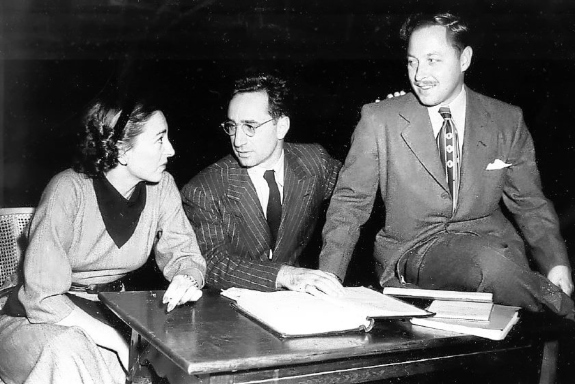 |
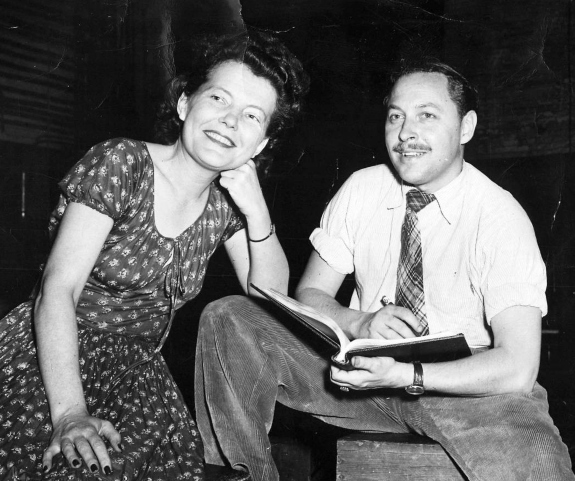
| Irene Selznick, Elia Kazan and Tennessee Williams pictured above, and Williams with his good friend Margo Jones below. |
Dear Irene:
Just had a talk over phone with Audrey. I am leaving early tomorrow morning for the Cape.
Audrey told me Gadge's terms and I must admit - though I have no idea what directors ordinarily receive - that these seem pretty stiff.
Irene, I don't think you have yet given sufficient consideration to the idea of direction by myself and Margo Jones. I know and appreciate your aversion to direction by a woman. However this would actually be direction by the author through a woman who is the only one who has a thorough interpretative understanding of his work. Also I think you must have observed how much direction is actually incorporated in the script itself. In writing a play I see each scene, in fact every movement and inflection, as vividly as if it were occurring right in front of me. However I could not direct by myself as I am insufficiently articulate. However with Margo I could. We have a sort of mental short-hand or Morse code, we are so used to each other and each other's work, and with Margo it would be a labor of love. Love cannot be discounted, even in a hardboiled profession, as one of the magic factors in success. I have a profound conviction that the two of us, working on this script, with you and Audrey and Liebling [Wood's husband and business partner] as a supporting team - could do something a little better with the play than any other single director, including Gadge. I felt that all along but pressed for Gadge because I felt at the outset that you were irrevocably prejudiced against another woman-director. Well, there is only one woman director and that's Margo. Regardless of what anyone says, I know she has the stuff - and her shortcomings are exactly what I am able to supply. With her I could also continue to function as a writer, during the rehearsals, but with any other - perhaps even Gadge - I don't think I would be able to achieve much more. I mean we have a way of stimulating each other.
Irene, this is not to be construed as pressure. I just thought - in view of the stiff terms offered by Kazan - that you should know that there is an alternative and it is in fact an alternative which I think is even preferable. Needless to say my direction would be gratuitous and Margo's terms would be negligible compared to the others.
I hope you will think about this. See you next week.
Love, Tennessee.
[Source: The Selected Letters of Tennessee Williams, Vol. 2: 1945-1957, edited by Albert J. Devlin and Nancy M. Tischler (2004)]
I wonder whether Selznick ever seriously considered Williams' proposal. At any rate, negotiations with Kazan resumed and a deal was eventually closed. Although not willing to share authority as producer, Selznick did compromise on the billing: "Irene M. Selznick presents Elia Kazan's Production of A Streetcar Named Desire." In addition she gave twenty percent of the show to Kazan while reducing her own share.
A Streetcar Named Desire opened on Broadway on 3 December 1947. It became a huge success and made an instant star of Marlon Brando. In 1951, Warner Bros. made a successful film adaptation of the play, again directed by Elia Kazan and with Brando, Karl Malden and Kim Hunter reprising their stage roles (Vivien Leigh replaced Jessica Tandy). Irene Selznick went on to produce several plays, including Bell, Book and Candle (1950) and The Chalk Garden (1955). I'm not sure if she ever worked with a female director again.
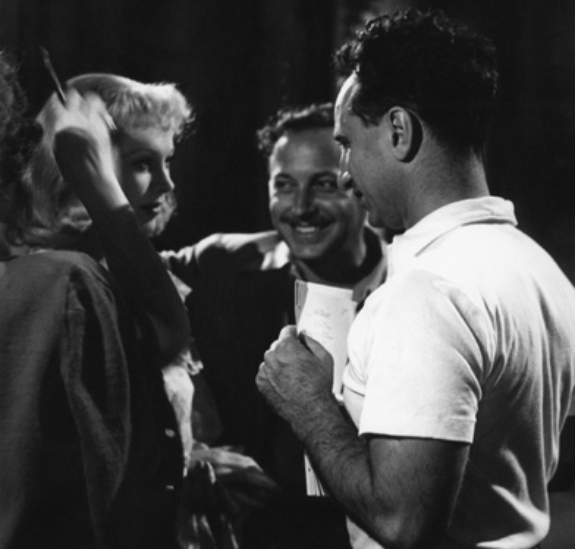 |
| Tennessee Williams and Elia Kazan with Vivien Leigh during production of the film adaptation of A Streetcar Named Desire. |


