Showing posts with label Barbara Stanwyck. Show all posts

5 June 2024

All three occasions cling to my memory as fun experiences

Barry Sullivan and Barbara Stanwyck made three films together. Their first picture was John Sturges' film noir Jeopardy (1953), followed by two westerns, Joseph Kane's The Maverick Queen (1956) and Samuel Fuller's Forty Guns (1957). Sullivan enjoyed making all three films with Barbara, even though as he says in the letter below to Ella Smith from March 1972 "only Jeopardy [stuck in his] mind as having any merit". In his letter, the actor talks about working with Barbara, while elaborately singing her praises and jokingly admitting to being "in love with the lady". Ella Smith was the author of the 1973 Starring Miss Barbara Stanwyck, and Sullivan's letter was his contribution to the bookAs can be seen in previous posts (here and here), other people had also sent letters to Smith about their collaborations with Barbara, each of them praising the actress for her character and professionalism.

Barry Sullivan and Barbara Stanwyck in Jeopardy
Source: eBay

Transcript:

10/3/72

Dear Ms Smith,

This note is probably too late for your deadline, but I do want you to know I am not really a rude SOB. Your letters re Barbara have just caught up. What circuitous route they traveled only God may know, but please understand I was not resisting a chance to expound on one of the more divine people I have known. (Allow me to throw down a few impressions for your personal edification and say good luck with the book)

Most of your replies to date, I am certain, have included glowing words about Missy's fantastic professionalism (and every word justified, by the way), but professionalism is nonsense if unaccompanied by heart.

Of the films I did with Miss Stanwyck only JEOPARDY sticks in my mind as having any merit, but all three occasions cling to my memory as fun experiences. This may seem a minor thing in discussing a fabulous artist, but, Dammit, in my book it looms very formidably. We start out in this business thinking of it as a glorious adventure and "fun", and all too often it seems like drudgery. You know you're not doing your best work when something is drudgery, right? When you work with the lady you know damn well it is fun and thus the glorious adventure you always dreamed about and you come up a couple of octaves.

All great artists have this one thing in common. Tracy had it, Bette Davis has it, George C. Scott has it, young Robert Foxworth has it -- They give it their very best shot regardless of the calibre of the material. And Barbara most certainly has it in large quantity.

We don't always get Arthur Miller or Lillian Hellman to perform. It is common knowledge that most of the material today borders on the mediocre. It would be easy, and perhaps forgiveable, if one were to sluff, or, as we say "walk through it" using only part of whatever God has given you. You'll never find Barbara doing that. I think maybe she might have worked harder when the writing was thin. She just damned well pulled it up to her level and everybody else in the cast could do no less.

I guess I am labeling her "inspirational", and she would laugh uproariously at that word. The ability to laugh, though, is perhaps what makes her so damn great. The set was always loose. No phony tensions that can distract from the job at hand. Young actors and actresses, perhaps on a first job and understandably somewhat nervous would lose the nervousness and begin to enjoy. I've seen her, too, with some of our senior performers who might be up tight (it happens at both ends of the spectrum, God help us). Her infinite patience, her joshing way, her generosity in blaming herself to reduce pressures when a scene would blow - all these things are marks of professionalism mayhap, but I rather feel they are the marks of one great human being.

This carried over to the technical people, too. She knew their problems always. Always their mechanical problems that beset all film making, and almost always their personal problems. If a director goofed because he had a hangover maybe, she was better than Bromo; If a prop man forgot something because the baby was sick at home, she was better than pediatrician; If a makeup man started applying the wrong color because he was preoccupied about a fight with his girl friend, she was better than Max Factor. What else can I tell you? One can go on ad infinitum. Bear in mind, however, that none of this was phony bleeding heart concern- it was and is all genuine.

If all this gush sounds like I'm in love with the lady, I plead guilty. My fondest hope is that I will walk on a set one day soon and and [sic] find her waiting. (as she will tell you, I am always late dammit). I know I will have one helluva good time and that's what it's all about, isn't it?

Sincerely
(signed) Barry Sullivan

Sullivan and Stanwyck in The Maverick Queen (above) and in Forty Guns (below). The Maverick Queen is, I think, by far their weakest film and Forty Guns their best.

29 December 2022

Fun with all the hard work

Coming to the end of 2022, here is a selection of random letters, written by a few of my fave actors and a fave director.

First up is a letter from Barbara Stanwyck to Miss Cunningham (a fan) about the making of Banjo on My Knee (1936). Barbara writes how she and her colleagues had enjoyed making the film. Banjo on My Knee is the first film in which Barbara sings on screen. While she wanted to be dubbed —"I have a deep husky voice without a high note in it", Barbara had warned beforehand— producer Darryl Zanuck insisted that she would do her own singing. (There's a lovely duet by Barbara and Tony Martin, to be watched here). Apart from Banjo, Barbara also sings in This is My Affair (1937) and Lady of Burlesque (1943) but her voice was dubbed in Ball of Fire (1941).

Via: Ebay

Transcript:

Jan 10/37

Dear Miss Cunningham —

Thanks for your nice letter. I'm glad you liked "Banjo" - we all liked making it - we just had fun with all the hard work.

The filming took thirty-one days, that's about average time with the exception of epics and they go on forever.

My hair is dark red - eyes blue- and there you have it.

I do appreciate your taking the time to write me and hope you will continue to like my work.

Thank you,
Barbara Stanwyck


Barbara Stanwyck in the door opening of her trailer during production of Banjo on My Knee.
_____


In October 1938, Norma Shearer wrote to her fans, Mr and Mrs Layton, about Marie Antoinette (her "most loved role"), while next touching on the subject of Cleopatra and her new film Idiot's Delight co-starring Clark Gable.

Via: vivelareine.tumblr.com


Above: Norma Shearer and Tyrone Power in a scene from Marie Antoinette (1938)directed by W. S. Van Dyke. Below: Norma with Clark Gable in Clarence Brown's Idiot's Delight (1939).
Next is another letter to a fan, this one is from Alfred Hitchcock to a Mr Parker, dated 21 April 1941. Hitch reacts to a suggestion from Mr Parker to have the audience solve the murder mystery. The film Before the Fact mentioned in the letter would be released under the name Suspicion (1941).

Source:  Worthpoint

On the set of Suspicion with the leads Cary Grant, Joan Fontaine and director Alfred Hitchcock.
_____


In March 1971, Doris Day wrote this lovely letter to friend and fellow actress Mary Wickes. The two women appeared together in four movies, i.e. On Moonlight Bay (1951), I'll See You in My Dreams (1951), By the Light of the Silvery Moon (1953) and It Happened to Jane (1959). Wickes also guest-starred on the first season of the tv series The Doris Day Show (1968).

Source: dorisday.net
A candid photo of Mary Wickes and Doris Day

Doris and Mary in By the Light of the Silvery Moon (1953)
_____

Cary Grant wrote the following note to fellow actor and friend Clifton Webb, signing it "Betsy and Cary". Betsy Drake, an actress and writer, was Grant's third wife and they were married from 1949 until 1962.

Source: Heritage Auctions

Transcript:

Monday- 29th 

Clifton —

It's so nice to know someone, in this seldom considerate, and usually selfish, world, who is kind courteous and undemanding. You have our affection, dear Clifton!

Betsy and Cary

Chrysanthemums are so impressive and colorful this time of the year that we thought we'd accompany this note with a few for your mother and you.
B and C.

Cary Grant and Betsy Drake in 1958
1935, Cary Grant and Clifton Webb and some friends/fellow actors, among them Claudette Colbert and Marlene Dietrich.
_____


The final letter for this post was written by Deborah Kerr to her friend Radie in May 1990. In it, Kerr talks about Greta Garbo and Garbo's last visit to Klosters (Switzerland), the Alpine village in which Kerr and her second husband, novelist/screenwriter Peter Viertel, had settled since they got married in 1960. Viertel's mother was Salka Viertel —an actress/screenwriter and a very close friend of Greta Garbo— who, in order to be near her family, had also moved to Klosters. Garbo was a regular visitor there and even after Salka's death in 1978 she kept visiting Klosters during the summer months, her last visit being in 1988. (Incidentally, the Viertels also had a house in Marbella (Spain) from where Kerr wrote her letter.)

Tea and Sympathy (1956) mentioned in Kerr's letter is a Vincente Minnelli film, in which Kerr co-starred with John Kerr. The film was based on the 1953 stage play of the same name, written by Robert Anderson. I assume Kerr is referring to Anderson when she talks about "Bob".

Source: Heritage Auctions
Deborah Kerr and Peter Viertel — the couple got married in 1960 and remained married until Kerr's death in 2007.
Deborah Kerr with co-star John Kerr from Tea and Sympathy and Robert Anderson (right) who wrote the original play.

HAPPY 2023, EVERYONE!!

20 October 2022

I can’t think of anyone who could do it as you could

Author Ayn Rand immigrated from her native Russia to the United States in 1926 and had her first big success with the novel The Fountainhead (1943). After selling the film rights to her book to Warner Bros. in 1943, Rand was hired by producer Hal Wallis to work as a screenwriter and script doctor (her work includes Love Letters (1945) and You Came Along (1945)). Adapting her own novel, Rand also wrote the screenplay for The Fountainhead, which was finally made into a film in 1949.

Barbara Stanwyck was an avid fan of Ayn Rand and desperately wanted to play the role of Dominique Francon, the female protagonist of The Fountainhead. For that purpose she had urged Jack Warner to purchase the film rights for her. As said, Warner bought the rights, but production got delayed and in the end Warner chose a different leading lady for the film. Patricia Neal got cast instead of Barbara, much to Barbara's dismay (read more in this post). 

While Barbara never got to play Dominique Francon, in a 1946 letter (seen below) she was approached by Rand to play one of Rand's other characters, the female protagonist in Red Pawn. Red Pawn was Rand's very first screenplay, which she sold to Universal in 1932; Paramount later bought it from Universal, reportedly as a vehicle for Marlene Dietrich. The script deals with the evils of dictatorship, in particular of Soviet Russia. The role Rand offered Barbara was that of an American woman, Joan Harding, who infiltrates a prison for political prisoners in order to free her Russian husband. Due to the anti-Soviet theme of the script, the filming of Red Pawn was postponed by Universal several times. In the end, Barbara rejected Rand's offer by telegram, simply stating that she and her manager found it not "the right kind of story". Red Pawn was never made into a film and was ultimately shelved.

Above: Barbara Stanwyck and Ayn Rand who eventually became friends. Below: Rand on the set of The Fountainhead, flanked by the leads, Gary Cooper and Patricia Neal. 

September 7, 1946 

Dear Barbara: 

Now that I have a better idea of the kind of story and characterization you like, it occurred to me that I should show you Red Pawn, a synopsis of which is attached. 

This is an original by me, the first story I ever sold. Paramount owns it, but has never produced it. 

I would like you to read it, keeping in mind that if it were to be made now, I would suggest changing the locale and having the story take place in an unnamed dictatorship, rather than in Soviet Russia. It would give the story deeper significance. 

I called this story to Mr. Wallis’ attention, when I first started to work for him. He read it and liked it, but hesitated for a long time over the question of the locale, saying that he did not like to have a story in an unnamed background. I don’t agree with him on that. He did admit that the story has the same dramatic pattern and the same basic situation as Casablanca (I wrote it long before that), but he could not quite make up his mind to do it, so I let it go and have not discussed it with him since. 

As far as I am concerned, since Paramount owns the story, I would not get any kind of extra payment for it — so this is not an attempt to sell you an original of mine for any reason except that I love this story. I think it is still the best film story I ever wrote, and I would rather work on it than on anything I know. 

The starring role is an acting part of the kind which a writer can succeed in devising very rarely; I know it, because I’ve tried since. She is the only woman in the story—and a kind of advance echo of Dominique. After seeing [The Strange Love of] Martha Ivers, I can’t think of anyone who could do it as you could. 

Since you said that what you were anxious to find was a love story, a story about positive characters, and a story that had a quality of prestige — I could not help sending you this one. It is all three. 

If you like it, I think we can persuade Mr. Wallis to make it; and I would be one of the happiest authors in Hollywood. But if you don’t, I shall do my best with Be Still, My Love, as we discussed it. 

I will telephone you Monday morning to learn your reaction before I make an appointment to see Mr. Wallis. If the time is not convenient to you, would you leave a message as to what time I may reach you, and I will call then.  

[Source: Letters of Ayn Rand (1997)— via archive.org]

 
The 1957 novel Atlas Shrugged is Ayn Rand's best-known work, her magnum opus, and in the fall of 1957 Rand again approached Barbara Stanwyck to see if she would be interested to play the novel's heroine: "As you see, I don't forget, even if Warner Brothers do. I will be very interested to hear your reaction to Atlas Shrugged. ...  Before I make any decision in regard to the movie rights of this novel, I would like to know whether you feel about Dagny Taggart as you did about Dominique Francon". Barbara replied a few days later, saying that she loved the book and even "lost a week’s sleep" over it. Nevertheless she declined, thinking that Hollywood would probably want somebody "young, beautiful, and all the rest that goes with it." Rand was working on a screenplay of Atlas Shrugged when she died in 1982, with only one-third of the script completed. 

11 August 2022

She walked through the film without trying to give herself

Lauded for her consumate professionalism, Barbara Stanwyck was an actress whom directors, fellow actors and crew members loved to work with. When Ella Smith was preparing her 1973 biography Starring Miss Barbara Stanwyck, she received many letters from those who had worked with Barbara, all having nothing but praise for her (read some of those letters here). However, director William Dieterle, who collaborated with Barbara on The Secret Bride (1934), was not as enthusiastic about her as others were. Below you'll find his letter to Ella Smith in which he talks about Barbara and The Secret Bride (mentioned here under its working title Concealment). 

At the time of The Secret Bride, Barbara had a non-exclusive contract with Warner Bros that she wanted to get out of. However, as much as she hated the film's script, according to Victoria Wilson's A Life of Barbara Stanwyck: Steel-True 1907-1940 (2013) Barbara couldn't afford to be suspended. She accepted the roleneeding the income to support her husband Frank Fay and their adopted son Dion and to pay for the staff, the house, the cars et cetera. For The Secret Bride Barbara was paid $50,000.

Barbara Stanwyck and Warren William in The Secret Bride. Barbara plays the daughter of a governor, having to keep her marriage to the attorney general (William) a secret after her father is accused of taking a bribe. 


Transcript:

8012 Riemerling- Munich. Geranienstr. 29

3.7.72

Dear Miss Smith:

Your letter of Feb.3.72, was forwarded to me and I will try to answer your questions, as good as I can. The work on the film "Concealment" was not very pleasant. The script was bad. I could not refuse it, for contractual reasons. Why Miss Stanwyck not rejected the script, as Betty Davis would have done, I can only guess. She was not happy at Warners and wanted to get out of her contract as quick as possible. But still, bad as the script was, instead to work hard and show that she can make even out of such poor material something interesting, she walked through the film without trying to give herself. Of all the films I directed, "Concealment" is the picture I don't like to think about anymore.

I am sorry to give you no better news.

Wishing you good luck for your work- I remain

Yours cordially

signed "William Dieterle"

[Via: Ebay]

_____


Incidentally, Victoria Wilson mentions an incident in her book that involved Barbara and Dieterle while filming The Secret Bride. Barbara's stand-in Katie Doyle, of whom the actress was very fond, had accidently walked through a scrim which the crew had just spent an hour repairing. Dieterle was furious with Doyle and began reprimanding and scolding her. Barbara then walked up to the director and said: "Don't you ever dare talk to anybody on any set that I am on, don't you ever dare talk to anybody like that again. The next time you do, I walk. I go right up to the office and I will not finish the picture under your direction.

William Dieterle was a German-born director who fled Germany for the USA in 1930 due to the political situation in his country. His films include The Life of Emile Zola (1937), The Hunchback of Notre Dame (1939), I'll Be Seeing You (1945) and Portrait of Jennie (1948). Dieterle always wore gloves on the set, presumably because of a germ or dirt phobia.

13 April 2021

Barbara Stanwyck dressed by Edith Head

For more than five decades famed costume designer Edith Head had dressed Hollywood's biggest stars. One of the stars whom Head most enjoyed working with was Barbara Stanwyck, who also became a good friend. "She possessed what some designers considered to be a figure "problem" – a long waist and a comparatively low rear end", said Head. "By widening the waistbands on the front in her gowns and narrowing them slightly in the back, I could still put her in straight skirts, something other designers were afraid to do, because they thought she might look too heavy in the seat. Since she wasn’t the least bit heavy, I just took advantage of her long waist to create an optical illusion."

Head's costume designs for Preston Sturges' The Lady Eve (1941) proved career changing for Barbara. Playing two very different types —con artist Jean Harrington and British aristocrat Lady Eve Sidwich— Barbara had twenty-five costume changes, which made The Lady Eve her first "fashion picture" and also changed her image from "plain Jane" to sexy. From then on, regardless of what studio she was working for, Barbara included in all her contracts that only Head was to design her clothes. This meant that in most cases Head had to be borrowed from Paramount Pictures, her studio for 44 years. (Barbara never had a long-term contract with one studio and worked mostly freelance.)

Barbara in her dual role in The Lady Eve dressed in Edith Head's fabulous gowns: above as the posh Lady Eve and below as the con woman Jean Harrington.

In the early 1940s, Barbara signed a non-exclusive contract with Warner Bros. and Head made the costume designs for such films as The Gay Sisters (1942), Christmas in Connecticut (1945), My Reputation (1946) and The Two Mrs. Carrolls (1947). Below is an agreement between Barbara and Warners regarding the costs of Head's services in connection with My Reputation. Apparently Barbara first had to pay the costs herself —after the bills had been sent to her by Paramount— and would then later be reimbursed by Warners. Incidentally, the agreement is dated 26 October 1943; while My Reputation was filmed from November 1943 to January 1944, it wasn't released until 1946.

Source: icollector.com

20 March 2021

She is fearless and has more guts than most men

Joel McCrea and Barbara Stanwyck made a total of six films together and became friends during the making of their first film Gambling Lady (1934). Their other five films are Banjo On My Knee (1936), Internes Can't Take Money (1937), Union Pacific (1939), The Great Man's Lady (1942) and Trooper Hook (1957). Right from the start McCrea was impressed by Barbara's work ethic. During production of their first film, Barbara had given McCrea a lesson in professionalism after he didn't show up for the stills shoot of the cast. When she asked him where he was and he indifferently said they didn't need him, she reportedly told him off: "I was in burlesque. We used to have to change our clothes on the train, and our makeup, and we couldn’t take a bath and we lived out of a suitcase. You’ve grown up in California where you go to the beach on your days off and ride the waves, and you’re a happy Southern Californian kid. Just get off your big fat ass and get to work."

Regarding the films in which he had starred with Stanwyck, McCrea was once asked to fill in a questionnaire, which is seen below. The questionnaire is undated and I don't know who composed it or for what purpose. At any rate, it told me a few things I didn't know, like the crucial role McCrea had played in Barbara's casting in Stella Dallas (1937). McCrea's opinion of working with Barbara, however, came as no surprise. Like many of his co-workers, he thought she was simply the greatest, the best he had ever worked with. By contrast, McCrea was quite modest about his own achievements: "All I had to do was try and stay aboard".


Transcript of Joel McCrea's answers:

From Joel McCrea, Rt #1, Camarillo, Calif.—93010-1

GAMBLING LADY

1. She was unhappy & they were not treating her like the important star she was.

2. Mayo was great fun to work with. He kidded a lot and you were relaxed & happy working with him. I was inexperienced in 1934. He helped me a lot. Stanwyck was always great- as a person & actress.

3.—


BANJO ON MY KNEE

1. Zanuck wrote a disparaging letter to Barbara showing his ego & stupidity —Walter Brennan stole the picture.

[As is apparent from his answer, McCrea didn't like producer Darryl Zanuck. He thought Zanuck was "an egotistical little bastard; a gutty little guy and a chaser, but smart."]


INTERNES CAN'T TAKE MONEY

1. All I can remember is that Stanwyck & Lloyd Nolan were good & I was trying.

2. Barbara might know. I don't.


STELLA DALLAS

1. King Vidor, the director, wanted Stanwyck from the start but [Samuel] Goldwyn wanted to test 3 or 4 other good actresses to be sure. Barbara didn't want to test and I got Vidor to promise to hold out for her if she made the test. He agreed. Then I talked her into taking the test. She was far and away the best but she shouldn't have had to test, anymore than you would test [Clark] Gable for a part. There is no better actress than Stanwyck if she is cast correctly. Goldwyn was a peculiar man but he made fine pictures. Stanwyck should have gotten an award for Stella Dallas.

2. No, "Banjo on my knee"


UNION PACIFIC

1. No. Four months- in all of it.

2. Good conditions.

3. Yes, De Mille was great with process. Witness Ten Comandments [sic].

4. No, he did it all with us. 2nd Unit director was Mr. Rosson.

5. In everything - she is fearless & has more guts than most men.

6. Stanwyck was there with De Mille. I was working in a picture with Jascha Heifetz [They Shall Have Music (1939)] and had to talk via telephone.


THE GREAT MAN'S LADY

1. She can tell you.

2. Don't know

3. Wild as ever, but good.

a. [play it for him as] we [thought it should be done]
Stanwyck should have gotten an award for this film, if ever any one deserved it.
b. —
c. yes
d. no
e. all three
f. yes

4. She would know.

5. She did.

6. She was great. All I had to do was try and stay aboard. 

7. Paramount 2 months

8. Wellman can tell you

9. She was touched- cried- delightful, delightful


TROOPER HOOK

1. As always, she was a pro. I could ride the horse well & we talked constantly of Bob Taylor whom we both admired a great deal.

[Barbara and Robert Taylor were married from 1939 to 1951.]

Only the greatest.
No reservations- best I ever met.

Every crew we ever worked with loved and admired her and so did I. She taught me a lot & I shall be ever grateful to her.

Joel McCrea

Clockwise from top row left: Gambling Lady, Banjo on my Knee, Internes Can't Take Money, Trooper Hook, The Great Man's Lady and Union Pacific.
Barbara Stanwyck in the heartwrenching finale of Stella Dallas, her performance earning her an Oscar nomination. The film became a huge hit.

7 February 2020

R.I.P. Kirk Douglas (1916-2020)

Two days ago, Kirk Douglas passed away at the age of 103. While he was never a personal favourite of mine, Douglas was certainly one of Hollywood's most charismatic and accomplished actors, boasting a career spanning several decades. His films include classic gems like Out of the Past (1947), Champion (1949), Ace in the Hole (1951), The Bad and the Beautiful (1952), Paths of Glory (1957) and Spartacus (1960).

Like many other actors, Douglas had started his acting career on Broadway. During WWII he paused his career for three years to join the U.S. Navy and after the war returned to Broadway. At the recommendation of Lauren Bacall (a friend and former classmate of Douglas at the American Academy of Dramatic Arts) producer Hal Wallis went to see one of the plays in which Douglas was performing. Wallis immediately recognised the actor's talent, giving him his first film role in The Strange Love of Martha Ivers (1946) opposite veteran Barbara Stanwyck. Wallis later said: "I knew I was taking a risk putting a newcomer against that powerhouse Stanwyck, but she was extraordinarily considerate and played unselfishly with him in every scene."


Douglas had different memories of his first and only collaboration with Barbara, saying in his autobiography The Ragman's Son (1988): "The crew adored her. They called her 'Missy,' and when she came on the set she went around hugging them, asking about their wives and children by name. But she was indifferent to me. Crew members need attention, but who needs help more than somebody working on his first picture? Several weeks later she noticed me. I could see it happening, like the lens of a camera turning into focus. She looked at me, made eye contact for the first time. She said, 'Hey, you're pretty good.' I said, 'Too late, Miss Stanwyck.' I don't think she knew what I meant. But after that, we became friends."

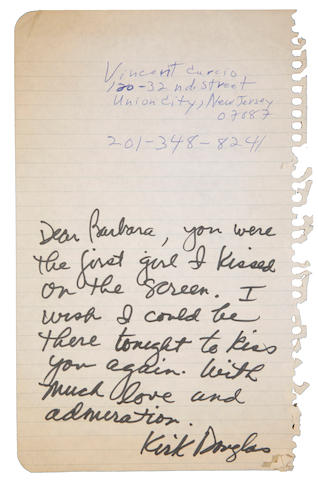
Here is a cute little note from Kirk to Barbara, who was his first on-screen love. According to Bonhams (the auction house that sold the note) it was likely sent before Barbara's 1981 Tribute at Lincoln Center or her 1987 AFI Salute.


Source: Bonhams

Transcript:

Dear Barbara, you were the first girl I kissed on the screen. I wish I could be there tonight to kiss you again. With much love and admiration.
Kirk Douglas

Kirk and Barbara in a scene from The Strange Love of Martha Ivers (above) and during a coffee break on the set (below).

2 February 2020

Missy and The President

Barbara Stanwyck and Ronald Reagan made one film together, the (only mildly interesting) western Cattle Queen of Montana (1954). In a letter to Ella Smith dated 16 May 1972, Reagan (then governor of California) talks about the film and how it was to work with a "pro" like Barbara. (More letters to Ella Smith, author of the biography Starring Miss Barbara Stanwyck, regarding Barbara's consummate professionalism can be found here).

Apart from Reagan's letter to Smith, also seen below is a correspondence between Barbara and "Ronnie" from 1981 following Barbara's tribute at the Film Society at Lincoln Center, their respective letters again referring to Cattle Queen. The letter from Barbara looks like a draft, not the actual letter she sent to the President.

Incidentally, Barbara also knew Nancy Reagan (then Davis) from when the latter was still an actress; the two women played together in East Side, West Side (1949).

Source: icollector.com

Transcript:

May 16, 1972

Miss Ella Smith
Assistant Professor
Department of Dramatic Arts
The University of Connecticut
Storrs, Connecticut 06268

Dear Miss Smith:

"Cattle Queen of Montana" was the only picture I ever made with Barbara Stanwyck, although I have known her for many years. She is one of the best thought of and most respected performers in all the industry.

Working with her I discovered why. She is a pro. Her only intolerance is of those who won't take our profession seriously, and who come to work without their lines learned or who are late and careless in their work. She is ready every day exactly on time, her lines learned perfectly for each day's shooting, prepared to undergo whatever has to be done to make the scene better for the audience who will eventually see the movie.

In "Cattle Queen", for example, there is a scene where she is bathing in a mountain lake. The director was prepared to shoot this with a double because the temperature of the water was in the mid-forties. Naturally, the scene would not be as good if the camera had had to play far enough away for use of a double. She insisted on doing the scene herself. She is most helpful to other performers, sacrificing many times some personal advantage in the scene and throwing the scene to another when she thinks it will benefit the overall story.

You asked about the S.A.G. award. Nothing illustrates more her personality and attitude. Those who know her were concerned that if she suspected she was getting an award she wouldn't be there, so they invited her to come down and present the award to me. She was standing off-stage, fully expecting to come out and make the presentation of the first such award to me, when she heard me making the presentation to her.

Thanks for letting me comment about this very wonderful gal in our business.

Sincerely,
"signed"
RONALD REAGAN
Governor

Source: Bonhams

Transcript:

Dear Mr President

Thank you so much for the lovely message you sent me to the Film Society at Lincoln Center. I deeply appreciate your taking the time to do this and I must tell you it surprised and delighted the audience. 
My prayers and best wishes for you in your difficult job.
Gratefully
Barbara 

P.S. Ronnie - If I had known during the filming of "Cattle Queen" that you were going to be President of our country I would have given you first billing!!
Love to you and Nancy,
Missy

Source: icollector.com

Transcript:

Aug 2nd

Dear Barbara

I'm very late in responding to your nice letter of June 17 and I'm sorry. Let me say however it isn't all my fault. It sometimes is quite a spell before mail gets through the bureaucratic maze and lands on my desk.

Nancy and I were happy to hear from you and wish we could have been at Lincoln Center. Nancy sends her love as do I and we were both delighted that you were honored. You deserve it. 

Incidentally I appreciate your willingness to give me top billing in the picture but it might have set me back - RR as .......?

Anyway thanks and from both of us, warmest regards.

Sincerely 
Ron

Above: Barbara Stanwyck flanked by fellow Republicans Ronald Reagan and Charlton Heston in the 1960s. Below: Reagan and wife Nancy photographed aboard a boat in California in 1964; the couple was married from 1952 until Ronald Reagan's death in 2004.