Showing posts with label John Wayne. Show all posts

2 June 2022

Dear Mr. Wayne

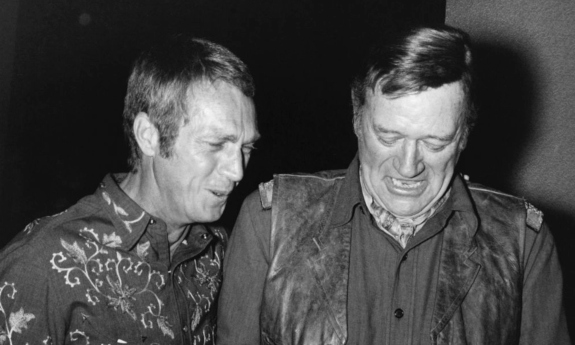
When John Wayne received a letter from ten-year-old Ross Brook who wrote how much he had liked Wayne's performance in the 1968 box-office hit Bullitt, the actor was undoubtedly amused by the boy's mistake. Of course, it wasn't Wayne who had starred in the film but Steve McQueen, Bullitt being one of McQueen's best-known films. Asked by Ross for an autographed picture, Wayne forwarded Ross' note to McQueen, accompanying it with a note of his own. 


Transcript:

Dear Mr. Wanye [sic] 
I love the movie Bulit [sic] and I thought your acting was great. I would like to know if I could have a autographed picture of you. I would like to see you some day.

Sincerely 
Ross Brook
age 10
55 Oak St
Los Altos Ca.
94022

_____


9570 Wilshire Blvd., Suite 400
Beverly Hills, California 90212
September 23, 1977

Mr. Steve McQueen
8899 Beverly Blvd., Suite 501
Los Angeles, California 90048

Dear Steve:
Would you please send him a picture of me from "Bullitt." 
I will be forever grateful.

Sincerely
(signed) Duke


Steve McQueen and John Wayne at an event in Los Angeles in 1969

22 February 2020

The Conqueror: I am positive this can be a very important, powerful picture

The Conqueror (1956) was John Wayne's final picture for RKO as part of a three-picture deal Wayne had signed with the studio. Directed by Dick Powell, it tells the story of Mongol leader Temujin (later known as Genghis Khan) who falls for Tartar princess Bortai and abducts her, causing a war between the Mongols and the Tartars. The film is generally regarded as one of the worst films of all time and also contains one of the worst miscastings in film history.

John Wayne stars as Genghis Khan, which is as bad and ridiculous as it sounds. Apart from looking utterly silly with his black wig and Fu Manchu moustache, Wayne plays the Asian warlord with his characteristic drawl as if Khan were an American cowboy. The stilted dialogue written by Oscar Millard doesn't help Wayne's performance (or anyone else's in the cast) either. Wayne delivers lines like "I feel this Tartar woman is for me. My blood says take her" and "I shall keep you
, Bortai. I shall keep you unresponding to my passion. Your hatred will kindle into love... ", while Susan Hayward, who is also wasted in her role as the Tartar princess, says things like: "Before that day dawns, Mongol, the vultures will feast on your heart!" It's all very laughable and makes you wonder why Wayne and Hayward, both at the height of their careers, had agreed to do the film at all.

John Wayne as Temujin "Genghis Khan" (below pictured with Susan Hayward) -- what was he thinking?!
I'm not sure about Hayward but Wayne, believe it or not, had really wanted to make The Conqueror. Having waited a long time for a suitable project to complete his three-picture contract with RKO, Wayne was immediately enthusiastic about The Conqueror after Dick Powell had asked him to read the scriptIn a letter to Howard Hughes written in April 1954 -- at the time Hughes was head of RKO -- Wayne shows his excitement about the script while being less enthused about other projects suggested to him, like The Silver Horde (meant as a sequel to The Spoilers (1942)) and The Long Wire which was also to be directed by Powell (both projects were abandoned).

Seen below is a small excerpt from Wayne's 4-page letter to Hughes, i.e. the part that deals with The Conqueror, in which Wayne says he has a good feeling about the project, comparing it to other films he did such as Stagecoach (1939) and The Quiet Man (1952). Wayne would later admit the film was a big mistake and regretted playing Genghis Khan for the rest of his life. He reportedly said that the moral of the film was "not to make an ass of yourself trying to play parts you're not suited for."

Now I come to the pleasant part. Last week Dick Powell asked me to read a script called "The Conqueror". As I read it I kept telephoning Dick of my honest enthusiasm. If my quarter of a century of experience in this business means anything, I am positive this can be a very important, powerful picture. This is the first script (and it is only a first draft) I have read from your studio that really excites me. I have the honest feelings for this that I had when I approached pictures like "Stagecoach", "Red River", "The Quiet Man" and "Hondo".   
Howard Hughes
Last Thursday I telephoned Dick in the presence of my agent and urged him to contact you right away in order to convey my thoughts about "The Conqueror", and to ask you to give him the green light on it. At best we're another three months from the completion of this assignment. I'm quite sure I can convince Dick - and you, if you wish - that the cost of this picture would be no more than "The Long Wire", and the possible profits and showmanship are four to one in favor of "The Conqueror". 
(Source: Heritage Auctions)

While The Conqueror did relatively well at the box-office, it failed to earn back its $6 million investment. The film was a critical flop and, as said, is now considered one of the worst films ever made. It is listed in The Official Razzie Movie Guide as being one of 'The 100 Most Enjoyably Bad Movies Ever Made', mainly thanks to the bizarre casting of John Wayne and the unintentionally funny dialogue. To this I must add that the film is not all bad, it still has a few redeeming features, i.e. the music score by Victor Young as well as the cinematography by Joseph LaShelle, Leo Tover, Harry J. Wild and William Snyder.


A concluding note: The Conqueror is now probably best remembered for the many cancer cases among its cast and crew members, often attributed to nuclear tests that had been executed at 137 miles (220 km) from the film location (the Utah desert) in 1953. During the production of the film, the cast and crew were exposed to radioactive fallout, even though the site had been deemed safe. By 1980, 91 of the 220 cast and crew members had some form of cancer and 46 had already died of it, including John Wayne, Susan Hayward, Agnes Moorehead and Dick Powell. While it was never proven that the nuclear fallout had indeed caused the cancer cases, Howard Hughes reportedly felt so guilty about the whole affair that he spent $12 million buying every existing copy of the film. The film was taken out of circulation and wasn't even shown on television until Universal purchased the film rights in 1979.

This post is my contribution to THE SECOND SO BAD IT'S GOOD BLOGATHON, hosted by TAKING UP ROOM. Click here, here and here for all the other entries!

Above and below: Dick Powell with his two stars. The Conqueror was the second film Powell directed following the 1953 film noir Split Second.


13 July 2017

I have been stupidly loyal

In the early 1950s, John Wayne made the worst decision of his film career. He decided to play the role of the Mongol warlord Genghis Khan in Howard Hughes' production The Conqueror (1956)a decision he would sorely regret. Wayne's casting as Khan is generally considered one of the worst miscastings ever --Wayne later agreed that he had been terribly miscast-- and the film itself also ranks as one of the worst films of all time.

Nevertheless, The Conqueror was a film Wayne had wanted to make and producer Howard Hughes had been willing to give him whatever he wanted. (At the time, Wayne was at the peak of his career and still had to make one more film as part of a three-picture deal with Hughes' studio RKO.) In mid-May 1954, filming on The Conqueror began and ended in early August. Production was not without problems and eventually cost RKO 6 million dollars, making The Conqueror the studio's most expensive production. Despite the huge investment, the film eventually became both a commercial and critical flop.

On 29 April 1954a disgruntled John Wayne wrote the following letter to Howard Hughes. Apparently Wayne had been waiting for two and half years to do his last film for RKO and he complains about the money he lost for holding himself available and how he had turned down "four very top pictures". Wayne also mentions his friendship with Hughes, feeling that he had been taken advantage of ("I have been stupidly loyal"). Production on The Conqueror finally began a few weeks after Wayne had written his letter to Hughes. As said, the film turned out to be a big disaster and Wayne would regret playing Genghis Khan for the rest of his life. (Wayne reportedly said that the moral of the film was "not to make an ass of yourself trying to play parts you're not suited for.")

source
Transcript:

1022 Palm Avenue
Hollywood 46, Calif.
April 29, 1954

Mr. Howard Hughes
Hughes Tool Company
7000 Romaine
Hollywood 38, Calif.

Dear Howard:

There seems to be no way of getting to you in time of stress except by letter. Knowingly, carelessly, or unintentionally --let's call it the latter-- you have caused me a huge financial loss and a great loss of prestige at a point in my life and in my career when I can afford neither.

"The Conqueror", if you will remember, was to start on April 1st, and a final plug was pulled when I now learn that it is not going to start until May 17th. Do you realize that this assignment has been hanging over my head since January 1952 -two and a half years?  I have kept my word to the very letter and held myself free and available for RKO to do one picture, pursuant to the studio' s request and your personal request, in the following manner:

In 1952, from January until May; in 1953 from July until the time of my divorce, which was October 19th; and this year from January 4th until the finish of the picture, which cannot possibly be completed before July 21st, and it is not probable that it will be finished then, due to the history of your production procedure at RKO.  The time lost on "Jet Pilot" is not being referred to in this letter.

Taking into consideration my average earnings over the last four years, you have cost me $250,000 in 1952, $250,000 in 1953, and $500,000 in 1954. This adds up to $1,000,000 in cash lost to me, without figuring the equities in percentages of the gross from four very top pictures I was obliged to reject while I was keeping my faith with you. And without figuring what it means to a star in my position to lose four top pictures; plus the fact that being off the screen at this time hurts my career and popularity and future earnings. I don't suppose an honest man can put any real premium on his word, but the fact remains this is a terribly severe loss to me at this crucial time of my life.

As you can see by these cold facts, I have never taken advantage of any friendship between us. As a matter of fact, I have been stupidly loyal. I hate to refer to this, but you made a statement to me that I was one of the few friends you had in the motion picture business. I feel that I have been tremendously imposed upon.

The above are facts that Mr. Tevlin can readily verify. If you had taken the trouble to read my letter of February 3rd, which resulted in a meeting about the middle of February, you would have a better understanding of my problems. In that meeting you cut through issues that were vital to me in a manner only you are capable of doing, and reached a surface conclusion without the slightest understanding of all the facts.

It's true, I admit, that you did one thing: you listened to me and changed the picture from "The Long Wire" to "The Conqueror". I don't want you to say that this was done merely for my good-- it was more for your good.

Therefore, realizing that your mind is obviously on more important matters than the production of motion pictures, I would like to suggest that, in order to avoid a lot of exploded tempers, you authorize Mr. Tevlin to sit down with Mr. Marin and myself, immediately and prior to the tests scheduled for Tuesday of next week, and discuss a re-adjustment of my financial return from this picture. $100,000 does not even start to make the necessary adjustment. 

Sincerely,

John Wayne

Images of the letter via icollector.


Notes
-Apart from being a cinematic and financial disaster, The Conqueror was also a disaster in a different, more horrific way. A year before production started, tests with nuclear weapons had been executed at 137 miles (220 km) from the film location (the Utah desert). During the whole production which lasted almost three months, the cast and film crew were exposed to radioactive fallout, even though the site had been deemed safe. By 1980, 91 of the 220 cast and crew members had some form of cancer and 46 had already died of it, including John Wayne, Susan Hayward, Agnes Moorehead and director Dick Powell. Although it was never conclusively proven that the nuclear tests were the cause of the cancer cases, an expert stated in 1980 that in a group of 220 you would expect only 30-some people to get cancer. Nevertheless, John Wayne always believed that his lung cancer had been caused by his smoking habit and not the nuclear fallout.

-Jet Pilot, another Howard Hughes' production mentioned in Wayne's letter, was filmed between December 1949 and February 1950. It wasn't released, however, until 1957. By that time, Hughes had already sold RKO, and the film was released by Universal-International. 

Leading lady Susan Hayward and John Wayne still having something to laugh about on the set of The Conqueror.

30 July 2015

John Wayne's personal favs

In 1977, 'The People's Almanac' sent out letters to all living Academy Award winning actors concerning a poll it was holding. For this poll the actors were asked to name their all-time favourite actors and films. One of the actors to receive such a letter was John Wayne, who had won the Academy Award for his leading role in True Grit (1969). Shown below are part of The People's Almanac's letter as well as John Wayne's lists of personal favourites. Amongst his favourite films were two John Ford pictures in which Wayne himself had played the lead roles (The Searchers and The Quiet Man), and The Four Horsemen of the Apocalypse, i.e. the 1921 silent version by Rex Ingram, not the 1962 remake by Vincente Minnelli.

Image courtesy of Heritage Auctions.

Transcript:

MY CHOICE OF THE 5 BEST MOTION PICTURE ACTORS OF ALL TIME:

1. Spencer Tracy
2. Elizabeth Taylor
3. Kathrine [sic] Hepburn
4. Laurence Olivier
5. Lionel Barrymore

Signed: John Wayne

Image courtesy of Heritage Auctions.

Transcript:

MY CHOICE OF THE 5 BEST MOTION PICTURES OF ALL TIME:

1. A Man For All Seasons
2. Gone with the Wind
3. The Four Horsemen of the Apocalypse
4. The Searchers
5. The Quiet Man

Signed: John Wayne

27 May 2015

Dear Pappy

One of the most legendary actor-director collaborations in Hollywood history is the collaboration between John Wayne and John Ford. The two men, who also enjoyed a longtime friendship, made 14 movies together, most of them westerns. Amongst their best known movies are Stagecoach (1936), The Quiet Man (1952), The Man Who Shot Liberty Valance (1962), and of course The Searchers (1956), often considered the pinnacle of their collaboration and one of the best westerns ever made.

The letter for this post (of which a file copy is shown below) was written by John Wayne to John Ford in November 1955. Wayne had just attended a screening of The Searchers (which they had completed earlier that summer) and apart from having doubts about the music he loved the film and thanked Ford for making it. The letter also mentions Wayne's problems with Robert Fellows with whom he had started a production company in 1952, Wayne-Fellows Productions; Wayne eventually bought Fellows out and renamed the company Batjac. Also, Wayne told Ford that he wanted to do the Wead picture with him for MGM (about the life of aviator-turned-screenwriter Frank "Spig" Wead) instead of making lucrative deals with Warners or RKO ("It's more important for me to be in a picture with you, career-wise -for my health- and for my mental relief"); the picture was eventually made as The Wings of Eagles (1957), also starring Maureen O'Hara and Ward Bond.

Incidentally, Wayne mentions a number of people in his letter: Bob Morrison was a producer and Wayne's younger brother; Andrew McLaglen was a director; Daniel O'Shea an executive at RKO; Charles Feldman Wayne's agent, and Arthur Loew, Benny Thau and Dore Schary were all MGM executives.

Image courtesy of heritage auctions

Transcript:

sent airmail to: Mr. John Ford, Yacht "Araner", Ala Wai Harbor, Honolulu, T.H.

1022 Palm Avenue
Hollywood 46, Calif.
Nov. 28, 1955

Dear Pappy,

First: I think "The Searchers" is just plain wonderful.

I wanted to tell you the other night, or at least before you got away to Honolulu, what I've decided to do. Here goes.

I built Bob Fellows into such an important character that I can't do anything with him. I find him incompetent, even when he's trying. I've encouraged Bob Morrison and Andy McLaglen and moved them up faster than I should have. I'm afraid that if I just fired Fellows and moved someone else in, number one, I'd wreck Fellows' career (what career?) - and I might just have as many headaches with someone else. So I'm going to fold the company up. I can make a hell of a deal at Warners, and an unbelievable one at RKO with Danny O'Shea, but if I make either one of these deals I couldn't do the Wead story, so to hell with it. It's more important for me to be in a picture with you, career-wise- for my health- and for my mental relief.

So I'm going to let Charlie Feldman talk to Loew, who is the guy behind the guns at MGM now , to set the deal, and if you hear I haven't talked to Schary or Thau, don't think that I'm ducking the picture-- it's just that Feldman can make a better deal with Loew.

Back to "The Searchers"- I don't think the music is great, but I think it's all right. At first I had hoped it would be a little nostalgic, but the whole treatment is so different than the usual western, that I think this music is probably more appropriate. It's just a wonderful picture. You got great performances out of everyone, and it has a raw brutalness without any pettiness or meanness. 

All I can say is- Thanks again, Coach.

Your everloving,

John Wayne as the vengeful Civil War veteran Ethan Edwards in "The Searchers", one of his best performances (above) -- and (below) tea and cookies on the set with John Wayne, John Ford and visitor Dolores Del Rio.

5 May 2015

What took you so long

Here is an exchange of two short messages between John Wayne and Ray Milland. Wayne replies in a funny way to a congratulatory telegram Milland and his wife Muriel had sent him. It doesn't say what he was congratulated for, but my guess is that it was for winning the Oscar for Best Actor for his role in True Grit (1969). It was the only Oscar of Wayne's career-- a long-overdue prize handed to him at the Oscar Ceremony in April 1970. Ray Milland also received only one Oscar in his career, but as early as 1946 for his lead performance as an alcoholic in The Lost Weekend; the note from Wayne (of which a file copy is shown below) is a reference to that. Incidentally, Wayne and Milland made one movie together, Reap the Wild Wind (1942), and the Millands signed the telegram with what were apparently their nicknames, Mal and Jack.

John Wayne and Ray Milland --here in a scene from "Reap the Wild Wind"-- got on very well during filming.
Image: heritage auctions (reproduced with permission)

Transcript:

BEVERLY HILLS CALIF
=JOHN WAYNE. BAY SHORES. DONT PHONE=
NEWPORT BEACH CALIF=

CONGRATULATIONS FROM US BOTH WHAT TOOK YOU SO LONG=
MAL AND JACK.= (Milland)

________


2686 Bayshore Drive
Newport Beach, Calif. 92660
July 15, 1970

Dear Mal and Jack:

Thanks for your telegram.

You asked me what took so long?
There was some drunken bum on
a lost weekend ahead of me!

My best,


Mr. and Mrs. Ray Milland
10664 Bellagio Road
Los Angeles, Calif. 90024

Ray Milland and Muriel Weber were married from 1932 until Milland's death in 1985. They had a son and an adopted daughter. 

22 April 2015

Keep punching and keep adoing!

Here is a correspondence between James Cagney and John Wayne from early 1979 when both men (then respectively 79 and 71 years old) were having health problems. While Cagney was suffering from a harmless but painful sciatica, Wayne had been diagnosed with stomach cancer for which he underwent surgery (in 1964 he was diagnosed with lung cancer, but had been declared cancer free since 1969). On 19 January 1979, Cagney wrote to Wayne in the hospital, saying that everybody was pulling for him and also bringing him regards from Frank McHugh, Wayne's co-star in the 1933 The Telegraph Trail. Cagney also mentioned his own medical problems for which he was treated in hospital in late March. Hearing about his pal's condition, Wayne, in turn, sent Cagney a mailgram on 2 April which showed he had kept his sense of humour despite all the miserySadly, Wayne died a few months later -on 11 June 1979- after his cancer had spread; Cagney eventually died of a heart attack in 1986 at age 86.
James Cagney (above) and John Wayne (below) in their younger days-- the two actors never made a movie together.
Transcript:

VERNEY FARM
STANFORDVILLE, NEW YORK

January 19, 1979

Dear Duke,

The news that you had all kinds of promise in this bout came as good news to all of us.

You may be sure we were all overjoyed when you recovered so beautifully from the first rap, and then when you put the second one behind you this really set us up. It takes a great deal of fortitude to handle it as you have.

For the past few weeks I've been nursing a damnable sciatica. Miss that one if you can. The cold weather here is not helping it I can tell you. We had ten degrees below this morning. Then the weather forecasts are being consistent as they promise nothing but below freezing weather for some days to come.

Keep punching and keep adoing. We are all pulling for you and I bring you regards from Frank McHugh, with whom you worked many, many years ago. He remembers you very warmly. 

All the best to you. 

As Ever,
(signed)
Jim Cagney

Transcript:

04/02/79

BATJAC PRODUCTIONS PS

9570 WILSHIRE BLVD SUITE 400
BEVERLY HILLS CA 90212

THIS MAILGRAM IS A CONFIRMATION COPY OF THE FOLLOWING MESSAGE:

JAMES CAGNEY, CARE GOOD SAMARITAN HOSPITAL
1212 SHATTO
LOS ANGELES CA 90017

DEAR JIMMY,

I HOPE YOU'RE [sic] SCIATIC PROBLEM IS NOT SERIOUS. IT WAS PROBABLY CAUSED BY BUMPING YOUR BUTTOCKS ALONG THE BASEMENT FLOOR IN THAT EXERCISE YOU SHOWED US YEARS AGO. GET HEALTHY AND COME SAY HELLO
SINCERELY

DUKE

PS THAT EXERCISE NEVER TOOK ANY WEIGHT OFF THE CHEEKS OF MY "RARETABOOMDEAY"

21:32  EST

Images of Cagney's letter and Wayne's mailgram courtesy of Heritage Auctions

6 February 2015

I am as goofy as a fan from Nebraska

It wasn't until 1974 that John Wayne and Katharine Hepburn finally got a chance to work together. For years Hepburn had wanted to play in a western with Wayne and with Rooster Cogburn (1975) she got her wish. It was the only time the two stars --both well into their sixties-- played in a film together, and they both enjoyed it immensely. While on location in Oregon, Hepburn explained why she loved working with Wayne: "He has confidence in himself, which gives him enormous charisma. He's quick, he's sensitive. He knows all the techniques. I think he's an awfully good actor- and a terribly funny man. We laugh all day. What a goddamn fascinating personality!" And Wayne said about his co-star: "I have never in my life worked with a woman who had the smell of drama that this woman has. She is so feminine- she's a man's woman [...] Imagine, how she must have been at age 25 or 30... how lucky a man would have been to have found her." [source]

In May of 1979, Katharine Hepburn wrote John Wayne a lovely letter after he had sent her a belated Christmas present. Referring to their film Rooster Cogburn and signing the note with her character's name, this is what she said.

Image: heritage auctions/ reproduced with permission

20 October 2014

Dean, you weren't very tall last night

John Wayne was one of Hollywood's most prominent Republicans. In 1968, the Republican Party asked him to run for president thinking it could profit from Wayne's huge popularity. Wayne declined as he believed people would not take a Hollywood actor in the White House seriously. So instead of running for president himself, he publicly supported Republican candidates such as Richard Nixon and Ronald Reagan (even though Reagan had been an actor too).

On 20 January 1969, Richard Nixon and vice-president Spiro Agnew took office. Wayne, who had actively campaigned for Nixon-Agnew, was not amused after friend and fellow actor Dean Martin had made jokes about the vice-president during a show. On 24 January, Wayne sent a telegram to Martin reprimanding him for his conduct. Four days later Martin sent Wayne his reply. Both telegrams can be read below.

Source: heritage auctions/ image reproduced with permission

Transcript: 

Telegram- January 24, 1969 
10:10 AM 
(operator DJ)

Mr. Dean Martin
601 Mountain Drive
Beverly Hills, Calif.

Dear Dino:

You weren't very tall last night. Spiro Agnew is Vice President of the United States of America.

Duke

Source: heritage auctions/ image reproduced with permission

Transcript:

1969, JAN 28 PM 3 20

JOHN WAYNE=
26 86 BAYSHORE DR NEWPORT BEACH CALIF (NR)=

DEAR DUKE I JUST RETURNED FROM THE CROSBY TOURNEMENT [sic] AND JUST RECEIVED YOUR WIRE. I ONLY WANT TO SAY THAT I WILL BE MORE THAN HAPPY TO RERUN THAT PARTICULAR SHOW FOR YOU SO YOU CAN SEE THAT WE SAID NOTHING AGAINST MR AGNEW OR POKED ANY FUN AT HIM. I NEVER DO THAT TO ANYONE ESPECIALLY OUR VICE PRESIDENT AND THIS IS SOMETHING THAT ONLY A FEW PEOPLE KNOW I VOTED FOR MR NIXON AND MR AGNEW AND ALSO GAVE A CONSIDERABLE SUM OF MONEY FOR HIS CAMPAIGN BECAUSE I BELIEVE IN HIM AND KNOW THAT HE WILL MAKE A FINE PRESIDENT. ALWAYS YOUR FRIEND=

DINO=

John Wayne and Dean Martin in Howard Hawks' great western "Rio Bravo" (1959). They would appear together in one other western, "The Sons of Katie Elder" (1965).

30 September 2014

You have the guts of a lion

Lauren Bacall and John Wayne made two movies together. The first one was the 1955 Blood Alley, directed by William Wellman and produced by Wayne's production company Batjac. And two decades later, the two were reunited for The Shootist (1976), which was Wayne's final film. 

On 7 May 1979, Lauren Bacall wrote the following letter to John Wayne in which she finally thanked him for standing up for her almost 25 years earlier. Both Wayne and director Wellman wanted Bacall to be the leading lady in Blood Alley, but for some reason gossip columnist Hedda Hopper tried to keep them from hiring Bacall. Wayne told Hopper to mind her own business ("Don't tell me how to cast my picture") and then went ahead and gave Bacall the female lead. 

John Wayne and Lauren Bacall in "Blood Alley"

Here is Lauren "Betty" Bacall's warm note to John Wayne, which was written just a month before Wayne lost his battle against stomach cancer.

Source: heritage auctions/ images reproduced with permission

Transcript:

Dear Duke-

This has been on its way to you for months. You have been so very much in my thoughts. 
I never have been able to tell you how much your standing up for me in 'Blood Alley' days meant to me. I wanted to say it on 'The Shootist'- never could somehow. I know how difficult that film was for you. You have the guts of a lion-I do admire you more than I can say. 
It was so great to see you Academy Award nite. I'm being inarticulate-
I want you to know how terrific you are and how really glad I am to know you. You give more than [you] know- I send you much love-
constant thoughts-
Betty

John Wayne and Lauren Bacall having fun during "The Shootist"