29 July 2020

R.I.P. Olivia de Havilland (1916-2020)

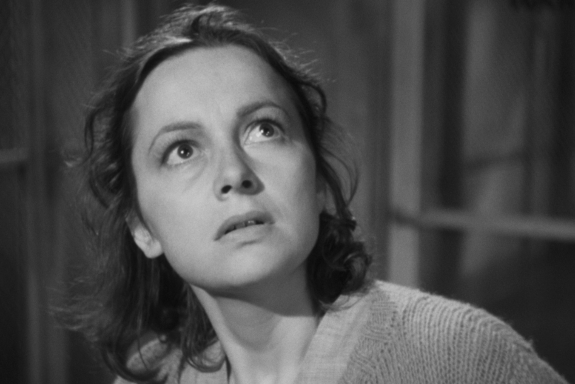
I must have mentioned once or twice before that Olivia de Havilland and Errol Flynn were more or less responsible for my becoming a classic Hollywood fan. At a young age (I think I was around ten years old), seeing them together in Captain Blood (1935), The Adventures of Robin Hood (1938) and Dodge City (1939), I fell in love with them, Errol becoming my hero and Olivia my heroine. When I grew older I had other heroes, but Olivia (and Errol too, of course) always held a special place in my cinematic heart. It is therefore with great sadness that I heard of Olivia's passing last Sunday. She died peacefully in her sleep at her Paris home at the incredible age of 104.

The films of Olivia that I saw as a child and loved (and still do!) were not the films she herself was most proud of. Olivia was very unhappy with her career by the time she made Dodge City ("I was in such a depressed state that I could hardly remember the lines") and was quite eager to take on more challenging roles. She would soon get her wish when David Selznick cast her in the role of Melanie Hamilton in Gone with the Wind (1939), for which she received her first Oscar nomination. There were more challenging, dramatic roles still to come with films like Hold Back The Dawn (1941), To Each His Own (1946), The Snake Pit (1948) and The Heiress (1949), earning her a further four Oscar nominations. Olivia eventually won the statuette twice, for her performances in To Each His Own and The Heiress.

Among Olivia's dramatic roles, probably the most demanding was that of schizophrenic Virginia Cunningham in Anatole Litvak's The Snake Pit — the role often cited as one of her personal favourites. To prepare for her role, Olivia did extensive research, visiting mental hospitals and observing treatments, such as hydrotherapy and electric shock. Furthermore, she attended therapy sessions and also spent time with patients at social functions. Olivia's hard work eventually paid off, earning her good reviews, an Oscar nomination ánd praise from people in the psychiatric field.

One of the professionals who was very impressed with The Snake Pit and Olivia's portrayal of Virginia was Dr. William Menninger, a renowned psychiatrist and after WWII a leader in reforming state mental hospitals. Here is a correspondence between him and Olivia from March 1949, several months after the release of the film. As one can imagine, Olivia was "tremendously thrilled" to receive Dr. Menninger's praise and approval.

Transcript:

436 N. Rockingham Road
Brentwood Park, California

March 5, 1949

Dear Dr. Menninger,

Your kind letter, written in November, arrived while my husband and I were visiting out of the state, so that it was not until our return that I received it. The holidays, a New York trip, and a recent illness have kept me until now from telling you how tremendously thrilled I was by your approval and praise of "The Snake Pit" and "Virginia". As you have no doubt learned from Mr. Litvak, all of us associated with the film earnestly hoped to create both a work of art and one of service. Therefore to have won your commendation of it as "a perfectly wonderful service to psychiatry and the public" is, indeed, a great satisfaction.

With warm good wishes,

Gratefully, 

Olivia de Havilland Goodrich
[Marcus Goodrich was Olivia's first husband to whom she was married from 1946 until 1953]

Transcript:

March 10, 1949

Mrs. Olivia de Havilland Goodrich
436 North Rockingham Road
Brentwood Park, California 

Dear Mrs. Goodrich:

Your note of March 5 was indeed a very gracious and warm note and I appreciated it deeply.

It is possible that you may have had an inquiry, through Mr. Spyros Skouras [President of 20th Century Fox], from me recently.  I don't need to tell you how backward our state hospitals are and we in this organized group, The American Psychiatric Association, plan to have a mental hospital institute in Philadelphia for the entire week of April 11 to 15. We have written to the Governors of the various states and to the mental health authorities and urged them to send representatives and I am hopeful that most of our states and territories will send men to this institute. It was planned that we would have a mass meeting in Philadelphia on Monday evening the 11th to open the program and I contacted Mr. Skouras as to the possibility of whether we might be able to persuade you to attend this opening meeting. Mr. Skouras confidentially reported back to me of your great expectations for this summer and that it was extremely unlikely that you would feel that such an expenditure of effort was practical. I am certainly in full agreement with such a point of view and do hope that all things go happily and well for you. 

Charles Schlaifer sent me the brochure of many, many reviews and editorial comments about THE SNAKE PIT. He also told me of the enormous box-office returns, all of which made me very happy and I am sure it must make you happy too. To have the satisfaction of making a remarkable piece of art and at the same time doing such a phenomenal public service I think must be a source of great satisfaction to yourself. Again I say that all of us in psychiatry are deeply in your debt.

Sincerely yours, 

William C. Menninger, M.D.  

Source of both letters: Kansas Historical Society

21 July 2020

Audrey, call us!

Gregory Peck, Fred Astaire and Anthony Perkins starred together in Stanley Kramer's On The Beach (1959) and during production of the film they realised they had all been leading men to Audrey Hepburn. Peck was Audrey's romantic lead in Roman Holiday (1953), Astaire in Funny Face (1957) and Perkins in Green Mansions (1959). While filming on location in Australia, the men decided to send Audrey a message ("Dear Audrey. If you need any help call us!") via this fun picture, autographed by the three of them. I'm sure Audrey must have been thrilled to receive this.

Source: Christie's


13 July 2020

You are the best musical composer in the industry

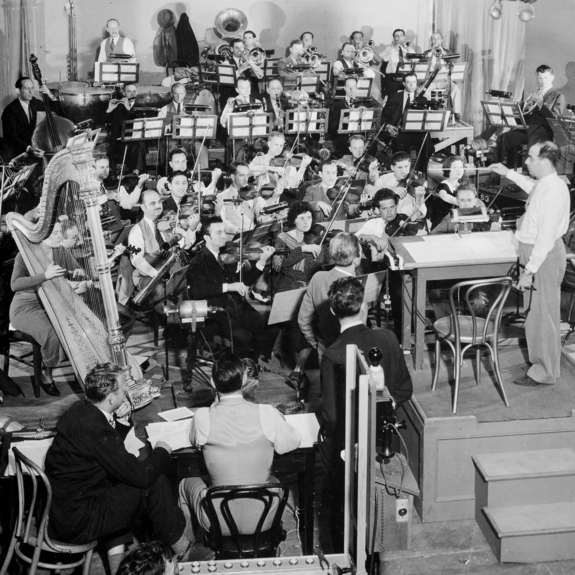
Austrian-born music composer Max Steiner moved to Hollywood in 1929 and was one of the first composers to write music scores for films. According to Steiner, filmmakers at the time generally regarded film music as a "necessary evil" but this would all change in the early 1930's. Put under contract at RKO, Steiner composed his first film score for Cimarron (1931) and after several films was asked by David Selznick (the studio's new head of production) to write the score for Symphony of Six Million (1932). The score for Symphony was groundbreaking. It was the first time underscoring (music played under dialogue or a scene) was used throughout an entire picture. Steiner later said that Symphony was "the most important picture [he] did as far as trendsetting". But while the film was a turning point for both Steiner's career and the film industry, it wasn't until a year later with King Kong (1933) that Steiner had his big breakthrough. Many people believe it's this score which marks the true beginning of the Hollywood film score.

In 1936, due to salary issues with RKO, Steiner went to work for David Selznick at his new studio Selznick International Pictures. A year later, following a professional disagreement with Selznick over A Star is Born (1937), Steiner left Selznick and signed a long-term contract with Warner Bros. under the condition that he was still allowed to work for Selznick if needed. Steiner desperately wanted the assignment to write the score for Gone with the Wind (1939), the rights to the novel having been purchased by Selznick in 1936.

In April 1939, Warners agreed to lend Steiner to Selznick who had never considered any other composer for GWTW than Steiner. Steiner had only three months to write the score and worked around the clock to meet the deadline (meanwhile also composing scores for Warners, 1939 being his busiest year with thirteen (!) films). Worried that Steiner wouldn't make it in time, Selznick asked Franz Waxman to write an additional score. In the end, Steiner came through and delivered a great score, which at nearly three hours is still one of the longest scores ever composed.

Max Steiner credited on screen for Gone With The Wind (above) and for Now, Voyager, My Reputation, Since You Went Away and Mildred Pierce (below, clockwise), which are some of my favourite Steiner scores.
As said, Steiner had been quite eager to work on GWTW and to make sure his boss Jack Warner would lend him to Selznick, he wrote Warner a letter in the spring of 1939. Warner wrote back immediately, giving Steiner the go-ahead while emphasising the composer's importance to the studio and calling him "the best musical composer in the industry". Steiner's letter (shown in part and only in transcript) as well as Warner's reply can be read below. 

Incidentally, the film score for GWTW (with its famous Tara's Theme) remains one of Steiner's most famous and best loved scores. Steiner was nominated for an Oscar but lost to Herbert Stothart for The Wizard of Oz. (That same year, Steiner was also nominated for another film, Dark Victory.) In all, Steiner composed more than 300 film scores and was nominated for an Oscar 24 times, ultimately winning three, i.e. for The Informer (1935), Now, Voyager (1942) and Since You Went Away (1944).

My dear Mr Warner: 
Charlie Feldman told me ... that it would be all right for me to do the music for Gone with the Wind .... When I came over to work at Warners, I had an understanding with Leo [Forbstein, responsible for Warners' contracts] that whatever happened I was to do Gone with the Wind .... In fact, the only way I could get my release from Mr. Selznick was with that promise .... It is absolutely necessary that I do a top picture of the type of ... Gone with the Wind with their vast opportunity for music .... One cannot win Academy Awards with ... Oklahoma Kid, etc.... Please do not misunderstand me .... I haven't slept for days, and it is all can [do to] try and get [Confessions of a] Nazi Spy finished in time. Really, Mr. Warner, I'm counting on you .... Will you please give your consent and tell ... Mr. Selznick ... should he find it necessary to get someone else, I would never get over it ...  
Source: Max Steiner: Composing, Casablanca, and the Golden Age of Film Music

Source: AuctionZip

Transcript: 

April 6, 1939

Dear Max:

Received your circular letter about doing GONE WITH THE WIND, and first I want to say that irrespective of what pictures you score, you are the best musical composer in the industry. If this is not true, I am sufficiently a music critic to prove it.

Therefore, I come to the point of replying to your letter reference your doing GONE WITH THE WIND. I have told Leo and Hal Wallis that this is satisfactory and that you can do it, and Mr. Forbstein and Mr. Obringer will handle the business of loaning you over there.

Just want to add that while I realize we have brought another composer in to do certain pictures from time to time, it is with great pride that we can point to the important music in pictures such as ANGELS WITH DIRTY FACES, DODGE CITY, OKLAHOMA KID, FOUR DAUGHTERS, CRIME SCHOOL and JEZEBEL and I am sure that the important music you have placed in these and many other films, have contributed much to their success, and I assure you it isn't the bigness of the picture that counts.... for you won an Academy Award for doing a picture no one ever heard of, THE INFORMER.

However, I do hope that with GONE WITH THE WIND you will not only win the Academy Award, but the plaudits of the public, who are after all, our most important judges.

Yours for more work and longer hours,

Sincerely,
(signed)
Jack Warner

P.S. Keep away from the Hollywood Turf Club .... because I am going to be there every Saturday.

Mr. Max Steiner
Studio

2 July 2020

What's in a name?

MGM mogul Louis B. Mayer once said that the idea of a star being born was "bushwah". During Hollywood's studio era, stars were not born but created. The studios signed actors and actresses who looked good and then they would work from there. "All I ever looked for was a face", said Mayer. "If someone looked good to me, I'd have him tested. If a person looked good on film, if he photographed well, we could do the rest."

The first step to creating a star often was changing the actor's name. Sometimes actors got to keep their name, provided they were born with a catchy name like Errol Flynn, Clark Gable or Ava Gardner. In some cases, actors already had a new name before coming to Hollywood for instance, Ruby Stevens chose the more sophisticated name Barbara Stanwyck while she was still performing on Broadway, and Issur Danielovitch changed his name to Kirk Douglas, feeling his real name was too Jewish for Hollywood. Quite often, however, it was the studios that gave the potential stars new names, and not always with the actor's input or consent. Names that didn't fit the physical image of the actor had to be changed, thus elegant men like Spangler Arlington Brugh and Archibald Leach were given more elegant (and easier to remember) names, resp. Robert Taylor and Cary Grant, and a big guy like Marion Morrison got the sturdier name John Wayne. Also, foreign names were often replaced with American names  e.g. Lucile Vasconsellos Langhanke and Margarita Carmen Cansino became resp. Mary Astor and Rita Hayworth. 


A special story is that of Lucille Fay Le Sueur, in the 1920s one of MGM's potential new stars. In the spring of 1925, feeling her last name was too hard to remember and sounded too much like "sewer", MGM decided to hold a contest to pick a new name for Lucille. In the fan magazine Movie Weekly, people were asked to come up with suitable screen names and the person to submit the winning name would be awarded $500 (and the next ten best names $50 each). "Joan Arden" came out the winner, but since there was somebody working at MGM with the same name*, Lucille had to settle for the runner-up, "Joan Crawford". Initially, Lucille hated her new name. She wanted her first name to be prounounced "Jo-Anne" and her last name reminded her of "crawfish". In time, the name grew on her and she later said she liked the security that came with it.

*This was MGM's version of the story. Another version is that there was nobody named "Joan Arden" but that the winning name had been submitted by two or three people. This meant that MGM had to pay the prize multiple times and they didn't think the young starlet was worth it.

Above and below: articles that appeared in Movies Weekly in April 1925 [source]. In September of that year, the magazine would announce that "Joan Crawford" was the winning name. 

Someone who also underwent the name-change was Phylis Walker, which brings me to today's correspondenceIn 1941, producer David Selznick was casting his upcoming film Claudia (1943) and Phylis, having just signed a seven-year contract with Selznick, was one of the candidates to audition for the female lead (which eventually went to Dorothy McGuire). Finding Phylis Walker "a particularly undistiguished name"  born Phylis Lee Isley, the young actress was then married to actor Robert Walker  Selznick wrote to Whitney Bolton, his Director of Advertising and Publicity, asking him to come up with a new name. Selznick's two memos to Bolton are seen below, the second also addressed to Selznick's assistant Kay Brown. In January 1942, Phylis Walker was renamed Jennifer Jones and Selznick would subsequently groom her to stardom (ánd also marry her in 1949).


September 10, 1941
To: Mr. Bolton
I would like to get a new name for Phylis Walker. I had a talk with her and she is not averse to a change. Normally I don't think names very important, but I do think Phylis Walker a particularly undistinguished name, and it has the additional drawback of being awfully similar to Phyllis Thaxter, which is doubly bad because of Thaxter being in Claudia [on the stage], which Walker may do, and because of the fact that Thaxter may soon be in pictures.
I don't want anything too fancy, and I would like to get at least a first name that isn't also carried by a dozen other girls in Hollywood. I would appreciate suggestions.
DOS
___________

January 8, 1942
To: Miss Brown, Mr. Bolton
Where the hell is that new name for Phylis Walker?
Personally, I would like to decide on Jennifer and get a one-syllable last name that has some rhythm to it and that is easy to remember. I think the best synthetic name in pictures that has been recently created is Veronica Lake.
DOS

Source: Memo from David O. Selznick (1972); selected and edited by Rudy Behlmer.

Jennifer Jones flanked by then-husband Robert Walker (left) and David Selznick on the set of Since You Went Away (1944).

23 June 2020

Groucho's letter to Peter Lorre

In the fall of 1961, Peter Lorre sent Groucho Marx a copy of Stuart Gilbert's James Joyce's Ulysses (1930), a study of Joyce's (often considered unreadable) novel. After receiving the book, Groucho wrote Lorre the following letter, saying that now he needed another book to explain Gilbert's study. In typical Groucho fashion, he then "confused" Stuart Gilbert with Gilbert Stuart, the artist who had painted the portrait of George Washington in 1796.

October 5, 1961
Dear Peter:  
It was very thoughtful of you to send me a book explaining James Joyce’s “Ulysses”. All I need now is another book explaining this study by Stuart Gilbert who, if memory serves, painted the celebrated picture of George Washington which hangs in the Metropolitan Museum. I realize that there is some two hundred years’ difference in their ages, but any man who can explain Joyce must be very old and very wise.
You disappeared rather mysteriously the other night, but I attribute this to your life of crime in the movies.

Best to you both.
Regards,
Groucho

Source: The Groucho Letters: Letters from and to Groucho Marx (1967) 

16 June 2020

Book Review — Robert Wise: The Motion Pictures

For a long time I only associated director Robert Wise with his two biggest hits, the musicals West Side Story (1961) and The Sound of Music (1965) — films I grew up with and still love to this day. It wasn't until much later that I realised that musicals make up only a small part of Wise's oeuvre. Throughout his career, Wise had tackled a wide range of genres, including film noir (The Set-Up, 1949), horror (The Haunting, 1963), drama (I Want to Live!, 1958), war (The Sand Pebbles, 1966) and sci-fi (The Day the Earth Stood Still, 1951). Wise was one of Hollywood's most versatile directors, yet he was often criticised for not leaving a personal stamp on his films (as opposed to directors like Alfred Hitchcock or John Ford who had very recognisable styles). In response to the criticism, he once said: "My answer to that is that I’ve tried to approach each genre in a cinematic style that I think is right for that genre. I wouldn’t have approached The Sound of Music the way I approached I Want to Live! for anything, and that accounts for a mix of styles."  

Robert Wise (above) and four of his films (below, clockwise): The Set-Up, Born to Kill, The Haunting and The Day the Earth Stood Still.


While Wise may not have had a signature style, there is no denying that he was a great filmmaker. Having started his career as editor at RKO where he edited, among others, Orson Welles' Citizen Kane (1941) and The Magnificent Ambersons (1942), the latter editing job not to everyone's liking  he turned to directing in 1944 with The Curse of the Cat People. Wise directed a total of forty films and a number of them he also produced. His directorial work is discussed in detail in J.R. Jordan's Robert Wise: The Motion Pictures originally published in 2017 and earlier this year released in a revised edition. 

As the title suggests, Jordan's book is not a biography but focuses on Wise's movies. Still, we learn a bit about Wise's early life from Douglas E. Wise (the director's nephew) in his heartfelt introduction and also from Jordan in his introduction to the first chapter. Jordan talks about Wise's start in Hollywood, his becoming an editor and how during the editing of The Magnificent Ambersons Wise directed one additional scene, marking his first steps as a director.

The forty films Wise would eventually direct are all given their own chapter in the book. In clear, unpretentious prose, Jordan discusses each film, while providing a plot synopsis, plenty of background information and an in-depth analysis of one or more aspects of the film. (Interesting, for example, is his analysis of the use of colours and its symbolism in West Side Story.) Although the films are arranged chronologically, the chapters can be read in random order. Admittedly, certain chapters I haven't read yet. There is still a number of Wise films I want to see and I will wait to read those entries until after I've seen the films. (Because, obviously, Jordan's analyses do contain spoilers.)

More than twenty chapters include interviews with cast and crew members who shared their memories of working with Wise. These personal accounts are a real treat, allowing us a peek behind the scenes and to learn a bit more about the man himself. Regarding his working methods, what I found especially interesting is that, according to several of the interviewed actors, Wise didn't really direct them during the actual filming. Lindsay Wagner, the female lead in Two People (1973), said that Wise did most of his directing during the casting of the film. At some point she asked him if he shouldn't direct her, to which he replied: "No, you showed me who this character was the day we did the screen test". 

From all these personal stories, it is clear that Wise must have been a wonderful man to work with. He is described as kind and gentle, easy-going, sensitive, patient and soft-spoken. Or as worded by Wise's nephew Douglas: "There was no temper. There was no ego. There was no flexing of power or anything else. He was simply a nice guy and everybody, cast and crew alike, admired him."

Robert Wise on the set of West Side Story with Natalie Wood and Rita Moreno. He co-directed the film with Jerome Robbins.

Joe Jordan's Robert Wise: The Motion Pictures is a must-have for any Wise fan and a great addition to any (classic) film buff's library. It's a book you will particularly enjoy once you've seen the films. For me, it was an incentive to delve more into Wise's filmography. There was a number of films I had been meaning to see for a long time and I'm glad I finally got around to it (Born to Kill, Three Secrets, The Day the Earth Stood Still, The House on Telegraph Hill, Until They Sail and Odds Against Tomorrow— all recommended). And of course I will be picking up the book again as I'm working my way through the rest of Wise's filmography.

To conclude this post, I will let Robert Wise himself do the talking. In a letter to a certain Irwin Schuett dated 16 December 1981 (not to be found in Jordan's book), Wise looks back on the filming of The Sound of Music.

Source: icollector.com

Transcript:

December 16, 1981

Mr. Irwin M. Schuett
3900 W. 109 St.
Chicago, Illinois 60655

Your letter about THE SOUND OF MUSIC brought back a lot of memories. As producer and director of the film, I was active in work on it for over 18 months.

All the exteriors of the film were shot in and around Salzburg, Austria. Of course, we had Julie Andrews, Christopher Plummer and all the children there for the filming. They all worked wonderfully together, so we had a very happy troupe during our three months of filming there. We filled the old town of Salzburg with the music of "Do, Re, Mi" as our playback machines poured out the music for the various pieces of filming we did around the town.

All the interiors for the picture were filmed back in Los Angeles at the 20th Century-Fox Studios. That took another three months, so all-in-all we shot on the picture for six months. But it took another six months for the post-production work to be finished. The rest is history.

Sincerely yours,
(signed)
ROBERT WISE

Robert Wise on the set of The Sound of Music with his stars Julie Andrews and Christopher Plummer.


Thanks to Joe Jordan and his publisher for sending me a copy of the book, in exchange for an unbiased review. Robert Wise: The Motion Pictures (Revised Edition) can be purchased here.


Update 30 July 2020

Author Joe Jordan contacted me with the sad news of his father's sudden passing. He asked me if I could add an addendum to this post in dedication to his father. So here it is, written by the author himself.

Addendum
The book is dedicated to the author's father. Joseph C. Jordan Jr. suddenly passed a short time following the publication of this article. In Robert Wise: The Motion Pictures the author wrote, "Those I interviewed for this book generally described Robert Wise as noble, patient, validating, and a class act. Such words, in short, apply to Dad."

Mr. Jordan's wife, Rosetta, preceded him in death by 37 years (see photo). He missed her every day since then and never remarried. The author was fortunately afforded the opportunity to be at his father's bedside on the day of the passing. Prior to the moment of death, he faced his father and said, "This is a special day. You're going to be with Mom again." Mr. Jordan's face lit up, as his excitement was clearly apparent. He passed a short time later.

28 May 2020

Darling Doris

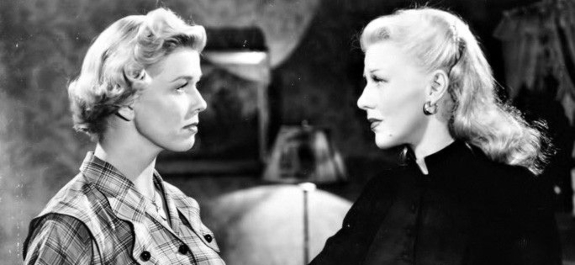
Ginger Rogers was one of Doris Day's childhood idols. As a teenager watching Ginger dance, Doris wanted to become a professional dancer but a car accident in 1937 abruptly shattered that dream. Years later, when asked to co-star with Ginger in Storm Warning (1951), Doris naturally jumped at the chance to work with her. The film, a grim anti-Ku Klux Klan noir/drama, remained their sole collaboration.

Doris and Ginger played sisters in Storm Warning, here pictured together in a scene. Doris was thrilled to be working with her longtime idol, who was eleven years her senior.


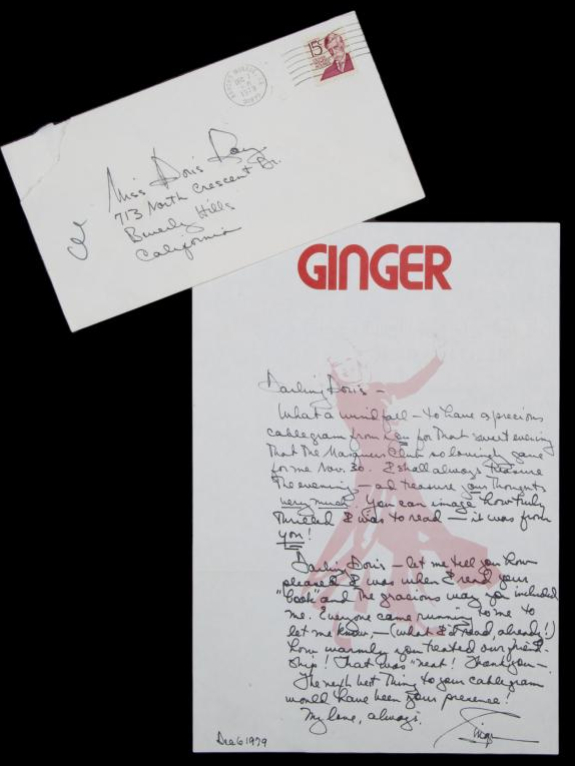
Fast forward to 30 November 1979. Ginger Rogers was given a tribute at The Masquers Club in Los Angeles and among those attending the event were Fred Astaire, Eve Arden, Joseph Cotten and Pat O'Brien. Doris didn't attend but was one of the people who had sent a congratulatory telegram. Thrilled to receive Doris' message, a week later Ginger responded with the following heartfelt letter. 

Source: Julien's Auctions

Transcript:

Darling Doris - 

What a windfall — to have a precious cablegram from you for that sweet evening that The Masquers Club so lovingly gave for me Nov. 30. I shall always treasure the evening — and treasure your thoughts very much. You can image how truly thrilled I was to read — it was from you!

Darling Doris - let me tell you how pleased I was when I read your "book" and the gracious way you included me. Everyone came running to me to let me know,  (what I'd read, already!) how warmly you treated our friendship! That was "neat ! Thank you  The next best thing to your cablegram would have been your presence!

My love, always.

Ginger

Dec 6 1979

11 May 2020

Elizabeth Taylor's letter to her lost cat

Growing up in the English countryside, Elizabeth Taylor loved being around animals and felt more comfortable around them than children her own age (chickens, pigs, horses, cats, dogs etc. young Liz befriended them all). As she grew older, Elizabeth's profound and unconditional love for animals remained and she once called them her "sweetest and most cherished friends". "I sometimes think I prefer animals to people", she said. "And I was lucky. My first leading men were dogs and horses" (referring to Lassie Come Home (1943) and National Velvet (1944)).

Throughout her life, Elizabeth had numerous pets and among them many cats. One of her beloved cats was Cassius. In 1974 when her then-husband Richard Burton went to Oroville (California) to film The Klansman, Liz accompanied him, bringing Cassius with her. The couple had rented a private house in town, but Cassius had trouble settling into his new environment and soon went missing. Looking everywhere for her furry friend, Liz was unable to find him. Very upset, she then wrote Cassius this touching letter, urging him to come back. Sadly, he never did. 

(The letter was later found in a drawer by the owner of the house, long after the Burtons had left.) 

Source: Letters of Note

Transcript:

Letter to my Lovely Lost Cat

I see you, my beauty boy, in the reflection of those shining black-brown rocks ahead of me. I see the green o’ thy eyes in every rained, sweated leaf shaking in my eyes.

I remember the sweet smell of your fur against my neck when I was deeply in trouble and how, somehow you made it better — you knew! You knew always when I hurt and you made comfort for me, as I did once for you when you were a broken kitten.

Anyway, I love you Cassius — and thank you for your beauty.

Please come back!


6 May 2020

This is not the kind of a letter I would want to dictate

I am no Jerry Lewis fan. At all. I find him mostly annoying and very unfunny, having seen several of the films he did with Dean Martin (whom I like). Coming across a letter from Lewis to Stella Stevens, however, I decided to give Lewis another chance and watch The Nutty Professor (1963)  the film in which he co-starred with Stevens and which is generally considered his best (Lewis also directed and co-wrote the screenplay).

A comical take on the classic Jekyll and Hyde story, The Nutty Professor is quite entertaining, I must admit, and despite being a Lewis "hater" I thought he was tolerable in this film. (His signature antics were luckily kept to a minimum and I liked the serious undertones of the film.) Stella Stevens, who was cast by Lewis in the female lead, was just right for the role, good at playing both sexy and innocent. Lewis himself was very impressed with Stevens and during filming he became even infatuated with her.


Three weeks into production, a smitten Lewis decided to write Stevens a letter (as said, the letter being the reason for my watching The Nutty Professor in the first place). In it, he raved about how absolutely wonderful Stevens was to work with, something he had never experienced before. Going a bit overboard with his praise, Lewis acknowledged it was "not the kind of a letter [he] would want to dictate", therefore typing it himself. 

Incidentally, The Nutty Professor became the biggest hit of Lewis' career and it remained the only film he and Stevens did together.


Transcript:

November 7, 1962

Dear Stella:

This note comes in the form of respect and appreciation, for not only your fantastic ability and know-how, but for your untiring efforts and hard work.

I was completely inspired last night. I suspect this was because I have never worked with anyone quite like you before. Your energy and listening power is beyond anything I have ever known.

You are the reason men can't live without the pride and thrill of direction. I only wish I could explain simply how wonderful you are to work with. Perhaps one day you too will know the feeling. If you don't, then you're missing one of the greatest thrills of creativity.

This note has been long overdue, but I have been so busy I haven't had a minute to sit down and peck it out myself. This is not the kind of a letter I would want to dictate.

I could say much more about how wonderful a performer and actress you are, but I'm sure all my words are, at this point, nothing more than redundancy.

Again, thank you for the rare privilege of being a small part of what I know will be one of the most exciting rockets to ever hit the star cluster.

Believe me to be sincere, and so very proud to be working with you.

Always and affectionately,

(signed) 
Jerry

30 April 2020

The Peculiar Marriage of Jean Peters & Howard Hughes

Eccentric billionaire, business tycoon, aviator and film producer Howard Hughes dated a lot of famous Hollywood actresses (including Katharine Hepburn, Ava Gardner, Bette Davis, Ginger Rogers and Gene Tierney) but married only one — Jean Peters. The two had met at a party in 1946 and had an on-and-off romance for several years. In 1954, Peters married Texas oilman Stuart Cramer but the marriage was shortlived and afterwards she resumed her relationship with Hughes. Peters and Hughes, then resp. thirty and fifty-one years oldeventually tied the knot in a secret ceremony in Tonopah (Nevada) in May 1957. During her marriage to Hughes, Peters abandoned her film career and hardly ever appeared in public. She refused to give interviews about her life with Hughes, even after their divorce in 1971. (As a divorce settlement Peters was given a relatively modest $70,000 per year. She never made any claims on Hughes' estate.)

Howard Hughes with (from left to right) Ginger Rogers, Bette Davis and Ava Gardner  three of the many famous Hollywood actresses he dated.

The Peters-Hughes marriage was, to say the least, unconventional. After the couple got married, they lived in separate bungalows at the Beverly Hills hotel for several years. When they finally moved in together at Peters' insistence— they still had their own living quarters, seeing each other only occasionally. It was during his marriage with Peters that Hughes became more and more mentally unstable. He got obsessed with germ contamination and also developed bizarre rituals (e.g. storing his own urine in jars). Hughes' behaviour grew increasingly weird and at some point Peters couldn't see her husband anymore unless she made an appointment through one of his aides. With Hughes turning into a recluse, Peters continued to live her own life while pursuing her own interests, like studying sociology at UCLA in 1969. In the end, the couple had spent more time apart than together during a marriage that lasted fourteen years. 

Jean Peters and Howard Hughes — not a single picture of them together can be found on the internet (and I looked hard!).

Several Hughes biographers have speculated about why Hughes married Peters when he did, having been a bachelor for thirty years.* They believe that Hughes (already mentally unstable by the time he married Peters) was afraid the CEO of his company Noah Dietrich was going to declare him mentally incompetent and have him committed. Being married would protect him from this, since in California a husband could not be committed without the consent of his wife. 

While Hughes may have had an ulterior motive for marrying Peters, he seemed to have loved her (and she him), judging from the following messages they wrote to each other. (It is even said that Peters was the only woman Hughes had ever loved.) Living in separate quarters, the couple was known to communicate through handwritten notes, i.e. messages often written on the same piece of paper which were (I imagine) carried back and forth between them by one of Hughes' aides. The notes below are undated, but were written at a time in their marriage when Peters and Hughes would see each other briefly around 11 PM before returning to their separate bedrooms.

*Note
Hughes was married once before to Ella Botts Rice from 1925 until 1929. Actress Terry Moore said she had also been Hughes' wife, having married him in 1949 aboard a ship with the ceremony performed by the ship captain. Moore claimed that Hughes had destroyed the ship log, so there was no official record of their marriage. 


Source: Heritage Auctions

Transcript:

My Very Dearest,

I love you so much. I will be expecting you tonight and I will try to have something you will like to watch. Please love me back and please don't give me up as a lost cause yet.

I hope not to have any stomach-aches tonight, and I am having the Dr. come now, so we won't be troubled with him. If something upsets you tonight, please write me a note and tell me about it.

I love you again and again and then some more.

Howard


Dearest love,

I will be looking forward to seeing you at 10:30 or 11:00. I love you very much.

J

(Hughes) 

It's only 1/2 finished + it's good. She's the old D W Griffith type. Vera is his daughter. He has absolute no scruples. I can't imagine where our hero is going to wind up after he takes out that policy. The boy plans to murder the old fox but I think Carradine will beat him to it.

That last close-up was overdone. C'est tous!  Why did you indicate disbelief?
It sounds terrific. Will it be the 1st Symphony in the new theater?

I think the conductor is very famous.
If you want to, ok - but that won't help my situation.
I just want to burp.


Source: Heritage Auctions

Transcript:

Dearest Love,

I adore you. I was thinking about your mother. I do so little for her - would you mind if I send a wire suggesting that we send a driver to any place along the way (where she may have had enough of billboards + good old U.S scenery) who would pick up her automobile and put her + Red on one of those beautiful brand new jets with the movies just like the president's.

Think about it, and tell me when we are together.

I love you some more,
Howard

Dearest-

You support her - that's enough 
I love you 
Hope you will be ready to say good-night about 11:00. I have the C 
 
So I am feeling mean and I want to get some sleep 
Tomorrow is my birthday - which you will probably forget - like the color sample book - which was not on the table as you promised.
I do not expect a present - but please send me some flowers - so I won't be embarassed if Shirl +  kids come by.

Love
J.

Me [drawing] grrrr 
(added by Hughes: Excellent artistry) 

(Hughes)
You were very unfair to assume I forgot the samples. I went thru the pile of material to my left, as you can see from the placement of newsweek there. I gave samples to Geo. with clear and emphatic instructions to put on your table in hall the next time he passed thru hall. This to avoid any possible unnecessary walking in hall (footsteps, "scratching around door" etc.)

He evidently forgot, as I see the samples where he temporarily placed on marble table.

would have disclosed location + the man on duty could have brought out.

You'll see

Definitely

I told you the other night

50 times I would have

I'm sorry. I sent John as soon as Dr. left


Source: Heritage Auctions

Transcript:

My Dearest Love,

This is just to let you know I am thinking about you.

Please, tonight, remember that every single minute I am loving you and please for this one night, tell your mind to stay on happy thoughts. I promise that you will feel it was justified.

I love you some more. Teahouse with Brando is on. Maybe you would like to try a few feet of it. I will send a smoke signal about eleven. I still love you more.

Howard

Dearest Love -

I will remember you are loving me. I love you too - I'm watching Secret Agent - I await your call-

Love, J.

(Hughes)
If I am boatless I may kill myself.

Ferrer's alibi is that he was in hospital unable — actually he anesthetizes himself thru hypnosis so he can stand the pain.

you can imagine what a ball Ferrer can have with a scene like that.

I love you!

No, I have not done an about face in my type of movie. I just wanted to see a few minutes of this to see how you like the beard.

He made a trademark of it.

Prisoner of Zenda
Dean Jagger

Of course we both know this one just as
well but at least it's not quite as daffy.

And it has José the great.

That is a hideous airplane.
In the cigarette ad.

Piper.

It's terrible - he rapes her

One of those early Ida Lupino quickies.

Then she cracks up completely

I love you little sweetheart.