10 April 2014

A costume job well done

When I think of great Hollywood costume designers, I immediately think of famous designers like Edith Head or Adrian. William Travilla is a name I had not heard of before, but of course I know his designs. Travilla is probably best known for his work in the 1950s when he was under contract to Twentieth Century-Fox. He is mainly associated with Marilyn Monroe, having dressed her in eight of her films (best remembered are his iconic dresses from Gentlemen Prefer Blondes (1953) and The Seven Year Itch (1955)).


Prior to working for Twentieth Century-Fox, Travilla had worked at Warner Bros. for three years. One of the films he did at Warner Bros. was the swashbuckler Adventures of Don Juan (1949), starring Errol Flynn. On 4 May 1948, while Don Juan was still in production, Errol Flynn sent a telegram to Travilla regarding his work on the film. Flynn couldn't have known then that two years later, on 23 March 1950, his pal would be awarded the Oscar for Best Costume Design (along with colleagues Leah Rhodes and Marjorie Best). It would be the only Oscar of Travilla's career.

Via: glamamor

Transcript: 

LOSANGELES CALIF MAY 4 1948

BILLIE TRAVILLA
WARNER BROS WARDROBE DEPT=

DEAR BILL YOU WOULD HAVE BEEN VERY HAPPY TO HAVE HEARD THE PRAISES FOR YOUR DON JUAN JOB NO COSTUME TO EQUAL HAS EVER BEEN SEEN ETC YOU NOW HAVE OTHER FANATIC BOOSTERS BESIDES YOUR PAL=

FLYNN.


3 April 2014

David Selznick gives a 'damn'

One of the most famous lines in movie history is without a doubt "Frankly, my dear, I don't give a damn", spoken by Clark Gable in David O. Selznick's production of "Gone with the Wind" (1939). In 1939, with the Production Code in full swing, use of the word 'damn' was nevertheless strictly forbidden. So how did it get past the censors and end up on the big screen?

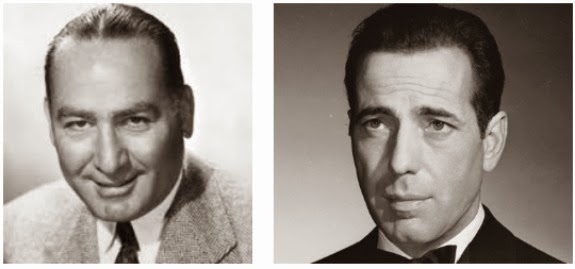
Left photo: David O. Selznick; right: Will H. Hays

A few months prior to the release of "Gone with the Wind", Joseph Breen (head of the PCA and responsible for the enforcement of the Code) had disallowed the word 'damn' and wanted it removed from the movie. Alternatives like "I don't give a hoot" or "I just don't care" were consideredbut producer David Selznick was adamant about keeping 'damn' in his crucial scene. In a final attempt to get his way, Selznick wrote a letter to Will Hays (Joseph Breen's boss) pleading with him not to forbid 'damn'. Hays proved sensitive to Selznick's arguments. On 1 November 1939 (a month and a half before the film's release), the Production Code was amended. 'Damn' was still forbidden, unless it was "essential and required for portrayal, in proper historical context, of any scene or dialogue based upon historical fact or folklore...or a quotation from a literary work, provided that no such use shall be permitted which is intrinsically objectionable or offends good taste". 

Selznick's fascinating letter to Hays can be read below.

October 20, 1939

Mr. Will H. Hays
Motion Picture Producers & Distributors of America, Inc.
28 West 44th Street
New York, N.Y.

Dear Mr. Hays:

As you probably know, the punch line of "Gone With the Wind", the one bit of dialogue which forever establishes the future relationship between Scarlett and Rhett, is, "Frankly, my dear, I don't give a damn."

Naturally I am most desirous of keeping this line and, to judge from the reactions of two preview audiences, this line is remembered, loved and looked forward to by the millions who have read this new American classic. 

Under the code, Joe Breen is unable to give me permission to use this sentence because it contains the word "damn," a word specifically forbidden by the code.

As you know from my previous work with such pictures as "David Copperfield," "Little Lord Fauntleroy," "A Tale of Two Cities," etc., I have always attempted to live up to the spirit as well as the exact letter of the producers' code. Therefore, my asking you to review the case, to look at the strip of film in which this forbidden word is contained, is not motivated by a whim. A great deal of the force and drama of "Gone With the Wind", a project to which we have given three years of hard work and hard thought, is dependent upon that word.

It is my contention that this word as used in the picture is not an oath or a curse. The worst that could be said against it is that it is a vulgarism, and it is so described in the Oxford English Dictionary.  Nor do I feel that in asking you to make an exception in this case I am asking for the use of a word which is considered reprehensible by the great majority of American people and institutions. A canvass of the popular magazines shows that even such moral publications as Woman's Home Companion, Saturday Evening Post, Collier's and the Atlantic Monthly, use this word freely. I understand the difference, as outlined in the code, between the written word and the word spoken from the screen, but at the same time I think the attitude of these magazines toward "damn" gives an indication that the word itself is not considered abhorrent or shocking to audiences.

I do not feel that your giving me permission to use "damn" in this one sentence will open up the flood-gates and allow every gangster picture to be peppered with "damns" from end to end. I do believe, however, that if you were to permit our using this dramatic word in its rightfully dramatic place, in a line that is known and remembered by millions of readers, it would establish a helpful precedent, a precedent which would give to Joe Breen discretionary powers to allow the use of certain harmless oaths and ejaculations whenever in his opinion they are not prejudicial to public morals.

Since we are trying to put "Gone With the Wind" into the laboratory this week, I should appreciate your taking this matter under immediate consideration. Mr. Lowell Calvert, our New York representative, has a print of the scene referred to which will take you, literally, only a few seconds to view. It is not a Movietone print, and must be exhibited with a dummy head, and therefore Mr. Calvert will have to arrange a room that is so equipped for you to see it. However, you may feel it possible to give the consent without viewing the film.

The original of the line referred to is on page 1036 of the novel, "Gone With the Wind," and you might have your secretary secure it for you.

We have been commended by preview audiences for our extremely faithful job on "Gone With the Wind," and practically the only point that has been commented on as being missing is the curious (to audiences) omission of this line. It spoils the punch at the end of this picture, and on our very fade-out gives an impression of unfaithfulness after three hours and forty-five minutes of extreme fidelity to Miss Mitchell's work which, as you know, has become an American Bible. 

Thanking you for your cooperation in this, 

Cordially and sincerely yours,

dos

Blind copies to Mr. Whitney, Mr. Calvert

Source: Harry Ransom Center (click here for the original image)

Note: John Whitney was Selznick's business partner and the film's main investor.

31 March 2014

"I hope you don't hate me anymore..."

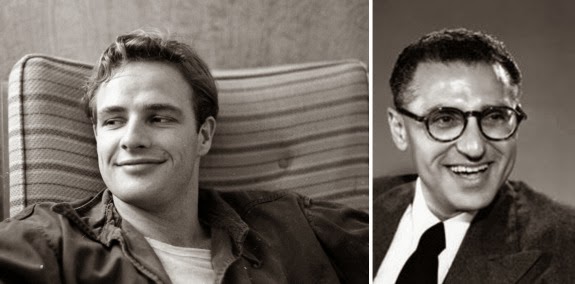
In 1954, George Cukor was going to direct the film version of the Broadway musical "Pal Joey" with Marlon Brando in the lead role. Brando was very interested in doing the project with Cukor but their collaboration was not to be. The film would eventually be made in 1957 with Frank Sinatra in the lead and George Sidney directing. 

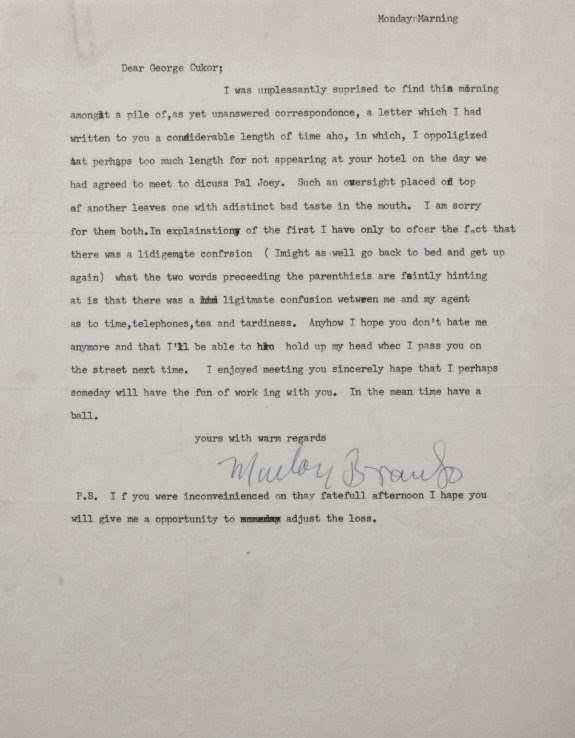
In the following letter from Marlon Brando to George Cukor, Brando apologises for having missed their meeting to discuss "Pal Joey". Furthermore, he says he was "unpleasantly surprisedthat the apology he had sent for missing the meeting came back. The letter is undated, but according to an article by Emanuel Levy Brando and Cukor met on 4 May 1954 to discuss the film (click here to read the article and why Cukor didn't direct "Pal Joey" after all). Brando's letter, which is full of misspellings, was possibly written around the same time. 

Source: bonhams/ image reproduced with permission

Transcript: 

Monday Marning [sic]

Dear George Cukor;

I was unpleasantly surprised to find this morning amongst a pile of,as yet unanswered correspondence, a letter which I had written to you a considerable length of time aho [sic], in which, I oppoligized [sic] at perhaps too much length for not appearing at your hotel on the day we had agreed to meet to discuss Pal Joey. Such an oversight placed on top of another leaves one with adistinct bad taste in the mouth. I am sorry for them both. In explaination [sic] of the first I have only to ofcer [sic] the fact that there was lidigemate [sic] confrsion [sic] (Imight as well go back to bed and get up again) what the two words preceeding the parenthisis [sic] are faintly hinting at is that there was a [redacted] ligitmate [sic] confusion wetween [sic] me and my agent as to time,telephones,tea and tardiness. Anyhow I hope you don't hate me anymore and that I'll be able to [ ] hold up my head whec [sic] I pass you on the street next time. I enjoyed meeting you sincerely hape [sic] that I perhaps someday will have the fun of working with you. In the mean time have a ball.

yours with warm regards

Marlon Brando (signed)

P.S. If you were inconveinienced [sic] on thay [sic] fatefull [sic] afternoon I hape [sic] you will give me a opportunity to [redacted] adjust the loss.

28 March 2014

Charity in Hollywood

The Community Chest was America's most important fund-raising organisation during the 1930s/40s. Collected funds were distributed to various causes, including movie relief organisations that offered assistance to those in need within the film industry. On 2 April 1940, a Special Committee for the Community Chest in Los Angeles (with members such as Frank Capra, Gary Cooper, Norma Shearer and Carole Lombard) wrote a solicitation letter to MGM's vice-president Eddie Mannix, asking for his help in supporting the Community Chest. Judging by the letter, apparently there had been some doubts regarding the Community Chest, but the Committee nevertheless believed that the Chest was "the best means with which to handle the serious problems of those in need". In the following letter the Committee is asking Mannix for his much-needed support.


Source: bonhams/ image reproduced with permission

Transcript:

April 2, 1940

Dear Edward J. Mannix,

Those of us whose names appear in printed form here met the other night to discuss confidentially and fearlessly our relationship to the Community Chest and the problems, doubts and responsibilities arising out of the matter from an industry standpoint. Some of us came to oppose, to fight. During a four hour meeting, with no outside influence present, we learned for the first time Community Chest facts which converted us as one to the cause of this organized charitable distributing agency that makes possible 88 separate charities within our community.

We learned that 94 cents out of every dollar goes into the hands of the needy; that only 6 cents out of each dollar is required for administrative expenses.

We learned we may designate, in giving our contribution to the Community Chest, the charity or charities of the 88 to which we wish our money to go, in full or in part.

We learned this community of which we are a part, is in need of our help and the Chest IS the best means with which to handle the serious problems of those in need.

We learned that an educational program is needed in behalf of the Community Chest so everyone else knows, as we know now, that the Chest truly deserves our support.

We want you to be with us, help us.

It is imperative for some of us to give a little more to make up our $200,000 shortage for the Community Chest.

If there are any questions you would like to ask, won't you please call anyone of us?

Sincerely,

signed by Joel McCrea, William A. Wellman, Ronald Colman, Carole Lombard, Frank Capra, Gary Cooper, Norma Shearer

Top row (from left to right): Eddie Mannix, Frank Capra, and William A. Wellman. Middle row: Charles BoyerRonald Colman and Gary Cooper. Bottom row: Carole Lombard, Norma Shearer and Joel McCrea.

18 March 2014

Complaining about George Raft

As mentioned in my previous post, Humphrey Bogart's road to fame came with his lead roles in High Sierra (1941) and The Maltese Falcon (1941). For both films, George Raft (at the time a major star at Warner Bros.) had been first choice. Raft, however, didn't think either film was interesting enough and refused both parts, inadvertently turning Bogie into a big star. These poor decisions would ultimately lead to the decline of Raft's career.

George Raft passed up The Maltese Falcon for a role in Raoul Walsh's Manpower (1941). As Raft's co-star, Bogart was cast. However, Raft refused to work with him, and Bogart was fired just after filming began (he was replaced by Edward G. Robinson). In hindsight not a bad thing for Bogie, since he was now free to play the lead in The Maltese Falcon (while Raft got stuck with Manpower, for which he got third-billing after Robinson and Marlene Dietrich).

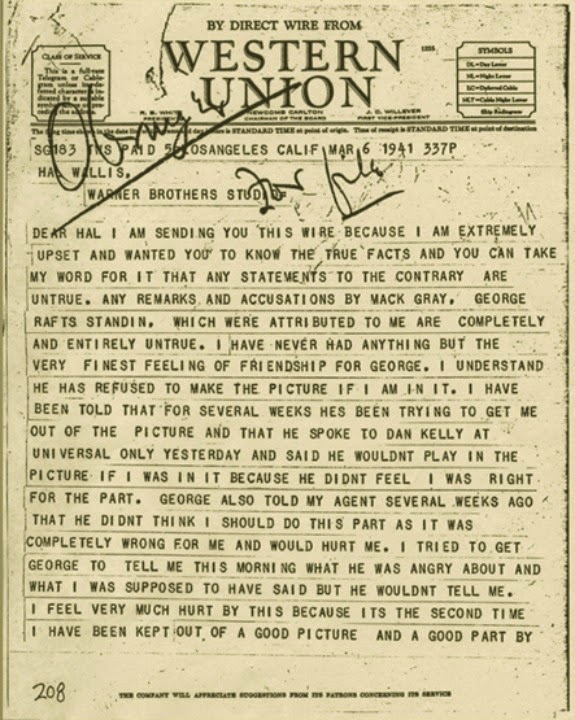
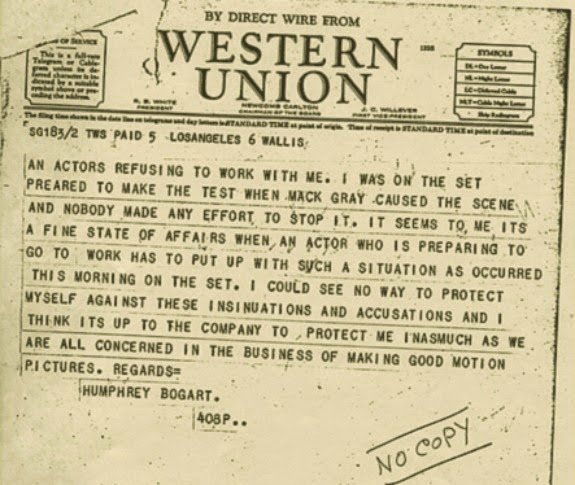
The following telegram is another telegram from Humphrey Bogart to Hal Wallis, producer at Warner Bros.. In it, an upset Bogie complains about George Raft and his stand-in Mack Gray. The telegram is dated 6 March 1941 and was most likely sent during production of the above mentioned Manpower. Probably not long thereafter, Bogart was removed from the film.


Transcript: 

LOS ANGELES CALIF MAR 6 1941

HAL WALLIS
WARNER BROTHERS STUDIO

DEAR HAL I AM SENDING YOU THIS WIRE BECAUSE I AM EXTREMELY UPSET AND WANTED YOU TO KNOW THE TRUE FACTS AND YOU CAN TAKE MY WORD FOR IT THAT ANY STATEMENTS TO THE CONTRARY ARE UNTRUE. ANY REMARKS AND ACCUSATIONS BY MACK GRAY, GEORGE RAFTS STANDIN, WHICH WERE ATTRIBUTED TO ME ARE COMPLETELY AND ENTIRELY UNTRUE. I HAVE NEVER HAD ANYTHING BUT THE VERY FINEST FEELING OF FRIENDSHIP FOR GEORGE. I UNDERSTAND HE HAS REFUSED TO MAKE THE PICTURE IF I AM IN IT. I HAVE BEEN TOLD THAT FOR SEVERAL WEEKS HES BEEN TRYING TO GET ME OUT OF THE PICTURE AND THAT HE SPOKE TO DAN KELLY AT UNIVERSAL ONLY YESTERDAY AND SAID HE WOULDNT PLAY IN THE PICTURE IF I WAS IN IT BECAUSE HE DIDNT FEEL I WAS RIGHT FOR THE PART. GEORGE ALSO TOLD MY AGENT SEVERAL WEEKS AGO THAT HE DIDNT THINK I SHOULD DO THIS PART AS IT WAS COMPLETELY WRONG FOR ME AND WOULD HURT ME. I TRIED TO GET GEORGE TO TELL ME THIS MORNING WHAT HE WAS ANGRY ABOUT AND WHAT I WAS SUPPOSED TO HAVE SAID BUT HE WOULDNT TELL ME. I FEEL VERY MUCH HURT BY THIS BECAUSE ITS THE SECOND TIME I HAVE BEEN KEPT OUT OF A GOOD PICTURE AND A GOOD PART BY AN ACTORS REFUSING TO WORK WITH ME. I WAS ON THE SET PREARED [sic] TO MAKE THE TEST  WHEN MACK GRAY CAUSED THE SCENE AND NOBODY MADE AN EFFORT TO STOP IT. IT SEEMS TO ME ITS A FINE STATE OF AFFAIRS WHEN AN ACTOR WHO IS PREPARING TO GO TO WORK HAS TO PUT UP WITH SUCH A SITUATION AS OCCURRED THIS MORNING ON THE SET. I COULD SEE NO WAY TO PROTECT MYSELF AGAINST THESE INSINUATIONS AND ACCUSATIONS AND I THINK ITS UP TO THE COMPANY TO PROTECT ME INASMUCH AS WE ARE ALL CONCERNED IN THE BUSINESS OF MAKING GOOD MOTION PICTURES. REGARDS=

HUMPHREY BOGART.


Bogie's big break

Humphrey Bogart's breakthrough came in 1941 with lead roles in High Sierra and The Maltese Falcon. Until then, Warner Brothers' top male stars were James Cagney, Paul Muni, George Raft and Edward G. Robinson. With his role in High Sierra, Bogart turned from supporting actor into Warners' new leading man. Bogie hadn't been first choice, though, to play the lead in High Sierra. He was cast after director Raoul Walsh failed to get Raft or Muni, and rumour has it that Robinson and Cagney also declined. 


Hal B. Wallis was producer for Warner Bros. and responsible for such classics as The Adventures of Robin Hood (1938) and Casablanca (1942). On 4 May 1940, Humphrey Bogart sent a telegram to Wallis, showing his interest in the lead role in High Sierra. George Raft had already turned down the role and since there was doubt about Paul Muni doing it, Bogie was eager to grab his chance.


Transcript:

NORTHHOLLYWOOD CALIF MAY 4 1940

HAL WALLIS=
WARNER BROS STUDIO=

DEAR HAL YOU TOLD ME ONCE TO LET YOU KNOW WHEN I FOUND A PART I WANTED. A FEW WEEKS AGO I LEFT A NOTE FOR YOU CONCERNING HIGH SIERRA I NEVER RECEIVED AN ANSWER SO IM BRINGING IT UP AGAIN AS I UNDERSTAND THERE IS SOME DOUBT ABOUT MUNI DOING IT REGARDS=

HUMPHREY BOGART.

10 March 2014

Invitation for Academy Membership

A week ago, on 2 March, the 86th Academy Awards Ceremony was held in Los Angeles. The organisation behind this annual ceremony is the Academy of Motion Picture Arts and Sciences, which is dedicated to the advancement of the arts and sciences of motion pictures. Today the Academy consists of nearly 6,000 movie professionals, mostly American, 94% white, 77% male, with an average age of 62 (according to a study conducted by the Los Angeles Times in February 2012). Membership is by invitation only.

Gregory Peck was President of the Academy between 1967 and 1970. Other Presidents include Frank Capra, Charles Brackett, George Stevens and Bette Davis (she became President in 1941, but resigned after only two months). On 1 August 1968, Peck wrote a letter to Lois Nettleton (an actress whose work I'm not really familiar with) inviting her to become a member of one of the branches of the Academy, the Actors Branch.


Via: hollywood golden guy

Transcript:

August 1, 1968

Miss Lois Nettleton
340 East 57th Street
New York, New York # 10022

Dear Miss Nettleton:

It gives me great pleasure to advise you that the Board of Governors of the Academy has authorized me to extend you an invitation to become a member of the Actors Branch.

The Academy is an honorary association of artists and craftsmen employed in the film industry, and our purpose is to foster cooperation among the creative leaders of our profession. Membership in our organization is offered to those who have made significant contributions to the arts and sciences of motion pictures.

The nominal dues of $36.00 per year are tax deductible. If you wish additional information, please telephone the Academy membership office, CRestview 5-1146, Ext. 17, or Mrs. Margaret Herrick, Academy Executive Director.

An acceptance card is enclosed for your convenience.

Cordially,

(signed)
Gregory Peck

GP:mm
Encl.


8 March 2014

"I got good and mad and walked out without a tear."

From Joan Crawford's extensive correspondence comes this letter she wrote to actress Lotte Palfi. Lotte Palfi was a German actress who only played tiny parts in Hollywood films. I had never heard of her, which is not surprising since many of her roles were uncredited. (For example, she was the nameless woman in Casablanca (1942) who had to sell her diamonds to escape the Nazis).

The letter, dated 1 September 1943, is mainly interesting because Joan tells Lotte about her leaving MGM after eighteen years. During the 1930s, Joan was one of MGM's biggest stars, but in the early 1940s MGM wanted to promote new stars like Judy Garland and began to see Joan as a bad investment. Consequently, Joan's contract was ended (by mutual consent) on 29 June 1943. Her new employer Warner Brothers put her on the payroll two days later. At Warner Bros. Joan would establish herself as one of the studio's leading ladies (next to Bette Davis), achieving her greatest success in 1945 with the title role in Mildred Pierce, for which she won her only Oscar. Incidentally, Joan mentions two films in her letter: Reunion in France (1942), which co-starred John Wayne, and Above Suspicion (1943), co-starring Fred MacMurray. The latter was Joan's final film at MGM. 


Transcript:

426 NORTH BRISTOL AVENUE
WEST LOS ANGELES, 24 CALIFORNIA

September 1st, 1943.

My dear Lotte Palfi:

How sweet of you to write me again. I must say I have really missed your notes. Thank you for your good wishes on my new venture at Warner Bros. and I am looking forward to our working together in the near future.

Yes, it was rather difficult to leave Metro after eighteen years but when I started to feel too depressed I suddenly remembered what lousy stories they'd given me and then I got good and mad and walked out without a tear. The people I hated leaving were my crews- the electricians, makeup, hairdressers, wardrobe. They really seemed like family to me. You were sweet to think of that because most people didn't. I guess they feel a job is a job and you can just walk in and walk out without any emotion.

"Above Suspicion" is not a very good picture I am sorry to say. However, it is far superior to that stinking "Reunion in France". But you are swell in it. I know you couldn't be anything but good in any work you attempted.

How nice that you and your husband both are working at the same studio and how sweet and generous you are to feel the way you do about losing the part to Nancy Coleman. This is a personal aside to you: She, in my estimation, could not be a better choice for any part nor can she be compared to you in any way because she is not an actress in my opinion. And youth and beauty are pushed far into the background when you compare them with a real actress.

I don't know when I will start yet. It may be a couple of months as we are having a little difficulty with scripts.

Do let me hear from you from time to time. It doesn't matter whether you feel that things are worth telling or not. I just love hearing from you.

Sincerely, Joan (signed)

Lotte Palfi,                                                          
8569 Nash St.,
Hollywood, California.


5 March 2014

Confidential telegram from Hitch


Alfred Hitchcock and Joan Fontaine made two movies together, Rebecca (1940) and Suspicion (1941). In 1942, Hitch wanted to work with Joan again on a new project called Shadow of a Doubt, but Joan was unavailable. Eventually Hitch settled for Teresa Wright instead. Shadow of a Doubt, which also starred Joseph Cotten, was released in 1943 and was to be Hitchcock's personal favourite.

Production on Shadow of a Doubt began in April 1942, with the actual shooting starting in August. On 8 June 1942, Alfred Hitchcock sent a telegram to Joan Fontaine, asking her to be part of his new film. "S", whom Hitch refers to in his telegram, is presumably Jack Skirball, the film's producer.


Via: telegrams from last century

Transcript:

VIA WESTERN UNION- STRAIGHT WIRE

June 8, 1942

JOAN FONTAINE
THE CAMPBELL HOUSE
PEBBLE BEACH, CALIF.

DEAR JOAN DO YOU WANT TO PLAY THE LEAD IN MY NEXT CONFIDENTIALLY BECAUSE S DOES NOT KNOW [redacted] I'VE TELEGRAPHED YOU LOVE

                                                                                              HITCH

Charge to: [redacted] Jack Skirball Productions

3 March 2014

Fred MacMurray's moustache

On 7 February 1941, Fred MacMurray wrote a letter to a fan (I can only presume that the addressee, Eric Moorehouse, was a fan), talking about his films and his moustache. MacMurray, normally without moustache, wore a moustache in only one picture, True Confession (1937) with Carole Lombard. While Hollywood had its share of leading men who looked good wearing moustaches (Errol Flynn, Clark Gable, George Brent, to name but a few), there were plenty of actors who looked considerably better without the facial hair. In the following letter MacMurray shares his sentiments on the subject.


Source: autograph gallery

Transcript: 

February 7, 1941

Eric Moorehouse
23 Culme Road, West Derby
Liverpool 12, England

Dear Eric:

Your letter stating your appreciation of my picture work is very gratifying. Since the recent release of "Virginia" I have been working on "Night in Lisbon", I trust you will enjoy both.

Under separate cover I am sending you an autographed picture 'without mustache' as per request. I wore the mustache in only the one picture. Am glad you like it not, for that is the way I feel about it.

Sincerely,

(signed)
Fred M. MacMurray 

FM/hg