17 April 2023

To tell you boldly like a lover that I love you

Six years after doing their first film together, Dr. Jekyll and Mr. Hyde (1941), Ingrid Bergman and Victor Fleming reunited for Joan of Arc (1948), a film based on Maxwell Anderson's successful Broadway play Joan of Lorraine. To great critical acclaim, Bergman had played the French heroine on the stage and was quite eager to reprise the role in the film version. While under contract to producer David O. Selznick, for years the actress had been promised to do a Joan of Arc film but it never happened. So when Walter Wanger (producer), Victor Fleming (director) and Maxwell Anderson (playwright, who would turn his own stage play into a script) committed themselves to bringing Joan of Arc to the screen, Ingrid was ecstatic.

In early 1947, during pre-production of the film, 31-year-old Ingrid Bergman and 58-year-old Victor Fleming started an affair (Fleming being married to Lucile Rosson and Bergman to Petter Lindström). Fleming fell in love with Bergman, while Bergman was in love with Joan of Arc rather than with Fleming. Their respective spouses eventually found out about the affair, Petter Lindström at one point showing up unannounced at the New York hotel where Fleming and Bergman were staying. Lindström reportedly called Fleming's room from the hotel lobby at two A.M. —after he didn't find Bergman in her own room— and asked to speak to his wife. "Damn embarrassing, that's what it was", Fleming later said. In the end, the affair didn't last beyond Joan of Arc and Fleming reconciled with his wife while Bergman went back to Lindström. (In 1949, Bergman started an affair with another director, Italian Roberto Rossellini, and for him she would leave Lindström; read more about the scandal that followed in this post.)

Victor Fleming and Ingrid Bergman on the set of Joan of Arc
Fleming and Bergman fooling around while filming Joan of Arc
Bergman and her first husband Petter Lindström

Fleming wrote several love letters to Bergman, two of them seen below. According to Alan Burgess (Ingrid's co-author on her 1980 memoir), Bergman never protested against Fleming's declarations of love as she felt that "it was all part of the flood of creation".


(written on the envelope) This was in my pocket when I arrived. Several more I destroyed. The Lord only knows what is written here, and no doubt His mind is a little hazy because he had not a very firm grip upon me at the time I was writing —we were slightly on the "outs". I was putting more trust in alcohol than in the Lord. And now I am putting all my trust in you when, without opening this, I send it, for you may think me very foolish. 

(letter inside the envelope) Just a note to tell you dear— to tell you what? That it's evening? That we miss you? That we drank to you? No—to tell you boldly like a lover that I love you—cry across the miles and hours of darkness that I love you—that you flood across my mind like waves across the sand. If you care—or if you don't, these things to you with love I say. I am devotedly—your foolish—ME.


_____


Dear and darling Angel,

How good to hear your voice. How tongue-tied and stupid I become. How sad for you. Then when you put the phone down, the click is like a bullet. Dead silence. Numbness and then thoughts. Thoughts that beat like drums upon my brain. My heart, my brain. I hate and loathe both. How they hurt and torment me— pain my flesh and bones. When they have had their fill of that, they quarrel and fight each other. My brain beats my heart into a great numbness. Then my brain pounds my heart to death. All this I can do nothing about.

In Arabian Nights it says: "Do what thy manhood bids thee do. From none but self expect applause. He best lives and noblest dies, who makes and keeps his self-made laws."

Time stopped when I got aboard that train. It became dark and in the darkness I was lost. Why I did not think to do some drinking I don't know. I went to bed for fourteen hours and I slept fourteen minutes, forgot to order breakfast on the Century, and had no food or coffee until 1 p.m. That much I remember. Someone met me at the train. I'm very much afraid she found me crying. A hundred years old and crying over a girl.  I said, "There's no fool like an old fool."


Sources: Victor Fleming: An American Movie Master (2008) by Michael Sragow and Ingrid Bergman: My Story (1980) by Ingrid Bergman and Alan Burgess. 


Released in November 1948, Joan of Arc received mixed reviews while failing at the box-office. The film was Victor Fleming's final achievement. On 6 January 1949, while at home sitting in a chair, Fleming suddenly collapsed and died of a heart attack en route to the hospital. Bergman said that Fleming had worn himself out making Joan of Arc, anxious to make the film a success knowing how much Joan of Arc meant to her. The actress was deeply saddened by Fleming's passing and, according to Alan Burgess, felt a certain responsiblity, wondering whether the pressures of the film had contributed to his untimely death. Fleming, best known for directing the 1939 classics Gone with the Wind and The Wizard of Oz, was 59 years old. 

10 November 1948, Ingrid Bergman is escorted by Victor Fleming to a benefit performance of Joan of Arc, given for the United Hospital Fund.

10 April 2023

If I ever weaken and begin to pretty my characters up, I shall remember your Walter and be fortified

It was a real treat to watch Double Indemnity (1944) again, not having seen it in years. Directed by Billy Wilder and based on the novella of the same name by James M. Cain, Double Indemnity is generally regarded as the first true film noir, setting the standard for other noirs that followed (it's the first noir to have "venetian blind" lighting and voice-over narration). For those not familiar with the story, it's about an insurance salesman who is seduced by a housewife into murdering her husband. The murder is made to look like an accident in order to collect the insurance money (to collect twice the amount in fact, thanks to a double indemnity clause in the policy). James Cain's novella was adapted for the screen by Billy Wilder and crime author Raymond Chandler who, despite disliking each other and having great difficulty working together, delivered a superb screenplay with razor-sharp dialogue.

Barbara Stanwyck and Fred MacMurray were cast as the leads (as respectively Phyllis Dietrichson and Walter Neff), both reluctant at first to accept their roles. Barbara, being Wilder's first choice, later recalled how she was hired: "... because it was an unsympathetic character I was a little frightened of it and, when I went back to [Wilder's] office I said: “I love the script and I love you, but I am a little afraid after all these years of playing heroines to go into an out-and-out cold-blooded killer.” And Mr. Wilder - and rightly so - looked at me and he said, “Well, are you a mouse or an actress?” And I said, “Well, I hope I’m an actress.” He said, “Then do the part.” And I did and I’m very grateful to him."

Above: On the set of Double Indemnity with (l-r) Billy Wilder, Fred MacMurray, Barbara Stanwyck and Raymond Chandler. Below: Stanwyck and MacMurray, both perfectly cast and terrific in their roles, pictured in several scenes from the film. The two had great chemistry, with Double Indemnity being the second of four films they made together (the other three being Remember the Night (1940), The Moonlighter (1953) and There's Always Tomorrow (1956)). 
Fred MacMurray had the same qualms about accepting the role as Stanwyck. Until then he had only played nice guys in lighter fare and was not at all eager to play a killer. Other actors before MacMurray had rejected the part, including Alan Ladd and George Raft, the latter because the film had no "lapel moment" (i.e. the moment where the male lead would flip over his lapel and reveal his police or FBI badge). As he had Barbara, Billy Wilder eventually persuaded MacMurray to accept the role, reportedly pestering the actor every day until he gave in. MacMurray never regretted his decision to play Walter Neff and later even stated that it was his best role.

Fred MacMurray with the inimitable Edward G. Robinson who plays clever insurance investigator Barton Keyes.

James Cain, who had created Walter Neff, was impressed with MacMurray's handling of the character. In early 1944, the author attended the Los Angeles premiere of Double Indemnity and wanted to tell MacMurray how much he had liked his performance. MacMurray had left the event early, however, so Cain didn't have the opportunity to tell him in person. A letter being the next best thing, Cain wrote to MacMurray on 4 February 1944. Five days later, MacMurray answered Cain's letter, telling the author about his initial reluctance to accept the role, while also expressing his hope to play another Cain character in the future (which ultimately never happened).

A fragment of MacMurray's letter
Dear Mr. Cain — I want to thank you for your very nice letter. As you’ve probably been told, it took a lot of persuading by a number of people to get me to tackle the part. I was crazy about the story — but having never done anything like it, I was afraid to take a crack at it. Even after seeing the finished picture, I was sure I’d given an Academy performance — in underacting! But if you, the author, liked it — that’s good enuff for me! I hope I may sometime have another opportunity to do one of your very interesting characters — Thanks again — Fred MacMurray.

Source of both letters: Library of Congress Blogs

Cain (left) and MacMurray

Double Indemnity was nominated for seven Academy Awards (including nominations for Best Picture, Best Director, Best Actress and Best Screenplay) but won none. Still, the film was a big success, both with critics and audiences. James Cain himself reportedly saw the film several times and once said: "It's the only picture I ever saw made from my books that had things in it I wish I had thought of." 

Another Double Indemnity fan was author Charles Jackson who, shortly after viewing it, wrote the following letter full of praise to Billy Wilder. Jackson was the author of the bestselling novel The Lost Weekend (1944), which Wilder would make into a successful film a year later. While Double Indemnity came away empty-handed at the Oscars, The Lost Weekend would win four Oscars, including Best Picture and Best Director.

Source: icollector.com
Above: MacMurray, Stanwyck and Wilder on the set of Double Indemnity. Below: Charles Jackson (left) and Billy Wilder with Ray Milland, the latter was cast as the male lead in Wilder's film adaptation of Jackson's novel The Lost Weekend.

4 April 2023

I am not career minded at all any more

When in early November 1941 Carole Lombard started filming To Be Or Not To Be (1942), it had been a year since she made her last film (i.e. Alfred Hitchcock's Mr. & Mrs. Smith (1941)). Lombard was quite happy focusing on her home and marriage to Clark Gable and was selective in choosing her projects. In a letter to her friends, socialites and polo stars Babs and Eric Tyrell-Martin, dated 29 November 1941, Lombard writes how she is "not career minded at all any more", being mostly concerned with pleasing her husband. The letter was written just six weeks before Lombard would meet her untimely death in a plane crash on 16 January 1942, returning home after a war bond rally. To Be Or Not To Be was released after Lombard's death, the film reportedly the happiest experience of her career.    

Beautiful Carole Lombard, below pictured with husband Clark Gable. There had been rumours that the couple was experiencing marital problems in 1941 and had separated and then reconciled. Lombard was also trying to get pregnant but had problems conceiving.
Source: RR Auction
Ranch life with husband Clark Gable (above) and on the set of To Be or Not To Be with co-star Robert Stack and Ernst Lubitsch, the latter Lombard's favourite comedy director whom she had long wanted to work with (below).

31 March 2023

There is something I would like to straighten out with you ...

Olivia de Havilland was still working on Gone with the Wind (1939) when she started filming The Private Lives of Elizabeth and Essex (1939). She had a minor role in the latter film as the queen's lady-in-waiting, playing third fiddle to Bette Davis and Errol Flynn and being billed below the title. It is said that casting Olivia in such an inferior role was Jack Warner's way of punishing her for doing David Selznick's GWTW. Warner, head of Warner Brothers and Olivia's boss, was at first unwilling to loan her out to Selznick, but Olivia was adamant about playing Melanie. In violation of her contract with Warners, the actress had secretly screentested for GWTW, and next secretly contacted Warner's wife Ann, pleading with her to make Warner change his mind. Persuaded by his wife, Warner eventually agreed to the loan-out but ordered producer Hal Wallis to cast Olivia in a secondary role on her return to Warners.

In early May 1939 —while still having to shoot retakes for GWTW— Olivia reported for work at Warners and later recalled that it was "torture for [her], leaving this wonderful atmosphere at Selznick for a very different atmosphere at Warner Brothers". A month later, on 10 June, an incident occurred on the set of Elizabeth and Essex, where Olivia had to do a scene but lost her usual calm in front of the cast and crew. The incident involved Warners' contract director Michael Curtiz, whom Olivia disliked working with (read more here). In a memo to production manager T.C. Wright, unit manager Frank Mattison described what had happened:


I had [a] display of temperament late SATURDAY afternoon from Miss DeHAVILLAND; to wit— at 5:15 PM when we started to rehearse a scene between her and Miss FABERES [Nanette Fabray], she informed Mr. Curtiz that she positively was going to stop at 6:00 PM, but Mr. Curtiz told her that unless she stayed and finished the sequence he positively would cut it out of the picture. Miss DeHAVILLAND expressed herself before the company and Mr. Curtiz came right back, with the result that it became necessary for me to dismiss the company at 6:15 without shooting this sequence. 

Inasmuch as this sequence of 2 pages was inserted at Miss DeHAVILLAND's request, I believe that we definitely should not shoot it and uphold Mr. Curtiz in the matter. I think this will put Miss DeHAVILLAND in a proper frame of mind so that she will take direction and instruction hereafter.  

[The scene was later shot and included in the film.]

Source: Inside Warner Bros. (1935-1951) (1985), selected and edited by Rudy Behlmer. 
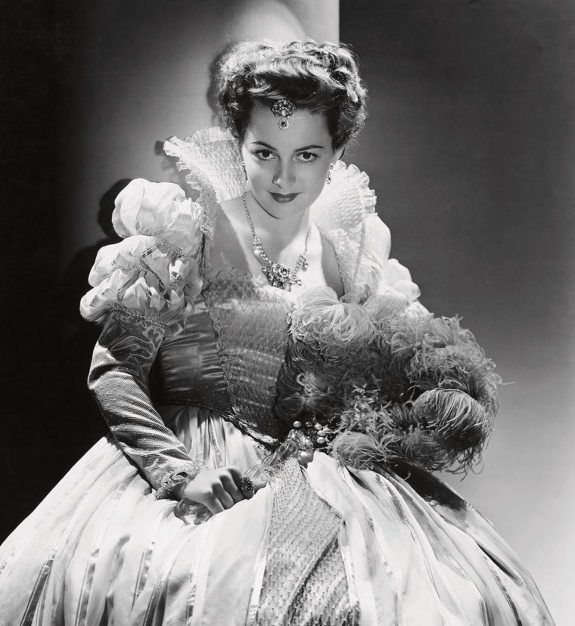
Olivia de Havilland as Penelope Gray in The Private Lives of Elizabeth and Essex


In order to defend herself and to explain the situation to her boss Jack Warner, Olivia wrote him the following letter on 18 July 1939. Long afterwards, Olivia said about the incident: "I lost my cool, which was not like me, and which is unforgivable." 

Incidentally, with "a certain man who means well" Olivia unmistakably refers to Michael Curtiz and the "famous blond actress" is Bette Davis. The Lady & the Knight was one of the film's working titles.


July 18, 1939

Dear Mr. Warner —

It is a shame that you are so busy this week that it is impossible to arrange a luncheon engagement. I should have enjoyed the experience so much.

There is something I would like to straighten out with you, something that is, I feel very important to both of us. I have not been at all happy about the situation that existed during The Lady & the Knight. I feel that a misunderstanding was created between us that had no business to be there. As you know, when you called me on the phone, full of indignation, I wanted to talk to you in person, rather than discuss so vital a matter through such an unsatisfactory medium, but you were busy or preferred not to do so ....

The first time you called, the conversation concerned my starting date on The Lady & the Knight. As I explained to you, I had, four weeks before, forseen the problems that would arise between the schedules of G.W.T.W. and The Lady & the Knight and had discussed the matter with Mr. Wallis, [co-producer] Mr. [Robert] Lord and Mr. Curtiz and come to a conclusion satisfactory to all of us. My principle in being concerned was simply this: I wanted to do a good job in G.W.T.W.  for it was a solemn responsiblity, & I wanted to do my best in The Lady & the Knight, for it is one of your big pictures for the year, & a bad performance on my part could weaken the film perceptibly. As you know it is impossible to perform two decided and different characters at the same time, so our problem was to work out the schedules so that they would not conflict ...

When I started my first important day's work on The Lady & the Knight, not having had a vacation since September, I was quite nervous, and as one always is on the first day of a picture, somewhat apprehensive of my first consequential scene. And that scene was a charming, well-written one, & I wanted to do it well.

I arrived at the studio at 6:45 A.M., shot a number of reaction shots beginning at 9. The morning passed, the afternoon passed, & finally at 5:30 P.M. with my nose shiny, my makeup worn off, my vitality gone, & my tummy doing nip-ups, we prepared to line up the charming scene. I mentioned that it was nearing six, that everyone was tired, and I hoped that we could shoot the scene another day since it required virtually no set. However, when the lights were arranged, at 6:15, with everything against me technically, I limped on the set prepared to go through with this thing. Unfortunately, to make matters much worse, I found that a certain man who means well wanted to get this charming scene over in a hurry — and then, bang! he said something very tactless, and to my horror I found myself shaking from head to foot with nerves, & unable to open my mouth for fear of crying— which would never do in front of so many people. The man, who meant well, realized he had gone too far, apologized, & dismissed the company assuring me that he could quite well shoot the scene another day for it required no set & could be done in a short time. He had said the same kind of thing a few days before to a famous blond actress who had gone home with the tears streaming down her face.

And someone went to you about all this! I know that if you had been present on that set, and had realized my problem, you would have dismissed the company rather than shoot that scene so late in the day. I know, too, that you understand that an actress, no matter how talented she is, is dependent very seriously upon her appearance & her vitality for the quality of her performance. When those two things leave her, whether it is after five years work or at the end of a day, she has nothing to rely on. And when I make suggestions to anyone at the studio, it is for the good of the whole ...

You have a tremendous business to conduct, one that you have built to astounding success & complexity, & your time is not to be wasted with trivialities. 

My very best wishes to you,

Olivia de Havilland 

Source: Inside Warner Bros. (1935-1951) (1985), selected and edited by Rudy Behlmer. 

Above: Olivia de Havilland and the "famous blond actress" in a scene from The Private Lives of Elizabeth and Essex. Below: Olivia and Mike Curtiz on the set of Captain Blood (1935), the first of nine films they did together. 

19 March 2023

If you are convinced, that is quite enough for me

Enticed by today's letter, I recently watched David Lean's Summertime (1955), a film I liked much more than anticipated. Based on the play The Time of the Cuckoo by Arthur Laurents, Summertime is the story of a lonely, middle-aged American woman who takes a holiday to Venice, where she falls in love with an Italian antiques dealer. The film was entirely shot on location in Venice during the peak tourist season in the summer of 1954, containing beautiful images of the city (shot in glorious Technicolor).

The lovely images of Venice aside, the main draw of the film is its leading lady, the inimitable Katharine Hepburn, who gives one of her finest performances as the insecure and vulnerable Jane Hudson. Following the completion of her MGM contract in 1952, Hepburn had spent two years relaxing and travelling before accepting the role in David Lean's film (being free now to choose her own projects). In the letter below to Lean, written on 11 January 1954, Katharine shows her excitement about the film and especially her excitement about working with Lean, of whom she was "a wild fan". Hepburn's sensitive performance eventually earned her an Oscar nomination but she lost to Anna Magnani for The Rose Tattoo. 

While David Lean directed such well-known classics as Brief Encounter (1945), The Bridge on the River Kwai (1957), Lawrence of Arabia (1962) and Doctor Zhivago (1965), of all the films he had made Summertime was his personal favourite. Katharine Hepburn was Lean's favourite actor to work with, and he once said about her: "She’s a joy. She’s a wonderful technician and she has I think a great, great gift. On top of that, I happen to like her very much personally. She’s a great human being." 

Above: A scene from Summertime with Katharine Hepburn as Jane Hudson and Rossano Brazzi as Renato de Rossi, the man she falls in love with. Below: Hepburn is dripping wet after doing the scene where she falls into the canal; here she is pictured with director David Lean. Hepburn performed her own stunt and ended up with a chronic eye infection.

Source: liveauctioneers

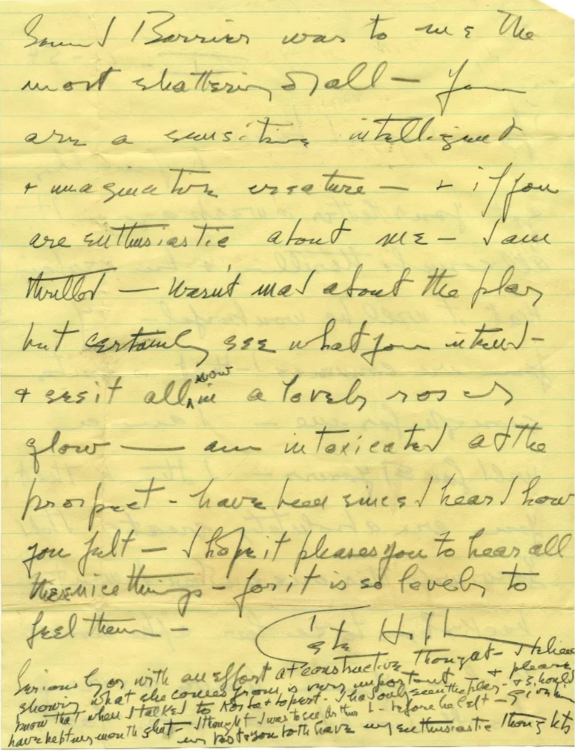
Transcript:

 I - 11 - 54

Dear David Lean - 

I finally got your letter a week ago - It all sounds thrilling + I'm certain that it will be wonderful - If you are convinced - that is quite enough for me - I am a wild fan of yours - I think that you are absolutely great - I told your wife [Ann Todd] this once when I went backstage to see her after Seventh Veil - You have never disillusioned me - In fact Sound Barrier was to me the most shattering of all - You are a sensitive intelligent + imaginative creature - + if you are enthusiastic about me - I am thrilled - wasn't mad about the play but certainly see what you intend - + see it all now in a lovely rosy glow - am intoxicated at the prospect - have read since I heard how you felt - I hope it pleases you to hear all these nice things - for it is so lovely to feel them - 

Kate Hepburn

Seriously or with all effort at constructive thought - I believe showing what she comes from is very important - + please know that when I talked to [art director Vincent] Korda + [producer Ilya] Lopert - I had only seen the play - + should have kept my mouth shut - I thought I was to see [playwright] Arthur L[aurents]- before he left - Give him our best + you both have my enthusiastic thoughts.

David Lean and Katharine Hepburn on the set of Summertime. Like Hepburn, Lean had received an Oscar nomination for Summertime but he lost to Delbert Mann for Marty.


15 March 2023

My dear Elvis

On this day —exactly 56 years ago— Joan Crawford wrote the following letter to Elvis Presley. While spending a few days on the MGM lot for the television series The Man from UNCLE (in which she had a guest role), Joan had met with Elvis' manager Colonel Parker while Elvis himself was out of town. In her letter, Joan thanks Elvis for his and Colonel Parker's kindness towards her, including being allowed the use of Elvis' golf cart. Incidentally, knowing they never made a film together, I searched for a connection between Joan and Elvis but found none (perhaps Joan was just a fan?). There was a link, however, between Elvis and Joan's daughter Christina. Christina had a small role in one of Elvis' films, Wild in the Country (1961), and off the set an incident between her and Elvis occurred, which you can read about here.

Source: The Best of Everything: A Joan Crawford Encyclopedia

7 March 2023

If you don't win the Academy Award, I'll drown my children

In Love Me Or Leave Me (1955) James Cagney played a gangster for the last time in his career. Directed by Charles Vidor, the film is based on the life story of singer Ruth Etting, focusing on her tempestuous relationship with mobster Martin "The Gimp" Snyder, who was her manager and helped her reach stardom. As "The Gimp", Cagney gave a powerful and nuanced performance, one that was praised by many, including fellow actor Dick Powell in the letter below. Cagney's performance garnered him an Oscar nomination, but he eventually lost to Ernest Borgnine for Marty

James Cagney and Doris Day in a scene from Love Me or Leave Me. While Doris shines as Ruth Etting in what was probably the best dramatic performance of her career, she was (shamefully) overlooked by the Academy, not even being nominated.

Source: Heritage Auctions
James Cagney with Dick Powell and Powell's then-wife June Allyson during the Academy Awards ceremony, Los Angeles, 1950. Cagney and Powell made one film together, Footlight Parade (1933).


4 March 2023

He is gradually losing his identity ...

In the early 1930s, Ann Harding was one of the most popular actresses in Hollywood. After several Broadway successes, Ann had made her film debut in 1929 with Paris Bound, followed by films such as Holiday (1930), The Animal Kingdom (1932), When Ladies Meet (1933) and Double Harness (1933). In 1926, Ann had married actor Harry Bannister, with whom she'd performed on the stage and subsequently played in two films, Her Private Affair (1929) and The Girl of the Golden West (1930). While Ann became a major star, husband Bannister never made it as an actor. It was Ann's success and Bannister's lack thereof that eventually led to their divorce.

In March 1932 Harding and Bannister, whose marriage was looked upon as one of the happiest in Hollywood, announced their divorce to the press. The couple felt a divorce was the only solution to the "untenable" situation they found themselves in. In the following letter to Brian Bell from the Associated Press, Ann gives her explanation for the divorce, saying how her husband was "gradually losing his identity, becoming a background for [her] activities, and looked upon as "Ann Harding's husband"". Bannister added in a separate statement: "During the five and a half years I have been married to Ann Harding, I have had the love and respect and devotion of the very great and lovely person who is my wife. Therefore, in order to preserve this in its entirety, we find the apparently drastic course of divorce the quickest and best solution to our eventual complete happiness." 

Source: Ebay


Following the divorce, however, the relationship between Ann and Bannister took a turn for the worse. Bannister's career wouldn't take off —despite the couple's initial hopes and expectations— and for years the two would be entangled in a bitter custody battle over their daughter Jane. The divorce also caused Ann to be hounded by the press, which made her stop speaking to the press altogether. (About Ann's unwillingness to talk to journalists, you can read more here.)

Above: Ann Harding with Harry Bannister and their daughter Jane. Below: Harding and Bannister in  Her Private Affair. 

24 February 2023

How dear of you to write with such warmth and affection

Audrey Hepburn and Merle Oberon were friends and, at different points in time, both romantically linked to the same man, Dutch actor Robert Wolders. In 1973, Merle met Wolders during production of the film Interval and they fell in love (Wolders being 25 years younger than Merle). At the time Merle was still married to Italian industrialist Bruno Pagliai, whom she divorced that same year. Merle and Wolders tied the knot in 1975, their marriage lasting until Merle's death from a stroke in 1979, at age 68. 

Audrey was still officially married to Italian psychiatrist Andrea Dotti when she and Wolders entered into a relationship in 1980. The two had met the year before at a dinner party while Wolders was still grieving over Merle's death. Audrey and Wolders were together for 13 years when Audrey died from cancer in 1993 (aged 63). In 1989, she described her years with Wolders as the happiest of her life. Following Audrey's death, Wolders briefly dated Leslie Caron before starting a long-term relationship with Henry Fonda's widow Shirlee (from 1995 until Wolder's own death in 2018). About the women in his life Wolders said in a 2012 interview: "The odd thing is that Shirlee was a great friend of Audrey, and a great friend of Merle. In the same circle. Maybe it sounds odd. They were friends, each one, and I knew that Merle would have approved of me being with Audrey certainly ... And Audrey would have approved of Shirlee."

Robert Wolders with Merle Oberon (above) and Audrey Hepburn (below)

Rewind to the spring of 1969, long before Robert Wolders would enter the picture. Merle was married to Bruno Pagliai (and living with him in Mexico) and Audrey had just married Andrea Dotti a few months earlier. In the letter below from Audrey to Merle, Audrey talks about her new-found happiness with Dotti. Sean, whom Audrey mentioned, was her son by first husband Mel Ferrer.

Audrey Hepburn and Andrea Dotti, who were married from 1969 until 1982. They had one son, Luca (born 1970).


Transcript:

11 April 69

tel. 655.370

Dearest Merle,

Returned last night from a snowy lovely holiday with Doris [Brynner] in St. Moritz to find your adorable letter here.

How dear of you to write with such warmth and affection.

Yes I am so happy and relaxed and every moment of the day has become so marvellous. 

I have the dearest most wonderful most loving husband and he's bright and funny, and dear with Sean and ... and... and I am so blessed and know it every second which is so good. 

Would love to come and see you one day ... it sounds so romantic.

Thank you, thank you and a huge HUG.

Till soon -
Audrey

17 February 2023

I have no flexibility below the ass at all

Married to the daughter of comedienne/singer/actress Fanny Brice, producer Ray Stark wanted to make a musical about his mother-in-law. The musical he eventually made was Funny Girl, written by Isobel Lennart, with music by Jule Styne and lyrics by Bob Merrill. Cast as Fanny Brice was 22-year-old Barbra Streisand (whose Broadway debut in I Can Get It for You Wholesale had been a big success), while Sydney Chaplin was cast in the role of Brice's husband Nick Arnstein. Funny Girl first opened on Broadway in March 1964 and became a critical and commercial hit, prompting producer Stark a year later to start preparations for the film version.  

Sharif and Streisand in Funny Girl
Despite being a sensation on Broadway, Barbra Streisand had yet to make her screen debut. For the film, Columbia Pictures wanted a more established star and instead of Streisand chose Shirley MacLaine to play the lead. Ray Stark, however, wanted nobody but Barbra, even refusing to make the film if she was not cast. The studio eventually gave in to Stark's demand and Barbra got the part, giving a marvellous performance and earning the Oscar for Best Actress (in a tie with Katharine Hepburn for The Lion in Winter). 

For the role of gambler Nick Arnstein, several actors were considered, including Sean Connery, James Garner, David Janssen, Gregory Peck and Paul Newman. Composer Jule Styne wanted Frank Sinatra but Stark found him too old for the part. Also, Sinatra demanded too high a salary $750,000 against Barbra's $200,000— ánd top billing (being the star of the film, Barbra refused to take second billing). In the end, Egyptian actor Omar Sharif, who had recently starred in the successful Doctor Zhivago (1965), was cast opposite Streisand at a salary of $50,000.

Like the original Broadway production, the film Funny Girl (1968), directed by veteran William Wyler, was a major success, both critically and commercially. It became the highest-grossing film of 1968 in the USA and received eight Academy Award nominations with, as said, Streisand winning the Oscar for Best Actress.

Barbra Streisand on the set of Funny Girl with (above) producer Ray Stark and (below) director William Wyler.

As mentioned above, Paul Newman was one of the actors approached to play Nick Arnstein. Newman, however, felt he was not right for the part and declined via this funny letter, written to Ray Stark and William Wyler in May 1967.


Although Paul Newman and Barbra Streisand never played in a film together, they were professionally linked in a different way. In June 1969, Newman and Streisand along with Sidney Poitier (all three pictured above) founded the production company First Artists in order to have more creative control over their own projects (one of the films the company produced was A Star Is Born (1976)). First Artists eventually ceased to operate in 1980 and was sold to Warner Brothers.