
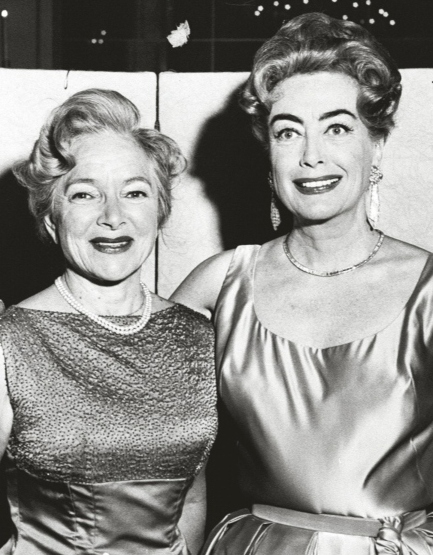
Helen Hayes and Joan Crawford became friends in the 1930s. In her (third) memoir My Life in Three Acts (1990) Hayes said that Joan had adopted her as her best friend, despite the fact that they were very different. Joan probably didn't feel threatened by her, Helen thought, not considering her a rival. In any case, Helen was fascinated by the glamorous Joan and the two women entered into an unlikely friendship.

According to her memoir, Hayes didn't see much of Joan anymore after Joan became involved with Pepsi-Cola, while Hayes herself was busy working in the theatre. (In 1955, Joan married Alfred Steele, president of Pepsi-Cola, and after Steele's death four years later she became a board member of Pepsi, to eventually retire in 1973.) Nevertheless, the women would still meet on occasion and also sent each other telegrams/letters. In her 1962 autobiography, Joan said that she and Helen were "staunch friends, sometimes only by letter". Below is some of Helen's correspondence to Joan from the 1970's, clearly showing that Joan never forgot her friends. .jpg) |
| Sources: letter above left The Concluding Chapter of Crawford and the two other letters The Best of Everything: A Joan Crawford Encyclopedia |

"Joan was not quite rational in her raising of children. You might say she was strict or stern. But cruel is probably the right word. [...]
When my young son Jim came to stay with me, we would go out to lunch with them [Joan and her son Christopher]. Joan would snap, “Christopher!” whenever he tried to speak. He would bow his little head, completely cowed, and then he’d say, “Mommie dearest, may I speak?” Joan’s children had to say [that] before she allowed them to utter another word. It would have been futile for me or anyone else to protest. Joan would only get angry and probably vent her rage on the kids.
On one of my Hollywood trips about this time, I ran into Dinah Shore in the hairdressing department of MGM. She beckoned me to come over, and then began talking in a whisper. “Helen, everybody knows that you’re Joan Crawford’s close friend. Can you do something about her treatment of those children? We’re all worried to death.” ... Well, I was frightened to do it. We were all afraid of Joan – which is the biggest problem in this kind of situation, as we’ve seen with fatal results. No one would speak up.
I have read that people who are abused as children often become abusive parents. Maybe it was Joan’s tough childhood that made her exert her power like that over her own children. But understanding the reason did not make their suffering any easier to watch."
 |
| (l to r) ca. 1956, Helen Hayes, Alfred Steele, Joan Crawford and James MacArthur; Steele was Joan's fourth husband and MacArthur was Hayes' adopted son. |
Interesting stuff! I had no idea that Helen Hayes and Joan Crawford were friends. These letters are lovely.
ReplyDeletethanks for visiting!
DeleteIt's definitely generational, to a degree I suppose?
ReplyDeleteHello. I've been reading your fascinating blog, immensely enjoyed the GWTW/Norma Shearer post as she is my all-time favorite actress (not on merit especially, but because I feel good every time I watch her in anything). Now, to the matter of this blog entry. I believe Christina, and I come to it from a unique angle. My mother was undiagnosed unmedicated bipolar, we found out after she died and we had her blood tested as all 3 of her brother's sons were diagnosed and told it was the hereditary kind. I read the book and saw immediately my own childhood. The coat hangers, hairbrush, all were used on me out of frustration late at night when my father was asleep. Also much of the verbal abuse as well. So I believe Joan, too, was bipolar. My mother had a flawless career as a teacher and while she was famous for her temper, she kept the worst behavior just for me, told me never to tell, threatened me and so I never did. Years later, my brother confessed he'd seen her do her thing to me many times and I was relieved and thankful to know that someone believed me. He unfortunately became a bigger bully to her bullying and it has affected his relationships, but he did it so she wouldn't treat him the same way. I did therapy and now forgive my mom and even empathize because her own mother was probably bipolar as well and treated her worse. What I'm saying is, unless you have personally experienced it, you have no idea and the mind rejects it as impossible. But if you are me, reading Christina's words, you know in your gut and soul no one could make that up, it was lived. Her book helped me feel less alone. What she did was very brave, even if assuming the worse, she retaliated for being left out of the will, it was probably like, you did this to me and I won't keep your secrets anymore, I will have to earn money you denied so I will do it with a confession your horrible behavior. That kind of thing. Doesn't make it a lie. Thank you for reading and I hope to continue reading through this wonderful collection of memories.
ReplyDeleteThanks for sharing your personal story.
Delete