![]() |
| Fred MacMurray with the inimitable Edward G. Robinson who plays clever insurance investigator Barton Keyes. |
![]() |
| A fragment of MacMurray's letter |
![]() |
| Cain (left) and MacMurray |
![]() |
| Source: icollector.com |
![]() |
| Fred MacMurray with the inimitable Edward G. Robinson who plays clever insurance investigator Barton Keyes. |
![]() |
| A fragment of MacMurray's letter |
![]() |
| Cain (left) and MacMurray |
![]() |
| Source: icollector.com |
When in early November 1941 Carole Lombard started filming To Be Or Not To Be (1942), it had been a year since she made her last film (i.e. Alfred Hitchcock's Mr. & Mrs. Smith (1941)). Lombard was quite happy focusing on her home and marriage to Clark Gable and was selective in choosing her projects. In a letter to her friends, socialites and polo stars Babs and Eric Tyrell-Martin, dated 29 November 1941, Lombard writes how she is "not career minded at all any more", being mostly concerned with pleasing her husband. The letter was written just six weeks before Lombard would meet her untimely death in a plane crash on 16 January 1942, returning home after a war bond rally. To Be Or Not To Be was released after Lombard's death, the film reportedly the happiest experience of her career.
![]() |
| Source: RR Auction |
Olivia de Havilland was still working on Gone with the Wind (1939) when she started filming The Private Lives of Elizabeth and Essex (1939). She had a minor role in the latter film as the queen's lady-in-waiting, playing third fiddle to Bette Davis and Errol Flynn and being billed below the title. It is said that casting Olivia in such an inferior role was Jack Warner's way of punishing her for doing David Selznick's GWTW. Warner, head of Warner Brothers and Olivia's boss, was at first unwilling to loan her out to Selznick, but Olivia was adamant about playing Melanie. In violation of her contract with Warners, the actress had secretly screentested for GWTW, and next secretly contacted Warner's wife Ann, pleading with her to make Warner change his mind. Persuaded by his wife, Warner eventually agreed to the loan-out but ordered producer Hal Wallis to cast Olivia in a secondary role on her return to Warners.
In early May 1939 —while still having to shoot retakes for GWTW— Olivia reported for work at Warners and later recalled that it was "torture for [her], leaving this wonderful atmosphere at Selznick for a very different atmosphere at Warner Brothers". A month later, on 10 June, an incident occurred on the set of Elizabeth and Essex, where Olivia had to do a scene but lost her usual calm in front of the cast and crew. The incident involved Warners' contract director Michael Curtiz, whom Olivia disliked working with (read more here). In a memo to production manager T.C. Wright, unit manager Frank Mattison described what had happened:
I had [a] display of temperament late SATURDAY afternoon from Miss DeHAVILLAND; to wit— at 5:15 PM when we started to rehearse a scene between her and Miss FABERES [Nanette Fabray], she informed Mr. Curtiz that she positively was going to stop at 6:00 PM, but Mr. Curtiz told her that unless she stayed and finished the sequence he positively would cut it out of the picture. Miss DeHAVILLAND expressed herself before the company and Mr. Curtiz came right back, with the result that it became necessary for me to dismiss the company at 6:15 without shooting this sequence.
Inasmuch as this sequence of 2 pages was inserted at Miss DeHAVILLAND's request, I believe that we definitely should not shoot it and uphold Mr. Curtiz in the matter. I think this will put Miss DeHAVILLAND in a proper frame of mind so that she will take direction and instruction hereafter.
[The scene was later shot and included in the film.]
Source: Inside Warner Bros. (1935-1951) (1985), selected and edited by Rudy Behlmer.
![]() |
| Olivia de Havilland as Penelope Gray in The Private Lives of Elizabeth and Essex |
July 18, 1939
Dear Mr. Warner —
It is a shame that you are so busy this week that it is impossible to arrange a luncheon engagement. I should have enjoyed the experience so much.
There is something I would like to straighten out with you, something that is, I feel very important to both of us. I have not been at all happy about the situation that existed during The Lady & the Knight. I feel that a misunderstanding was created between us that had no business to be there. As you know, when you called me on the phone, full of indignation, I wanted to talk to you in person, rather than discuss so vital a matter through such an unsatisfactory medium, but you were busy or preferred not to do so ....
The first time you called, the conversation concerned my starting date on The Lady & the Knight. As I explained to you, I had, four weeks before, forseen the problems that would arise between the schedules of G.W.T.W. and The Lady & the Knight and had discussed the matter with Mr. Wallis, [co-producer] Mr. [Robert] Lord and Mr. Curtiz and come to a conclusion satisfactory to all of us. My principle in being concerned was simply this: I wanted to do a good job in G.W.T.W. for it was a solemn responsiblity, & I wanted to do my best in The Lady & the Knight, for it is one of your big pictures for the year, & a bad performance on my part could weaken the film perceptibly. As you know it is impossible to perform two decided and different characters at the same time, so our problem was to work out the schedules so that they would not conflict ...
When I started my first important day's work on The Lady & the Knight, not having had a vacation since September, I was quite nervous, and as one always is on the first day of a picture, somewhat apprehensive of my first consequential scene. And that scene was a charming, well-written one, & I wanted to do it well.
I arrived at the studio at 6:45 A.M., shot a number of reaction shots beginning at 9. The morning passed, the afternoon passed, & finally at 5:30 P.M. with my nose shiny, my makeup worn off, my vitality gone, & my tummy doing nip-ups, we prepared to line up the charming scene. I mentioned that it was nearing six, that everyone was tired, and I hoped that we could shoot the scene another day since it required virtually no set. However, when the lights were arranged, at 6:15, with everything against me technically, I limped on the set prepared to go through with this thing. Unfortunately, to make matters much worse, I found that a certain man who means well wanted to get this charming scene over in a hurry — and then, bang! he said something very tactless, and to my horror I found myself shaking from head to foot with nerves, & unable to open my mouth for fear of crying— which would never do in front of so many people. The man, who meant well, realized he had gone too far, apologized, & dismissed the company assuring me that he could quite well shoot the scene another day for it required no set & could be done in a short time. He had said the same kind of thing a few days before to a famous blond actress who had gone home with the tears streaming down her face.
And someone went to you about all this! I know that if you had been present on that set, and had realized my problem, you would have dismissed the company rather than shoot that scene so late in the day. I know, too, that you understand that an actress, no matter how talented she is, is dependent very seriously upon her appearance & her vitality for the quality of her performance. When those two things leave her, whether it is after five years work or at the end of a day, she has nothing to rely on. And when I make suggestions to anyone at the studio, it is for the good of the whole ...
You have a tremendous business to conduct, one that you have built to astounding success & complexity, & your time is not to be wasted with trivialities.
My very best wishes to you,
Olivia de Havilland
Source: Inside Warner Bros. (1935-1951) (1985), selected and edited by Rudy Behlmer.
Enticed by today's letter, I recently watched David Lean's Summertime (1955), a film I liked much more than anticipated. Based on the play The Time of the Cuckoo by Arthur Laurents, Summertime is the story of a lonely, middle-aged American woman who takes a holiday to Venice, where she falls in love with an Italian antiques dealer. The film was entirely shot on location in Venice during the peak tourist season in the summer of 1954, containing beautiful images of the city (shot in glorious Technicolor).
Source: liveauctioneers
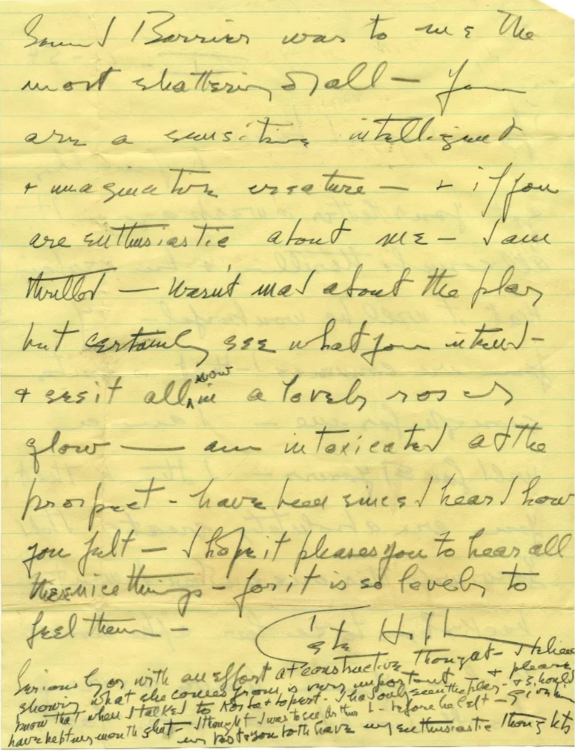
Transcript:
I - 11 - 54
Dear David Lean -
I finally got your letter a week ago - It all sounds thrilling + I'm certain that it will be wonderful - If you are convinced - that is quite enough for me - I am a wild fan of yours - I think that you are absolutely great - I told your wife [Ann Todd] this once when I went backstage to see her after Seventh Veil - You have never disillusioned me - In fact Sound Barrier was to me the most shattering of all - You are a sensitive intelligent + imaginative creature - + if you are enthusiastic about me - I am thrilled - wasn't mad about the play but certainly see what you intend - + see it all now in a lovely rosy glow - am intoxicated at the prospect - have read since I heard how you felt - I hope it pleases you to hear all these nice things - for it is so lovely to feel them -
Kate Hepburn
Seriously or with all effort at constructive thought - I believe showing what she comes from is very important - + please know that when I talked to [art director Vincent] Korda + [producer Ilya] Lopert - I had only seen the play - + should have kept my mouth shut - I thought I was to see [playwright] Arthur L[aurents]- before he left - Give him our best + you both have my enthusiastic thoughts.
![]() |
| David Lean and Katharine Hepburn on the set of Summertime. Like Hepburn, Lean had received an Oscar nomination for Summertime but he lost to Delbert Mann for Marty. |
On this day —exactly 56 years ago— Joan Crawford wrote the following letter to Elvis Presley. While spending a few days on the MGM lot for the television series The Man from UNCLE (in which she had a guest role), Joan had met with Elvis' manager Colonel Parker while Elvis himself was out of town. In her letter, Joan thanks Elvis for his and Colonel Parker's kindness towards her, including being allowed the use of Elvis' golf cart. Incidentally, knowing they never made a film together, I searched for a connection between Joan and Elvis but found none (perhaps Joan was just a fan?). There was a link, however, between Elvis and Joan's daughter Christina. Christina had a small role in one of Elvis' films, Wild in the Country (1961), and off the set an incident between her and Elvis occurred, which you can read about here.
![]() |
| Source: The Best of Everything: A Joan Crawford Encyclopedia |
![]() |
| Source: Heritage Auctions |
![]() |
| James Cagney with Dick Powell and Powell's then-wife June Allyson during the Academy Awards ceremony, Los Angeles, 1950. Cagney and Powell made one film together, Footlight Parade (1933). |
In the early 1930s, Ann Harding was one of the most popular actresses in Hollywood. After several Broadway successes, Ann had made her film debut in 1929 with Paris Bound, followed by films such as Holiday (1930), The Animal Kingdom (1932), When Ladies Meet (1933) and Double Harness (1933). In 1926, Ann had married actor Harry Bannister, with whom she'd performed on the stage and subsequently played in two films, Her Private Affair (1929) and The Girl of the Golden West (1930). While Ann became a major star, husband Bannister never made it as an actor. It was Ann's success and Bannister's lack thereof that eventually led to their divorce.
![]() |
| Source: Ebay |
Audrey Hepburn and Merle Oberon were friends and, at different points in time, both romantically linked to the same man, Dutch actor Robert Wolders. In 1973, Merle met Wolders during production of the film Interval and they fell in love (Wolders being 25 years younger than Merle). At the time Merle was still married to Italian industrialist Bruno Pagliai, whom she divorced that same year. Merle and Wolders tied the knot in 1975, their marriage lasting until Merle's death from a stroke in 1979, at age 68.
Audrey was still officially married to Italian psychiatrist Andrea Dotti when she and Wolders entered into a relationship in 1980. The two had met the year before at a dinner party while Wolders was still grieving over Merle's death. Audrey and Wolders were together for 13 years when Audrey died from cancer in 1993 (aged 63). In 1989, she described her years with Wolders as the happiest of her life. Following Audrey's death, Wolders briefly dated Leslie Caron before starting a long-term relationship with Henry Fonda's widow Shirlee (from 1995 until Wolder's own death in 2018). About the women in his life Wolders said in a 2012 interview: "The odd thing is that Shirlee was a great friend of Audrey, and a great friend of Merle. In the same circle. Maybe it sounds odd. They were friends, each one, and I knew that Merle would have approved of me being with Audrey certainly ... And Audrey would have approved of Shirlee."
![]() |
| Robert Wolders with Merle Oberon (above) and Audrey Hepburn (below) |
Rewind to the spring of 1969, long before Robert Wolders would enter the picture. Merle was married to Bruno Pagliai (and living with him in Mexico) and Audrey had just married Andrea Dotti a few months earlier. In the letter below from Audrey to Merle, Audrey talks about her new-found happiness with Dotti. Sean, whom Audrey mentioned, was her son by first husband Mel Ferrer.
![]() |
| Audrey Hepburn and Andrea Dotti, who were married from 1969 until 1982. They had one son, Luca (born 1970). |
![]() |
| Sharif and Streisand in Funny Girl |
![]() |
| Barbra Streisand on the set of Funny Girl with (above) producer Ray Stark and (below) director William Wyler. |
Despite being a prolific letter writer, Groucho Marx didn't write to his brothers often. There was little need to write letters as the brothers spoke to each other regularly, either in person or on the phone. It was a treat then to come across this post's letter, written by Groucho to his brother Chico, originally published in 1942 in a column for The Hollywood Reporter. (The column —Tales of Hoffman— was run by Groucho's friend Irving Hoffman, with Groucho being a regular contributor to Hoffman's column.) Written in Groucho's usual funny way, the letter was a reaction to Chico's failure to answer the letters Groucho had sent him. Considering the fact that Chico was no letter writer at all, it's quite possible that Groucho never received an answer to this letter either.
Incidentally, Groucho and Chico —the eldest of the Marx Brothers and Groucho's senior by three years— had a strained relationship, one that was "marked by jealousy and resentment" (according to Groucho biographer Hector Arce). Chico had been their mother's favourite, and while he had become a compulsive gambler by the age of nine and was always running into trouble, he usually got away with it. "[Groucho] was always trying to be the good son, while I was busy being the bad one", Chico once said, "yet Minnie always forgave me and loved me and was never that way with Grouch." Groucho was a natural-born worrier while Chico was the eternal optimist. In the end, it was Chico's optimism and his bold approach to life that had made the Marx Brothers move from the vaudeville circuit to Broadway and ultimately to Hollywood. (Groucho later recalled: "Harpo [the brother Groucho felt closest to] and I were always very timid. We didn't think we would ever be successful. But Chico was a gambler and he felt differently ... He gave us courage and confidence.")
![]() |
| Groucho (l) and his brother Chico on the set of A Day at the Races (1937) |
Dear Chico:
Our correspondence is becoming increasingly strained and I can only attribute it to the curious and mystifying ways you have of answering your mail. In the past three weeks I have written you three times. In return you have sent me a package of cheese, a small barrel of herring and a smoked tongue. These are eloquent answers—much stronger than words—but you must admit they are difficult to decode unless one has spent his early years as a delicatessen apprentice. What is this unholy terror you have for the written word? Were you once scared by a vowel or a consonant?
Words, in case you don’t know, are beautiful. Keats, Shelley and Conrad enriched and gladdened the whole world with words. Is it possible that your odd method of correspondence is more effective? Have you stumbled on something that will replace all the beautiful poems and love sonnets of the centuries? I only ask you this because I’ve heard it told that you conduct your romances in the same manner. It is well known that for years you left a trail of broken hearts and sawn-off shotguns from the Orpheum Theatre in Bangor to the Pantages Theatre in San Diego. Is delicatessen your secret weapon? Do you send soft cheese where others send orchids? When a love-sick girl sends you a perfume-scented note pleading for your kisses, I understand your answer is three slices of pumpernickel. I don’t say that this last present may not be just what she needs, but you must concede it’s a novel slant on a subject that has bewildered experts since Adam and Eve. Romeo was considered quite a lover in his day but I’m sure Juliet’s love for him would have wavered had it reeked so strongly of the pickle barrel. But then your views on love and life have always been unique and bizarre and I guess on you, it looks good.
Unless you answer this letter and I don’t mean with delicatessen, groceries or alphabet soup, but with plain words (the dictionary, by the way, is full of them) it will be necessary for me to reduce my correspondence to the same level and my answers in the future will consist of shoe-string potatoes, salamis and apple strudel.
Love and garlic from the Hebrew National, Woloshin’s, Levitoff’s, Isaac Gellis’s, Greenblatt’s and Rubin’s.
Yours,
Groucho
Source: Groucho Marx and Other Short Stories and Tall Tales: Selected Writings of Groucho Marx (1993), by Groucho Marx, edited by Robert S. Bader. Letter originally published in the column Tales of Hoffman, Hollywood Reporter, 29 August 1942.
![]() |
| 1937, Los Angeles - Chico and Groucho Marx in court for copyright infringement of a radio script, a case they eventually lost. |
Mayer also helped Barrymore with a different problem. After a broken hip injury in 1936 combined with his arthritis, Barrymore was always in pain and by 1938 he was confined to a wheelchair. In order to cope with the pain Mayer provided Barrymore with cocaine ("L.B. gets me $400 worth of cocaine a day to ease my pain. I don’t know where he gets it. And I don't care. But I bless him every time it puts me to sleep.").
Barrymore remained a MGM contract player during his entire film career and was only occasionally loaned out to other studios.
Dissatisfied with the roles MGM offered her, Joan Crawford left the studio in June 1943 after having been a contract player for 18 years. Two days later, she signed a contract with Warner Bros for only a third of her MGM salary. Her first film at Warners was The Hollywood Canteen (1944), in which Joan and a lot of other stars appeared in cameo roles. Joan was next offered several roles by Warners but, much to the studio's dismay, declined them all. Then Mildred Pierce (1945) came along and Joan was quite eager to play the titular role. While director Michael Curtiz wanted Barbara Stanwyck and Bette Davis was Warners' first choice, Joan was cast after Bette turned down the part. Mildred Pierce proved to be both a success and the boost Joan's career needed, with Joan eventually winning the Academy Award for Best Actress.
In the years that followed, Joan made several other films for Warner Bros —Humoresque (1946), Possessed (1947), Flamingo Road (1949), It's a Great Feeling (1949), The Damned Don't Cry (1950), Goodbye, My Fancy (1951) and This Woman Is Dangerous (1952). After finishing the latter film, which she later called the worst picture of her career, Joan asked Warner Bros to release her from her contract.
Five years prior to the termination of Joan's contract, studio boss Jack Warner was contemplating to "drop" Joan, as the following telegram to the studio's vice-president Samuel Schneider shows. Later Warner decided against it and kept Joan on his payroll a while longer.
Incidentally, Warner calls Humoresque and Possessed "failures", while both films did well at the box-office.
DECEMBER 15, 1947
TO SCHNEIDER STRICTLY CONFIDENTIAL
FROM PRESENT INDICATIONS APPEARS TO ME WE GOING HAVE LOT TROUBLE WITH JOAN CRAWFORD, TEMPERAMENT AND SUCH THINGS ... MAY HAVE SUSPEND HER THIS WEEK. SECONDLY, WHAT DO YOU THINK OF DROPPING HER ENTIRELY. WE HAD SEMI FAILURE IN "HUMORESQUE" AND EXCEPTIONAL FAILURE IN "POSSESSED". INSTEAD WORRYING ABOUT HER COULD BE DEVOTING MY TIME TO WORTHWHILE PRODUCTIONS AND NEW PERSONALITIES ... HOWEVER, THIS ONLY WAY I FEEL TODAY. IF SHE STRAIGHTENS OUT BY END WEEK MAY NOT FEEL THIS WAY BUT FACTS MUST BE FACED AS THESE THINGS TAKE ALL YOUR TIME.
Source: Inside Warner Bros. (1935-1951) (1985), selected and edited by Rudy Behlmer.
![]() |
| Circa 1935: Joan Crawford chats with Jack Warner at a dinner party (seated next to Joan are Cesar Romero, Sonja Henie and Michael Brook). |
![]() |
| Laughton in 1933 |
MAY 17 1934
LONDON
TO: L.B. MAYER
...MUST KNOW WHAT CHANCE CHARLES LAUGHTON FOR ROLE OF MICAWBER. FEEL MORE THAN EVER VITAL IMPORTANCE OF BENDING EVERY EFFORT TO SECURE HIM, BUT MUST KNOW WITHIN FEW DAYS SO CAN DECIDE WHETHER TO SIGN ANOTHER MICAWBER. IF LAUGHTON UNAVAILABLE FOR MICAWBER, MIGHT LIKE W.C. FIELDS. CAN WE GET HIM? TO AVOID NECESSITY OF TRYING PARAMOUNT, THINK WE SHOULD GET WORD TO FIELDS DIRECT, WHO WOULD PROBABLY GIVE EYE TOOTH TO PLAY MICAWBER ... CORDIALLY
DAVID
SEPTEMBER 27, 1934
J. ROBERT RUBIN1540 BROADWAYNEW YORK, N.Y.CONFIDENTIALLY, ENTIRELY POSSIBLE WE WILL NOT, IN SPITE OF EVERYTHING WE WENT THROUGH, BE ABLE USE CHARLES LAUGHTON IN "COPPERFIELD" BECAUSE HIS ILLNESS HAS DELAYED HIS PARAMOUNT PICTURE AND IF WE WAITED UNTIL HE FINISHED THAT, COST WOULD BE IMPOSSIBLE. ALSO WE ARE HAVING CERTAIN DIFFICULTIES WITH HIM. WHAT I WOULD LIKE TO KNOW IMMEDIATELY IS WHETHER IF IT COMES TO ISSUE, HOW MUCH DIFFERENCE COMMERCIALLY WOULD THERE BE HAVING W.C. FIELDS INSTEAD OF LAUGHTON? IT OF COURSE NOT CERTAIN WHETHER WE CAN OBTAIN FIELDS, BUT AM RAISING QUESTION IN HOPE WE COULD. FIELDS WOULD PROBABLY MAKE BETTER MICAWBER, BUT WE'VE ALWAYS FELT WE REQUIERED THE ONE IMPORTANT NAME IN CAST IN LAUGHTON. WOULD YOU CHECK THIS IMMEDIATELY WITH FOREIGN AND DOMESTIC SALES DEPARTMENTS AND ADVISE ME. REGARDS
DAVID SELZNICK
Source: Memo from David O. Selznick (1972); selected and edited by Rudy Behlmer.