31 March 2020

It is a completely enjoyable film, full of fun and YOU

While Billy Wilder's Some Like It Hot (1959) is now regarded as one of the greatest comedies ever made, at the time its leading lady Marilyn Monroe was less enthusiastic about the film. Marilyn had shared her disappointment over the finished film with her close friend, poet/ playwright Norman Rosten, and in response Rosten wrote her a brief letter in an attempt to cheer her up (seen below). Despite Marilyn's own feelings regarding Some Like It Hot and her role in it, the film became a huge critical and commercial success, with Marilyn's comedic performance now considered one of the best of her career (for which she even won a Golden Globe).

Incidentally, Some Like It Hot is a recommended comfort film to watch or re-watch during these difficult times. Stay safe!


Source: Julien's Live

Transcript: 

Marilyn dear -

About the movie - don't jump!

Look at it this way: it is a completely enjoyable film, full of fun and YOU.

It is not a starring vehicle for you because the story is simply not set up that way - which is either a shame or a crime, depending on how you feel. I feel it's a shame you didn't get more to do, and better lines for what you did do.

BUT (that necessary word) nothing could really destroy your wonderful quality that gives the film the one touch of "seriousness" (humanity) it needs for any sort of balance.

It will not hurt you one little bit, and let everyone be more watchful the next time. That is all and when are you wearing that dress again?

Philosopher Claude
(signed "N")

handwritten (Did you get my red rose?)


24 March 2020

You are a very good friend

Just a sweet little note from a friend to a friend. Ava Gardner and George Cukor were good friends -- Cukor seemed to have been friends with a lot of people in Hollywood -- and this note was written by Ava to Cukor in September 1973. The two worked together only once, on Bhowani Junction (1956) in which Ava co-starred with Stewart Granger. For years after that Cukor tried to find another project for them to do together, but no suitable project was ever found. Ava once said that it was Cukor who gave her the nicest compliment anyone had ever given her: "'Ava', he told an interviewer, 'is a gentleman'. A gentleman. I like that."


Source: icollector.com

Transcript:

Sept./73

George dear - you are a very good friend - I remember once you said - in fun - maybe not so much fun — I care for first – my dogs – then my Irene & my cook – & then my relatives — I think after that dear Mrs. Goldyn — I came somewhere near —

I love you
Ava


STAY SAFE EVERYONE!!!

10 March 2020

Casting "My Cousin Rachel" (1952)

David O. Selznick made practically every decision for Jennifer Jones when it came to her film career. Having discovered Jones in 1941 -- she was still Phyllis Walker then, married to actor Robert Walker --  Selznick gave her a new name, a seven-year contract and then groomed her to stardom (and in 1949 he also married her). Selznick was responsible for getting Jones numerous parts, including her Oscar-winning role in Song of Bernadette (1943) as well as roles in his own productions such as Since You Went Away (1944) and Duel in the Sun (1946).

But as powerful as Selznick was, he didn't always get his way. In 1952, he wanted Jones to get the female lead in My Cousin Rachel, a film based upon the novel by Daphne du Maurier. However, 20th Century-Fox studio head Darryl Zanuck, who had purchased the rights to Du Maurier's novel, didn't consider Jones right for the role and director George Cukor and producer/screenwriter Nunnally Johnson agreed with him.

Jennifer Jones and David Selznick, who were married from 1949 until Selznick's death in 1965. 


In a letter to David Selznick dated 31 March 1952, Darryl Zanuck explains why Jones would be wrong for the part of Rachel, his main reason being that she was too young and not of British descent or foreign-born. Zanuck wanted to make sure that Selznick knew that the decision not to cast Jones was nothing personal and that it had nothing to do with Jones' acting abilities ("I am not going into a lot of nonsense about how much I admire and appreciate Jennifer's talent. It would be stupid of me to be unaware of it"). In the end, it was Olivia de Havilland who got the role of Rachel. She was three years older than Jones and of British descent. Other actresses considered for the role were Vivien Leigh and Greta Garbo. (Incidentally, I think De Havilland was perfectly cast, giving one of the best performances of her career.)

Olivia de Havilland in My Cousin Rachel with co-star Richard Burton as Philip Ashley in his American debut role. 


March 31, 1952
Mr. David O. Selznick
Selznick Releasing Organization
400 Madison Avenue
New York 17, New York
PERSONAL AND CONFIDENTIAL
Dear David:
I feel compelled to write you about the role in My Cousin Rachel. George Cukor* and others have told me of their discussions with you, and our good friend Charles Kenneth Feldman** has been bombarding me daily with everything from bouquets to bombshells. Somehow he seems to feel that you hold him personally responsible for our failure to see "the light" in connection with the role of Rachel.
I am not going into a lot of nonsense about how much I admire and appreciate Jennifer's talent. It would be stupid of me to be unaware of it. I just want to tell you how we feel about the role of Rachel.
When I say we I mean Nunnally Johnson, George Cukor and me. From the very beginning when we purchased the story we thought of it in terms of an English actress or a foreign-born actress. We felt that this was absolutely essential. The perfect combination would be a woman who spoke with an English accent and was able at the same time to think "in Italian". Furthermore Rachel cannot be younger than forty years of age*** unless we destroy the whole premise of this odd love story. It is the love story of a twenty-five year old boy with a woman fifteen years older. It seems to us that if we eliminate this factor or compromise with it we will destroy the most unique premise in the book. This is exactly what makes it, we hope, "different". 
This was my thought when I purchased the book. Independently it was Nunnally Johnson's thought. And when George Cukor came on the assignment it was also his viewpoint. Now I grant you that we may all be entirely wrong. Time will tell. When I suggested Jeanne Crain to play the Negro girl in Pinky [Elia] Kazan thought I was nuts. When Kazan suggested Marlon Brando to play Zapata I thought he was nuts. It turned out in both cases we were both nuts in the right way.
The reason I wanted to write you directly is so that you would get the story straight and not feel for a moment that any other motives or considerations were involved.
Best always
s/Darryl

Source: 
Memo from Darryl F. Zanuck: The Golden Years At Twentieth Century-Fox (1993); selected and edited by Rudy Behlmer.

Darryl F. Zanuck in his office in the mid-1940s. (The LIFE Images Collection/Getty Images)


Notes
*  Unhappy with the script, George Cukor withdrew from the project and was replaced by Henry Koster. 
** Charles Feldman was a film producer and talent agent.
*** In Daphne du Maurier's novel Rachel is 35 years old and not 40, as Zanuck states, and Philip is 24 (at the start of the book), making the age difference between them 11 years. At the time Olivia de Havilland was 36 and Richard Burton 27.

22 February 2020

The Conqueror: I am positive this can be a very important, powerful picture

The Conqueror (1956) was John Wayne's final picture for RKO as part of a three-picture deal Wayne had signed with the studio. Directed by Dick Powell, it tells the story of Mongol leader Temujin (later known as Genghis Khan) who falls for Tartar princess Bortai and abducts her, causing a war between the Mongols and the Tartars. The film is generally regarded as one of the worst films of all time and also contains one of the worst miscastings in film history.

John Wayne stars as Genghis Khan, which is as bad and ridiculous as it sounds. Apart from looking utterly silly with his black wig and Fu Manchu moustache, Wayne plays the Asian warlord with his characteristic drawl as if Khan were an American cowboy. The stilted dialogue written by Oscar Millard doesn't help Wayne's performance (or anyone else's in the cast) either. Wayne delivers lines like "I feel this Tartar woman is for me. My blood says take her" and "I shall keep you
, Bortai. I shall keep you unresponding to my passion. Your hatred will kindle into love... ", while Susan Hayward, who is also wasted in her role as the Tartar princess, says things like: "Before that day dawns, Mongol, the vultures will feast on your heart!" It's all very laughable and makes you wonder why Wayne and Hayward, both at the height of their careers, had agreed to do the film at all.

John Wayne as Temujin "Genghis Khan" (below pictured with Susan Hayward) -- what was he thinking?!
I'm not sure about Hayward but Wayne, believe it or not, had really wanted to make The Conqueror. Having waited a long time for a suitable project to complete his three-picture contract with RKO, Wayne was immediately enthusiastic about The Conqueror after Dick Powell had asked him to read the scriptIn a letter to Howard Hughes written in April 1954 -- at the time Hughes was head of RKO -- Wayne shows his excitement about the script while being less enthused about other projects suggested to him, like The Silver Horde (meant as a sequel to The Spoilers (1942)) and The Long Wire which was also to be directed by Powell (both projects were abandoned).

Seen below is a small excerpt from Wayne's 4-page letter to Hughes, i.e. the part that deals with The Conqueror, in which Wayne says he has a good feeling about the project, comparing it to other films he did such as Stagecoach (1939) and The Quiet Man (1952). Wayne would later admit the film was a big mistake and regretted playing Genghis Khan for the rest of his life. He reportedly said that the moral of the film was "not to make an ass of yourself trying to play parts you're not suited for."

Now I come to the pleasant part. Last week Dick Powell asked me to read a script called "The Conqueror". As I read it I kept telephoning Dick of my honest enthusiasm. If my quarter of a century of experience in this business means anything, I am positive this can be a very important, powerful picture. This is the first script (and it is only a first draft) I have read from your studio that really excites me. I have the honest feelings for this that I had when I approached pictures like "Stagecoach", "Red River", "The Quiet Man" and "Hondo".   
Howard Hughes
Last Thursday I telephoned Dick in the presence of my agent and urged him to contact you right away in order to convey my thoughts about "The Conqueror", and to ask you to give him the green light on it. At best we're another three months from the completion of this assignment. I'm quite sure I can convince Dick - and you, if you wish - that the cost of this picture would be no more than "The Long Wire", and the possible profits and showmanship are four to one in favor of "The Conqueror". 
(Source: Heritage Auctions)

While The Conqueror did relatively well at the box-office, it failed to earn back its $6 million investment. The film was a critical flop and, as said, is now considered one of the worst films ever made. It is listed in The Official Razzie Movie Guide as being one of 'The 100 Most Enjoyably Bad Movies Ever Made', mainly thanks to the bizarre casting of John Wayne and the unintentionally funny dialogue. To this I must add that the film is not all bad, it still has a few redeeming features, i.e. the music score by Victor Young as well as the cinematography by Joseph LaShelle, Leo Tover, Harry J. Wild and William Snyder.


A concluding note: The Conqueror is now probably best remembered for the many cancer cases among its cast and crew members, often attributed to nuclear tests that had been executed at 137 miles (220 km) from the film location (the Utah desert) in 1953. During the production of the film, the cast and crew were exposed to radioactive fallout, even though the site had been deemed safe. By 1980, 91 of the 220 cast and crew members had some form of cancer and 46 had already died of it, including John Wayne, Susan Hayward, Agnes Moorehead and Dick Powell. While it was never proven that the nuclear fallout had indeed caused the cancer cases, Howard Hughes reportedly felt so guilty about the whole affair that he spent $12 million buying every existing copy of the film. The film was taken out of circulation and wasn't even shown on television until Universal purchased the film rights in 1979.

This post is my contribution to THE SECOND SO BAD IT'S GOOD BLOGATHON, hosted by TAKING UP ROOM. Click here, here and here for all the other entries!

Above and below: Dick Powell with his two stars. The Conqueror was the second film Powell directed following the 1953 film noir Split Second.


7 February 2020

R.I.P. Kirk Douglas (1916-2020)

Two days ago, Kirk Douglas passed away at the age of 103. While he was never a personal favourite of mine, Douglas was certainly one of Hollywood's most charismatic and accomplished actors, boasting a career spanning several decades. His films include classic gems like Out of the Past (1947), Champion (1949), Ace in the Hole (1951), The Bad and the Beautiful (1952), Paths of Glory (1957) and Spartacus (1960).

Like many other actors, Douglas had started his acting career on Broadway. During WWII he paused his career for three years to join the U.S. Navy and after the war returned to Broadway. At the recommendation of Lauren Bacall (a friend and former classmate of Douglas at the American Academy of Dramatic Arts) producer Hal Wallis went to see one of the plays in which Douglas was performing. Wallis immediately recognised the actor's talent, giving him his first film role in The Strange Love of Martha Ivers (1946) opposite veteran Barbara Stanwyck. Wallis later said: "I knew I was taking a risk putting a newcomer against that powerhouse Stanwyck, but she was extraordinarily considerate and played unselfishly with him in every scene."


Douglas had different memories of his first and only collaboration with Barbara, saying in his autobiography The Ragman's Son (1988): "The crew adored her. They called her 'Missy,' and when she came on the set she went around hugging them, asking about their wives and children by name. But she was indifferent to me. Crew members need attention, but who needs help more than somebody working on his first picture? Several weeks later she noticed me. I could see it happening, like the lens of a camera turning into focus. She looked at me, made eye contact for the first time. She said, 'Hey, you're pretty good.' I said, 'Too late, Miss Stanwyck.' I don't think she knew what I meant. But after that, we became friends."

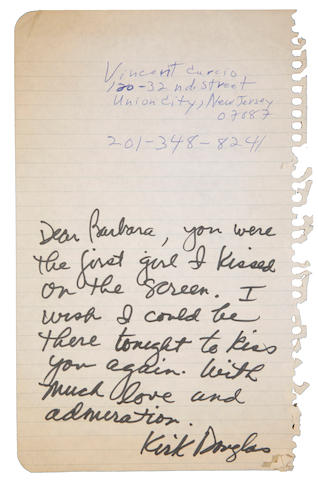
Here is a cute little note from Kirk to Barbara, who was his first on-screen love. According to Bonhams (the auction house that sold the note) it was likely sent before Barbara's 1981 Tribute at Lincoln Center or her 1987 AFI Salute.


Source: Bonhams

Transcript:

Dear Barbara, you were the first girl I kissed on the screen. I wish I could be there tonight to kiss you again. With much love and admiration.
Kirk Douglas

Kirk and Barbara in a scene from The Strange Love of Martha Ivers (above) and during a coffee break on the set (below).

2 February 2020

Missy and The President

Barbara Stanwyck and Ronald Reagan made one film together, the (only mildly interesting) western Cattle Queen of Montana (1954). In a letter to Ella Smith dated 16 May 1972, Reagan (then governor of California) talks about the film and how it was to work with a "pro" like Barbara. (More letters to Ella Smith, author of the biography Starring Miss Barbara Stanwyck, regarding Barbara's consummate professionalism can be found here).

Apart from Reagan's letter to Smith, also seen below is a correspondence between Barbara and "Ronnie" from 1981 following Barbara's tribute at the Film Society at Lincoln Center, their respective letters again referring to Cattle Queen. The letter from Barbara looks like a draft, not the actual letter she sent to the President.

Incidentally, Barbara also knew Nancy Reagan (then Davis) from when the latter was still an actress; the two women played together in East Side, West Side (1949).

Source: icollector.com

Transcript:

May 16, 1972

Miss Ella Smith
Assistant Professor
Department of Dramatic Arts
The University of Connecticut
Storrs, Connecticut 06268

Dear Miss Smith:

"Cattle Queen of Montana" was the only picture I ever made with Barbara Stanwyck, although I have known her for many years. She is one of the best thought of and most respected performers in all the industry.

Working with her I discovered why. She is a pro. Her only intolerance is of those who won't take our profession seriously, and who come to work without their lines learned or who are late and careless in their work. She is ready every day exactly on time, her lines learned perfectly for each day's shooting, prepared to undergo whatever has to be done to make the scene better for the audience who will eventually see the movie.

In "Cattle Queen", for example, there is a scene where she is bathing in a mountain lake. The director was prepared to shoot this with a double because the temperature of the water was in the mid-forties. Naturally, the scene would not be as good if the camera had had to play far enough away for use of a double. She insisted on doing the scene herself. She is most helpful to other performers, sacrificing many times some personal advantage in the scene and throwing the scene to another when she thinks it will benefit the overall story.

You asked about the S.A.G. award. Nothing illustrates more her personality and attitude. Those who know her were concerned that if she suspected she was getting an award she wouldn't be there, so they invited her to come down and present the award to me. She was standing off-stage, fully expecting to come out and make the presentation of the first such award to me, when she heard me making the presentation to her.

Thanks for letting me comment about this very wonderful gal in our business.

Sincerely,
"signed"
RONALD REAGAN
Governor

Source: Bonhams

Transcript:

Dear Mr President

Thank you so much for the lovely message you sent me to the Film Society at Lincoln Center. I deeply appreciate your taking the time to do this and I must tell you it surprised and delighted the audience. 
My prayers and best wishes for you in your difficult job.
Gratefully
Barbara 

P.S. Ronnie - If I had known during the filming of "Cattle Queen" that you were going to be President of our country I would have given you first billing!!
Love to you and Nancy,
Missy

Source: icollector.com

Transcript:

Aug 2nd

Dear Barbara

I'm very late in responding to your nice letter of June 17 and I'm sorry. Let me say however it isn't all my fault. It sometimes is quite a spell before mail gets through the bureaucratic maze and lands on my desk.

Nancy and I were happy to hear from you and wish we could have been at Lincoln Center. Nancy sends her love as do I and we were both delighted that you were honored. You deserve it. 

Incidentally I appreciate your willingness to give me top billing in the picture but it might have set me back - RR as .......?

Anyway thanks and from both of us, warmest regards.

Sincerely 
Ron

Above: Barbara Stanwyck flanked by fellow Republicans Ronald Reagan and Charlton Heston in the 1960s. Below: Reagan and wife Nancy photographed aboard a boat in California in 1964; the couple was married from 1952 until Ronald Reagan's death in 2004.

23 January 2020

You must destroy this Svengali before it destroys you

Starting with Clash By Night (1952) Marilyn Monroe refused to film a scene unless her acting coach Natasha Lytess was present on the set. Marilyn had met Lytess in the spring of 1948 when the latter was still head drama coach at Columbia. The two women first worked together on Ladies of the Chorus (1948) and continued their collaboration through The Seven Year Itch (1955). Extremely insecure about her acting abilities, Marilyn relied heavily upon Lytess, asking for her approval after each take. If Lytess disapproved, Marilyn would request another take and often ended up doing numerous takes. Needless to say, directors were not happy with the interference from Lytess. She was often banned from the set (for example by Otto Preminger and Roy Baker on respectively River of No Return and Don't Bother to Knock) but would always be reinstated as Marilyn wouldn't shoot without her.

Above and below: Marilyn Monroe studying with her coach Natasha Lytess. Directors and Marilyn's co-stars considered Lytess' presence on the set a major nuisance.


Darryl Zanuck, studio head of 20th Century-Fox, was very unhappy with the Marilyn-Lytess situation. Before Don't Bother To Knock (1952) went into production, he received a request from Marilyn to have Lytess on the set with her. Zanuck responded by letter, saying it was "completely impractical and impossible" and "how ludicrous it would be if every actor or actress felt that they needed special coaching from the sidelines". But despite Zanuck's letter to Marilyn (as seen below), Lytess was not only present on the set of Don't Bother To Knock but also on the sets of Marilyn's subsequent films. With Marilyn quickly becoming one of 20th Century-Fox's biggest box-office draws, directors and co-workers had no choice but to put up with Lytess' interference. In 1955, after disapproving of Marilyn's relationship with Joe DiMaggio, Lytess was replaced with Paula Strasberg who, much to everybody's annoyance, continued to coach Marilyn on the set.


December 10, 1951
Miss Marilyn Monroe
611 N. Crescent Drive
Beverly Hills
Dear Marilyn:
Your request to have a special dialogue director work with you on the set is a completely impractical and impossible request. The reason we engage a director and entrust him to direct a picture is because we feel that he has demonstrated his ability to function in that capacity. Whether the final performance comes out right or wrong there cannot be more than one responsible individual and that individual is the director. You must rely upon his individual interpretation of the role. You cannot be coached on the sidelines or the result will be a disaster for you.
In Asphalt Jungle you had a comparatively simple part, in which you were very effective, but it did not particularly call for any acting as compared to the role you are going to play at the present time. It is more than ever important that you therefore place yourself completely in the hands of the director -- or ask to be relieved from the role.
Either Mr. Baker is capable of directing you as well as the rest of the picture or he is not capable of directing anything, but since he is the director we must place our responsibility in him.
I am sure you realize how ludicrous it would be if every actor or actress felt that they needed special coaching from the sidelines. The result would be bedlam, and whatever creative ideas the director might possess would be lost or totally diffused. 
I think you are capable of playing this role without the help of anyone but the director and yourself. You have built up a Svengali and if you are going to progress with your career and become as important talent-wise as you have publicity-wise then you must destroy this Svengali before it destroys you. When I cast you for the role I cast you as an individual. 
Best always,
Darryl Zanuck

Source: Memo from Darryl F. Zanuck: The Golden Years At Twentieth Century-Fox (1993); selected and edited by Rudy Behlmer.

Above: Marilyn Monroe in her role as the disturbed babysitter Nell in Don't Bother To Knock for which she was directed by both her coach Natasha Lytess and the film's director Roy Baker. Below: Marilyn photographed with 20th Century-Fox head Darryl Zanuck.

12 January 2020

I don't honestly like the feeling of the film

Today's letter enticed me to watch Love Among the Ruins (1975), a film made especially for television, directed by George Cukor and starring Katharine Hepburn and Laurence Olivier in their only film together. It's a charming film about an ageing actress who, after having been sued for breach of promise, hires a lawyer with whom she was romantically involved some 40 years ago; although she doesn't remember him, he has been in love with her ever since.

What makes the film so delightful are the great performances by the leads, in particular by Laurence Olivier whom I loved in this role. Both Hepburn and Cukor wanted Olivier as the male lead from the start but Olivier wasn't interested in the project at all, as his letter to Cukor dated 27 November 1973 indicates (seen below). According to an interesting Emanuel Levy article, Hepburn and Cukor tried to persuade Olivier to accept the role by writing him a long letter back, asking several questions: "Do you find the relationship–thus cast–not interesting? Do you find it not funny? Do you find it too trivial? Would there be any particular thing which could make you do it, and if so, what? Say it's just hopeless, and we will both blow our brains out." Adding more pressure Cukor then jokingly mentioned their greatest individual failures: "What a combo! The star of Romeo and Juliet; the girl who was so successful in The Lake; and the director–fresh from his success–of Gone With the Wind. Irresistible!". To this Olivier had no defense and finally accepted.

Love Among the Ruins was a huge success, receiving seven Emmy Awards including awards for Cukor, Hepburn and Olivier.


Source: 
icollector.com

Transcript:

27th November 1973

My dearest Georgie,

I am a hell of a coward not to have got on to you before you left. Let me grovel before you about this, and now I have to grovel again about the opinion - which can be as wrong as all get out but it does insist and therefore has to be sincere - I don't honestly like the feeling of the film of LOVE AMONG THE RUINS, and what makes me feel so badly about not liking it is my opinion is an absolute polarization from yours and from Kate's, whose opinions I respect more than almost anybody else's I can think of.

I am dreadfully sorry but try as I may I just can't change my opinion or make my love and deep admiration for you both alter it to come into line with yours. I can't imagine why this is and there must be something wrong with me. I hope it isn't serious and I hope that it won't make both or either of you feel differently about thinking of me for such a heavensent partnership at some other time.

It was marvellous to see you last week and I can't tell you how Joanie [Plowright] and I ate up your most generous and delicious words of praise for what you saw.

Your appalledly contrite but ever devoted and worshipful,

Larry. (signed) 

Mr. George Cukor

Laurence Olivier, Katharine Hepburn and director George Cukor having a laugh on the set of Love Among the Ruins. For Olivier it was his first and only collaboration with Hepburn and Cukor.


7 January 2020

Lucille Ball & Lela Rogers' Little Theatre

Lela Rogers, mother of Ginger Rogers, was not your typical stage mom. Apart from managing Ginger's career, Rogers had a successful career in her own right. She was a journalist, editor, screenwriter and producer, and from the mid-1930s through the early 1940s she worked as an assistant to Charles Koerner, Vice-President of Production at RKO. Put in charge of RKO's budding talent, Rogers ran her own workshop on the studio lot called the Little Theatre, where she trained promising young actresses like Betty Grable, Joan Fontaine, Ann Miller and Lucille Ball.

In her autobiography Love, Lucy (1996), Lucille Ball fondly remembered those early days at RKO with Lela Rogers"It was such a busy, happy time for me. Lela took the dungarees off us and put us into becoming dresses; she ripped off our hair bands and made us do our hair right. If we went to see a big producer in his office, she cautioned us to put on full makeup and look like somebody. She made us read good literature to improve our English and expand our understanding of character. She drummed into us how to treat agents and the bosses upstairs... " 

Ball studied with Rogers for two years and would later give Rogers credit for turning her into the actress she became. Rogers was the first person to recognise Ball's potential as a comedienne ("a clown with glamour" she called her) even when RKO producer Pandro Berman had told her not to waste her time on Ball. Rogers also stood up for Ball when RKO wouldn't renew her contract and she was responsible for getting Ball a few of her early roles, e.g her first speaking role in Top Hat (1935) as well as her role in Stage Door (1937), the latter being Ball's first standout role.

Above: Lucille Ball and her mentor Lela Rogers whom Ball described as a "wise, warm woman". Below: Rogers shows John Shelton how to hold the gun in one of her Little Theatre productions while Lucy Ball looks on.
Below: Circa 1940, Lela Rogers is giving advice to her students Helen Parrish, Lucille Ball, Cathy Lewis and Anita Louise.

During two years Ball worked with Rogers in her Little Theatre, rehearsing and performing plays which attracted large crowds at 25 cents a ticket. The shows were a terrific opportunity for Ball and others to showcase their talent, especially since directors, producers and critics were often present in the audience. One of the plays produced and directed by Rogers at the Little Theatre was Fly Away Home in January 1936. Ball participated in the play, after which Rogers wrote her the following letter to thank her for taking part. Rogers called Ball's performance "excellent", her praise undoubtedly giving a boost to the young actress' ego. 

Source: icollector.com

Transcript:

January 23, 1936.

Dear Lucille:

I want you to know how sincerely grateful I feel for your participation in "Fly Away Home", and I want you to know that any time I can be of service to you in any way within my power please feel free to call upon me, as I felt free to call upon you.

Your performance was excellent and made "Fly Away Home" the success that it was.

Sincerely yours,

Signed "Lela E Rogers"

Miss Lucille Ball
1344 N. Ogden Drive,
Hollywood, California.

Above: Ginger Rogers and her mother Lela had a close relationship, both personal and professional. They appeared in one film together, Billy Wilder's The Major and the Minor (1942), where Lela played Ginger's mom.
Above: Lucille Ball and Ginger Rogers in Gregory La Cava's 1937 Stage Door (one of my favourite movies of all time). Ball wrote in her autobiography that La Cava didn't really like her but that he only gave her the part at Lela Rogers' insistence. Fun trivia: Lela Rogers was reportedly related to Ball on her mother's side which made Lucy and Ginger distant cousins (the two actresses were also lifelong friends).

19 December 2019

Am all excited by the idea of "Oliver"

At one time Audrey Hepburn considered playing the role of Nancy in Oliver!, the film version of Lionel Bart's stage musical of the same name. Having enjoyed working with director George Cukor on My Fair Lady (1964), Audrey very much wanted to make another film with him. The project she had in mind for the two of them was Oliver! which enjoyed a successful run on Broadway from January 1963 until November 1964. Audrey went to see the show and wrote Cukor a letter on 6 January 1964, telling him what she thought of it.

Audrey Hepburn and George Cukor photographed on the set of My Fair Lady, 1963.

Transcribed below is part of Audrey's letter to Cukor, i.e. the part that deals with Oliver!. It's interesting that Audrey was even considering the role of Nancy, seeing that the part was not a leading role but a relatively small one. (Apparently Audrey's wish to do another film with Cukor was so strong that she was willing to settle for a supporting role.) In her letter Audrey makes a few suggestions on how to improve the role by making Nancy "more human" with "more spirit and much more humor". She also suggests that the film version should not be a musical but a story "where the music and songs are incidental". Having just finished My Fair Lady with her voice not deemed good enough (her songs were dubbed by Marni Nixon) Audrey understandably wasn't eager to do another full-blown musical. In the end, Audrey never played Nancy and never worked with Cukor again. The film version of Oliver! (a British production) was eventually released in 1968 with Shari Wallis in the role of Nancy. Directed by Carol Reed, the film became a big hit, winning six Oscars including Best Picture and Best Director.
Source: icollector.com

Transcript:

Dear dear George

[.....] 

Am all excited by the idea of ‘Oliver’ if you were to do it. As you know Harold asked me to see it explaining that the girl was no great shakes as a part but that it could be rewritten. I went to it to enjoy the show but with a skeptical view of doing it—as usually a part ‘isn't there’ for a good reason, there is none. Watching the show I found the performance in general stale, they all seemed to have done it too often, with the exception of ‘Fagan’ [sic] played by Clive Revill whom I thought was brilliant and highly entertaining. In all I felt much much more can be made of the piece. The girl I find could be more human, have far more warmth for and relationship with the Boys—and be more one of them, the ‘pickpocket with heart of gold’ so to speak. I think she could have more spirit and much more humor, the girl ‘yammered’ a bit too much for my liking. The Bumbles and Bill Sykes [sic] are badly cast—the first could be jollier less sinister and Sykes [sic] should be a brute but physically more attractive. You may wonder why I want to play the girl as the boy and Fagan [sic] are the whole cheese. But she could be fascinating if you see it too, if you and Mel [Ferrer] don’t then I am wrong about the possibilities. The movie should be Hogarthian, Dickensian, sepia, moody and real. The score is not superb … it should be a story, where the music and songs are incidental, not a MUSICAL as such… I know how frantically busy you are and I may kill myself if I have wasted your time. The prospect of doing another with you is what may have persuaded and coloured my reaction! We’ll see!

[....]
xx

Above: Shari Wallis in Carol Reed's Oliver! was the perfect Nancy. Here she is pictured with Ron Moody (Fagin) and Oliver Reed (Bill Sikes) in a scene from the film.