19 November 2021

Your obedient servant, Alfred Hitchcock

During his career Alfred Hitchcock made only one film for Twentieth Century-Fox. In late 1942, while under contract to David Selznick, Hitchcock was loaned out to Fox for a two-picture deal, the deal having been closed with Selznick by Fox executive William Goetz. (Goetz was Selznick's brother-in-law and temporarily replaced studio boss Darryl Zanuck who served in the Army Signal Corps.) The picture Hitchcock made for Fox was Lifeboat (1944) —the second Fox picture was never made— based on a story by John Steinbeck and starring Tallulah Bankhead, William Bendix, Walter Slezak and John Hodiak. (For the plot of the film, go here.) 

In the summer of 1943, with pre-production of Lifeboat in full swing, Darryl Zanuck returned from military service. While he was usually involved in the scripting of Fox's A-films, in his absence Lifeboat was written by Jo Swerling (the only one eventually credited), John Steinbeck, Alma Reville (Hitchcock's wife) and Hitchcock himself. Upon his return Zanuck found Hitch firmly in charge, with producer Kenneth Macgowan more or less acting as the director's assistant. In August 1943, filming on Lifeboat finally began. Zanuck was not happy, however, feeling the pace was too slow and the screenplay too long. 

On 19 August, Zanuck wrote a joint memo to Hitchcock, Macgowan and Swerling, saying that he had the script timed with a stopwatch and that, according to his calculations, the finished film would last almost three hours. "Drastic eliminations are necessary", he said, and they had to be prepared "to drop some element in its entirety". Annoyed by Zanuck's missive, Hitchcock replied the next day, his memo to Zanuck seen below ("I have never encountered such stupid information as has been given you by some menial who apparently has no knowledge of the timing of a script..."). Zanuck answered Hitch the same day (on 20 August), his memo to be read below as well. (Zanuck's first memo from 19 August is not shown.)

The finished film eventually ran 97 minutes and cost a little over 1.5 million dollars. Despite Zanuck's complaints, Hitch was able to complete Lifeboat with little interference from the studio boss. In September 1943 when Zanuck saw the first reel of the film he was enthusiastic and later called Lifeboat "an outstanding film with awards potential". The picture would receive three Academy Award nominations, i.e. for Hitchcock (Best Direction), Steinbeck (Best Story) and Glen MacWilliams (Best Cinematography) but no one won. Although Lifeboat was a box-office flop, it is now considered an underrated entry in Hitchcock's impressive oeuvre.

Above: Alfred Hitchcock on the set of Lifeboat. Below: Part of the Lifeboat cast with (from left to right) Mary Anderson, Hume Cronyn, John Hodiak, Tallulah Bankhead, Henry Hull and Canada Lee.
Dear Mr. Zanuck:

I have just received your note regarding the length of LIFEBOAT. I don't know who you employ to time your scripts, but whoever did it is misleading you horribly. I will even go so far as to say disgracefully. In all my experience in this business, I have never encountered such stupid information as has been given you by some menial who apparently has no knowledge of the timing of a script or the playing of dialogue.

According to the note, in paragraph two you express your opinion, based upon this ridiculous information, that the picture will be 15,000 feet in length. I can only think that the person who did this for you is trying to sabotage the picture. Maybe it is a spy belonging to some disgruntled ex-employee.

Now let us get down to facts, and let us base our calculations on facts that come from persons of long experience and also the fact of actual shooting time. Through Page 28 of the script, which includes a fair amount of silent action, the shot footage is actually timed at 15 minutes. This, on the basis of a 147-page script, works out to actually 79 minutes. Add to this a maximum of 5 minutes, (which is generous for the storm sequence), we arrive at an extremely generous estimate of 84 minutes. Films run through at 90 feet a minute. Therefore, we arrive at a length of 7560 feet, which, in my opinion, is considerably inadequate for a picture of this calibre and importance.

I am gravely concerned at the suggestion of cutting the story for fear that after the shooting is completed we will find that the picture is so short that we will have to commence writing added sequences to make the picture sufficiently long for an important release.

In view of our previous discussions regarding the shooting time, I would like to repeat that we are all considerably misled by the cumbersome methods of shooting on an exterior stage which could never be repeated under normal conditions in the studio. As I pointed out to you in our previous conversation, I am at present shooting a sequence of 9 pages which will take approximately 2 days - which is exactly one day under the allotted time in the production schedule.

Dear Mr. Zanuck, please take good note of these above facts before we commit ourselves to any acts which in the ultimate may make us all look extremely ridiculous by giving insufficient care and notice to these considerations.

Your obedient servant,

ALFRED HITCHCOCK

__________

My dear Hitchcock:
The timing of the script was not done by an expert, nor by anyone who was deliberately attempting to mislead us. One person merely read the dialogue aloud, while the other person took down the timing with a stop-watch. Now, of course, they did not overlap any dialogue, and they might have read slowly, or they might have paused too long between speeches, and, of course, they are not aware of any of the cuts in dialogue or script pages that we have recently eliminated.
According to your calculation, the script will run to 7,500 feet. I will bet you $1,000, the winner to donate the amount to charity, that you are wrong by 2,000 feet. I am now speaking about the script as it stands, and I believe I am allowing myself plenty of footage for protection. 
A picture of this scope, in my opinion, should hold up very well at 9,000 feet, and perhaps even longer, but if we actually are over 10,000 feet, then I know that you agree the matter is serious, not only from the standpoint of economy.
You are making excellent progress, and certainly no one could complain about the amount of film you have exposed in the last few days.
It still remains my opinion, however, that our story is repetitious in places, and monotonous. I am certain that the cuts we have made in the last few days have not harmed the quality of the production one iota. As a matter of fact, I feel that they have been helpful [...]
I do not make a habit of interfering with productions placed in such capable hands as yours. Any interference in this case comes from an emergency problem, which I inherited. On all sides, I have been advised to call off the production. The picture was devised originally, so I understand, to be a million dollar cost project. Suddenly its cost has doubled, and no one could possibly dislike the idea of butting in any more than I do. I have plenty of worries on my own personal productions, and nothing would give me greater joy than to forget all about LIFEBOAT until the night I go to the preview. 
You felt you could make the picture in eight or nine weeks. You told me so. Lefty Hough [Fox's production manager] thought that you could. He told me so, and so did Macgowan. We took into consideration this fact, and arrived at a fair budget. We were all wrong. It would be folly now, in my opinion, to butcher the story in an effort to save a penny here and there, but it is also folly to fail to study each scene, each line and each episode, and see if we cannot find ways and means to eliminate non-essentials.
Darryl


Source of both memos: Hitchcock's Notebooks: An Authorized And Illustrated Look Inside The Creative Mind Of Alfred Hitchcock (1999) by Dan Auiler.

Darryl F. Zanuck in his military outfit

7 November 2021

Jane Bryan - The Almost Star

Jane Bryan had a very short Hollywood career which lasted only four years. Initially wishing to be a stage actress, Bryan followed a dramatic training in Jean Muir's theatre workshop where Bette Davis discovered her. After being offered a contract at Warner Bros. she made her film debut in The Case of the Black Cat (1936) and other roles in memorable Warner films followed— e.g. Marked Woman (1937) co-starring Bette Davis and Humphrey Bogart; Kid Galahad (1937) with Edward G. Robinson, Bette and Bogart; A Slight Case of Murder (1938) with Robinson; Each Dawn I Die (1939) with James Cagney and George Raft; and probably her best remembered role as Bette's daughter in The Old Maid (1939), co-starring Miriam Hopkins. Bryan's biggest and most critically acclaimed role came with We Are Not Alone (1939) opposite Paul Muni. In 1940, at age 22, Bryan retired from acting after she married wealthy businessman Justin Dart. She and Dart had three children and remained married until Dart's death in 1984. 

Above: Jane Bryan and Bette Davis in Marked Woman. The actresses played in four films together; apart from the three films already mentioned they also co-starred in The Sisters (1938).
Above: Bette and Jane in a scene from The Old Maid. Bette later said about Jane's performance: "I had to hide her face in a pillow to stop her stealing my scenes."  Below: Jane and Paul Muni in We Are Not Alone.
At the time of her retirement Bryan was a very promising young actress. Apart from Bette Davis who had discovered her and would praise her at every opportunity, there were many others who lauded Bryan. For example, her performance as Edward G. Robinson's daughter in A Slight Case of Murder led Variety to comment: "Robinson is at his peak as a comical gangster who goes straight when Prohibition ends, but it's Jane Bryan who steals the picture." And her first (and only) leading role in We Are Not Alone (as a troubled Austrian dancer who becomes governess to Paul Muni's son) earned her positive reviews and the National Board of Review acting award. Playwright Noël Coward even called her "the best young movie actress working today" while film critic Robbin Coons said: "It is a heart-touching performance in which sincerity and truth are radiant factors ... the picture should mean virtually immediate stardom for her." 

But while stardom seemed to be in the offing, Bryan soon left Hollywood and never looked back. (She was very shy and in later years refused to give interviews, in particular about her "long ago" film career.) In 1974 Davis, who remained friends with her protégée long after the latter quit acting, said about Bryan's decision: "Jane Bryan, in her short career, gave many fine performances. When she confided that she was in love and was going to give up her career, as the man she loved did not want her to continue if she married him, I was sorry, as I thought she had a great future in films. She has, however, never regretted her decision in all these many years."

Apart from being a devoted mother, Bryan was a philanthropist and a well-known patron of the arts. From 1971 to 1976, she served on the United States Commission of Fine Arts in Washington DC. Furthermore, she enjoyed participating in archaeological expeditions and at one time was governor of the Los Angeles Natural History Museum. 

__________


The following postscript from Bette Davis to columnist Allan Smith led me to write this post about Jane Bryan, initially knowing nothing about her although I had seen several of her films (most notably The Old Maid). The P.S. is from a letter dated 30 April 1938, in which Bette first talked about her own fan club and then added this comment on Bryan. 

Source: icollector.com (click on the link if you want to read Bette's full letter)

Transcript:
P.S. I wish some intelligent person would start a Club for Jane Bryan — I am so interested in her — she is a grand actress and has a wonderful future in pictures. Is under contract to Warner Bros. and played with me in 'Marked Woman' and 'Kid Galahad'. My reason for mentioning this to you is because I too, as you know, am a Massachusetts-ite!!
Bette D.

Jane Bryan with Justin Dart, the man for whom she gave up her Hollywood career. The two were staunch Republicans and lifelong friends of the Reagans (first when Ronald Reagan was married to Jane Wyman and later to Nancy Davis). The Darts influenced Reagan (one of Bryan's former co-stars ar Warners) to switch from the Democratic to the Republican Party and were among the first to encourage him to run for Governor of California and later for President.

1 November 2021

Paulette Goddard and her relationship with Diego Rivera & Frida Kahlo

In May 1940, Paulette Goddard travelled to Mexico for a publicity shoot for Look magazine and also hoped to get her portrait painted by renowned painter Diego Rivera. She had heard about Rivera from her good friend George Gershwin, a fan of the painter, and had become intrigued by him. In Mexico Rivera not only agreed to paint Goddard, but soon the two also began an affair. (At the time Goddard was still married to Charlie Chaplin, while Rivera had just divorced Frida Kahlo.)

Rivera was working on Goddard's painting when someone tried to kill Leon Trotsky, the Marxist revolutionary who was a friend of Rivera and Kahlo (Trotsky had also been Kahlo's lover). Rivera was a suspect in the case and Goddard helped him hide out, providing him with food and drink, before eventually leaving the country together. Upon arrival in the U.S. in early June 1940, Rivera had to pay a $500 bond —"to guarantee that I wouldn't overthrow the government of the United States"— and reportedly sold a number of watercolours to Goddard in order to pay for the bond. (Rivera would later state to the American press that Goddard had saved his life.) In San Francisco the painter began work on a mural for the Golden Gate International Exposition, a project he would work on for many months and which he ultimately called Pan-American Unity. His painting Portrait of Paulette Goddard was finished at a later date and eventually found its way to Goddard's home.

Above: Paulette Goddard photographed in her home with the Rivera painting. After Goddard's death in 1990, the painting was donated to an educational institution and in 1999 it was sold at auction at Christie's for $552,500. 
Above: Detail of the huge mural Pan-American Unity by Diego Rivera. (For images of the full mural, click here.) Rivera painted himself holding Goddard's hands, while sharing La Ceiba, the Sacred Tree Of Life; Kahlo stands behind them. Asked why he held hands with Goddard, Rivera answered: "It means closer Pan-Americanism". Incidentally, the mural also contains two scenes from Rivera's favourite films, The Great Dictator with Charlie Chaplin (whom he greatly admired) and Confessions of a Nazi Spy with Edward G. Robinson. Below: Goddard and Rivera photographed in June 1940.
Frida Kahlo didn't arrive in the United States until early September 1940. Several weeks before, another attempt on Trotsky's life had proven successful and Kahlo was questioned by the police and even put in prison for two days (having previously been in contact with Trotsky's assassin Ramón Mercader). In San Francisco, Kahlo reunited with Rivera and the two eventually remarried in December of that same year.

It is unclear when Goddard and Kahlo met for the first time. Gossip columnist Louella Parsons wrote in The San Francisco Examiner that Kahlo and Rivera were weekend guests at the home of Goddard in December 1940, while a letter from Rivera suggests the two women didn't meet until a year later. On 6 December 1941, Rivera wrote to his assistant Emmy Lou Packard: "Paulette ... came here to dinner and she and Frida liked each other", implying they had not met before. 

Goddard and Kahlo reportedly became friends, something which often happened to Kahlo, i.e. befriending the mistresses of her husband. (She had befriended Dolores del Rio too, another actress who had an affair with Rivera and whose portrait he had also painted.) It is said that Kahlo painted the still life The Flower Basket as a gift to Goddard and that her motivation for creating the painting was to forgive Goddard for her love affair with Rivera. In addition, it has been rumoured that the two women were not just friends —a similar rumour had been circulating about Kahlo and Del Rio— and that the painting may also have been a lover's gift.

Frida Kahlo's The Flower Basket

That Kahlo painted The Flower Basket for Goddard is contradicted by art historian Luis-Martín Lozano who said the work was part of a presidential commission. According to Lozano, in June 1941 Kahlo was commissioned by the President of Mexico to paint a few still lifes as decoration for the new dining room of the Palacio Nacional. In the end, the project was cancelled and the paintings, including The Flower Basket (originally entitled Still Life), were returned to the artist. As the following document shows, Kahlo eventually sold —not gave— the painting to Goddard who paid $300 for it. (In 2019, the painting would sell for $3.1 million at Christie's.)

Source: Heritage Auctions


Not only Kahlo sold her work to Goddard but also Rivera sold the actress (at least) one of his paintings. While his portrait of Goddard was likely a gift, the painting Calla Lilies was sold to her for $1000. Documents below are proof of the sale and also shown is Goddard's letter to get the painting cleared through customs. 

Source: Heritage Auctions
Above: Rivera made a number of paintings with calla lilies but I could find no painting entitled Calla Lilies. Perhaps it was this painting, known as Calla Lily Seller from 1942, that he sold to Goddard. Below: Kahlo and Rivera, who were married for the first time from 1929 until 1939 and remarried in December 1940. Kahlo agreed to the second marriage under the condition that she would be financially independent from Rivera and that their relationship would be celibate. The couple remained married until Kahlo's death in 1954.

23 October 2021

Peter O'Toole is it!

In February 1962, for a then record amount of $5.5 million, Warner Bros. obtained the rights to produce the film version of the successful stage musical My Fair Lady (1956). For the role of Professor Henry Higgins, studio boss Jack Warner initially didn't want to hire Rex Harrison, although the actor had successfully played Higgins on Broadway. Warner not only considered Harrison too old for the part but also felt he lacked drawing power at the box-office.

An actor who was in demand at the time was Peter O'Toole. He was much younger than Harrison and had just played the titular role in Lawrence of Arabia (1962), David Lean's epic film which would become a huge critical and financial hit. Both Warner and director George Cukor thought O'Toole was the right man to play Higgins and next tried to hire him. In Europe Cukor even met with the actor who (according to Cukor) was "crazy" about the part. In the end, however, O'Toole proved too expensive for Warners. His agent demanded a salary of $400,000 which Warners wasn't willing to pay and negotiations ultimately fell through. 

Cary Grant (believe it or not) was also offered the part but he declined, convinced that Rex Harrison should be cast. And indeed, Harrison was cast and eventually delivered an Oscar-winning performance. (Harrison was paid $200,000, half of O'Toole's asking price.)

Here is part of a letter which George Cukor wrote to his secretary and friend Irene Burns on 11 September 1962. The fragment deals with Peter O'Toole and shows how excited Cukor was for the actor to play Henry Higgins. While O'Toole didn't get to play Higgins in the film musical, later in his career he would star as the professor twice, i.e. in the 1983 television movie Pygmalion with Margot Kidder as Eliza Doolittle; and in 1987 in a new Broadway production of Pygmalion with Amanda Plummer starring as Eliza. (As you undoubtedly know, My Fair Lady —book and lyrics by Alan Jay Lerner and music by Frederick Loewe— is based on George Bernard Shaw's 1913 play Pygmalion.) For those interested, click here for the full 1983 television film with O'Toole as Higgins and Margot Kidder as Eliza.


Transcript:

I had supper with Peter O'Toole last night, his wife, his agent. He is it, Henry Higgins — or I miss my guess. He's handsome, alive, romantic and as I'm told a great — I don't use the word lightly, great actor. He says he's the best Shaw actor in the world — no idle boast — others agree. He sings, he is musical — What are we waiting for? They left me at three A.M. — 3 hours sleep — oy!! I'll crawl into bed before I start my duties today.

I saw "My Fair Lady" last night — Disgraceful — I'm not sure which one was worse — here or New York — no resemblance to the original production but the audience swooned.

That's all for now except my love — to one and all and that includes you —

signed 
Thomas A Edison
who only slept 3 hours a night

Above: Rex Harrison, Audrey Hepburn and George Cukor on the set of My Fair Lady (1964). While Peter O'Toole would not play opposite Audrey in MFL, he would get his chance a few years later in the great How To Steal a Million (1966). Below: O'Toole and Amanda Plummer as Eliza in the 1987 Broadway production of Pygmalion.

17 October 2021

I can't wait to work with you again

Natalie Wood and Tony Curtis made three films together, i.e. the WWII drama Kings Go Forth (1958) and the two comedies Sex and the Single Girl (1964) and The Great Race (1965). Curtis later said that he and Wood became great friends and claimed in his autobiography American Prince (2008) that they were also romantically involved during production of The Great Race*. In her book Natasha: The Biography of Natalie Wood, published several years prior to Curtis' book (in 2001), Suzanne Finstad said that the two actors were not on the best of terms while shooting their last film. According to Finstad's sources, Curtis' ex-wife Janet Leigh and producer Martin Jurow, Curtis and Wood had become "estranged" some time between the end of Sex and the Single Girl and the start of The Great Race. Jurow said that during the shoot of The Great Race Curtis' behaviour towards Wood was "very juvenile" ("like little boys in the playground pick on certain little girls ...") and at one point they even stopped speaking to each other. Wood biographer Gavin Lambert (Natalie Wood: A Life, 2004) never mentioned a friendship or estrangement between the two but stated that from their first film on Wood had found Curtis "agressively self-important".

*While Curtis liked to boast about his affairs with famous actresses, I'm always inclined to take his stories with a pinch of salt, especially when the women involved were no longer alive to confirm or deny his claims, like Natalie Wood or Marilyn Monroe.

Well, whatever the relationship between them, Wood wrote Curtis this sweet (undated) note after her first day at work on either Sex and the Single Girl or The Great Race. She thanked Curtis for his flowers and also told him that she was looking forward to working with him again. (Obviously I don't know whether she was being truthful or not.)


Transcript:

Dear Tony — 

Just wanted to thank you again for the marvelous flowers that greeted me on my first day. It was most thoughtful + made me feel so good most of the butterflies went away. Well almost. Anyway I can't wait to work with you again. You're terrific!

Love,
Natalie

Natalie Wood and Tony Curtis in The Great Race, a Warner Bros. film directed by Blake Edwards. Wood was emotionally fragile at the time, following her divorce from Robert Wagner and also because she was unhappy with her career. She hated her role in The Great Race and didn't want to do it. Studio boss Jack Warner asked Curtis if he would give a percentage of his film earnings to Wood to make her accept but Curtis refused ("I couldn't give her anything to make her want to do the movie"). Only after Warner had promised to cast Wood in Inside Daisy Clover (1965), a film she really wanted to do, she accepted the role. 


9 October 2021

Send this minor masterpiece whizzing through the film exchanges of America

In December 1948, production wrapped on Irving Cummings' It's Only Money, a RKO comedy starring Jane Russell, Groucho Marx and Frank Sinatra. The film was not released right away, despite positive preview screenings and a fair amount of publicity in the film magazines. RKO boss Howard Hughes decided to put the film on the shelf, where it subsequently sat for three years. (Why Hughes chose not to release it remains unclear; it has been said that his intense dislike of Frank Sinatra —the men had a shared interest in Ava Gardner— may have been a motive.)

Someone who didn't like the picture being shelved was Groucho Marx. After performing with his brothers for decades, Groucho was working on his solo career and therefore eager to have It's Only Money released. In January 1951, two years after filming had ended, Groucho wrote to Howard Hughes and asked him to finally get "this minor masterpiece" off the shelf and into film theatres. It's not clear if Groucho's letter had anything to do with it but eleven months later the film was released. Hughes had given the picture a different title, though, i.e. Double Dynamite, apparently a reference to Russell's breasts. Due to Hughes' resentment towards Sinatra, Sinatra received third billing and his face didn't even appear on the film poster.

Double Dynamite was released in December 1951, receiving negative reviews and bad box-office results. Years later, Groucho said that with the film "[his] acting career almost went down the drain" while co-star Jane Russell dryly commented: "He [Sinatra] was playing a dumb little guy and I was playing a dumber little girl and it was a stupid picture, but we sang in it." (To watch and listen to the songs, click here for It's Only Money, sung by Sinatra and Groucho, and here for Kisses and Tears by Sinatra and Russell.)

In January 1951, Groucho wrote the following letter to Howard Hughes, perhaps later wishing he had never sent it.

January 23, 1951

Dear Mr. Hughes:

Between retooling for the war effort and dueling with Wald and Krasna, I presume you are a fairly busy man. However, I wonder if you could spare a few moments to release a picture that was made some years ago involving Jane Russell, Frank Sinatra and your correspondent. The name of the picture, if memory serves, is "It's Only Money". I never did see it but I have been told that at its various previews it was received with considerable enthusiasm.

I am not a young man any more, Mr. Hughes, and before I shuffle off this mortal coil if you could see your way clear to pry open your strong box and send this minor masterpiece whizzing through the film exchanges of America, you would not only have earned my undying gratitude but that of the United Nations, the popcorn dealers of America and three RKO stockholders who at the moment are trying to escape from the Mellon bank of Pittsburgh.

Sincerely,
Groucho Marx 
Source: The Groucho Letters: Letters from and to Groucho Marx (1967) 

30 September 2021

This thing called Zsa Zsa Gabor ...

Seldom praised for her acting skills, Hungarian-born Zsa Zsa Gabor is probably best known for her flamboyant personality, her many marriages (9!) and her great one-liners. Her memorable quotes include "I am a marvellous housekeeper. Every time I leave a man, I keep his house."/ "Husbands are like fires. They go out when unattended."/ "I want a man who's kind and understanding. Is that too much to ask of a millionaire?" That Zsa Zsa had a way with words is also clear from the following letter she sent to the fan magazine Photoplay in April 1953 (published in the Soap Box-section of the Readers Inc. page). The letter was Zsa Zsa's response to a negative comment about her from a reader named Lou Sullivan — a comment she simply couldn't ignore.

Source: Photoplay, December 1952 via Archive.org


Source: Photoplay, April 1953 via Archive.org

26 September 2021

Signed, David-in-quest-of-his-Mate

In her autobiography A Private View (1983) Irene Mayer Selznick said that David Selznick didn't seriously propose to her until long after they knew they were going to be married. Once he had begun to propose, he never stopped. In fact, not a day went by without yet another proposal, each one more original than the previous one. 

One of Selznick's marriage proposals to Irene Mayer is seen below. In a letter the producer first discussed several film-related matters and then, seemingly as an afterthought, added this great proposal:

I've been thinking of you and decided to marry you if you'll have me. I'm middle-aged to be sure; I have a hammer toe and I run into things; I'm ex-arrogant, and once I wanted to be a big shot; I snore loudly, drink exuberantly, cuddle (i.e. snuggle) expansively, work excessively, play enthusiastically, and my future is drawing to a close, but I'm tall and Jewish and I do love you. David-in-quest-of-his-Mate.  

David Selznick and Irene Mayer (daughter of MGM mogul Louis B. Mayer) were married from 1930 until 1949 and had two sons. They eventually grew apart as a result of Selznick's infidelity —he had started an affair with Jennifer Jones— and his gambling addiction. The couple separated in 1945 but their divorce wouldn't be finalised until 1949. Having worked as an executive at her husband's production company Selznick International Pictures, Irene began a career as a theatre producer after the separation, producing the 1947 play A Streetcar Named Desire.  

Source letter fragment: Ingrid Bergman: My Story (1980) by Ingrid Bergman and Alan Burgess.

20 September 2021

Bette Davis & Life with Father

When Warner Bros. decided to film Life with Father (1947), the 1939 hit play by Howard Lindsay and Russel Crouse, they quickly settled on William Powell for the role of Father (Clarence Day Sr.) and borrowed him from MGM. Finding the right actress to play Mother (Vinnie Day) proved a more difficult task, though. Several actresses were tested, including Rosalind Russell, Rosemary DeCamp and even Mary Pickford who, wishing to make her comeback to the screen after a thirteen-year absence, was very eager to play the part. None of these ladies was chosen, however, with Pickford quite devastated when she was rejected. (Producer Robert Buckner recalled: "[Studio boss] Jack Warner and [director] Mike Curtiz were cowards about telling her, so they told me to go to Pickfair and inform America's sweetheart that she was washed up in pictures. She made a great entrance down a staircase and was smiling and beaming, thinking she had the part. She just dissolved in front of my eyes when I told her the bad news.")

1945, Bette Davis' costume test for Life with Father


The studio's initial choice for the female lead was Bette Davis, Warners' top leading lady at the time. While Bette wanted the role, the authors of the play weren't convinced she would be right for it, so they insisted that Michael Curtiz shoot a test with her doing a comedy scene. Curtiz travelled to New York to show the test to the theatre people but they were unimpressed and Bette was rejected. In a 1980's interview Bette said she didn't mind losing the part as she didn't want to work with Curtiz again anyway. (Having worked with Curtiz six times, Bette once said about him: "He was not a performer's director ... You had to be very strong with him. And he wasn't fun. He could humiliate people, but never me. He was a real BASTARD! Cruelest man I have ever known. But he knew how to shoot a film well.") 

The part of Vinnie Day was eventually given to freelance actress Irene Dunne, at the time still a top box-office draw. Irene thought the role wasn't appealing at all —she hated Vinnie's ditsiness— and refused it several times. It took a lot of persuasion from Curtiz before Dunne finally accepted: "... I accepted the part because it seemed to be rewarding enough to be in a good picture that everyone will see." And indeed — Life with Father became a huge box-office hit, receiving generally good reviews and four Oscar nominations to boot (including nominations for William Powell and Max Steiner for his score).

In December 1945, after returning from New York where he had screened Bette Davis' test for Howard Lindsay and Russel Crouse, Michael Curtiz sent Bette the following telegram in care of the Plaza Hotel in Laredo, Texas, where she and her third husband William Grant Sherry were still enjoying their honeymoon. Curtiz informed her that the people in New York didn't approve of the test, finding her performance "too powerful, too dominating, too superior and without any naivete...". The director went on to say that he was "heart-broken" as he had looked forward to working with her again. Whether Curtiz was sincere or not I don't know; at any rate, as mentioned above, Bette didn't like working with him and the two never worked together again.


Mrs. William Grant Sherry
Plaza Hotel
Laredo Texas 

December 14, 1945

Dear Bette: Just returned from New York after projecting your test to the group that operates "Life with Father". Bette, it was worse than the Potsdam Conference. I was not born to be a diplomat, so probably hurt a few people's feelings. I was and still am honestly convinced that you are the woman to play the part but I could not overcome objections of these critics using all the technical terms of the theatre, such as the characterization is too powerful, too dominating, too superior and without any naivete, etc., etc. I explained the circumstances under which we made the test without much preparation. Tried to convince them that being the great artist you are you could overcome all objections and you could easily characterize the part as it should be played but I was not very successful; was overruled, and I am afraid Bette, we will have to just consider it for the time being forgotten, unless I can change their minds when they come out to the coast and insist upon other tests. All I can tell you is that I am heart-broken as I had looked forward to working with you and I hope some day we can start on a moving picture which will not have to be approved by superior prejudiced critics of the theatre. Much love and happiness to you and your husband— Michael Curtiz


Source: Inside Warner Bros. (1935-1951) (1985), selected and edited by Rudy Behlmer. 

Above: Michael Curtiz and Bette Davis during production of The Private Lives of Elizabeth and Essex (1939), the last of their six collaborations. The other films are The Cabin in the Cotton (1932), 20,000 Years in Sing Sing (1932), Jimmy the Gent (1934), Front Page Woman (1935) and Kid Galahad (1937). Below: William Powell and Irene Dunne as Clarence and Vinnie Day in Life with Father. I can only agree that Bette would have been totally wrong for the role of Vinnie; Irene, however, was delightful in the role, being sweet, ditsy and clever at the same time.


11 September 2021

You should face the fact that he has no talent

In 1952, Italian neorealist director Roberto Rossellini approached Rebecca West, British author and literary critic, to write the dialogue for his next film, to be based on Colette's novel Duo. West then travelled to Italy to meet with Rossellini and his wife Ingrid Bergman who was to be the female star of the film. Meeting Rossellini, West found the director "a show-off, very gabby, ignorant and pretentious" and thought that his idea for the screenplay was "not enough to make a good film". (As Rossellini had not been able to purchase the rights to Colette's novel, he had presented her with a plot line that was quite different from the book.) Also unimpressed with Rossellini's previous film Europe '51 (1952), West eventually declined the assignment and went back home.

Above and below: Rebecca West and Ingrid Bergman at the Women's National Press Club in April 1948.


Returning home from her disappointing Italian trip, West received a letter from Ingrid Bergman who apologised for the failure of their joint project. The letter shown below is not Bergman's letter, though, but West's brutally honest reply ("an extraordinary letter", as she herself called it, unlike anything she had ever written).

Incidentally, although West felt Bergman had "great talent and a great personality", she once made some derogatory remarks about the actress, saying that she was "common and mannerless" and that —after West's husband had told her that Ingrid's mother came from Hamburg, Germany— "she might well be a housemaid in a big Hamburg hotel".


10 March 1953

Dear Miss Bergman,

Thank you very much for your letter, which I am going to answer honestly. My feelings were not in the least hurt by the abandonment of what was for both of us a trial trip. But I was distressed by the whole incident, from your point of view. I had been asked to write the dialogue of a film which was being founded on an important novel, Duo, by an important writer, Colette.

Instead I was faced with a ridiculous idea, incapable of development in any way not likely to be prejudicial to your reputation.

You may love your husband very much, but you should face the fact that he has no talent. You have great talent and a great personality, and it is absurd that for the sake of your private emotions you should allow these gifts to be wasted in a film like Europe 1951, which is so inept that even your performance, which excites admiration by itself, cannot save it.

You will not believe this when you read it, and you will think me an odious woman. But when your husband has made two more films for you, you remember this letter, and think about putting yourself in the hands of a competent director.

I never wrote such an extraordinary letter as this in my life. But I have also never seen such an extraordinary situation as the wreck of your artistic life.

With all good wishes,

I am, 

Yours sincerely,

Rebecca West  

[Source: Selected Letters of Rebecca West, edited by Bonnie Kime Scott (2000)] 


The film that Rossellini eventually made without West's help was Journey to Italy (1954), starring Ingrid Bergman and George Sanders as an estranged married couple vacationing in Italy. While both a box-office and critical flop upon release, the film is now regarded by many as Rossellini's masterpiece and according to director Martin Scorsese "one of the most honest portraits of a marriage ever put on film". Loosely based on Colette's novel Duo, the screenplay was written by Rossellini and Vitaliano Brancati.

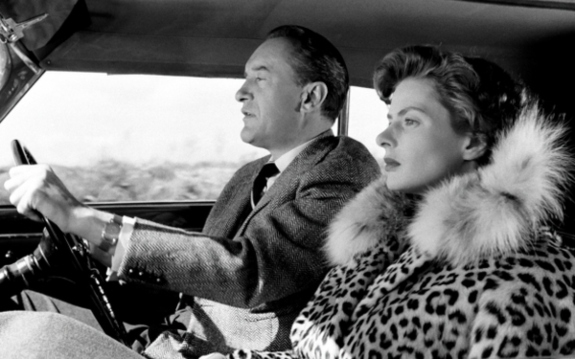
George Sanders and Ingrid Bergman as Alex and Katherine Joyce in a scene from Journey to Italy aka Viaggio in Italia or Voyage to Italy.
Roberto Rossellini on the set of Europe '51 with Ingrid Bergman and another cast member. Rossellini and Bergman worked together six times — on Stromboli (1950), Europe '51 (1952), We, the Women (1953), Journey to Italy (1954), Fear (1954) and Joan of Arc at the Stake (1954).