By 1934 Walt Disney was no longer satisfied making animated shorts, despite their popularity with audiences. Shorts made very little money for the company, with the highly successful
Three Little Pigs (1933) earning only $64,000 while it had cost $60,000 to make. ("
Every time I produce another Mickey Mouse
or Silly Symphony
, I'm accused of making another million dollars. I only wish it were true," Disney once said.) In order for the studio to grow —both financially and artistically— Disney decided to make a feature-length animated film and as its subject chose the story of
Snow White, the famous German fairy tale written by the Brothers Grimm.
While Disney's
Snow White and the Seven Dwarfs (1937) would not be the first animated feature film in history —that distinction goes to the Argentinian film
El Apóstol (1917)— it would be the first
cel animated feature film. Production
was to
last three years, during which the project was mockingly referred to as 'Disney's Folly'. Many people believed that audiences wouldn't go see a feature-length cartoon and that the film was going to bankrupt the studio. While this didn't happen,
Snow White cost a whopping $1.5 million, six times more than its original budget of $250,000. Disney took a huge financial risk and even mortgaged his house to help finance the film. Halfway through production, he also needed an extra loan of $250,000 to complete his picture. Although bankers were reluctant to lend Disney money, Joseph Rosenberg of Bank of America —after watching a rough cut of
Snow White— approved the loan and reportedly said, "
Walt, that thing is going to make a hatful of money!".
Premiering in Los Angeles on 21 December 1937, after a long and difficult production, Snow White did what Rosenberg had predicted and made a hatful of money, in fact more than $8 million during its initial release. Apart from being a huge commercial success, the film was also hailed by the critics. To this day, Snow White is still considered one of the greatest animation films in history. It set the standard for other animation features and remains one the most popular Disney pictures of all time. (For this blogathon I rewatched Snow White and still loved it!)
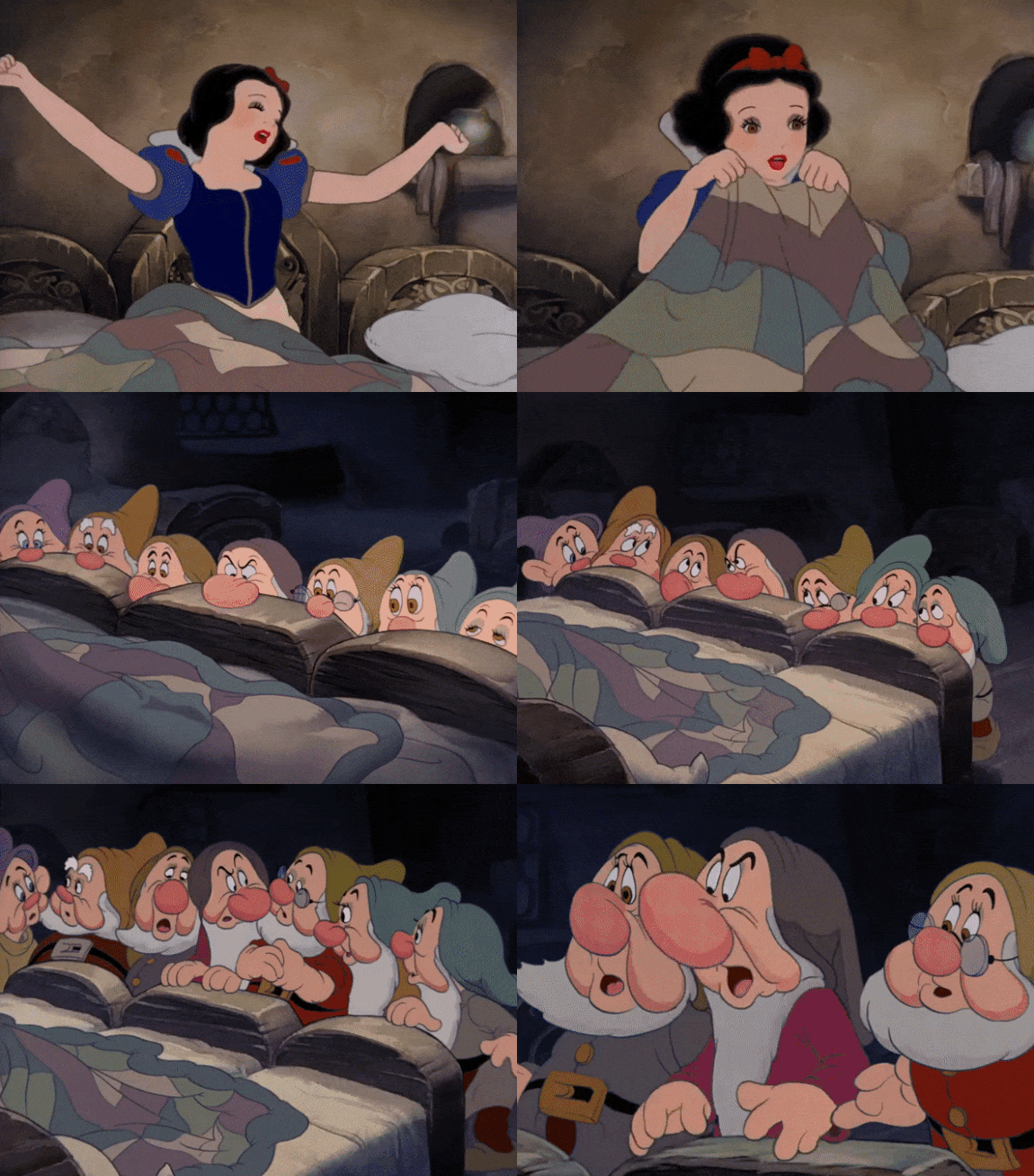 |
| Above: Snow White meets the Seven Dwarfs (gif made by my sister who blogs at Classic Movies Round-Up). Below: On 23 February 1939, at the 11th Oscars ceremony, Shirley Temple presented Walt Disney with an honorary Oscar for Snow White and the Seven Dwarfs, the award consisting of one full-size Oscar and seven little ones (watch the clip here). |
On to the correspondence!
Amidst all the praise for Snow White and Disney, there was also criticism. Many exhibitors resented both Disney and distributor RKO for the amount they were being charged to show the film in their cinemas (reportedly having to hand over 50% of the revenue). Also, Disney-RKO didn't allow Snow White to be played as part of a double bill, meaning that exhibitors couldn't make money from the second film with its more favourable conditions. As a result, exhibitors complained about not being able to make a profit and some claimed they were even losing money.
In June 1938, (Sidney?) Skolsky wrote about this subject in his column, which caught the attention of a Mrs Barker from Chicago. Feeling that Disney's tactics smelled "unpleasantly of greed or unfairness", Barker next typed a letter to the big man himself. The extensive and very cordial response she subsequently received did not come from Walt but from his older brother Roy (who handled the company's finances while Walt was the creative brain). It's quite an interesting correspondence, with Roy Disney explaining the business practices of the company and how they —considering the enormous financial risk that was taken— were only demanding their rightful share.
Transcript:
901 N. Waller Ave.,
Chicago, Ill.
June, 11, 1938.
My dear Walt Disney:
If this column is a reliable picture of the whole case, it smells unpleasantly of greed or infairness [sic] somehwere [sic]. And I hope you can correct it pronto. Even my eleven year-old boy when hearing only that part which can be put in a sentence --- "Snow White is a headache to the exhibitors because it costs so much to book that they can't make a profit"--- said, after a thoughtful silence,"Looks like success has gone to Disney's head." Then he added, loyally, maybe it is the distributors and not Disney's doing."
The great power of your art is the clean, fine spirit that shines through it all. Neither greed nor unfairness is clean or fine. Any such getting into your creative make-up must spoil the spirit and effective charm. My personal belief is that no artist who ever lived has been as great as you, because no other ever gave so much good to a needy world. That makes you and all that is your good my sincere concern, heart-felt.
For all of us, then, I let you see my hope, and why, that you can make this unlovely impression a most short-lived one. Loyalty only allows time to correct mistakes, not excuse for their continuance.
In reading this over, it sounds like a churchy reformer! How awful! Honestly I'm not. I am just a movie fan of such long standing and real interest in my hobby that I had much time to think, to observe, and by adding introspection to learn a bit of understanding of why we "tick" as we do.
Very sincerely,
.jpg)
.jpg)
Transcript:
June 15, 1938
Mrs. Beulah Barker
901 N.Waller Avenue
Chicago, Illinois
Dear Mrs. Barker:
I am answering your letter of June 11th, addressed to the attention of Mr. Walt Disney, because he confines himself entirely to production, while I supervise the sale and handling of our product.
The motion picture business, from production to distribution, is a very involved industry. It has many different personalities and entities engaged in its various ramifications. All the problems of any manufacturing and selling organization come into play in the motion picture business, with a great number of angles peculiar to our field.
We are an independent organization; that is, we have no tie-up with any organization in the production or distribution field. To retain our independence as we have through the years has required a willingness on our part to stand up for our rights. One must expect under such a policy to differ with a great many people. Without going into detail, but merely as a matter of courtesy to you because of your nice letter and the interest you express, I want to tell you that under our policy my brother makes the very best pictures he possibly can, without stint of expenses or work. Of course, this has to be kept within the realm of reason and commercial limitations. We expect and want exhibitors to make money with our pictures.
On the other hand, we want and demand our full share. This objective has been impossible of achievement with our Mickey Mouse and Silly Symphony pictures for the reason that it is difficult to prove that anybody really comes to a theatre to see a Mickey Mouse. Therefore, I say to you very sincerely, that our short product has not been a financial success to any great extent. A number of our pictures have never returned our costs. This may sound like a Ripley "Believe it or Not"; nevertheless, it is true.
Now we have ventured into the field of feature picture production. We can now definitely claim credit for the people who come to the theatre because our picture is the meat of the program. Here we demand our rightful share and if, by virtue of playing square with our product through the years, we have gained the good will and following of the public at large around the world, we feel we are entitled to share accordingly. This is all we are asking. We accepted a severe financial risk and merely want the exhibitor to compensate us for this risk and the public good will we have through the years so painstakingly sought. We must also consider the risk and financial necessity of future production. Our attitude has created quite a furor in the picture business because it is a precedent and people always dislike precedents. Other companies sell thirty, forty or fifty pictures in one group, many of which are merely titles and before the particular story or cast is decided upon. Their ultimate entertainment value is, of course, only a matter of speculation. On such a basis, naturally, people sell their product for much less than we ask on a product in the production of which we have taken our own gamble. We are delivering something the public can see and judge on its merits.
All this sales resistance shows itself in many different ways, including press comments such as you read in Mr. Skolsky's article. Specifically to the point, is a well known West Coast exhibitor who attempted to take his problem direct to us in place of our distributor, claiming our distributor was asking too much money for our picture. These people by their own statement have been losing money for twenty-five years but in the meantime have built up a chain of almost one hundred theatres. That tells the story briefly.
I trust you will pardon this long letter. It is not customary for us to attempt to justify ourselves in this manner. However, yours was an unusual letter and deserved a proper reply.
Sincerely,
(signed) Roy O. Disney
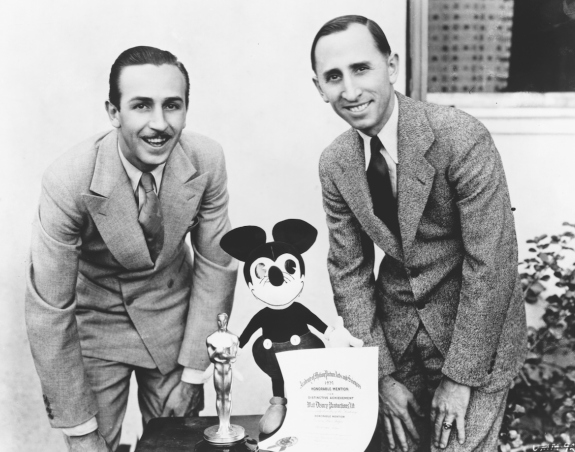 |
| Walt (l) and Roy Disney photographed in 1932 (with Walt's special Oscar for the creation of Mickey Mouse). On 16 October 1923, the brothers had founded their company and named it Disney Brothers Studio. Later the name was changed to Walt Disney Studio (1926–1929), Walt Disney Productions (1929–1986) and since 1986 it's named The Walt Disney Company. Walt Disney was both the creative force and the public face of the company, but without Roy's financial brain Walt could never have realised his dreams. "If it hadn't been for my big brother, I swear I'd have been in jail several times for check bouncing", Walt once said. After Walt's death of lung cancer in 1966 (aged 65), Roy postponed his retirement, took control of the company and supervised the completion of the theme park in Florida which Walt had started. In October 1971, the park finally opened and Roy named it Walt Disney World in honour of his brother. Roy Disney died from a stroke less than three months later, 78 years old. |
_____
This post is my contribution to
The 100 Years of Disney Blogathon, hosted by the Metzinger Sisters at Silver Scenes. Click on the link for all the other entries!


.jpg)


.jpg)
.jpg)
%20(1).jpg)
.jpg)


.jpg)

.jpg)


.jpg)
.jpg)


.jpg)


_04%20(1).jpg)


.jpg)


.jpg)


.jpg)