Showing posts with label Paulette Goddard. Show all posts

18 January 2022

Now the bitch has all the riches

German novelist Erich Maria Remarque, who is best known for his 1929 bestselling novel All Quiet on the Western Front, had an affair with Marlene Dietrich which started in 1937 and lasted at least three years. Dietrich was married to Rudolf ("Rudi") Sieber —their marriage lasted from 1923 until Sieber's death in 1976— and at the time Remarque was married to his first wife Ilse Jutta Zambona, whom he eventually divorced in 1957. After their affair had ended, Remarque and Dietrich remained close friends, sharing a special bond for the rest of their lives. (They kept up a correspondence and a selection of their letters was published in the 2003 Sag Mir Dass Du Mich Liebst (Tell Me That You Love Me).)
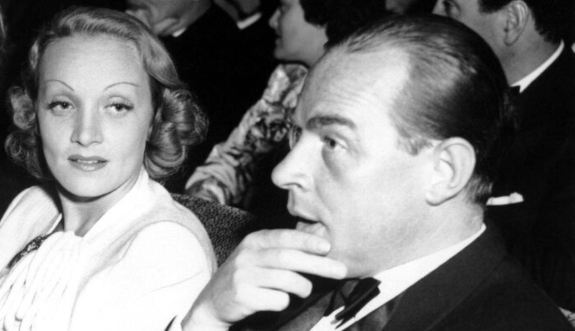
Dietrich and Remarque at a film premiere in 1939


When Dietrich first learned about Remarque being romantically involved with Paulette Goddard, she was shocked and appalled. Dietrich had felt contempt for Goddard ever since the actress had given her advice about men (which happened on a train ride to Hollywood sometime in the 1930s): "The only thing you have to always rememberNever, ever sleep with a man until he gives you a pure white stone of at least ten carats." Goddard not only loved diamonds but she also loved art and antiques, and Dietrich was convinced that when Goddard eventually married Remarque it was because of his money and his massive collection of impressionist paintings. It should be noted, incidentally, that Remarque had first proposed to Dietrich but when she refused he asked Goddard.

Remarque and Goddard tied the knot in 1958. Twelve years her senior, Remarque adored Goddard, loving her carefree attitude to life and her mind. (Writer Anita Loos, a longtime friend of the actress, said that Goddard was one of the most intelligent and most well-read people she knew.) In a marriage that lasted twelve years until Remarque's death in 1970, Goddard brought her husband emotional stability and made him feel the joy of life again. Remarque, in turn, gave his wife what she wanted, her needs mostly materialistic. "I think it was a happy marriage", said actress friend Luise Rainer who saw the couple often. "He could give her a lot of jewellery and that's what she loved. George Gershwin had once told me years before that Paulette was a little gold-digger, and I'm sure she was perfectly aware of Erich's money, his art collection, his beautiful house when she married him ... She was not very enthusiastic about his virility, but she certainly loved him."

Dietrich was certain, however, that Goddard had never loved Remarque. Four days after Remarque's death  —after many strokes he died of heart failure on 25 September 1970, aged 72— she wrote the following letter to her friend Scotty, among others talking about "that bitch Goddard". 
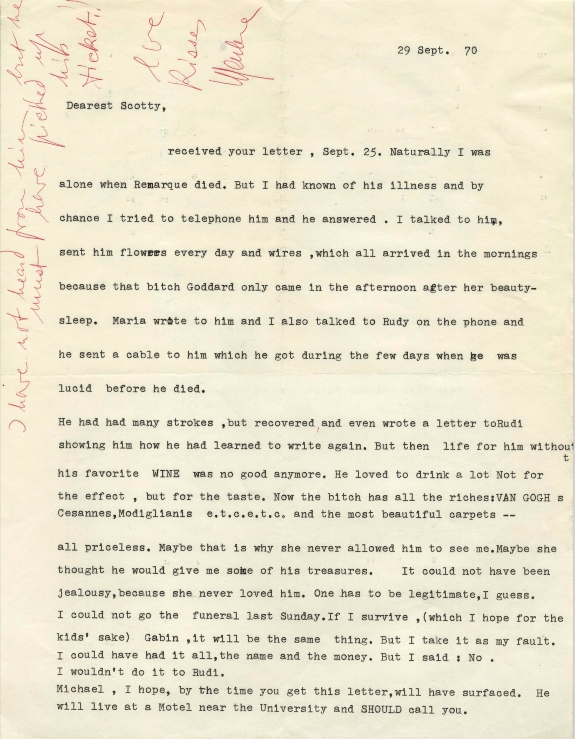

transcript handwritten part:
I have not heard from him but he must have picked up his ticket!! 
love kisses Marlene
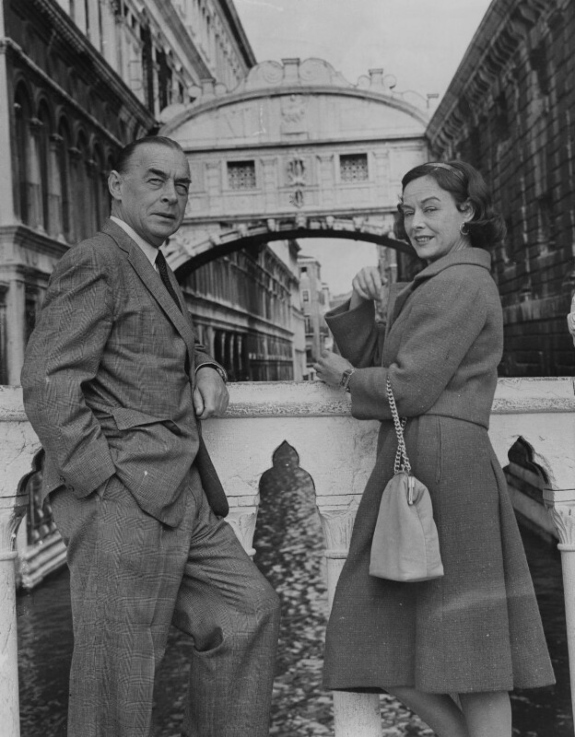
Remarque and Goddard photographed in October 1958
The only picture I could find of Paulette Goddard and Marlene Dietrich together. I don't know when it was taken or what the occasion was but here they are pictured with Mischa Auer (left) and Broderick Crawford.

Following Remarque's death, Goddard gradually sold her husband's collection of impressionist paintings, feeling that "the public should have access to such great paintings" and "tired of having them stored away in crates." A large part of the collection sold for $3 million at auction at Sotheby's in 1979. Remarque's original manuscripts of his work as well as his diaries and personal library were donated by Goddard to the New York University. While the actress may have been a "gold-digger" accumulating a lot of wealth during her lifetime, she also gave back. When she passed away in 1990, Goddard left more than $20 million to the same N.Y.U. for the establishment of scholarships and the development of educational and research programmes. In accordance with Goddard's wishes, in 1995 the N.Y.U. founded The Remarque Institute, in honour of the actress' late husband. 

1 November 2021

Paulette Goddard and her relationship with Diego Rivera & Frida Kahlo

In May 1940, Paulette Goddard travelled to Mexico for a publicity shoot for Look magazine and also hoped to get her portrait painted by renowned painter Diego Rivera. She had heard about Rivera from her good friend George Gershwin, a fan of the painter, and had become intrigued by him. In Mexico Rivera not only agreed to paint Goddard, but soon the two also began an affair. (At the time Goddard was still married to Charlie Chaplin, while Rivera had just divorced Frida Kahlo.)

Rivera was working on Goddard's painting when someone tried to kill Leon Trotsky, the Marxist revolutionary who was a friend of Rivera and Kahlo (Trotsky had also been Kahlo's lover). Rivera was a suspect in the case and Goddard helped him hide out, providing him with food and drink, before eventually leaving the country together. Upon arrival in the U.S. in early June 1940, Rivera had to pay a $500 bond —"to guarantee that I wouldn't overthrow the government of the United States"— and reportedly sold a number of watercolours to Goddard in order to pay for the bond. (Rivera would later state to the American press that Goddard had saved his life.) In San Francisco the painter began work on a mural for the Golden Gate International Exposition, a project he would work on for many months and which he ultimately called Pan-American Unity. His painting Portrait of Paulette Goddard was finished at a later date and eventually found its way to Goddard's home.

Above: Paulette Goddard photographed in her home with the Rivera paintingAfter Goddard's death in 1990, the painting was donated to an educational institution and in 1999 it was sold at auction at Christie's for $552,500
Above: Detail of the huge mural Pan-American Unity by Diego Rivera. (For images of the full mural, click here.) Rivera painted himself holding Goddard's hands, while sharing La Ceiba, the Sacred Tree Of Life; Kahlo stands behind them. Asked why he held hands with Goddard, Rivera answered: "It means closer Pan-Americanism". Incidentally, the mural also contains two scenes from Rivera's favourite films, The Great Dictator with Charlie Chaplin (whom he greatly admired) and Confessions of a Nazi Spy with Edward G. Robinson. Below: Goddard and Rivera photographed in June 1940.
Frida Kahlo didn't arrive in the United States until early September 1940. Several weeks before, another attempt on Trotsky's life had proven successful and Kahlo was questioned by the police and even put in prison for two days (having previously been in contact with Trotsky's assassin Ramón Mercader). In San Francisco, Kahlo reunited with Rivera and the two eventually remarried in December of that same year.

It is unclear when Goddard and Kahlo met for the first time. Gossip columnist Louella Parsons wrote in The San Francisco Examiner that Kahlo and Rivera were weekend guests at the home of Goddard in December 1940, while a letter from Rivera suggests the two women didn't meet until a year later. On 6 December 1941, Rivera wrote to his assistant Emmy Lou Packard: "Paulette ... came here to dinner and she and Frida liked each other", implying they had not met before. 

Goddard and Kahlo reportedly became friends, something which often happened to Kahlo, i.e. befriending the mistresses of her husband. (She had befriended Dolores del Rio too, another actress who had an affair with Rivera and whose portrait he had also painted.) It is said that Kahlo painted the still life The Flower Basket as a gift to Goddard and that her motivation for creating the painting was to forgive Goddard for her love affair with Rivera. In addition, it has been rumoured that the two women were not just friends —a similar rumour had been circulating about Kahlo and Del Rio— and that the painting may also have been a lover's gift.

Frida Kahlo's The Flower Basket

That Kahlo painted The Flower Basket for Goddard is contradicted by art historian Luis-Martín Lozano who said the work was part of a presidential commission. According to Lozano, in June 1941 Kahlo was commissioned by the President of Mexico to paint a few still lifes as decoration for the new dining room of the Palacio Nacional. In the end, the project was cancelled and the paintings, including The Flower Basket (originally entitled Still Life), were returned to the artist. As the following document shows, Kahlo eventually sold —not gave— the painting to Goddard who paid $300 for it. (In 2019, the painting would sell for $3.1 million at Christie's.)

Source: Heritage Auctions


Not only Kahlo sold her work to Goddard but also Rivera sold the actress (at least) one of his paintings. While his portrait of Goddard was likely a gift, the painting Calla Lilies was sold to her for $1000. Documents below are proof of the sale and also shown is Goddard's letter to get the painting cleared through customs. 

Source: Heritage Auctions
Above: Rivera made a number of paintings with calla lilies but I could find no painting entitled Calla Lilies. Perhaps it was this painting, known as Calla Lily Seller from 1942, that he sold to GoddardBelow: Kahlo and Rivera, who were married for the first time from 1929 until 1939 and remarried in December 1940. Kahlo agreed to the second marriage under the condition that she would be financially independent from Rivera and that their relationship would be celibate. The couple remained married until Kahlo's death in 1954.