Showing posts with label John Ford. Show all posts

27 April 2024

Casting "How Green Was My Valley"

When producer Darryl F. Zanuck bought the rights to Richard Llewellyn's 1939 best-selling novel How Green Was My Valley, he intended to make a four-hour, lush Technicolor production to match David O. Selznick's epic Gone with the Wind (1939). To direct the filmZanuck borrowed William Wyler from Samuel Goldwyn, and Philip Dunne was hired to adapt Llewellyn's novel into a screenplay. With Gregg Toland as cinematographer (also on loan from Goldwyn), the film was to be shot in Wales.

The first person to be cast was Roddy McDowall in the role of young Huw Morgan, the main character of Llewellyn's book. (In the book Huw is followed from boyhood to adulthood, the story of his Welsh mining family told from his point of view.) McDowall was one of several British youngsters who had tested for the role. Zanuck and Wyler were so impressed with the young actor that they decided to remove the adult Huw from the story the part that was going to be played by Tyrone Power and concentrate only on Huw as a boy. With the elimination of the adult Huw, the problems Dunne was having with his script were immediately solved. The overlong script could now be brought down to a manageable size. 

Above: Donald Crisp, Roddy McDowall and Sara Allgood in How Green Was My Valley. Below: John Ford directs 12-year-old McDowall in a scene from the film.
When Dunne's script was presented to the Fox executives in New York, they refused to give Zanuck the money for his film. Zanuck's bosses believed that Valley was heading for failure, with its script focusing too much on labour issues. Furthermore, they were very worried about William Wyler's perfectionism and his reputation for going over budget. Zanuck was furious and stood by Dunne's script, even threatening to take it to another studio.

In January 1941, with Valley being delayed, Wyler and Toland returned to Sam Goldwyn to shoot The Little Foxes (1941), their contracts with Fox having expired. Zanuck replaced Wyler with John Ford and Toland with Arthur C. Miller. A few months later, Fox's New York executives finally gave their approval for Valley, albeit under a few conditions. The film would have to be shot in black-and-white, its length reduced to two hours and the budget limited to $1 million. Due to the war in Europe, shooting on location in Wales was not possible, so a replica of a Welsh mining town was built in the hills near Malibu, California. 

Above: Maureen O'Hara and Walter Pidgeon, How Green Was My Valley was their only pairing. Below: Anna Lee (right) and Sara Allgood in the moving film's finale.

Darryl F. Zanuck
Shooting on How Green Was My Valley would start in June 1941, with John Ford at the helm as the film's new director. Several sources claim that most of the cast was already chosen by Wyler when Ford took over. However, in her autobiography 'Tis Herself (2004), Maureen O'Hara stated: "One of the first things Mr. Ford did was to recast the picture. Mr. Ford was far too proud to ever let another director cast his movie, and only one of the originally cast actors appeared in the film (...) The only actor originally cast by Wyler that Mr. Ford kept was young Roddy McDowall as the boy Huw." 

O'Hara's views seem to be supported by the following memo from Zanuck to Ford, written in April 1941, a few months before production was to start. In his memo Zanuck put forward his casting ideas, which indeed imply that of the principal players only McDowall was already cast. Of the actors mentioned by Zanuck, Walter Pidgeon, Sara Allgood and Donald Crisp eventually ended up in the picture (Pidgeon borrowed from MGM and Crisp from Warner Bros). Zanuck's choice for Angharad, Gene Tierney, was rejected by Ford who picked Maureen O'Hara. Neither Martha Scott nor Geraldine Fitzgerald, suggested by Zanuck for the part of Bronwen, was chosen; Ford cast Anna Lee instead. Walter Pidgeon, who Philip Dunne thought was "the one really phony actor" in the film, was cast as the priest Mr Gruffydd to provide Valley with the necessary star power. (Incidentally, Wyler's choice for Angharad had been Katharine Hepburn, Greer Garson for Bronwen and Laurence Olivier for Mr Gruffydd.)


DATE: April 7, 1941
TO: Mr. John Ford
SUBJECT: HOW GREEN WAS MY VALLEY

Dear Jack:

Over the weekend I went through the script again of How Green Was My Valley, and I think I have come up with some fairly good casting ideas.

You directed Gene Tierney in Tobacco Road and did a great job with her ...

In How Green Was My Valley, for the role of Angharad, where could we get a better actress? She has youth —a strange quality about her— and she has sex. We can understand her falling in love with the preacher and we can understand her marrying the miller's son*. We can also understand her going back to the preacher at the finish. There is a strange quality about her that might easily be adapted to this picture, and I think that with proper schooling she can master a slight accent.

For the part of Bronwen, who is the eldest of the two girls, what about the great actress, Martha Scott?

If there is some way we can borrow Ray Milland from Paramount, I think he would be great as the preacher. What about Walter Pidgeon for this role? He is giving a great performance in Man Hunt. Also, there is George Brent to be considered.

There is also another great actress who could play Bronwen. Her name is Geraldine Fitzgerald.

Sara Allgood cannot be beat for Beth.

Donald Crisp is perfect for the role of Morgan.

In order to get any of these people, we'll have to work far in advance— as you know what the casting troubles are.

We should discuss this sometime tomorrow.

D.F.Z. 

[*This should be the mine owner's son.]

Source: Memo from Darryl F. Zanuck: The Golden Years At Twentieth Century-Fox (1993); selected and edited by Rudy Behlmer.
Suggested by Darryl Zanuck for principal roles in How Green Was My Valley, none of these actors ended up playing in the film. Clockwise: Gene Tierney, Ray Milland, Geraldine Fitzgerald, Martha Scott and George Brent. 

Released in October 1941, How Green Was My Valley was a huge success, both commercially and critically. The film was nominated for ten Academy Awards, winning five, i.e. Best Picture (Darryl Zanuck), Best Director (John Ford), Best Supporting Actor (Donald Crisp), Best Cinematography (Arthur Miller) and Best Black-and-White Art Direction-Interior Decoration (Richard Day, Nathan H. Juran and Thomas Little). Valley famously beat other Best Picture contenders, like Citizen Kane, The Maltese Falcon ánd William Wyler's The Little Foxes

16 July 2023

There is no one even second to her ...

From the mid-1940s until the early 1950s, Jeanne Crain was one of the biggest stars at 20th Century-Fox. After signing a long-term contract with Fox in 1943, Crain made her (uncredited) debut in the musical The Gang's All Here (1943). Her first substantial role was in the horse racing drama Home in Indiana (1944), followed by roles in Winged Victory (1944) and in such box-office hits as the musical State Fair (1945) —opposite Dana Andrews, with her singing voice dubbed— and the film noir Leave Her to Heaven (1945) playing the good sister to Gene Tierney's bad one. By 1946, Crain had become one of the studio's main box-office draws. The actress received more fanmail than anyone on the Fox lot (except for Betty Grable) and was also a personal favourite of studio head Darryl F. Zanuck. 

Since Crain was a big Fox star, Zanuck wouldn't let her play the relatively small role of Clementine in John Ford's western My Darling Clementine (1946). In the memo below, Zanuck informs director Ford of his decision not to cast Crain in the part, which eventually went to newcomer Cathy Downs. According to John Ford biographer Ronald L. Davis, the director later responded to Zanuck's memo, saying he didn't care much who played Clementine, "providing she doesn't look like an actress".

DATE: February 26, 1946

TO: Mr. John Ford

CC: Sam Engel [producer]

SUBJECT: MY DARLING CLEMENTINE

Dear Jack:

There will be no chance for us to get Jeanne Crain to play in My Darling Clementine. I know she would be delighted to be directed by you but the part is comparatively so small that we would be simply crucified by both the public and critics for putting her in it. She is the biggest box-office attraction on the lot today. There is no one even second to her ...

D.F.Z. 

Source: Memo from Darryl F. Zanuck: The Golden Years At Twentieth Century-Fox (1993); selected and edited by Rudy Behlmer.


Crain with Zanuck and his children
Jeanne Crain went on to make successful films for Fox like Margie (1946) and Apartment for Peggy (1948), in the latter picture playing William Holden's young, chattering bride. Her most acclaimed films were still to come, however. Being top-billed, Crain starred alongside Linda Darnell, Ann Sothern and Kirk Douglas in A Letter to Three Wives (1949); and she played the titular role in Pinky (1949) as a light-skinned black girl passing for white. The latter performance earned Crain an Academy Award nomination for Best Actress, the only nomination of her career (losing to Olivia de Havilland in The Heiress).

It's interesting to note that the directors of A Letter to Three Wives and Pinky, respectively Joseph L. Mankiewicz and Elia Kazan, were both unimpressed with Crain's acting skills. Mankiewicz was unhappy with her performance in his film —against his will he would direct her again in People Will Talk (1951)— and once said about Crain: "I could only rarely escape the feeling that Jeanne was, somehow, a visitor to the set. She worked hard. Too hard at times, I think, in response to my demands, as if trying to compensate by sheer exertion for what I believe must have been an absence of emotional involvement with acting... She was one of the few whose presence among the theatre-folk I have never fully understood." And Kazan said about her: "Jeanne Crain was a sweet girl, but she was like a Sunday school teacher. I did my best with her, but she didn't have any fire. The only good thing about her was that it went so far in the direction of no temperament that you felt Pinky was floating through all of her experiences without reacting to them, which is what 'passing' is." While I agree that Crain was an actress of limited range, I have always liked her and I think she did a fine job in both A Letter to Three Wives and Pinky. (And I've just rewatched the delightful Apartment for Peggy and Crain is great in that.)

After appearing in several other films including Cheaper by the Dozen (1950), The Model and the Marriage Broker (1951), Dangerous Crossing (1953) and Vicki (1953), Jeanne Crain eventually left 20th Century-Fox in 1953. A few years earlier, Marilyn Monroe had (re) joined the studio and would soon become Fox's biggest star.

Clockwise: Jeanne Crain with Gene Tierney in Leave Her To Heaven (1945); Crain in Margie (1946); with William Holden in Apartment For Peggy (1948); with Linda Darnell and Ann Sothern in A Letter To Three Wives (1949), and with Ethel Waters in Pinky (1949). 


21 April 2019

John Ford's love letters to Maureen O'Hara

After completing Rio Grande (1950) director John Ford started preparations for his magnum opus The Quiet Man (1952), his personal tribute to Ireland which he had wanted to make for a long time. In the fall of 1950, Ford left for Ireland developing his story and seeking locations, while his preferred leading lady Maureen O'Hara flew to Australia to make the film Kangaroo (1952). It was at a stopover in Honolulu where O'Hara received a strange letter from Ford addressed to "Herself", the first of many letters which surprised and confused her. In her 2004 autobiography 'Tis Herself, O'Hara described the moment when the letters, apart from confusing her, also started to worry her: "I hadn't been overly concerned about these letters up to this point, but now I was. Over the next several weeks, more letters arrived for Herself. By the end of February [1951], I had received a stack of them. I couldn't keep dismissing them as John Ford eccentricities or as harmless whims during a drunken stupor. I could no longer deny that, for whatever reason, John Ford was sending me love letters."

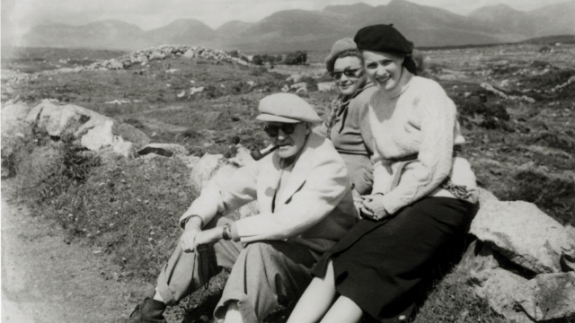
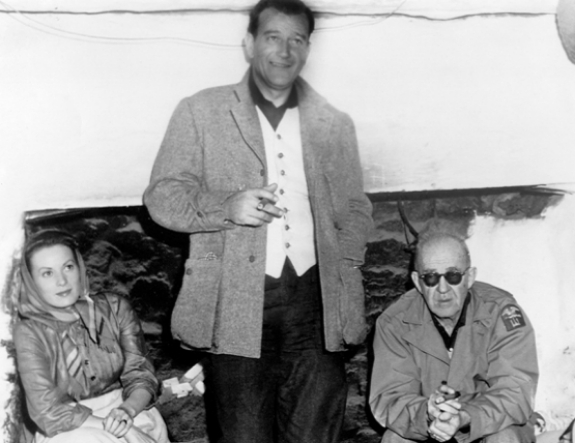
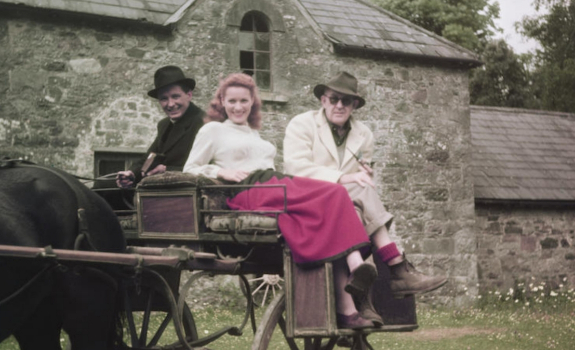
John Ford and Maureen O'Hara in Ireland-- above they are pictured with Ford's secretary and script supervisor Meta Sterne and below with John "Duke " Wayne. 

Trying to figure out why John Ford was sending her these letters, Maureen O'Hara came to realise that it was not hér Ford was in love with, but the character Mary Kate Danaher she was going to play in The Quiet Man. O'Hara believed that Ford (who was born in the USA to Irish immigrants and wanted to get in touch with his Irish roots) was so absorbed in writing his script that she became his ideal Irish woman through Mary Kate and that the letters were all part of Ford's creative process as he was preparing The Quiet Man. Naturally, when filming finally began, O'Hara was curious to see how Ford would behave towards her, not having seen him since receiving the letters. In her autobiography 'Tis Herself  she recalled:

Obviously, I was eager to see how John Ford was going to act toward me on and off the set. His letters had me confused and curious, but not overly concerned. I wanted to know if he was still playing this Quiet Man romance-fantasy of me in his head. I was relieved to see that he was no different from how he had always been. He never mentioned the letters to me, and it was strange, as if they had never existed. On the set, he was the typical Mr. Ford-- happy at times, irritated at others, sometimes insulting, at times abusive, acerbic with his wit, a bastard, but always in control-- and so I felt everything was normal. I later learned, after the picture was finished, that he was still clinging to these fantasies about me. But while we were making the movie, he managed to hide that from me.
And she hastened to add:
With that said, let me get this out of the way once and for all: I did not have an affair with John Ford while we were making The Quiet Man, or at any other time. The man was old enough to be my father! I've heard the rumors that have been thrown around. These stories and assumptions are spewed out in interviews and end up printed in books about John Ford as though they are fact. I'm sorry, guys, but you have it wrong. You should have asked me. Ford did not assign me to a room at Ashford Castle that was adjacent to his, as one person alleged. What Ford did do, however, was deliberately assign me to a room that was very beat up, with holes in the worn-out carpet and wallpaper peeling off the walls. Duke, on the other hand, had a gorgeous suite. I thought, Oh, that old bastard. He did this on purpose, just so I'll make a fuss and complain. But I never said a word. I would never have given him the satisfaction.

Whether it was indeed as Maureen O'Hara believed (i.e. John Ford not really being in love with hér but with her character) -- well, who knows ... At any rate, in the years following The Quiet Man the relationship between O'Hara and Ford grew more difficult with an embittered Ford often verbally assaulting O'Hara, especially during production of The Long Gray Line (1955). (O'Hara once said about Ford's bitterness: "He wanted to be born in Ireland and he wanted to be an Irish rebel. The fact that he wasn't left him very bitter".) Still, O'Hara respected Ford and considered him a friend. She also felt that he was the best director she had ever worked with, having made a total of five films with him (i.e. How Green Was My Valley (1941), Rio Grande (1950), The Quiet Man (1952), The Long Gray Line (1955) and The Wings of Eagles (1957)).
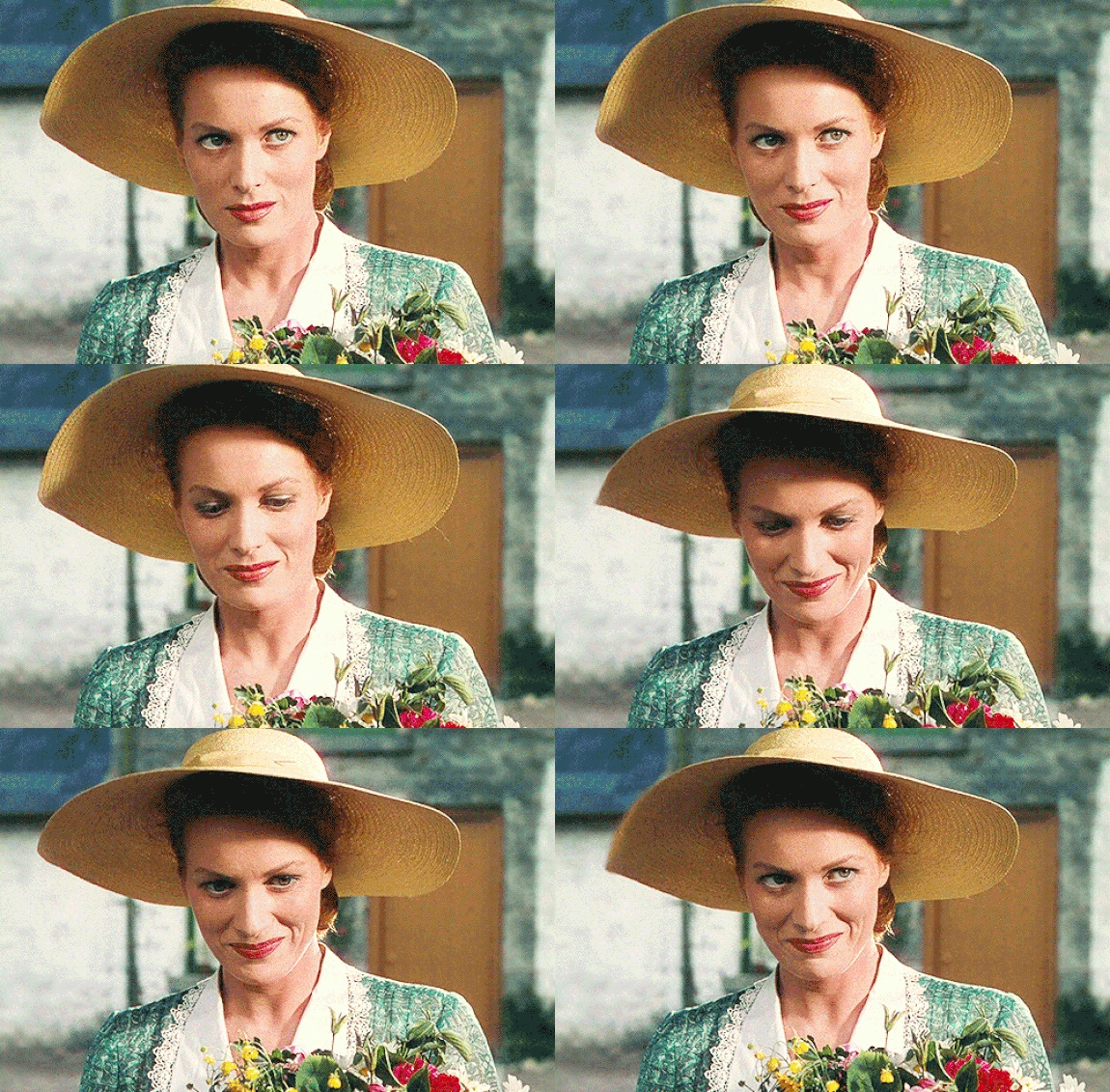
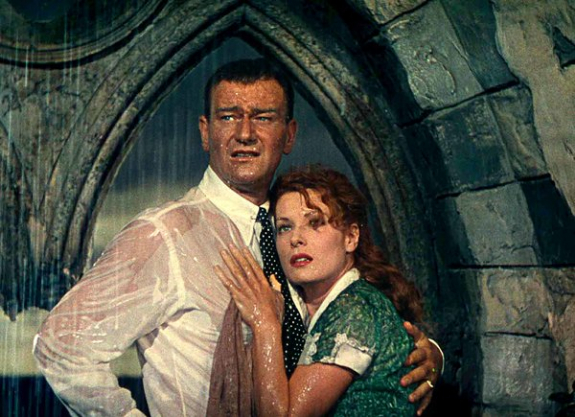
Maureen O'Hara as the feisty Mary Kate Danaher in The Quiet Man (of all the films she had done, it was her favourite film)pictured below with co-star John Wayne as Sean Thornton in the film's romantic rain scene.


And now to the letters!

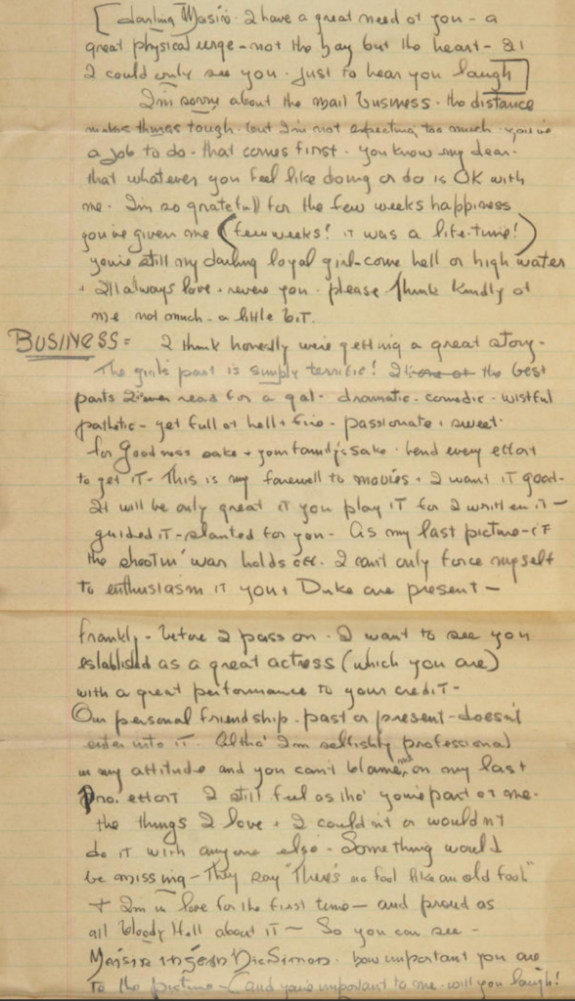
Seen below are two of John Ford's letters to Maureen O'Hara. The first one is part of a letter, not the whole letter, probably written in late 1950. The second letter was written in January 1951 in Korea, where Ford was making the documentary This is Korea! before returning to Ireland. (Incidentally, Ford signed his letters with "Sean", Irish for John, which was also the name for his male protagonist in The Quiet Man.)

Source: Bonhams

Transcript:

[darling Maisín, I have a great need of you- a great physical urge- not the bay but the heart- if I could only see you, just to hear you laugh]

I'm sorry about the mail business- the distance makes things tough but I'm not expecting too much. You've a job to do- that comes first. You know my dear, that whatever you feel like doing or do is OK with me. I'm so grateful for the few weeks happiness you've given me (few weeks! it was a lifetime!) You're still my darling loyal girl- come hell or high water- I'll always love + revere you- please think kindly of me- not much- a little bit.

BUSINESS: I think honestly we're getting a great story. The girl's part is simply terrific! It's the best part I've ever read for a gal- dramatic- comedic- wistful- pathetic- yet full of hell + fire- passionate + sweet. For goodness sake + your family's sake, bend every effort to get it. This is my farewell to movies + I want it good. It will be only great if you play it for I [sic] written it- guided it- slanted for you. As my last picture- if the shootin' war holds off. I can only force myself to enthusiasm if you + Duke are present—

frankly- before I pass on, I want to see you established as a great actress (which you are) with a great performance to your credit. Our personal friendship- past or present- doesn't enter into it. Altho' I'm selfishly professional in my attitude and you can't blame me, on my last pro. effort I still feel as tho' you're part of me- the things I love, I couldn't or wouldn't do it with anyone else. Something would be missing- They say "There's no fool like an old fool"+ I'm in love for the first time- and proud as all bloody hell about it- So you can see- Maisin [....] how important you are to the picture- (and you're important to me- will you laugh!

Korea
My darlin' my loved one my heart-Maisín!
Oh God-at last-at long last-I hear from you! And such lovely letters (Oh thank you my heart) the last dated Jan 6. And here I was moping like a gossoon-about my last & only love— Irish like- an' all the time you were writing regularly! And thru' it all I got the impression you were still fond of me. Darling-you've made me so happy! I looked at the letters for a whole day—afraid to open them—then I said, "I'll read one a day." Then like a drunk & his bottle I read them all-word for word-inflection for inflection-I thought I would have a heart attack- frankly, I damn near fainted several times. I've read them over a hundred times, each time they're different. Again my love thanks. You've made me so happy!!! I love you-I love you-I love you! I kiss you a million times! I'm delirious with happiness.
Oh Maisín agrad, why can't we just chuck it & go back to our lovely Isle-the three of us? Life is so different there-the people-our people-are nicer. We can social climb a bit and say we're peasants.
Did you like the "houseen"? It's at Ballyconnelly (Hell-I already told you) but it's lovely & lovely-so beautiful—
Brian Hurst and I have paid two years rent on Michael Killanin's church cottage (church of Ireland ol' dear) in Spiddal. Nice fishing-bathing- plain but comfortable- but too near my relations- Ballyconnelly is away up in Connemara-near Ballylahunch-
(Gawd what am I raving about! And me old enough to be your grandfather!) But a guy can dream can't he? And I'm in love-for once. Ireland was so pretty my darling-oh how I love it-and you.
I hope this letter makes sense. I'm writing by candlelight out in the boondocks. (I think I'll knock off a while and rest my eyes & hands & re-read your letters a couple of times-I feel sensual- all aglow & warm with love-I can feel your arms around me-and your lips pressed to mine and your red hair-oh my love).
Sleep tight my sweet. I hope I'm still y'fella- think kindly of me my love for I love you with all my heart & soul.
Séan
Source: 'Tis Herself (2004) by Maureen O'Hara with John Nicoletti 

17 January 2019

My Darling Clementine: Ford's handshake vs. Zanuck's kiss

John Ford's My Darling Clementine is often regarded as one of Ford's best films and one of the greatest Westerns of all time. Released in December 1946, the film is a retelling of events leading up to the legendary gunfight at the OK Corral. The film as we know today, however, is not the version Ford himself had in mind. In late June 1946, 20th Century-Fox studio head Darryl F. Zanuck saw Ford's cut and while he liked parts of it, his overall impression was that it was too long and needed serious editing. Zanuck edited the film himself without Ford's interference (like he had done with other Ford films, i.e. The Grapes of Wrath (1940) and How Green Was My Valley (1941)) and ultimately removed 30 minutes from Ford's version while also adding and changing scenes. 


Probably the most significant change that Zanuck made to Ford's version was the ending. In the original cut, Wyatt Earp (Henry Fonda) and Clementine (Cathy Downs) say goodbye with a friendly shake of the hand. While Zanuck himself liked the ending, preview audiences hated it. And so, having invested $2 million in the film, Zanuck had a kiss inserted in the final scene: Earp kisses Clementine on the cheek before shaking her hand. (Henry Fonda and Cathy Downs were called back to film the kiss in the studio, months after shooting had already wrapped.)

In the following memo, written on 4 September 1946, Zanuck informed the film's producer and co-screenwriter Samuel Engel about his decision to change Ford's ending and to add the kiss.

DATE: Sept. 4, 1946
TO: Mr. Samuel Engel
SUBJECT: MY DARLING CLEMENTINE
Dear Sam:
Insomuch as I am flying East in the morning I thought you should have this note in case you wish to show it to Jack Ford and Henry Fonda.
I like the ending of My Darling Clementine exactly as it is. It is completely satisfactory to me from every standpoint. Unfortunately 2,000 people who saw the picture at a preview did not agree. You were present at the preview and you know what happened and you have read the preview cards.
I would like to ridicule the mental attitude of the audience at this preview but you must remember that this is the same audience which applauded the quality of the picture in its earlier sequences....
Therefore it is difficult for me to ignore their request for a more satisfying or satisfactory conclusion to the film. Furthermore, let us be frank. This audience accepted and tremendously enjoyed every moment of the picture but they laughed at us at the finish.
You will recall that the last scene was perfect up to where Fonda reaches out to shake hands with Cathy Downs. It was such an obvious buildup for a kiss or for some demonstration of affection that the audience felt first amused and then completely cheated...
I do feel that it will be honest, legitimate and reasonable if Henry looks at the girl, smiles, leans over and kisses her on the cheek. It is a good-bye kiss and nothing more. He does like her. The audience knows he likes her. Now is no time for us to get smart.
Believe me we need the picture in New York. I detest going back for this scene as much as anybody. But I actually think that it is absolutely essential that we avoid spoiling the last moment of an outstanding picture and we certainly spoiled it for the audience that saw it at the preview.
D.F.Z. 

Source: 
Memo from Darryl F. Zanuck: The Golden Years At Twentieth Century-Fox (1993); selected and edited by Rudy Behlmer.

[Watch Ford's original ending here]

Above: in Ford's ending of My Darling Clementine Wyatt Earp (Henry Fonda) and Clementine (Cathy Downs) only shake hands, while in Zanuck's ending a kiss was inserted to please the audience (photo below). 


19 February 2016

A fitting tribute to your judgement and courage


With a little more than a week to go until Oscar night, here is a short letter from an Oscar winner to a fellow winner. On 26 February 1942, John Ford and Darryl F. Zanuck both won the coveted statuette for their work on How Green Was My Valley, respectively for Best Director and Best Picture. In the following (undated) letter to Zanuck, Ford congratulates the producer on his well-deserved prize, knowing what problems Zanuck had in getting the film made (see note below). Ford was serving as a commander in the U.S. Naval Reserve at the time, thus signing his letter with "Cmdr. John Ford USNR".

Image courtesy of Heritage Auctions.

Transcript:

Dear Darryl,

Congratulations on the Award for "How green was my valley". It was a well deserved choice. Even you+ I will admit that. It was a fitting tribute to your judgement + courage. I know what a scrap you had with the company about its production-- well you won!
Please grant me a favor. Would you have a miniature Oscar made up for me as a memento? You know quarter size- "best production" etc? Would appreciate it and it looks like a long time before I compete again.

Hoping you are in the best of health + with kindest regards
I am
yr old servant
Jack

Cmdr John Ford USNR
Kaneohe Naval Air Station
Oahu T.H.

John Ford (left) with young Roddy McDowall (who played the role of Huw) and screenwriter Philip Dunne on the set of "How Green Was My Valley".


Darryl F. Zanuck
Note
When How Green Was My Valley was well into pre-production, Zanuck's bosses at 20th Century Fox decided to pull the plug on the film. Unhappy with the script that focused too much on labour issues, and also dissatisfied with the first director William Wyler who they feared would not stay within budget, Fox executives in New York refused to put up the money for the project. Zanuck was furious and fought hard for his film, even threatening to take it to another studio. Eventually Fox gave in, and John Ford was brought in to replace Wyler. (Wyler, who had been borrowed from Samuel Goldwyn and whose contract with Fox had expired anyway, went back to Goldwyn to direct The Little Foxes.)

27 May 2015

Dear Pappy

One of the most legendary actor-director collaborations in Hollywood history is the collaboration between John Wayne and John Ford. The two men, who also enjoyed a longtime friendship, made 14 movies together, most of them westerns. Amongst their best known movies are Stagecoach (1936), The Quiet Man (1952), The Man Who Shot Liberty Valance (1962), and of course The Searchers (1956), often considered the pinnacle of their collaboration and one of the best westerns ever made.

The letter for this post (of which a file copy is shown below) was written by John Wayne to John Ford in November 1955. Wayne had just attended a screening of The Searchers (which they had completed earlier that summer) and apart from having doubts about the music he loved the film and thanks Ford for making it. The letter also mentions Wayne's problems with Robert Fellows with whom he had started a production company in 1952, Wayne-Fellows Productions; Wayne eventually bought Fellows out and renamed the company Batjac. Also, Wayne tells Ford that he wants to do the Wead picture with him for MGM (about the life of aviator-turned-screenwriter Frank "Spig" Wead) instead of making lucrative deals with Warners or RKO ("It's more important for me to be in a picture with you, career-wise -for my health- and for my mental relief"); the picture was eventually made as The Wings of Eagles (1957), also starring Maureen O'Hara and Ward Bond.

Incidentally, Wayne mentions a number of people in his letter: Bob Morrison was a producer and Wayne's younger brother; Andrew McLaglen was a director; Daniel O'Shea an executive at RKO; Charles Feldman Wayne's agent, and Arthur Loew, Benny Thau and Dore Schary were all MGM executives.

Image courtesy of heritage auctions

Transcript:

sent airmail to: Mr. John Ford, Yacht "Araner", Ala Wai Harbor, Honolulu, T.H.

1022 Palm Avenue
Hollywood 46, Calif.
Nov. 28, 1955

Dear Pappy,

First: I think "The Searchers" is just plain wonderful.

I wanted to tell you the other night, or at least before you got away to Honolulu, what I've decided to do. Here goes.

I built Bob Fellows into such an important character that I can't do anything with him. I find him incompetent, even when he's trying. I've encouraged Bob Morrison and Andy McLaglen and moved them up faster than I should have. I'm afraid that if I just fired Fellows and moved someone else in, number one, I'd wreck Fellows' career (what career?) - and I might just have as many headaches with someone else. So I'm going to fold the company up. I can make a hell of a deal at Warners, and an unbelievable one at RKO with Danny O'Shea, but if I make either one of these deals I couldn't do the Wead story, so to hell with it. It's more important for me to be in a picture with you, career-wise- for my health- and for my mental relief.

So I'm going to let Charlie Feldman talk to Loew, who is the guy behind the guns at MGM now , to set the deal, and if you hear I haven't talked to Schary or Thau, don't think that I'm ducking the picture-- it's just that Feldman can make a better deal with Loew.

Back to "The Searchers"- I don't think the music is great, but I think it's all right. At first I had hoped it would be a little nostalgic, but the whole treatment is so different than the usual western, that I think this music is probably more appropriate. It's just a wonderful picture. You got great performances out of everyone, and it has a raw brutalness without any pettiness or meanness. 

All I can say is- Thanks again, Coach.

Your everloving,

John Wayne as the vengeful Civil War veteran Ethan Edwards in "The Searchers", one of his best performances (above) -- and (below) tea and cookies on the set with John Wayne, John Ford and visitor Dolores Del Rio.

10 November 2014

I resent your attitude!

On 27 August 1936, director John Ford wrote this angry letter to fellow director George Cukor, presumably after reading an article in the Brooklyn Daily Eagle on Cukor's latest film Romeo and Juliet. In the letter, Ford accuses Cukor of living off his reputation, and quarrels over who "made" Katharine Hepburn and how Greta Garbo was filmed in Camille. Ford is obviously being sarcastic since he talks about hís films (A Bill of Divorcement and Camille) while it was in fact George Cukor who directed them. Unfortunately I couldn't find the newspaper article in question, so I don't know what Ford was so upset about. At any rate, his sneer at Cukor can be read below.

Two great directors: John Ford (left) and George Cukor
Source: bonhams/ image reproduced with permission

Transcript:

August 27th, 1936

Mr. George Cukor,
Metro-Goldwyn-Mayer,
Culver City, Calif.

My Dear Cukor:

I resent your attitude. I saw "Romeo and Juliet" and am suing the Brooklyn Daily Eagle for damages. Your presumption in living off my reputation is highly reprehensible and stinking.

I understand from reliable sources that in my present film "La Dame Aux Camelias" (pronounced "La Dame Aux Camelias") that you were personally making all the long shots while I only did the close-ups of Miss Garbo. And while I am on the subject, I need only refer to one of my first hits, "Bill of Divorcement" in which you claimed you had discovered and made Miss Katharine Hepburn, whereas I had only discovered her.

I beg that any further reference to the subject should be made to my attorneys Malurnski, Driscoll and O'Brien. Malurnski is in Europe.

John Copperfield Ford
(signed "John Ford")

Top photo: Greta Garbo and director George Cukor on the set of "Camille" (1936); below: Katharine Hepburn and John Barrymore in Hepburn's screen debut "A Bill of Divorcement" (1932), directed by George Cukor.