30 August 2022

Groucho's letter to Woody Allen

Groucho Marx and Woody Allen met in 1961 and struck up a friendship that lasted sixteen years. Forty-five years younger than Groucho, Allen was a big fan of his fellow comedian and often made references to Groucho and the Marx Brothers in his films. He once said that Groucho reminded him of "a Jewish uncle in [his] family, a wisecracking Jewish uncle with a sarcastic wit". In 1976, Groucho complimented Allen by saying that he was "the most important comic talent around".

After they became friends, Groucho and Allen fell out of touch for several years. At some point Allen had written Groucho a letter but never got an answer. Allen was offended by this and word about his hurt feelings eventually reached Groucho, who then wrote Allen a letter of apology. Shown below is Groucho's letter, written on 22 March 1967 and filled with his characteristic humour. The letter ended the silence between the two men and they remained friends until Groucho's death in 1977.

Dear WW:

Goodie Ace told some unemployed friend of mine that you were disappointed or annoyed or happy or drunk that I hadn't answered the letter you wrote me some years ago. You know, of course, there is no money in answering letters – unless they're letters of credit from Switzerland or the mafia. I write you reluctantly, for I know you are doing six things simultaneously – five including sex. I don't know where you get the time to correspond.

Your play, I trust, will still be running when I arrive in New York the first or second week in April. This must be terribly annoying to the critics who, if I remember correctly, said it wouldn't go because it was too funny. Since it's still running, they must be even more annoyed. This happened to my son's play, on which he collaborated with Bob Fisher. The moral is: don't write a comedy that makes an audience laugh.

This critic problem has been discussed ever since I was Bar Mitzvahed almost 100 years ago. I never told this to anyone, but I received two gifts when I emerged from childhood into what I imagine today is manhood. An uncle, who was then in the money, presented me with a pair of long black stockings, and an aunt, who was trying to make me, gave me a silver watch. Three days after I received these gifts, the watch disappeared.

The reason it was gone was that my brother Chico didn't shoot pool nearly as well as he thought he did. He hocked it at a pawnshop at 89th Street and Third Avenue. One day while wandering around aimlessly, I discovered it hanging in the window of the hock shop. Had not my initials been engraved on the back, I wouldn't have recognised it, for the sun had tarnished it so completely it was now coal black. The stockings, which I had worn for a week without ever having them washed, were now a mottled green. This was my total reward for surviving 13 years.

And that, briefly, is why I haven't written you for some time. I'm still wearing the stockings—they're not my stockings anymore, they're just parts of my leg.

You wrote that you were coming out here in February, and I, in a frenzy of excitement, purchased so much delicatessen that, had I kept it in cold cash instead of cold cuts, it would have taken care of my contribution to the United Jewish Welfare Fund for 1967 and '68.

I think I'll be at the St Regis hotel in New York. And for God's sake don't have any more success – it's driving me crazy. My best to you and your diminutive friend, little Dickie.

Groucho 

Via: The Guardian


Groucho Marx died on 19 August 1977, just three days after the death of Elvis Presley had shocked the world. While there was an abundance of tributes in the press for Elvis, the press paid little attention to Groucho's passing. The lack of coverage for his friend in Time Magazine (which devoted only one small paragraph to Groucho) led Woody Allen to write to the editor: "Is it my imagination, or were you guys a little skimpy with the Groucho Marx obituary?

The Marx Brothers' Duck Soup (1933) was a big influence on Woody Allen's films. Allen said in a 1976 interview that the film was "probably the best talking comedy ever made".

19 August 2022

We are catering to an audience and that is why you get your money and I get mine

The successful collaboration between director Alfred Hitchcock and music composer Bernard Herrmann abruptly ended over Torn Curtain (1966). The two men had worked together on eight films, with Herrmann composing the score for The Trouble with Harry (1955), The Man Who Knew Too Much (1956), The Wrong Man (1956), Vertigo (1958), North by Northwest (1959), Psycho (1960) and Marnie (1964). On The Birds (1963), which doesn't have actual music but natural and electronic bird sounds, Herrmann had served as a sound consultant. Following MarnieTorn Curtain was the next Hitch-Herrmann project but artistic differences led Hitchcock to eventually fire Herrmann, thereby ending their longtime collaboration and friendship. 


Universal initially didn't want Herrmann to score Torn Curtain but Hitchcock insisted he'd be hired. Once Herrmann was on board, Hitch —under pressure to deliver a hit film after the critical and box-office failure of Marnie— instructed him not to compose a conventional symphonic score but a pop/jazz score that would appeal to younger audiences. Universal wanted a modern score and Hitch went along with the studio, also because he was afraid of becoming old-fashioned. In the end, Herrmann composed music he felt was appropriate for the film, a typical Herrmann score which was precisely what Hitch and Universal did not want.

A confrontation between Hitchcock and Herrmann seemed inevitable and things eventually came to a head in late March 1966. Herrmann was recording his score at the Goldwyn Studios in Los Angeles when Hitch walked in unannounced. The director was extremely unhappy with what he heard and there was a big scene, with Hitch sending home the orchestra, cancelling the rest of the recording session ánd firing Herrmann. It was the sad end of a decade-long collaboration and friendship. Hitch and Herrmann never spoke cordially to each other again. Years later when asked if he would work with Herrmann again, Hitch simply said: "Yes, if he'll do as he's told".

British composer John Addison was eventually hired as Herrmann's replacement, but his score couldn't save Torn Curtain from becoming both a critical and commercial failure. To listen to Addinson's "Main Title" for Torn Curtain, click here; for Herrmann's unused score, go here (I personally prefer Herrmann's music).  

_____


Several months before their collaboration would come to an end, on 4 November 1965 Hitchcock sent the following telegram to Herrmann. At that time Hitch was still eager to work with the composer, although he criticised Herrmann's score for Joy in the Morning (1965), finding it "extremely reminiscent of the Marnie music". To meet audience demands, Hitch urged Herrmann to write a modern score for Torn Curtain, something with "a beat and a rhythm". Herrmann answered Hitch the very next day, his telegram (possibly meant ironically) seen below as well.

DEAR BENNY

TO FOLLOW UP PEGGYS CONVERSATION WITH YOU LET ME SAY AT FIRST I AM VERY ANXIOUS FOR YOU TO DO THE MUSIC ON TORN CURTAIN STOP I WAS EXTREMELY DISAPPOINTED WHEN I HEARD THE SCORE OF JOY IN THE MORNING NOT ONLY DID I FIND IT CONFORMING TO THE OLD PATTERN BUT EXTREMELY REMINISCENT OF THE MARNIE MUSIC IN FACT THE THEME WAS ALMOST THE SAME STOP UNFORTUNATELY FOR WE ARTISTS WE DO NOT HAVE THE FREEDOM THAT WE WOULD LIKE TO HAVE BECAUSE WE ARE CATERING TO AN AUDIENCE AND THAT IS WHY YOU GET YOUR MONEY AND I GET MINE STOP THIS AUDIENCE IS VERY DIFFERENT FROM THE ONE TO WHICH WE USED TO CATER IT IS YOUNG VIGOROUS AND DEMANDING STOP IT IS THIS FACT THAT HAS BEEN RECOGNIZED BY ALMOST ALL OF THE EUROPEAN FILM MAKERS WHERE THEY HAVE SOUGHT TO INTRODUCE A BEAT AND A RHYTHM THAT IS MORE IN TUNE WITH THE REQUIREMENTS OF THE AFORESAID AUDIENCE STOP THIS IS WHY I AM ASKING YOU TO APPROACH THIS PROBLEM WITH A RECEPTIVE AND IF POSSIBLE ENTHUSIASTIC MIND STOP IF YOU CANNOT DO THIS THEN I AM THE LOSER STOP I HAVE MADE UP MY MIND THAT THIS APPROACH TO THE MUSIC IS EXTREMELY ESSENTIAL I ALSO HAVE VERY DEFINITE IDEAS AS TO WHERE THE MUSIC SHOULD GO IN THE PICTURE AND THERE IS NOT TOO MUCH STOP SO OFTEN HAVE I BEEN ASKED FOR EXAMPLE BY [DIMITRI] TIOMKIN TO COME AND LISTEN TO A SCORE AND WHEN I EXPRESS MY DISAPPROVAL HIS HANDS WERE THROWN UP AND WITH THE CRY OF QUOTE BUT YOU CANT CHANGE ANYTHING NOW IT HAS ALL BEEN ORCHESTRATED UNQUOTE IT IS THIS KIND OF FRUSTRATION THAT I AM RATHER TIRED OF BY THAT I MEAN GETTING MUSIC SCORED ON A TAKE IT OR LEAVE IT BASIS STOP ANOTHER PROBLEM THIS MUSIC HAS GOT TO BE SKETCHED IN AN ADVANCE BECAUSE WE HAVE AN URGENT PROBLEM OF MEETING A TAX DATE STOP WE WILL NOT FINISH SHOOTING UNTIL THE MIDDLE OF JANUARY AT THE EARLIEST AND TECHNICOLOR REQUIRES THE COMPLETE PICTURE BY FEBRUARY FIRST

SINCERELY 

HITCH

_____


ALFRED HITCHCOCK

DELIGHTED COMPOSE VIGOROUS BEAT SCORE FOR TORN CURTAIN ALWAYS PLEASED HAVE YOUR VIEWS REGARDING MUSIC FOR YOUR FILM PLEASE SEND SCRIPT INDICATING WHERE YOU DESIRE MUSIC CAN THEN BEGIN COMPOSING HERE WILL BE READY RECORD WEEK AFTER FINAL SHOOTING DATE GOOD LUCK

BERNARD 


Source of both telegrams: Hitchcock's Notebooks: An Authorized And Illustrated Look Inside The Creative Mind Of Alfred Hitchcock (1999) by Dan Auiler.

The seven Hitchcock films that were scored by Bernard Herrmann, my favourite scores being Vertigo and Marnie.

11 August 2022

She walked through the film without trying to give herself

Lauded for her consumate professionalism, Barbara Stanwyck was an actress whom directors, fellow actors and crew members loved to work with. When Ella Smith was preparing her 1973 biography Starring Miss Barbara Stanwyck, she received many letters from those who had worked with Barbara, all having nothing but praise for her (read some of those letters here). However, director William Dieterle, who collaborated with Barbara on The Secret Bride (1934), was not as enthusiastic about her as others were. Below you'll find his letter to Ella Smith in which he talks about Barbara and The Secret Bride (mentioned here under its working title Concealment). 

At the time of The Secret Bride, Barbara had a non-exclusive contract with Warner Bros that she wanted to get out of. However, as much as she hated the film's script, according to Victoria Wilson's A Life of Barbara Stanwyck: Steel-True 1907-1940 (2013) Barbara couldn't afford to be suspended. She accepted the roleneeding the income to support her husband Frank Fay and their adopted son Dion and to pay for the staff, the house, the cars et cetera. For The Secret Bride Barbara was paid $50,000.

Barbara Stanwyck and Warren William in The Secret Bride. Barbara plays the daughter of a governor, having to keep her marriage to the attorney general (William) a secret after her father is accused of taking a bribe. 


Transcript:

8012 Riemerling- Munich. Geranienstr. 29

3.7.72

Dear Miss Smith:

Your letter of Feb.3.72, was forwarded to me and I will try to answer your questions, as good as I can. The work on the film "Concealment" was not very pleasant. The script was bad. I could not refuse it, for contractual reasons. Why Miss Stanwyck not rejected the script, as Betty Davis would have done, I can only guess. She was not happy at Warners and wanted to get out of her contract as quick as possible. But still, bad as the script was, instead to work hard and show that she can make even out of such poor material something interesting, she walked through the film without trying to give herself. Of all the films I directed, "Concealment" is the picture I don't like to think about anymore.

I am sorry to give you no better news.

Wishing you good luck for your work- I remain

Yours cordially

signed "William Dieterle"

[Via: Ebay]

_____


Incidentally, Victoria Wilson mentions an incident in her book that involved Barbara and Dieterle while filming The Secret Bride. Barbara's stand-in Katie Doyle, of whom the actress was very fond, had accidently walked through a scrim which the crew had just spent an hour repairing. Dieterle was furious with Doyle and began reprimanding and scolding her. Barbara then walked up to the director and said: "Don't you ever dare talk to anybody on any set that I am on, don't you ever dare talk to anybody like that again. The next time you do, I walk. I go right up to the office and I will not finish the picture under your direction.

William Dieterle was a German-born director who fled Germany for the USA in 1930 due to the political situation in his country. His films include The Life of Emile Zola (1937), The Hunchback of Notre Dame (1939), I'll Be Seeing You (1945) and Portrait of Jennie (1948). Dieterle always wore gloves on the set, presumably because of a germ or dirt phobia.

4 August 2022

James Dean at UCLA

In May 1949, James Dean graduated from Fairmount High School and then moved back to California to live with his father Winton and stepmother. Until then he had been living with his aunt and uncle, Ortense and Marcus Winslow, on their Quaker farm in Fairmount, Indiana, following the death of his mother when he was nine years old. Back in California, Dean's intention was to enrol at UCLA (University of California, Los Angeles) and study drama. His father didn't approve of his choice, however, and by the end of the summer had persuaded Dean to enrol as a pre-law student at Santa Monica City College. While majoring in pre-law, Dean took as many drama lessons as he possibly could, still determined to become an actor. After a year at Santa Monica College, he transferred to UCLA and finally changed his major to drama ("I wasn't happy where I was. I was studying a field I didn't like, so I transferred to UCLA for a drama major. I figured I might as well pursue this dream now, cause you'll never know if you'll have time to do so later."). During his time at UCLA, Dean was chosen out of a group of 350 actors to play the role of Malcolm in Macbeth and also attended James Whitmore's acting workshop. In 1951, he dropped out of UCLA to fully dedicate himself to his acting career. 

After graduating from high school in May 1949, James Dean wanted to study at UCLA in the fall and also attend the university's summer session. Needing his school records from Fairmount to attend UCLA, in early June Dean wrote the following letter to F. Stanton Galey, Superintendent of Schools in Fairmount. As said, Dean would major in pre-law at Santa Monica City College, like his father wanted, and it still took a year before he enrolled at UCLA and switched his major to drama. Although Dean spent only one semester at UCLA, it marked the beginning of his acting career, eventually leading him to the New York stage and finally to Hollywood.


Transcript:

June 6, 1949

Dear Mr. Galey, 

Well here I am, and I have inquired as to my education at U.C.L.A. (summer session). I hope this reaches you without any detainment because I must have my records or transcripts just as soon as possible. I would appreciate it deeply if you would send them special airmail and then send me the bill for postage. 

I really got a break on the first day. I met Mr. Wooten a Prof. at UCLA. He is from Fairmount and tomarro [sic] he is introducing me to the staff head of the Theatrical Dept. A mister McCowain used to be a director for Fox + Paramount. 

Send to room 10 University of California, Los Angeles 
Administration building

With all due appreciation and respect
Jim Dean

James Dean (right) as Malcolm in UCLA's production of Macbeth. The faculty newspaper criticised his performance: "Malcolm failed to show any growth, and would have made a hollow king."

26 July 2022

I do not give permission for my life story to be made into a movie!!

In December 2021, Tom Holland announced that he would portray Fred Astaire in an upcoming Sony Pictures' biopic about the legendary actor/dancer. The announcement evoked many surprised and angry reactions since the film would go against Astaire's own wishes. Astaire, who was a shy man and very modest when it came to his past achievements, has always refused permission for a film to be made about his life. "However much they offer me —and offers come in all the time— I shall not sell", he said. Even a clause was included in Astaire's will to prevent anyone from making his biopic. "It is there because I have no particular desire to have my life misinterpreted, which it would be." 

Apart from the biopic by Sony Pictures, in 2020 it was also announced that Jamie Bell and Margaret Qualley would star as Fred Astaire and Ginger Rogers in a film for Amazon Studios called Fred & Ginger. I could find no recent information on either project, but presumably they are in pre-production now. (I'm not sure if Astaire's heirs can do anything to prevent these films from being made?)

c.1937, Astaire working on one of his dance routines with choreographer Hermes Pan.


In the following letter to fellow actor Lionel Jeffries, written on 22 August 1980, Fred Astaire confirms the existence of the clause in his will and also says how he hates talking about his past work. Astaire had struck up a friendship with Jeffries in the 1960s and this letter is only one of many he had written to his friend.


Transcript:

Aug. 22nd 

Dear Lionel:- 

Thanks for thinking of me but I must tell you that there is no way I would ever take on a project as suggested in your letter. The idea has been brought to me by all three major networks here, a number of times.

As you know I hate talking about my past work. I even have it in my will that I do not give permission for my life story to be made into a movie!!

All is well here and my love to all the family.

As ever Fred A- 

Lionel Jeffries and Fred Astaire on the set of the 1962 comedy The Notorious Landlady, also co-starring Jack Lemmon and Kim Novak.

21 July 2022

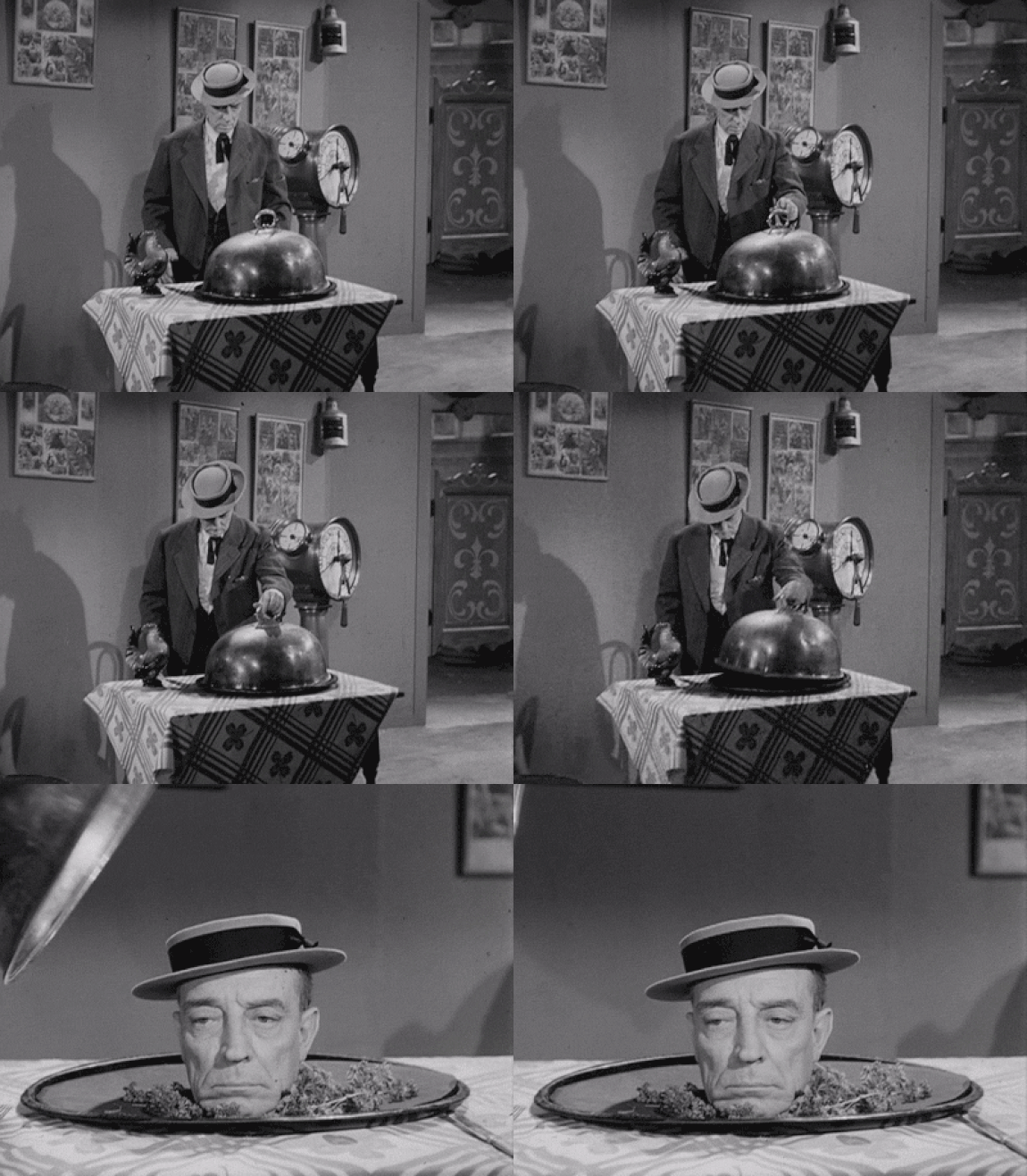
The Decline of Buster Keaton's Career

In 1928, Buster Keaton signed a contract with MGM which he later called the biggest mistake of his career. Until then he had been working as an independent filmmaker, enjoying great artistic freedom in the making of his shorts and feature films. Charlie Chaplin and Harold Lloyd had warned Keaton beforehand that he would lose his independence if he signed with MGM, and they were right. While Keaton could still film his first MGM feature The Cameraman (1928) his own way, this would all change. The actor/filmmaker, who was used to working without a proper script, soon had to deal with dozens of writers, script conferences and in the end was given merely script material he hated. Keaton did go along with the studio's wishes but by the time What! No Beer? (1933) was filmed, he had sunk into a deep depression, causing him to drink excessively. When he failed to meet his commitments, MGM fired him.

Following his dismissal by MGM, Keaton made a few films in Europe before returning to Hollywood to make a series of shorts for Educational Pictures and later for Columbia Pictures (after which Keaton vowed never to make "another crummy two-reeler" again). He was rehired by MGM in the late 1930s, this time as a gag writer, providing material for the Marx Brothers, Red Skelton and Laurel & Hardy. Keaton appeared in a cameo role in Sunset Boulevard (1950) and also had small roles in In the Good Old Summertime (1949) and Chaplin's Limelight (1952). He loved television and in the 1950s the medium revived his career and provided him with steady work, even with a tv show of his own (i.e. The Buster Keaton Show). Television also helped rekindle the interest of the public in Keaton's silent films. In 1959, Keaton received an Academy Honorary Award ("for his unique talents which brought immortal comedies to the screen”) and the Venice Film Festival also honoured him in 1965 for his contributions to the film industry.

Buster Keaton, "The Great Stone Face". As an independent fimmaker he made shorts like One Week (1920), The Goat (1921) and Cops (1922), and among his feature films are Sherlock Jr. (1924), Seven Chances (1925), The General (1926) and Steamboat Bill Jr. (1928).
Buster Keaton at work as a gag writer for MGM with above The Marx Brothers (Groucho and Chico) and below Red Skelton. The collaboration between Buster and the Marx Brothers did not always go smoothly. When Groucho told him his gags were not compatible with the Marx Brothers' humour,  Buster answered, "I'm only doing what Mr. Mayer asked me to do. You guys don't need help."


Buster Keaton never again enjoyed the successes he had in the 1920s. The mid-1920s saw him at the height of his career, earning $3,500 a week while building a $300,000 house for his first wife, actress Natalie Talmadge. His descent into alcoholism and depression —after MGM had taken away his creative control— coincided with the crumbling of his marriage to Talmadge, which ended in divorce in 1932. By the mid-1930s, Keaton was broke (Talmadge having extravagantly spent his money) and filed for bankrupcy. While he would earn a decent living in the decades to come, unlike Charlie Chaplin and Harold Lloyd, Keaton didn't own the rights to his own films and never became a millionaire. Still, he was a content man —in 1940 he married his third wife, MGM dancer Eleanor Norris, to whom he remained happily married until his death in 1966— and looking back on his life said in 1960: "I think I have had the happiest and luckiest of lives. Maybe this is because I never expected as much as I got ... It would be ridiculous of me to complain. I count the years of defeat and grief and disappointment, and their percentage is so minute that it continually surprises and delights me."

Shown below is an Internal Revenue Service tax form (W-4), filled out and signed by Buster Keaton in June 1943. At the time he was working as an uncredited gag man for MGM and requested to be exempted from paying income taxes. Keaton often had tax problems and in 1933, following his bankrupcy, even owed the IRS $28,000 in back taxes (today's equivalent is about $630,000). Also shown is an agreement between MGM and Keaton, concerning Keaton's two-day leave in June 1945 for which he didn't get paid.

Source: Heritage Auctions
Above: Buster Keaton with his third wife Eleanor Norris who is credited with saving his life and career. Norris, 23 years younger than Keaton, was a contract dancer at MGM. When the two met in 1938, Keaton was working as a gag consultant and still having bouts with alcoholism. Norris helped him to get his alcohol consumption under control. During the marriage, the couple toured European circuses together doing vaudeville acts and also performed together on The Buster Keaton Show. They were happily married for 26 years until Keaton's death of lung cancer in 1966. Norris played an important role in keeping Keaton's legacy alive after his death. (And in case you're wondering who Keaton's second wife was— she was his nurse Mae Scriven, whom he married in 1933 during an alcoholic blackout; they divorced in 1936.) Below: Buster on television, early 1950s. 


16 July 2022

God’s eye may be on the sparrow but my eye will always be on you

Elizabeth Taylor and Richard Burton are known far more for their intense and turbulent relationship than for the eleven films they made together (which include Cleopatra (1963) and the 1966 acclaimed Who’s Afraid of Virginia Woolf?). The couple met at a Hollywood party in 1953 and in his diary Burton recalled seeing Elizabeth, who was already a star at 21, for the first time: "... a girl sitting on the other side of the pool lowered her book, took off her sunglasses and looked at me. She was so extraordinarily beautiful that I nearly laughed out loud ... she was unquestioningly gorgeous ... She was lavish. She was a dark unyielding largess. She was, in short, too bloody much, and not only that, she was totally ignoring me.” They would meet again almost ten years later on the set of Cleopatra, their first film together, and it was during the first love scene that sparks started flying, with their kiss taking a lot longer than necessary. Married to other people —Elizabeth to singer Eddie Fisher and Burton to actress Sybil Williams— the two soon embarked on a heavily publicised love affair. The affair was met with public disapproval as well as criticism from the U.S. Congress and the Vatican, the latter condemning the couple for "erotic vagrancy". 

Once divorced from their spouses, "Liz and Dick" —as they were dubbed by the tabloid press that followed them wherever they went— were married on 15 March 1964. They divorced in 1974, then remarried in 1975 and divorced again less than a year later. Their life together had been one of extreme luxury, with millions spent on diamonds, furs, art, grand hotels, a yacht and a jet, et cetera. Also a lot of heavy drinking was involved (by both Burton and Taylor) as well as vicious fighting. After their final divorce, the couple remarried other people but the bond between them would never be broken. Looking back, Elizabeth said later in life: "After Richard, the men in my life were just there to hold the coat, to open the door. All the men after Richard were really just company." And in an interview with Vogue, she admitted: "I was still madly in love with him the day he died. I think he still loved me, too." 

During their time together, Richard Burton wrote Elizabeth Taylor many letters, one of them seen below. In the letter, written in June 1973, he said goodbye to Elizabeth after she had told him their marriage was over. Burton was a womaniser and had several affairs during the marriage and Elizabeth had had enough. It would still take a year, though, before the couple had their first divorce.

Also shown is a passionate love letter from Elizabeth to Richard, written in March 1974 on the occasion of their 10-year wedding anniversary. Shortly thereafter, the couple separated and three months later they were divorced. 


June 25, 1973

So My Lumps, 

You’re off, by God! 

I can barely believe it since I am so unaccustomed to anybody leaving me. But reflectively I wonder why nobody did so before. All I care about—honest to God—is that you are happy and I don’t much care who you’ll find happiness with. I mean as long as he’s a friendly bloke and treats you nice and kind. If he doesn’t I'll come at him with a hammer and clinker. God’s eye may be on the sparrow but my eye will always be on you. Never forget your strange virtues. Never forget that underneath that veneer of raucous language is a remarkable and puritanical LADY. I am a smashing bore and why you’ve stuck by me so long is an indication of your loyalty. I shall miss you with passion and wild regret. 

You may rest assured that I will not have affairs with any other female. I shall gloom a lot and stare morosely into unimaginable distances and act a bit—probably on the stage—to keep me in booze and butter, but chiefly and above all I shall write. Not about you, I hasten to add. No Millerinski Me, with a double M. There are many other and ludicrous and human comedies to constitute my shroud. 

I’ll leave it to you to announce the parting of the ways while I shall never say or write one word except this valedictory note to you. Try and look after yourself. Much love. Don’t forget that you are probably the greatest actress in the world. I wish I could borrow a minute portion of your passion and commitment, but there you are—cold is cold as ice is ice.

Source:  Letters of Note

Source: Paul Fraser Collectibles

Transcript:

My darling (my still) My husband 

I wish I could tell you of my love for you, of my fear, my delight, my pure animal pleasure of you - (with you) - my jealousy, my pride, my anger at you, at times.

Most of all my love for you, and whatever love you can dole out to me - I wish I could write about it but I can't. I can only "boil and bubble" inside and hope you understand how I really feel.

Anyway, I lust thee 

Your (still) Wife 

P.S. O'Love, let us never take each other for granted again! 

P.P.S. How about that - 10 years!!


Note: On the back of Elizabeth's letter the following was written: "This letter written by Elizabeth Taylor while renting my home from Feb 15th till April 18th 1974. It was left behind - inside a book in the drawer under the masterbedroom bed." Elizabeth and Richard had rented a private home in Oroville, California, while Burton was filming The Klansman. The owner of the house Antonia Henning had found Elizabeth's letter after the Burtons had already left. Another letter from Elizabeth to her lost cat Cassius (here) was found in the same drawer.


7 July 2022

Oscar For Sale

For those artists lucky enough to win an Oscar, the Academy of Motion Picture Arts and Sciences has strict rules in case winners should ever wish to part with their golden prize. In 1951, the Academy included in the regulations that winners are not allowed to sell their Oscar without first offering it to the Academy for $10 (today the sum is a mere $1). This rule also applies to those who inherited or were gifted an Oscar.

A number of times the Academy has taken legal action when an Oscar was being offered for sale. For instance, in 2014 the Academy found their 1951 rule had been violated when an Oscar was sold at auction by the heirs of art director Joseph Wright, who had won the award for his work on My Gal Sal (1942). Joseph Tutalo, Wright's nephew, had consigned the statuette to Briarbrook Auctions and auction house Nate D. Sanders then bought the Oscar from Briarbrook for $79,200. The Academy subsequently went to court, arguing that although Wright had won the Oscar before 1951 he had kept his Academy membership until his death in 1985, which made the sale illegal. Eventually the judge ruled in the Academy's favour and the Academy reclaimed Wright's Oscar for $10.

Spencer Tracy with his Best Actor Oscar for Boys Town (1938) and Bette Davis with her Best Actress Oscar for Jezebel (1938), the latter Oscar sold at auction in 2001 to an anonymous bidder (who turned out to be Steven Spielberg).

Oscars have been sold succesfully in the past, though. For instance, in 1999 David Selznick's Best Picture statuette for Gone with the Wind (1939) was sold to Michael Jackson for a whopping $1.5 million, a trophy that unfortunately went missing years after Jackson's death (I couldn't find information whether it's turned up yet). Magician David Copperfield bought Michael Curtiz's 1943 Casablanca Oscar for $232,000 in 2003 and made a huge profit when he sold it at auction for more than $2 million ten years later. And director Steven Spielberg purchased several Oscars, including Clark Gable's 1934 Oscar for It Happened One Night (for $607,500 in 1996) and Bette Davis' 1938 Best Actress trophy for Jezebel (for $578,000 in 2001). However, Spielberg didn't buy these trophies for himself but, for the sake of preserving film history, returned them to the Academy instead.

Since 1951 Oscar winners are obliged to sign a document saying they won't sell their trophy without offering it to the Academy first. Here is the "Receipt for Academy Award Statuette" signed by Audrey Hepburn in May 1954, after she had won her Best Actress Oscar for Roman Holiday.

Via: Rare Audrey Hepburn (original source: The Audrey Hepburn Treasures)

Audrey Hepburn with the only Oscar of her career

28 June 2022

Your truest and best admirer, Edna

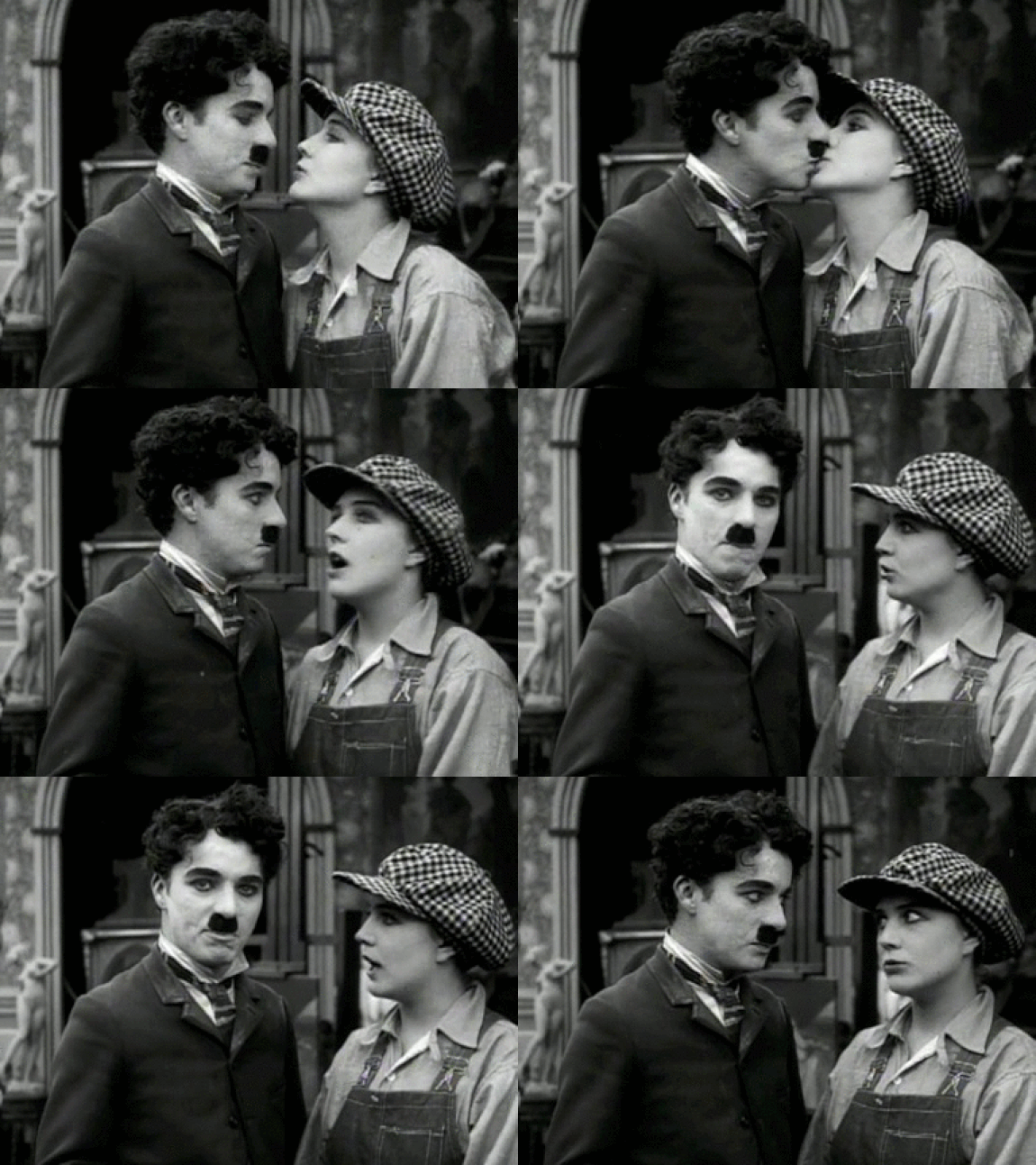
In early 1915, Charlie Chaplin was looking for a leading lady for his next film A Night Out, when one of his employees saw Edna Purviance at a café, thinking she might be suited for the role. At the time Edna was working as a secretary and had no previous acting experience. Enthralled by her beauty and charm, Chaplin hired Edna, which was the start of a long working relationship. Edna would appear as Chaplin's leading lady and often romantic interest in 33 of his films, all of them shorts except for The Kid (1921) and A Woman of Paris (1923). In the latter film she had her first and only leading role and it was Chaplin's attempt to launch her career as a dramatic actress. Sadly, the attempt was unsuccessful and after two more films —the unreleased A Woman of the Sea and a French film Éducation de Prince (1927)— Edna's film career was over. (While several sources, including Wikipedia and IMDB, state that the actress made uncredited appearances in Chaplin's Monsieur Verdoux (1947) and Limelight (1952), apparently she doesn't appear in those films at all; read more here.)

Apart from working together, Chaplin and Edna were also romantically involved (from 1915 until 1917) and remained friends after their relationship had ended. When Edna retired from acting, she lived a quiet life away from Hollywood. Chaplin, feeling responsible for her well-being, kept her on his payroll until her death in 1958. 

Above: Edna Purviance and Charlie Chaplin pictured together off-screen. Below: Edna and Charlie in (left) The Immigrant (1917) and A Dog's Life (1918).

When Chaplin was casting Monsieur Verdoux (1947), he considered Edna for the role of Madame Grosnay (which eventually went to Isobel Elsom). In his 1964 My Autobiography, Chaplin writes about meeting Edna again after not having seen her for twenty years. A melancholy and touching excerpt from the book in which he describes their reunion is seen below. Included in the excerpt are two letters from Edna to Chaplin. At the time of writing these letters, Edna was battling throat cancer and eventually succumbed to the disease on 13 January 1958, 62 years old. 

During the casting of Monsieur Verdoux, I had thought of Edna for the important part of Madame Grosnay. I had not seen her for twenty years, for she never came to the studio because her weekly cheque was mailed to her by the office. She confessed afterwards that when she received a call from the studio she was more shocked than thrilled.

When Edna arrived, Rolly, the cameraman, came into my dressing-room. He, too, had not seen her in twenty years. ‘She’s here,’ he said, his eyes glistening. ‘Of course, she’s not the same – but she looks great!’ He told me that she was waiting on the lawn, outside her dressing-room.

I wanted no emotional reunion scene, so I assumed a matter-of-fact manner as if it had been only a few weeks since I last saw her. ‘Well! Well! We’ve eventually got round to you,’ I said cheerily.

In the sunlight I noticed that her lip trembled as she smiled; then I plunged into the reason why I had called her, and told her about the film. ‘It sounds wonderful,’ she said – Edna was always an enthusiast.

She read for the part and was not bad; but all the while her presence affected me with a depressing nostalgia, for she was associated with my early successes – those days when everything was the future!

Edna threw herself into the role, but it was fruitless – the part required European sophistication, which Edna never had – and after working with her three or four days I was forced to admit that she was unsuitable. Edna herself was more relieved than disappointed. I did not see or hear from her again until she wrote to me in Switzerland to acknowledge her severance pay:


Dear Charlie,

For the first time I am able to write my thanks for your friendship down the years, and for all you have done for me. In early life we do not seem to have so many troubles and I know you have had your share. I trust your cup of happiness is full with a charming wife and family.…

[Here she described her illness and the terrific expense of doctors and nurses, but she finished as she always did with a joke:]

Just a story I heard. A chap was sealed in a rocket ship and shot upwards to see how high he could go – was told to keep track of the altitude. So he kept counting 25,000 – 30,000 – 100,000 – 500,000… When he got this far he said ‘Jesus Christ!’ to himself, and a very silent soft voice answered back: ‘Yessss –?’

Please, please, Charlie, let me hear something from you in the near future. And please come back, you belong here.

Sincerely your truest and best admirer,

Love, Edna.


Through all the years I had never written a letter to Edna; I always communicated with her through the studio. Her last letter was an acknowledgement of the news that she was still on the payroll:


November 13th, 1956.

Dear Charlie,

Here I am again with a heart full of thanks, and back in hospital (Cedars of Lebanon), taking cobalt X-ray treatment on my neck. There cannot be a hell hereafter! It all comes while one can wriggle even a little finger. However, it is the best known treatment for what ails me. Hope to be going home at the end of the week, then can be an outside patient (how wonderful!). Am thankful my innards are O.K., this is purely and simply local, so they say – all of which reminds me of the fellow standing on the corner of Seventh and Broadway tearing up little bits of paper, throwing them to the four winds. A cop comes along and asks him, what was the big idea. He answers: ‘Just keeping elephants away.’ The cop says: ‘There aren’t any elephants in this district.’ The fellow answers: ‘Well, it works, doesn’t it?’ This is my silly for the day, so forgive me.

Hope you and the family are well and enjoying everything you have worked for.

Love always, Edna.


Shortly after I received this letter she died. And so the world grows young. And youth takes over. And we who have lived a little longer become a little more estranged as we journey on our way.


Source: Charles Chaplin: My Autobiography (1964)

Charlie en Edna in Behind the Screen (1916)

19 June 2022

I am asking of both Budd and you that you treat me fairly ...

After the screenplay of On the Waterfront (1954) was finished, director Elia Kazan and screenwriter Budd Schulberg went to see Darryl F. Zanuck, producer and studio boss at 20th Century-Fox, to offer him the script. The two were very confident that Zanuck would like it and would be willing to produce it. During their meeting, however, the producer was not interested in Waterfront at all but kept talking about Prince Valiant (1954) and how wonderful it would be in CinemaScope. CinemaScope was Fox's new widescreen process (with all films to be shot in colour) and it was all Zanuck could think and talk about. (He knew full well that Waterfront was to be shot in black-and-white and in standard format.) In a 2004 interview with William Baer, Schulberg recalled Zanuck's reaction when Kazan finally asked him about the Waterfront script: "I'm sorry, boys, but I don't like a single thing about it ... What have you got here, boys? All you've got is a lot of sweaty longshoremen. I think what you've written is exactly what the American people don't want to see." Having previously worked with Schulberg on the script himself, Zanuck had now completely turned against it.

Devastated by Zanuck's rejection, Kazan took the script to other studios but they turned him down as well. Then quite unexpectedly, when Kazan and Schulberg believed Waterfront would never be filmed, independent producer Sam Spiegel came along and agreed to take on their project. With Spiegel as producer and eventually released by Columbia Pictures, On the Waterfront became a huge critical and commercial success. The film also won eight Academy Awards, including Best Picture (Spiegel), Best Actor (Marlon Brando), Best Supporting Actress (Eve Marie Saint), Best Director (Kazan) and Best Story and Screenplay (Schulberg). 

Above: Sam Spiegel (second from left), Marlon Brando and Brando's parents visiting their son on the set of On the Waterfront.


Darryl Zanuck regretted his rejection of Waterfront even before the film was showered with accolades and awards. In the following letter to Elia Kazan ("Gadg") from 15 July 1954, Zanuck admitted that "the advent and debut of Cinemascope was responsible more than anything else for [his] final decision against the property". He resented the suggestion made by Schulberg in a New York Times article that he had rejected the film because "he lost his courage and ran out on a "touchy" subject." (In the 11 July 1954 article Schulberg had said: "The head of the studio had changed his mind, Waterfront wouldn't fit in with the program of costumed horse operas he was lining up ... The picture was still too controversial, we were told. Too grim, too shocking. And, would the people care about the struggle on the docks?".) 

Annoyed that Kazan and Schulberg didn't acknowledge his role in the making of Waterfront, Zanuck also reminded Kazan of the important contributions he had made to the script and of being the one who had first suggested Brando to them.


July 15, 1954
Mr. Elia Kazan 
Warner Bros. Studios
Burbank, California
Personal & Confidential 

Dear Gadg:

Thanks for your letter of June 28th. I just returned from Europe and only received it today ...

The only thing in your letter that disturbs me is when you say that I let Budd and you come out to California on the Waterfront story and then gave you a cold turn-down— and that a telegram would have served just as well.

You have a short memory, Gadg. Budd came to see me more than once. I spent many hours on many days working with him and trying to develop and alter the script. He accepted all but one of my major suggestions. You accepted them. Four of them are a part of your finished picture, or at least I have been told so by those who have seen the picture and who also had read the original treatment and script and had also read the conference notes.

I am not asking for screen credit but I am asking of both Budd and you that you treat me fairly and that you recognize the facts. I have just reread my conference notes and my various communications on this story. I think both Budd and you should read them again and think of them in the light of your finished picture. I think you should also remember that I am the one who insisted in writing that only Marlon Brando should play the role and that I first suggested him in a telegram to you.

I have just seen an article in last Sunday's New York Times written by Budd in which he does not mention me by name but in which he indicates that I lost my courage and ran out on a "touchy" subject.

I am really astonished that Budd should write anything such as this. Even more than this, he knows how I sweated and worked with him in a conscientious effort to improve the dramatic construction of the story, and particularly the love story, etc. etc. The last day I saw him he shook my hands and told me that no matter how it turned out he had received valuable assistance and that working with me had been a "unique and exhilarating experience."

Actually the advent and debut of CinemaScope was responsible more than anything else for my final decision against the property. At that time I felt that since we had overnight committed ourselves to a program of CinemaScope "spectacles" I had no alternative but to back away from intimate stories even though they were good stories. I have since changed my mind as one of our most successful CinemaScope pictures [Three Coins in the Fountain, 1954] is based on an intimate story. 

I understand your picture has turned out to be wonderful. I am happy because every great picture is helpful to the best interests of our industry.

I am taking the liberty of sending a copy of this letter to Budd. I just cannot accept the idea that I lost my courage or gave you a quick brush-off. I spent more time on your project than I do on some of the pictures that we actually produce. In addition to this I invested $40,000 in the property. If this is a brush-off then I have a wrong interpretation of the phrase.

You and I are due for a hit next time we get together ...

I look forward to seeing you. Come over when you finish [East of Eden (1955) at Warners].

Best always,

Darryl

Source: Memo from Darryl F. Zanuck: The Golden Years At Twentieth Century-Fox (1993); selected and edited by Rudy Behlmer.

Above: (l to r) Schulberg, Zanuck and Kazan. Below: Eve Marie Saint and Marlon Brando in a scene from On the Waterfront.