26 July 2022

I do not give permission for my life story to be made into a movie!!

In December 2021, Tom Holland announced that he would portray Fred Astaire in an upcoming Sony Pictures' biopic about the legendary actor/dancer. The announcement evoked many surprised and angry reactions since the film would go against Astaire's own wishes. Astaire, who was a shy man and very modest when it came to his past achievements, has always refused permission for a film to be made about his life. "However much they offer me —and offers come in all the time— I shall not sell", he said. Even a clause was included in Astaire's will to prevent anyone from making his biopic. "It is there because I have no particular desire to have my life misinterpreted, which it would be." 

Apart from the biopic by Sony Pictures, in 2020 it was also announced that Jamie Bell and Margaret Qualley would star as Fred Astaire and Ginger Rogers in a film for Amazon Studios called Fred & Ginger. I could find no recent information on either project, but presumably they are in pre-production now. (I'm not sure if Astaire's heirs can do anything to prevent these films from being made?)

c.1937, Astaire working on one of his dance routines with choreographer Hermes Pan.


In the following letter to fellow actor Lionel Jeffries, written on 22 August 1980, Fred Astaire confirms the existence of the clause in his will and also says how he hates talking about his past work. Astaire had struck up a friendship with Jeffries in the 1960s and this letter is only one of many he had written to his friend.


Transcript:

Aug. 22nd 

Dear Lionel:- 

Thanks for thinking of me but I must tell you that there is no way I would ever take on a project as suggested in your letter. The idea has been brought to me by all three major networks here, a number of times.

As you know I hate talking about my past work. I even have it in my will that I do not give permission for my life story to be made into a movie!!

All is well here and my love to all the family.

As ever Fred A- 

Lionel Jeffries and Fred Astaire on the set of the 1962 comedy The Notorious Landlady, also co-starring Jack Lemmon and Kim Novak.

21 July 2022

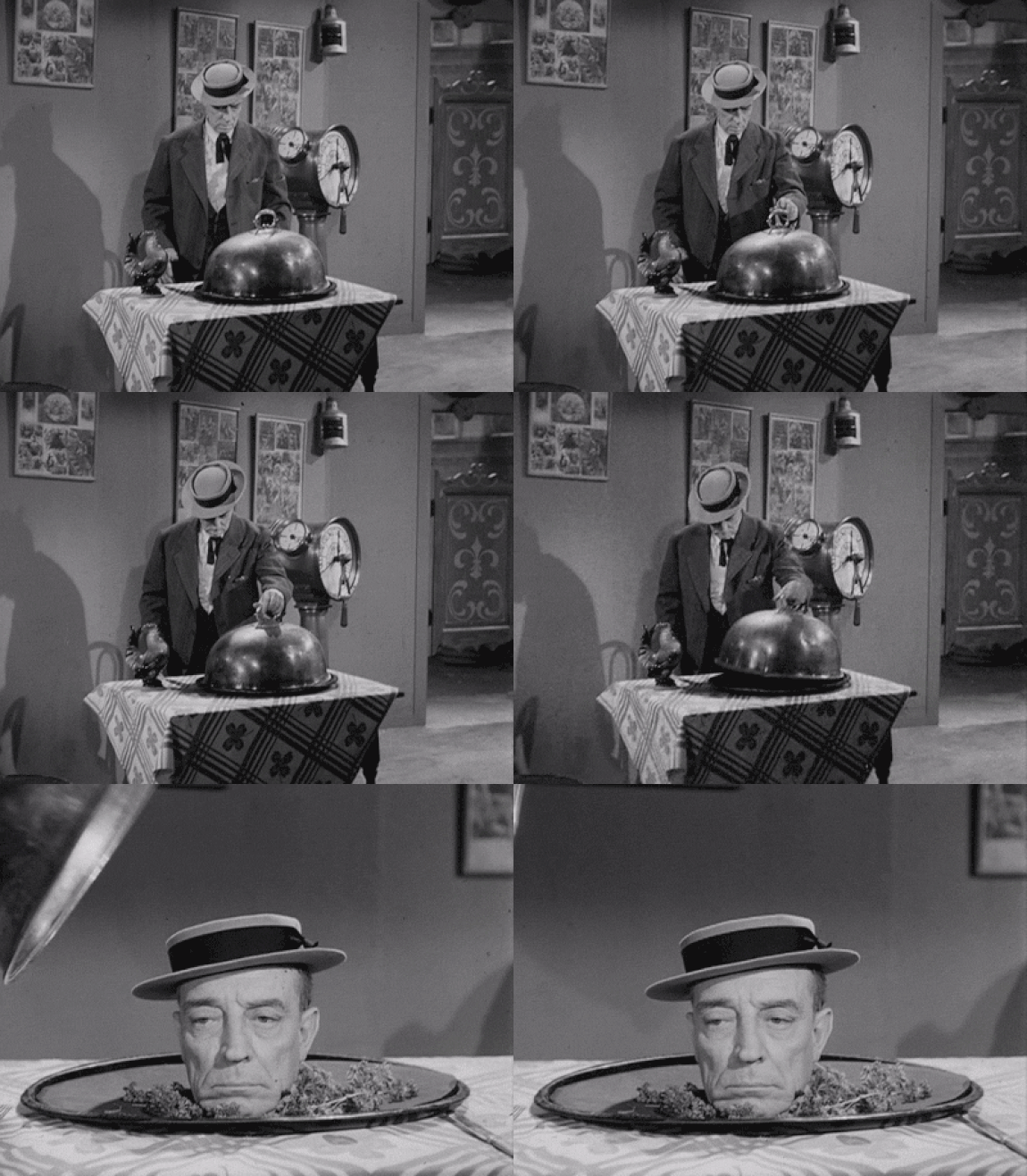
The Decline of Buster Keaton's Career

In 1928, Buster Keaton signed a contract with MGM which he later called the biggest mistake of his career. Until then he had been working as an independent filmmaker, enjoying great artistic freedom in the making of his shorts and feature films. Charlie Chaplin and Harold Lloyd had warned Keaton beforehand that he would lose his independence if he signed with MGM, and they were right. While Keaton could still film his first MGM feature The Cameraman (1928) his own way, this would all change. The actor/filmmaker, who was used to working without a proper script, soon had to deal with dozens of writers, script conferences and in the end was given merely script material he hated. Keaton did go along with the studio's wishes but by the time What! No Beer? (1933) was filmed, he had sunk into a deep depression, causing him to drink excessively. When he failed to meet his commitments, MGM fired him.

Following his dismissal by MGM, Keaton made a few films in Europe before returning to Hollywood to make a series of shorts for Educational Pictures and later for Columbia Pictures (after which Keaton vowed never to make "another crummy two-reeler" again). He was rehired by MGM in the late 1930s, this time as a gag writer, providing material for the Marx Brothers, Red Skelton and Laurel & Hardy. Keaton appeared in a cameo role in Sunset Boulevard (1950) and also had small roles in In the Good Old Summertime (1949) and Chaplin's Limelight (1952). He loved television and in the 1950s the medium revived his career and provided him with steady work, even with a tv show of his own (i.e. The Buster Keaton Show). Television also helped rekindle the interest of the public in Keaton's silent films. In 1959, Keaton received an Academy Honorary Award ("for his unique talents which brought immortal comedies to the screen”) and the Venice Film Festival also honoured him in 1965 for his contributions to the film industry.

Buster Keaton, "The Great Stone Face". As an independent fimmaker he made shorts like One Week (1920), The Goat (1921) and Cops (1922), and among his feature films are Sherlock Jr. (1924), Seven Chances (1925), The General (1926) and Steamboat Bill Jr. (1928).
Buster Keaton at work as a gag writer for MGM with above The Marx Brothers (Groucho and Chico) and below Red Skelton. The collaboration between Buster and the Marx Brothers did not always go smoothly. When Groucho told him his gags were not compatible with the Marx Brothers' humour,  Buster answered, "I'm only doing what Mr. Mayer asked me to do. You guys don't need help."


Buster Keaton never again enjoyed the successes he had in the 1920s. The mid-1920s saw him at the height of his career, earning $3,500 a week while building a $300,000 house for his first wife, actress Natalie Talmadge. His descent into alcoholism and depression —after MGM had taken away his creative control— coincided with the crumbling of his marriage to Talmadge, which ended in divorce in 1932. By the mid-1930s, Keaton was broke (Talmadge having extravagantly spent his money) and filed for bankrupcy. While he would earn a decent living in the decades to come, unlike Charlie Chaplin and Harold Lloyd, Keaton didn't own the rights to his own films and never became a millionaire. Still, he was a content man —in 1940 he married his third wife, MGM dancer Eleanor Norris, to whom he remained happily married until his death in 1966— and looking back on his life said in 1960: "I think I have had the happiest and luckiest of lives. Maybe this is because I never expected as much as I got ... It would be ridiculous of me to complain. I count the years of defeat and grief and disappointment, and their percentage is so minute that it continually surprises and delights me."

Shown below is an Internal Revenue Service tax form (W-4), filled out and signed by Buster Keaton in June 1943. At the time he was working as an uncredited gag man for MGM and requested to be exempted from paying income taxes. Keaton often had tax problems and in 1933, following his bankrupcy, even owed the IRS $28,000 in back taxes (today's equivalent is about $630,000). Also shown is an agreement between MGM and Keaton, concerning Keaton's two-day leave in June 1945 for which he didn't get paid.

Source: Heritage Auctions
Above: Buster Keaton with his third wife Eleanor Norris who is credited with saving his life and career. Norris, 23 years younger than Keaton, was a contract dancer at MGM. When the two met in 1938, Keaton was working as a gag consultant and still having bouts with alcoholism. Norris helped him to get his alcohol consumption under control. During the marriage, the couple toured European circuses together doing vaudeville acts and also performed together on The Buster Keaton Show. They were happily married for 26 years until Keaton's death of lung cancer in 1966. Norris played an important role in keeping Keaton's legacy alive after his death. (And in case you're wondering who Keaton's second wife was— she was his nurse Mae Scriven, whom he married in 1933 during an alcoholic blackout; they divorced in 1936.) Below: Buster on television, early 1950s. 


16 July 2022

God’s eye may be on the sparrow but my eye will always be on you

Elizabeth Taylor and Richard Burton are known far more for their intense and turbulent relationship than for the eleven films they made together (which include Cleopatra (1963) and the 1966 acclaimed Who’s Afraid of Virginia Woolf?). The couple met at a Hollywood party in 1953 and in his diary Burton recalled seeing Elizabeth, who was already a star at 21, for the first time: "... a girl sitting on the other side of the pool lowered her book, took off her sunglasses and looked at me. She was so extraordinarily beautiful that I nearly laughed out loud ... she was unquestioningly gorgeous ... She was lavish. She was a dark unyielding largess. She was, in short, too bloody much, and not only that, she was totally ignoring me.” They would meet again almost ten years later on the set of Cleopatra, their first film together, and it was during the first love scene that sparks started flying, with their kiss taking a lot longer than necessary. Married to other people —Elizabeth to singer Eddie Fisher and Burton to actress Sybil Williams— the two soon embarked on a heavily publicised love affair. The affair was met with public disapproval as well as criticism from the U.S. Congress and the Vatican, the latter condemning the couple for "erotic vagrancy". 

Once divorced from their spouses, "Liz and Dick" —as they were dubbed by the tabloid press that followed them wherever they went— were married on 15 March 1964. They divorced in 1974, then remarried in 1975 and divorced again less than a year later. Their life together had been one of extreme luxury, with millions spent on diamonds, furs, art, grand hotels, a yacht and a jet, et cetera. Also a lot of heavy drinking was involved (by both Burton and Taylor) as well as vicious fighting. After their final divorce, the couple remarried other people but the bond between them would never be broken. Looking back, Elizabeth said later in life: "After Richard, the men in my life were just there to hold the coat, to open the door. All the men after Richard were really just company." And in an interview with Vogue, she admitted: "I was still madly in love with him the day he died. I think he still loved me, too." 

During their time together, Richard Burton wrote Elizabeth Taylor many letters, one of them seen below. In the letter, written in June 1973, he said goodbye to Elizabeth after she had told him their marriage was over. Burton was a womaniser and had several affairs during the marriage and Elizabeth had had enough. It would still take a year, though, before the couple had their first divorce.

Also shown is a passionate love letter from Elizabeth to Richard, written in March 1974 on the occasion of their 10-year wedding anniversary. Shortly thereafter, the couple separated and three months later they were divorced. 


June 25, 1973

So My Lumps, 

You’re off, by God! 

I can barely believe it since I am so unaccustomed to anybody leaving me. But reflectively I wonder why nobody did so before. All I care about—honest to God—is that you are happy and I don’t much care who you’ll find happiness with. I mean as long as he’s a friendly bloke and treats you nice and kind. If he doesn’t I'll come at him with a hammer and clinker. God’s eye may be on the sparrow but my eye will always be on you. Never forget your strange virtues. Never forget that underneath that veneer of raucous language is a remarkable and puritanical LADY. I am a smashing bore and why you’ve stuck by me so long is an indication of your loyalty. I shall miss you with passion and wild regret. 

You may rest assured that I will not have affairs with any other female. I shall gloom a lot and stare morosely into unimaginable distances and act a bit—probably on the stage—to keep me in booze and butter, but chiefly and above all I shall write. Not about you, I hasten to add. No Millerinski Me, with a double M. There are many other and ludicrous and human comedies to constitute my shroud. 

I’ll leave it to you to announce the parting of the ways while I shall never say or write one word except this valedictory note to you. Try and look after yourself. Much love. Don’t forget that you are probably the greatest actress in the world. I wish I could borrow a minute portion of your passion and commitment, but there you are—cold is cold as ice is ice.

Source:  Letters of Note

Source: Paul Fraser Collectibles

Transcript:

My darling (my still) My husband 

I wish I could tell you of my love for you, of my fear, my delight, my pure animal pleasure of you - (with you) - my jealousy, my pride, my anger at you, at times.

Most of all my love for you, and whatever love you can dole out to me - I wish I could write about it but I can't. I can only "boil and bubble" inside and hope you understand how I really feel.

Anyway, I lust thee 

Your (still) Wife 

P.S. O'Love, let us never take each other for granted again! 

P.P.S. How about that - 10 years!!


Note: On the back of Elizabeth's letter the following was written: "This letter written by Elizabeth Taylor while renting my home from Feb 15th till April 18th 1974. It was left behind - inside a book in the drawer under the masterbedroom bed." Elizabeth and Richard had rented a private home in Oroville, California, while Burton was filming The Klansman. The owner of the house Antonia Henning had found Elizabeth's letter after the Burtons had already left. Another letter from Elizabeth to her lost cat Cassius (here) was found in the same drawer.


7 July 2022

Oscar For Sale

For those artists lucky enough to win an Oscar, the Academy of Motion Picture Arts and Sciences has strict rules in case winners should ever wish to part with their golden prize. In 1951, the Academy included in the regulations that winners are not allowed to sell their Oscar without first offering it to the Academy for $10 (today the sum is a mere $1). This rule also applies to those who inherited or were gifted an Oscar.

A number of times the Academy has taken legal action when an Oscar was being offered for sale. For instance, in 2014 the Academy found their 1951 rule had been violated when an Oscar was sold at auction by the heirs of art director Joseph Wright, who had won the award for his work on My Gal Sal (1942). Joseph Tutalo, Wright's nephew, had consigned the statuette to Briarbrook Auctions and auction house Nate D. Sanders then bought the Oscar from Briarbrook for $79,200. The Academy subsequently went to court, arguing that although Wright had won the Oscar before 1951 he had kept his Academy membership until his death in 1985, which made the sale illegal. Eventually the judge ruled in the Academy's favour and the Academy reclaimed Wright's Oscar for $10.

Spencer Tracy with his Best Actor Oscar for Boys Town (1938) and Bette Davis with her Best Actress Oscar for Jezebel (1938), the latter Oscar sold at auction in 2001 to an anonymous bidder (who turned out to be Steven Spielberg).

Oscars have been sold succesfully in the past, though. For instance, in 1999 David Selznick's Best Picture statuette for Gone with the Wind (1939) was sold to Michael Jackson for a whopping $1.5 million, a trophy that unfortunately went missing years after Jackson's death (I couldn't find information whether it's turned up yet). Magician David Copperfield bought Michael Curtiz's 1943 Casablanca Oscar for $232,000 in 2003 and made a huge profit when he sold it at auction for more than $2 million ten years later. And director Steven Spielberg purchased several Oscars, including Clark Gable's 1934 Oscar for It Happened One Night (for $607,500 in 1996) and Bette Davis' 1938 Best Actress trophy for Jezebel (for $578,000 in 2001). However, Spielberg didn't buy these trophies for himself but, for the sake of preserving film history, returned them to the Academy instead.

Since 1951 Oscar winners are obliged to sign a document saying they won't sell their trophy without offering it to the Academy first. Here is the "Receipt for Academy Award Statuette" signed by Audrey Hepburn in May 1954, after she had won her Best Actress Oscar for Roman Holiday.

Via: Rare Audrey Hepburn (original source: The Audrey Hepburn Treasures)

Audrey Hepburn with the only Oscar of her career

28 June 2022

Your truest and best admirer, Edna

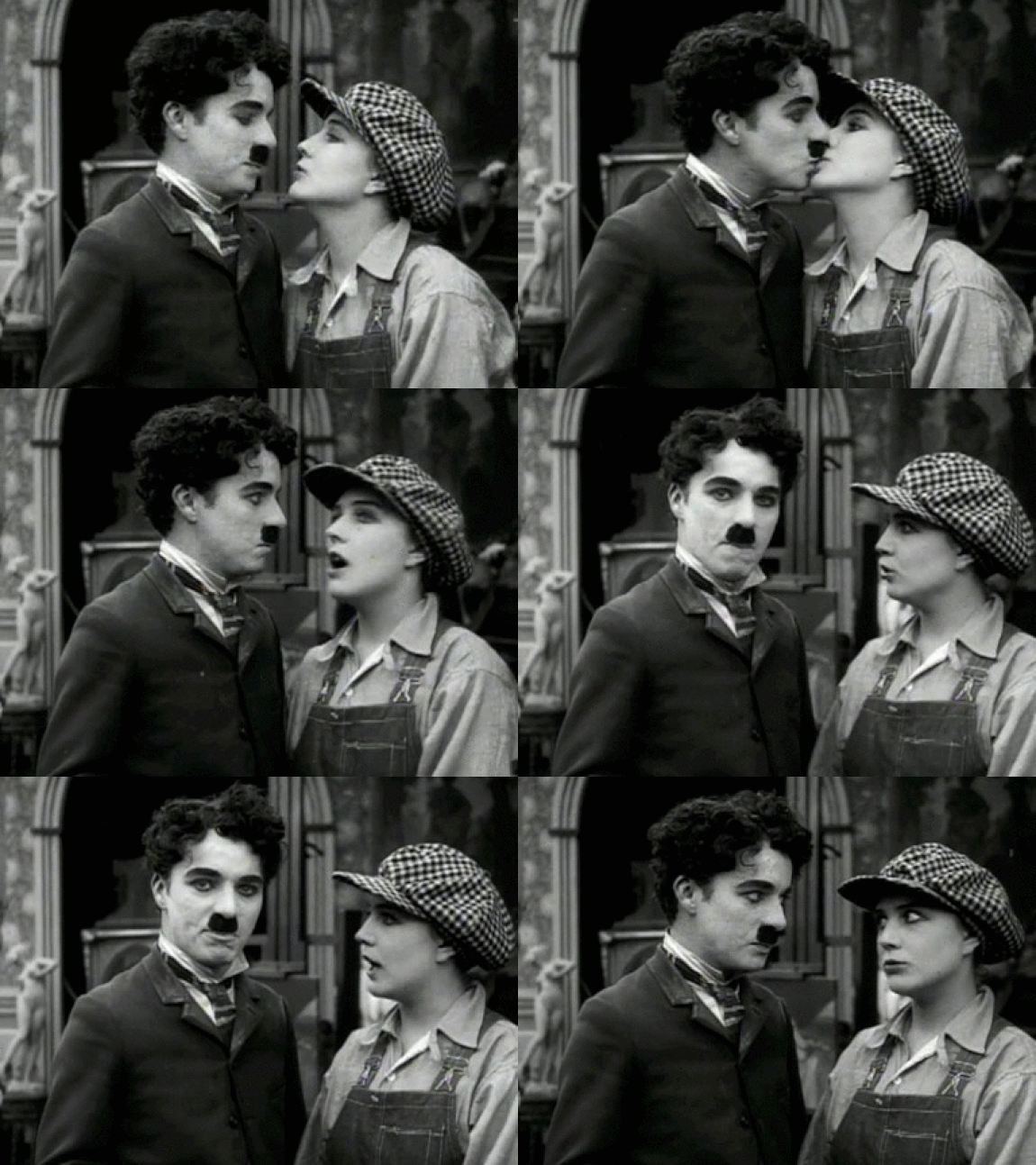
In early 1915, Charlie Chaplin was looking for a leading lady for his next film A Night Out, when one of his employees saw Edna Purviance at a café, thinking she might be suited for the role. At the time Edna was working as a secretary and had no previous acting experience. Enthralled by her beauty and charm, Chaplin hired Edna, which was the start of a long working relationship. Edna would appear as Chaplin's leading lady and often romantic interest in 33 of his films, all of them shorts except for The Kid (1921) and A Woman of Paris (1923). In the latter film she had her first and only leading role and it was Chaplin's attempt to launch her career as a dramatic actress. Sadly, the attempt was unsuccessful and after two more films —the unreleased A Woman of the Sea and a French film Éducation de Prince (1927)— Edna's film career was over. (While several sources, including Wikipedia and IMDB, state that the actress made uncredited appearances in Chaplin's Monsieur Verdoux (1947) and Limelight (1952), apparently she doesn't appear in those films at all; read more here.)

Apart from working together, Chaplin and Edna were also romantically involved (from 1915 until 1917) and remained friends after their relationship had ended. When Edna retired from acting, she lived a quiet life away from Hollywood. Chaplin, feeling responsible for her well-being, kept her on his payroll until her death in 1958. 

Above: Edna Purviance and Charlie Chaplin pictured together off-screen. Below: Edna and Charlie in (left) The Immigrant (1917) and A Dog's Life (1918).

When Chaplin was casting Monsieur Verdoux (1947), he considered Edna for the role of Madame Grosnay (which eventually went to Isobel Elsom). In his 1964 My Autobiography, Chaplin writes about meeting Edna again after not having seen her for twenty years. A melancholy and touching excerpt from the book in which he describes their reunion is seen below. Included in the excerpt are two letters from Edna to Chaplin. At the time of writing these letters, Edna was battling throat cancer and eventually succumbed to the disease on 13 January 1958, 62 years old. 

During the casting of Monsieur Verdoux, I had thought of Edna for the important part of Madame Grosnay. I had not seen her for twenty years, for she never came to the studio because her weekly cheque was mailed to her by the office. She confessed afterwards that when she received a call from the studio she was more shocked than thrilled.

When Edna arrived, Rolly, the cameraman, came into my dressing-room. He, too, had not seen her in twenty years. ‘She’s here,’ he said, his eyes glistening. ‘Of course, she’s not the same – but she looks great!’ He told me that she was waiting on the lawn, outside her dressing-room.

I wanted no emotional reunion scene, so I assumed a matter-of-fact manner as if it had been only a few weeks since I last saw her. ‘Well! Well! We’ve eventually got round to you,’ I said cheerily.

In the sunlight I noticed that her lip trembled as she smiled; then I plunged into the reason why I had called her, and told her about the film. ‘It sounds wonderful,’ she said – Edna was always an enthusiast.

She read for the part and was not bad; but all the while her presence affected me with a depressing nostalgia, for she was associated with my early successes – those days when everything was the future!

Edna threw herself into the role, but it was fruitless – the part required European sophistication, which Edna never had – and after working with her three or four days I was forced to admit that she was unsuitable. Edna herself was more relieved than disappointed. I did not see or hear from her again until she wrote to me in Switzerland to acknowledge her severance pay:


Dear Charlie,

For the first time I am able to write my thanks for your friendship down the years, and for all you have done for me. In early life we do not seem to have so many troubles and I know you have had your share. I trust your cup of happiness is full with a charming wife and family.…

[Here she described her illness and the terrific expense of doctors and nurses, but she finished as she always did with a joke:]

Just a story I heard. A chap was sealed in a rocket ship and shot upwards to see how high he could go – was told to keep track of the altitude. So he kept counting 25,000 – 30,000 – 100,000 – 500,000… When he got this far he said ‘Jesus Christ!’ to himself, and a very silent soft voice answered back: ‘Yessss –?’

Please, please, Charlie, let me hear something from you in the near future. And please come back, you belong here.

Sincerely your truest and best admirer,

Love, Edna.


Through all the years I had never written a letter to Edna; I always communicated with her through the studio. Her last letter was an acknowledgement of the news that she was still on the payroll:


November 13th, 1956.

Dear Charlie,

Here I am again with a heart full of thanks, and back in hospital (Cedars of Lebanon), taking cobalt X-ray treatment on my neck. There cannot be a hell hereafter! It all comes while one can wriggle even a little finger. However, it is the best known treatment for what ails me. Hope to be going home at the end of the week, then can be an outside patient (how wonderful!). Am thankful my innards are O.K., this is purely and simply local, so they say – all of which reminds me of the fellow standing on the corner of Seventh and Broadway tearing up little bits of paper, throwing them to the four winds. A cop comes along and asks him, what was the big idea. He answers: ‘Just keeping elephants away.’ The cop says: ‘There aren’t any elephants in this district.’ The fellow answers: ‘Well, it works, doesn’t it?’ This is my silly for the day, so forgive me.

Hope you and the family are well and enjoying everything you have worked for.

Love always, Edna.


Shortly after I received this letter she died. And so the world grows young. And youth takes over. And we who have lived a little longer become a little more estranged as we journey on our way.


Source: Charles Chaplin: My Autobiography (1964)

Charlie en Edna in Behind the Screen (1916)

19 June 2022

I am asking of both Budd and you that you treat me fairly ...

After the screenplay of On the Waterfront (1954) was finished, director Elia Kazan and screenwriter Budd Schulberg went to see Darryl F. Zanuck, producer and studio boss at 20th Century-Fox, to offer him the script. The two were very confident that Zanuck would like it and would be willing to produce it. During their meeting, however, the producer was not interested in Waterfront at all but kept talking about Prince Valiant (1954) and how wonderful it would be in CinemaScope. CinemaScope was Fox's new widescreen process (with all films to be shot in colour) and it was all Zanuck could think and talk about. (He knew full well that Waterfront was to be shot in black-and-white and in standard format.) In a 2004 interview with William Baer, Schulberg recalled Zanuck's reaction when Kazan finally asked him about the Waterfront script: "I'm sorry, boys, but I don't like a single thing about it ... What have you got here, boys? All you've got is a lot of sweaty longshoremen. I think what you've written is exactly what the American people don't want to see." Having previously worked with Schulberg on the script himself, Zanuck had now completely turned against it.

Devastated by Zanuck's rejection, Kazan took the script to other studios but they turned him down as well. Then quite unexpectedly, when Kazan and Schulberg believed Waterfront would never be filmed, independent producer Sam Spiegel came along and agreed to take on their project. With Spiegel as producer and eventually released by Columbia Pictures, On the Waterfront became a huge critical and commercial success. The film also won eight Academy Awards, including Best Picture (Spiegel), Best Actor (Marlon Brando), Best Supporting Actress (Eve Marie Saint), Best Director (Kazan) and Best Story and Screenplay (Schulberg). 

Above: Sam Spiegel (second from left), Marlon Brando and Brando's parents visiting their son on the set of On the Waterfront.


Darryl Zanuck regretted his rejection of Waterfront even before the film was showered with accolades and awards. In the following letter to Elia Kazan ("Gadg") from 15 July 1954, Zanuck admitted that "the advent and debut of Cinemascope was responsible more than anything else for [his] final decision against the property". He resented the suggestion made by Schulberg in a New York Times article that he had rejected the film because "he lost his courage and ran out on a "touchy" subject." (In the 11 July 1954 article Schulberg had said: "The head of the studio had changed his mind, Waterfront wouldn't fit in with the program of costumed horse operas he was lining up ... The picture was still too controversial, we were told. Too grim, too shocking. And, would the people care about the struggle on the docks?".) 

Annoyed that Kazan and Schulberg didn't acknowledge his role in the making of Waterfront, Zanuck also reminded Kazan of the important contributions he had made to the script and of being the one who had first suggested Brando to them.


July 15, 1954
Mr. Elia Kazan 
Warner Bros. Studios
Burbank, California
Personal & Confidential 

Dear Gadg:

Thanks for your letter of June 28th. I just returned from Europe and only received it today ...

The only thing in your letter that disturbs me is when you say that I let Budd and you come out to California on the Waterfront story and then gave you a cold turn-down— and that a telegram would have served just as well.

You have a short memory, Gadg. Budd came to see me more than once. I spent many hours on many days working with him and trying to develop and alter the script. He accepted all but one of my major suggestions. You accepted them. Four of them are a part of your finished picture, or at least I have been told so by those who have seen the picture and who also had read the original treatment and script and had also read the conference notes.

I am not asking for screen credit but I am asking of both Budd and you that you treat me fairly and that you recognize the facts. I have just reread my conference notes and my various communications on this story. I think both Budd and you should read them again and think of them in the light of your finished picture. I think you should also remember that I am the one who insisted in writing that only Marlon Brando should play the role and that I first suggested him in a telegram to you.

I have just seen an article in last Sunday's New York Times written by Budd in which he does not mention me by name but in which he indicates that I lost my courage and ran out on a "touchy" subject.

I am really astonished that Budd should write anything such as this. Even more than this, he knows how I sweated and worked with him in a conscientious effort to improve the dramatic construction of the story, and particularly the love story, etc. etc. The last day I saw him he shook my hands and told me that no matter how it turned out he had received valuable assistance and that working with me had been a "unique and exhilarating experience."

Actually the advent and debut of CinemaScope was responsible more than anything else for my final decision against the property. At that time I felt that since we had overnight committed ourselves to a program of CinemaScope "spectacles" I had no alternative but to back away from intimate stories even though they were good stories. I have since changed my mind as one of our most successful CinemaScope pictures [Three Coins in the Fountain, 1954] is based on an intimate story. 

I understand your picture has turned out to be wonderful. I am happy because every great picture is helpful to the best interests of our industry.

I am taking the liberty of sending a copy of this letter to Budd. I just cannot accept the idea that I lost my courage or gave you a quick brush-off. I spent more time on your project than I do on some of the pictures that we actually produce. In addition to this I invested $40,000 in the property. If this is a brush-off then I have a wrong interpretation of the phrase.

You and I are due for a hit next time we get together ...

I look forward to seeing you. Come over when you finish [East of Eden (1955) at Warners].

Best always,

Darryl

Source: Memo from Darryl F. Zanuck: The Golden Years At Twentieth Century-Fox (1993); selected and edited by Rudy Behlmer.

Above: (l to r) Schulberg, Zanuck and Kazan. Below: Eve Marie Saint and Marlon Brando in a scene from On the Waterfront.

12 June 2022

She is an extremely clever little artist

In September 1935, 13-year-old Judy Garland signed a seven-year contract with MGM at a starting salary of $100 a week. It would take some time, however, before Judy made her first feature film for the studio. Her debut film Pigskin Parade (1936) was on loan-out to 20th Century-Fox and her first MGM appearance was in the musical short Every Sunday (1936) with Deanna Durbin. It wasn't until 1937 that MGM finally put her into her first feature film, Broadway Melody of 1938, starring Eleanor Powell and Robert Taylor. In the film Judy sang You Made Me Love You (I Didn't Want to Do It) to a photograph of Clark Gable, her performance turning her into an overnight success. 

About a year earlier, in June 1936, while still waiting to be cast in her first film, Judy was sent by MGM on a promotional tour to New York City. It was her first visit to the Big Apple, during which she made several appearances on the Rudy Vallee radio show and recorded Stompin' at the Savoy with Decca Records (the first single she ever released). Furthermore, Judy paid a visit to MGM's New York offices, where she met executives like Nicholas Schenck and MGM representative Florence Browning.


Before Judy left for New York, Ida Koverman had given her a letter of introduction to take with her and give to Miss Browning at MGM. Koverman was executive secretary to MGM's boss Louis B. Mayer and is regarded as one of the most powerful women in Hollywood during the 1930s and 40s. She was a big supporter of Judy and was also the one who had convinced Mayer to sign her. Koverman's letter to Browning, in which she has nothing but good things to say about young Judy, is seen below. Also shown is a letter from Judy to Koverman after she had just arrived in New York as well as Koverman's reply. (Incidentally, in her letter to Browning, Koverman said that Judy was twelve years old although she was about to turn fourteen.)


Transcript:

June 1st, 1936

Dear Florence:

This will be presented to you by little Judy Garland, who is under contract to us. 

She is twelve years old and an extremely clever little artist. Her mother, who will be with her, plays her accompaniments, and I hope you will be able to arrange to hear her sing a few numbers. She is really a marvellous child. 

Her agent is taking her East to try to book her in some of the theatres, and I think it would be very wise to have someone connected with our office see the child before she gets into an opposition house. 

She sings very well and is an excellent dancer, and does the Eleanor Powell routines, and is a little genius.

In addition to this she is a dear little thing, and I am devoted to her. I know you will like her too.

Sincerely yours, 


Miss Florence Browning,
Metro-Goldwyn-Mayer Corporation,
1540 Broadway,
New York City.


Transcript: 

June 5, 1936

Dear Mrs. Koverman-

We arrived today in New York. I could hardly wait to write you to tell you how thrilled and dazed I am. 

We were at the M.G.M. offices today and saw Miss Florence, Mr. Rubin, Mr. Schenck and so forth. They were all so lovely to me. 

I hope my singing pleased them. 


Thank you so much for your letter to Miss Florence. It helped me so much and I sincerely appreciate it. 

As you have found out I certainly don't take any medles [sic] for writting [sic]. 

Please forgive it

Nothing else to say except thank you again

Sincerely yours
Judy

P.S Have you Jackie Copper's [sic] address? 

I forgot to get it before I left and he told me to be sure to write to him.

Please, if you have time, answer this.


Transcript:

June 8, 1936

My dear Judy:

I was very glad to get your nice little note, and to know you are having such a thrilling time. I was sure you would like Miss Florence Browning -- she is a very fine person, and I am sure also that your singing pleased them all.

We all miss you very much and certainly will be glad to see you when you return. Do write and let me know all that happens to you.

With kindest regards to your mother and Mr. Rosen [Judy's agent], and much love to yourself, I am 

Sincerely yours,
IRK (signed)

P.S. Jackie Cooper's address is 141 South Grand Avenue, Santa Monica.

Miss Judy Garland
Edison Hotel
47th and Broadway
New York City 

Source letters: Bonhams

Two days late but still — Happy 100th Birthday, Judy!

Ida R. Koverman

8 June 2022

Women do not do any of the creative work

During the National Board of Review awards ceremony in January 2014, Meryl Streep caused quite a stir when she labelled Walt Disney a "gender bigot". To prove her point, Streep had read from a 1938 rejection letter, written by Walt Disney Productions to a female job applicant who was seeking work in animation. "Women do not do any of the creative work in connection with preparing the cartoons for the screen, as that task is performed entirely by young men", the letter read. "For this reason girls are not considered for the training school. The only work open to women consists of tracing the characters on clear celluloid sheets with India ink and filling in the tracings on the reverse side with paint according to directions".

As the letter indicates, women worked in the inking and painting department while men worked in story, art direction and animation. In this pre-feminism era, it was a policy exercised not just by Disney but by every other animation studio in Hollywood. Still, there were women who found jobs at Disney in non-ink-and-paint departments, even as early as the 1930s. 

The women artists who worked at Disney in those early days were mainly story artists, like Bianca Majolie, the first woman to be hired by Disney's story department in 1935. Grace Huntington was employed in 1936 and in her autobiography Please Let me Fly she recalled how reluctant Disney was to hire women. "It takes years to train a good story man", he told her. "Then if the story man turns out to be a story girl, the chances are ten to one that she will marry and leave the Studio high and dry with all the money that had been spent on her training gone to waste as there will be nothing to show for it." For that same reason, Disney also wouldn't hire women as animators. (By contrast, the training period for inkers, painters and stenographers was relatively short, so if these women left the company to get married not much would be lost.) Nevertheless, since Disney valued real talent, Huntington was still hired and soon others followed, like Dorothy Ann Blank and Retta Scott who joined the story department in resp. 1936 and 1938.

Above: Walt Disney chats and laughs with some of the ink-and-paint employees at his studio in August 1939.

The first female animator at Disney was hired some time later, which actually happened by chance. Story artist Retta Scott was working on Bambi (1942) when her male colleagues saw her amazing drawings of hunting dogs. Very impressed by Scott's work, Disney then allowed her to do her own animations. Scott was tutored by animator Eric Larson and soon other women were being trained as well (in various fields). In a company speech from February 1941, Disney acknowledged the importance of women in creative jobs and explained why they were being trained, one of the reasons being World War II. With America possibly joining the war, Disney realised he simply needed women artists in order to keep his business going ("I believe that if there is to be a business for these young men to come back to after the war, it must be maintained during the war. The girls can help here."). Some of the talented women who had started in the inking and painting department were trained to be animators, among them Mildred Rossi and Virginia Fleener.

Other important talented women who were hired by Disney include Mary Weiser (master chemist who established the Walt Disney Studio's Paint Lab in 1935), Sylvia Holland (storyboard artist who was especially known for her work on the 1940 Fantasia) and perhaps the most influential of Disney's female artists Mary Blair (art supervisor and color stylist for films like Cinderella (1950), Alice in Wonderland (1951) and Peter Pan (1953)).

Retta Scott (left) and Mary Blair pictured above


Article in Glamour of Hollywood, May 1941. Source: archive.org


It is clear that, especially in the early days, Disney was not at all eager to hire women in creative jobs. He didn't want to lose his investment once women left the company to start a family and was also worried that women wouldn't survive in a male-dominated workplace. To Grace Huntington Disney had said in March 1936: "It is difficult for a woman to fit in this work. The men will resent you ... If you are easily shocked or hurt, it is just going to be bad". Female artists indeed had a lot to put up with, working in a mostly hostile environment while not receiving the recognition they deserved. Still, despite his own hiring policy, Disney did employ women from time to time, the ones mentioned above and many others (as said, WWII playing an important role). "If a woman can do the work as well, she is worth as much as a man", Disney had said in his 1941 speech to his employees. "The girl artists have the right to expect the same chances for advancement as men, and I honestly believe that they may eventually contribute something to this business that men never would or could".

Seen below is the letter Meryl Streep had read from during the award show, written in 1938 and addressed to Mary Ford. Another rejection letter (almost identical) to Frances Bowen is also shown, this one being from 1939. Both letters were signed by Mary Cleave (secretary?), containing a standard text that was taken from the Disney policy handbook. For how many years thereafter this form letter was used I don't know, the only copies to be found online are these from the late 1930s.
 

Transcript:

June 7, 1938

Miss Mary T. Ford
Searcy,
Arkansas

Dear Miss Ford,

Your letter of recent date has been received in the Inking and Painting Department for reply.

Women do not do any of the creative work in connection with preparing the cartoons for the screen, as that work is performed entirely by young men. For this reason girls are not considered for the training school.

The only work open to women consists of tracing the characters on clear celluloid sheets with India ink and filling in the tracings on the reverse side with paint according to directions.

In order to apply for a position as “Inker” or “Painter” it is necessary that one appear at the Studio, bringing samples of pen and ink and water color work. It would not be advisable to come to Hollywood with the above specifically in view, as there are really very few openings in comparison with the number of girls who apply.

Yours very truly,

WALT DISNEY PRODUCTIONS, LTD.

By:
(signed) 'Mary Cleave'


Transcript:

May 9, 1939

Miss Frances Brewer
4412 Ventura Canyon Avenue
Van Nuys, California

Dear Miss Brewer:

Your letter of some time ago has been turned over to the Inking and Painting Department for reply.

Women do not do any of the creative work in connection with preparing the cartoons for the screen, as that work is performed entirely by young men. For this reason girls are not considered for the training school.

The qualify for the only work open to women one must be well grounded in the use of pen and ink and als of water color. The work to be done consists of tracing the characters on clear celluloid sheets with India ink and filling in the tracings on the reverse side with paint according to directions.

In order to apply for a position as “Inker” or “Painter” it is necessary that one appear at the studio on a Tuesday morning between 9:30 and 11:30, bringing samples of pen and ink and water color work. We will be glad to talk with you further should you come in. 

Yours very truly,

WALT DISNEY PRODUCTIONS

By: (signed) 'Mary E. Cleave' 

2 June 2022

Dear Mr. Wayne

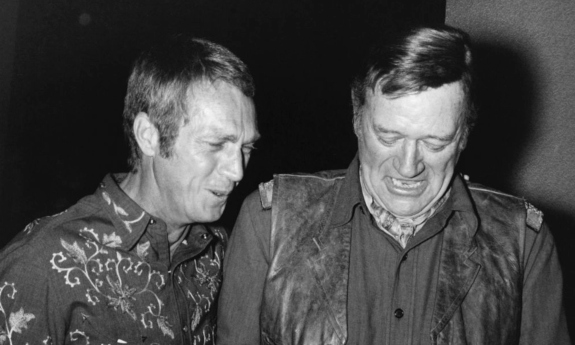
When John Wayne received a letter from ten-year-old Ross Brook who wrote how much he had liked Wayne's performance in the 1968 box-office hit Bullitt, the actor was undoubtedly amused by the boy's mistake. Of course, it wasn't Wayne who had starred in the film but Steve McQueen, Bullitt being one of McQueen's best-known films. Asked by Ross for an autographed picture, Wayne forwarded Ross' note to McQueen, accompanying it with a note of his own. 


Transcript:

Dear Mr. Wanye [sic] 
I love the movie Bulit [sic] and I thought your acting was great. I would like to know if I could have a autographed picture of you. I would like to see you some day.

Sincerely 
Ross Brook
age 10
55 Oak St
Los Altos Ca.
94022

_____


9570 Wilshire Blvd., Suite 400
Beverly Hills, California 90212
September 23, 1977

Mr. Steve McQueen
8899 Beverly Blvd., Suite 501
Los Angeles, California 90048

Dear Steve:
Would you please send him a picture of me from "Bullitt." 
I will be forever grateful.

Sincerely
(signed) Duke


Steve McQueen and John Wayne at an event in Los Angeles in 1969

26 May 2022

I have always been a thoroughly hypnotized admirer of your pictures

After living in Barcelona for five years, recently we (my sister and I) moved to Valencia, Spain's third largest city, which is located about 300 km south of Barcelona. During the years we've lived in Barcelona, we were lucky enough to see about 200 classic (predominantly Hollywood) films on the big screen at the wonderful film theatre Filmoteca. Fortunately Valencia also has a Filmoteca, where currently a small retrospective is dedicated to Orson Welles. As part of the Welles programme we've watched The Lady from Shanghai (1947) and Touch of Evil (1958), the latter film for the first time, and still to come are new-to-me films The Third Man (1949) and The Trial (1962). (Unfortunately I've missed Citizen Kane (1941), which I would have liked to rewatch on the big screen.)

Welles in The Third Man (left) and in Touch of Evil with Charlton Heston

While I enjoyed the Welles films I've seen (I especially love the visual aspects), I am not a Welles fan. Someone who was —and a big one at that— was Peter Bogdanovich, director of such classics as The Last Picture Show (1971), What's Up, Doc? (1972) and Paper Moon (1973). 

The letter for this post was written by Bogdanovich to Welles in January 1962, several years before the two men would actually meet. Bogdanovich, then 22 years old, wrote Welles in connection with a monograph he had written about Welles' work. The previous year, the aspiring film director had been commissioned by the Museum of Modern Art in New York to organise a retrospective on Welles —the first one ever in the USA— and to also write the accompanying monograph. As Welles himself could not attend the event since he was living and working in Europe, a copy of the 16-page monograph (entitled The Cinema of Orson Welles) was sent to him and he reportedly liked it. Nevertheless, Bogdanovich never got an answer to his letter and didn't hear from Welles until 1968, when Welles suddenly phoned him and asked if they could finally meet. The two men immediately hit it off —they eventually became friends— and not before long started having in-depth conversations about Welles' work, which they decided to tape and assemble in a bookThe book, This is Orson Welles, was not published until 1992, seven years after Welles' death.  

Source: Heritage AuctionsDon Quixote, mentioned in the letter, was one of Welles' unfinished film projects and eventually released in 1992.
(from left to right) John Huston, Orson Welles and Peter Bogdanovich during the making of The Other Side of the Wind, which Welles had begun shooting in 1970. The film was another unfinished Welles project. After Welles' death in 1985, shooting was completed and several attempts were made to reconstruct the film. Eventually in 2018, The Other Side of the Wind was released under supervision of Bogdanovich and producer Frank Marshall.