22 February 2019

I am only just emerging from a small nightmare....

If I hadn't come across the following note from Audrey Hepburn to George Cukor, I never would have known about this interesting bit of Oscar trivia. Audrey wrote to Cukor after the 37th Academy Award Ceremony (which took place in April 1965), where Cukor was presented with the Oscar for Best Director for My Fair Lady (1964). In her letter, Audrey first talks about Cukor's Oscar and then continues to say that she just woke up from a small nightmare: "... the idea that I might have hurt Pat.... is agonizing."

So what happened?

Patricia Neal ("Pat") had won the Oscar for Best Actress for her performance in Hud the year beforeand as the Oscar tradition goes, the previous year's winner of the Best Actress Oscar presents the Oscar to the current year's Best Actor. However, Patricia had suffered three strokes earlier that year (at age 39 while pregnant) and at the time of the Oscar ceremony was still recovering at home. To present the Best Actor award, Audrey was asked to replace Patricia. So when the time came for Audrey to give out the award to her My Fair Lady co-star Rex Harrison, Patricia, who was watching the Oscar ceremony on television with then-husband Roald Dahl, expected Audrey to say something about her. In her 1988 autobiography As I Am, Patricia recalled: "I had been told that Audrey Hepburn would bestow the honor in my place and I couldn't wait to hear all the nice things she would say about me. "There! There!" I pointed to the TV when Audrey was introduced. ... But suddenly she was handing Rex Harrison his award, and she hadn't said a thing about me. It had to be a mistake. I pounded on the table with my good hand. "God! God! Me! Not me!""

Audrey Hepburn and Patricia O'Neal on the set of Breakfast at Tiffany's (1961), their only film together. During production of the film the two had gotten along well.


Patricia was very angry and upset about Audrey's failure to mention her. Husband Dahl later told the press: "She thought it bloody well stunk. She and Audrey have known each other for a long time. And Audrey didn't even call until the day after the ceremonies and that was after I think someone told her Pat was hurt. Audrey had to leave on a one o'clock plane so she didn't have time to see Pat either. Had we not sent the telegram to Bob Hope from Pat at the awards, there probably would have been no mention of her at all.

When she learned about Patricia being hurt, Audrey was naturally devastated. She called Patricia to apologise and also sent her a gift to make amends. According to Audrey biographer Barry Paris, Patricia said years later"The incident at the Academy Awards occurred under enormous pressure and has long since been forgotten. Audrey sent me a fabulous porcelain rose, which was very good of her. I guess it just didn't occur to her that night. I suppose she was distracted. One never knows how these things happen." Audrey was indeed under a lot of pressure that night, handing out the Best Actor Award while being greatly upset about not having been nominated herself. She had been in doubt whether to go to the ceremony or not, but when asked to replace Patricia she simply couldn't refuse.


So here is Audrey's note to her dear friend George Cukor which made me aware of the incident in the first place. Audrey first expresses her happiness over Cukor's first and only Oscar win before briefly mentioning the incident with Patricia. (Incidentally, after having been nominated for an Oscar four times, i.e. for Little Women (1934), The Philadelphia Story (1941), A Double Life (1948) and Born Yesterday (1951), with My Fair Lady Cukor finally got his prize.)

Source: icollector

Transcript:

Dearest George,

Once again there are no words to discribe [sic] the joy of staying with you—and what made it really great is that you now have a permanent solid gold houseguest Oscar by name—I wonder if you know the happiness you gave all your friends by winning it. 

I must tell you that I am only just emerging from a small nightmare…. the idea that I might have hurt Pat…. is agonizing. Who was right or wrong did not seemed [sic] to matter, only she mattered to me. So…. I am sorry that I did not once again thank you during our last minute talk. Would you darling George give this note to Irene? I send you all my love. Audrey


This post is my contribution to the 31 Days of Oscar Blogathon, hosted by ONCE UPON A SCREENOUTSPOKEN AND FRECKLED and PAULA'S CINEMA CLUB.  Be sure to check out all the other entries too!


10 February 2019

I want to do it more than any script I have ever read

Elizabeth Taylor was fed up with the roles MGM kept giving her and wanted better roles, especially after being cast against her will in the period drama Beau Brummell (1954). In 1953, while in Rome with husband actor Michael Wilding, Elizabeth met director Joseph L. Mankiewicz who had started the preparations for his next film The Barefoot Contessa (1954)Elizabeth desparately wanted to play the Maria Vargas part and asked Mankiewicz if she could read the script. Back in London, she wired MGM-executive Benny Thau, letting him know that she had met Mankiewicz in Rome and that she wanted to do The Barefoot Contessa "more than any script [she had] ever read". Much to Elizabeth's dismay, Thau wired back that the role had already been given to Ava Gardner.

Elizabeth's telegram to Thau and her subsequent telegram to Mankiewicz (sent in November 1953) are seen below. Having been denied the role in The Barefoot Contessa, Elizabeth next starred in The Last Time I saw Paris (1954), a film she liked and of which she later said: "[It] convinced me I wanted to be an actress instead of yawning my way through parts."


DEAREST, DARLING BENNY: SAW JOE MANKIEWICZ IN ROME AND ASKED HIM TO LET ME READ BAREFOOT CONTESSA. I WANT TO DO IT MORE THAN ANY SCRIPT I HAVE EVER READ. I KNOW WHAT HAPPENED BETWEEN AVA AND SCHENCK* BUT IF METRO HAS NOTHING IMPORTANT FOR ME, PLEASE HELP ME WITH THIS BECAUSE AS YOU KNOW IT WOULD DO ME MORE GOOD PERHAPS THAN ANYTHING I HAVE EVER DONE. PLEASE, PLEASE, PLEASE BENNY AND LET ME KNOW AS SOON AS POSSIBLE DORCHESTER. FONDEST LOVE, ELIZABETH 

[*Ava Gardner had an affair with movie mogul Joseph Schenck.] 


JOE MANKIEWICZ
GRAND HOTEL ROME

DEAR JOE  RECEIVED A SOMEWHAT EMBARRASING [sic] ANSWER FROM BENNY SAYING I WAS MENTIONED BY NOBODY INCLUDING EVIDENTLY BERT OR YOU FOR THE PART AND INFORMING ME THAT AVA WAS ALREADY SET STOP DO WISH THAT YOU COULD HAVE LET ME KNOW STOP BUT THE BEST OF LUCK TO YOU AND THE FILM  I AM SURE IT WILL BE WONDERFUL  LOVE ELIZABETH

source: Bonhams

Above: Joseph Mankiewicz and Elizabeth Taylor during production of Suddenly, Last Summer (1959). While Mankiewicz didn't think Elizabeth was right for The Barefoot Contessa, he would direct her in two films, Suddenly, Last Summer and Cleopatra (1963) // Below: Ava Gardner was chosen to play Maria Vargas in The Barefoot Contessa; here she is in a scene from the film with leading man Humphrey Bogart.

7 February 2019

We bought Rebecca and we intend to make Rebecca

In late 1938, Alfred Hitchcock was approached by producer David Selznick to direct Rebecca (1940), based on Daphne du Maurier's acclaimed novel of the same name. Making his first American picture, Hitch would soon discover that his ideas about adapting a novel for the screen were quite different from Selznick's. While Hitch used novels purely as a starting point for his films ("If I like the basic idea, I just forget all about the book and start to create cinema"), Selznick insisted on staying as true to the source material as possible. It is no surprise then that the first story treatment Hitch submitted to Selznick in June 1939 (which he had worked on with his former secretary Joan Harrison and author Philip MacDonald) was rejected. Selznick was not at all happy with the treatment, in particular with Hitch's alteration of the main characters and the comical opening of the film. (Hitch later said that he considered Rebecca "not a Hitchcock picture" due to its lack of humour.) Soon a more faithful treatment was submitted, and this time Hitch had also worked with his wife Alma Reville and screenwriter Michael Hogan. Selznick eventually brought in Pulitzer Prize-winning playwright Robert E. Sherwood to prepare the final screenplay.

*spoiler ahead*

While Selznick got his way the final result is a fairly faithful adaptation of du Maurier's novel— there was one major concession that had to be made in order to get the film released. In the novel, Maxim kills Rebecca but is not punished for his deed. As it was impossible under the Hays Code to let a murderer go free, the murder of Rebecca became an accident in the film. Selznick hated it and said: "The whole story of Rebecca is the story of a man who has murdered his wife, and it now becomes the story of a man who buried a wife who was killed accidentally!"

Seen below are two memos from David Selznick, written respectively to Alfred Hitchcock in June 1939 and Katharine Brown (Selznick's assistant) in February 1940. First up is Selznick's fascinating, lengthy memo to Hitchcock, written after Hitch had submitted his first story treatment. Selznick told Hitch that he wanted "to produce Rebecca, and not an original scenario based on Rebecca", sending Hitch back to the drawing board. Selznick's memo to Brown is up next and was written just a month before Rebecca premiered. In it, Selznick asked Brown to let Daphne du Maurier know about the plot change that was forced upon him by the censors ("I don't want her to think we are imbeciles when she sees this change, which is that Maxim actually did not kill Rebecca.")

Alfred Hitchcock and David Selznick had a troublesome working relationship. After Rebecca, they would make two more films together, i.e. Spellbound (1945) and The Paradine Case (1947).

June 12, 1939

To: Mr. Alfred Hitchcock

Dear Hitch:

It is my unfortunate and distressing task to tell you that I am shocked and disappointed beyond words by the treatment of Rebecca. I regard it as a distorted and vulgarized version of a provenly successful work, in which, for no reason that I can discern, old-fashioned movie scenes have been substituted for the captivatingly charming du Maurier scenes. This is particularly true in the Riviera sequence.

We bought Rebecca and we intend to make Rebecca. The few million people who have read the book and who worship it would very properly attack us violently for the desecrations which are indicated by the treatment; but quite apart from the feelings of these few million, I have never been able to understand why motion-picture people insist upon throwing away something of proven appeal to substitute things of their own creation. It is a form of ego which has very properly drawn upon Hollywood the wrath of the world for many years, and, candidly, I am surprised to discover that the disease has apparently also spread to England.
I don't hold at all with the theory that the difference in medium necessitates a difference in storytelling, or even a difference in scenes. In my opinion, the only thing that is justified by the difference in medium is a difference in the manner in which a scene is told; and the only omissions from a successful work that are justified are omissions necessitated by length, censorship, or other practical considerations. Readers of a dearly loved book will forgive omissions if there is an obvious reason for them; but very properly, they will not forgive substitutions. 
Nor do I hold with the theory that stories should be changed for motion pictures because they fall into a so-called narrative classification. I have made too many classics successfully and faithfully not to know beyond any question of a doubt that whether a film is narrative or dramatic it will succeed in the same manner as the original succeeded if only the same elements are captured and if only as much as possible is retained of the original— including alleged faults of dramatic construction. No one, not even the author of an original work, can say with any degree of accuracy why a book has caught the fancy of the public; if it were this easy, the author of the original could duplicate these elements and duplicate the success, which we know very few authors of successful works are able to do. The only sure and safe way of aiming at a successful transcription of the original into the motion-picture form is to try as far as possible to retain the original, and the degree of success in transcribing an original has always been proportionate to the success of the transcribers in their editing process and the qualities that are gotten into the casting, performances, direction, settings, etc.— as well, of course, as in the proper assembly for motion-picture purposes of the original elements. 
This is not theory. I have too long and too successfully resisted attempts to movie-ize successful works not to be sure that my process of adaptation is sound. While others monkeyed around distorting original works, I insisted upon faithfulness in a long list of transcriptions...

This is the process that I had hoped was being engaged in on Rebecca. This is why I have kept warning you to be faithful. I have my own ego and I don't mind letting my own creative instincts run wild either on an original, as in the case of A Star Is Born, or in the adaptation of an unsuccessful work, as in Made for Each Other. But my ego is not so great that it cannot be held in check on the adaptation of a successful work. I don't think I can create in two months or in two years anything as good with the characters and situations of Rebecca as du Maurier created; and frankly, I don't think you can either. I want this company to produce Rebecca, and not an original scenario based upon Rebecca
The medium of the radio is certainly no closer to the novel form than is the motion picture. And yet Orson Welles, throwing together a radio script on Rebecca in less than a week's time, had one of the greatest dramatic successes the radio has ever known by simply assembling ten or fifteen scenes from the book word for word— thereby proving that du Maurier's Rebecca in any form has the identical appeal that it had in book form. A clever showman, he didn't waste time and effort creating anything new but simply gave them the original. I hope we will be equally astute. If we do in motion pictures as faithful a job as Welles did on the radio, we are likely to have the same success the book had and the same success that Welles had. If we create an original script, we can only pray that we'll get something that is as good and as appealing as what we had and threw away. 
Now the lecture having ended, let's get down to individual instances some very minor, some very important— of what I am talking about. I will make these comments, trivial or important, in the order of the scenes to which they apply in the treatment. 
I hope that it is not our intention to use the name Daphne or any other name for the girl. Next to the fact that the title character Rebecca never appeared, one of the most talked-about things in connection with the book was that the principal character had no name. Again, Welles shrewdly capitalized on this point, and the ten or fifteen million people who were fascinated by the story on the air also know that the leading character never appeared by name. We certainly would be silly to give her a name in our picture. This is not a point of storytelling but simply of showmanship.  
I think the scenes of seasickness are cheap beyond words, and old-fashioned in the bargain. If there is any humor left on the screen in seasickness, let's for God's sake leave it to the two-reel comedies and not get our picture off on a low note by indulging in such scenes. And the first portrait of Max smoking a cigar that makes the other passengers ill is not my idea of an introduction for a romantic and mysterious figure. On the contrary, it would be a good introduction for a boor.
And quite apart from this, I don't know what we gain with our principals on their way to the Riviera, and I know a great deal that we lose: in the first place, we lose the idea of the brooding, introspective man who has for some time been away from England, trying to forget and wipe out the past. In the treatment he has apparently only just left England. In the second place, we lose the idea of the girl who has been living on the Riviera for some time with her vulgar employer, apparently having led a miserable existence for at least months. In the treatment, she has no background of existence at all with her vulgar employer because she meets de Winter the very night she leaves England. 
The opening of the book is excellent, and why it requires any change for motion pictures or any other medium I am sure I don't know— with its picture of snobbish Mrs. Van Hopper and her unhappy companion, and the ever-so-slight and romantic first hint of de Winter in the distance...
And Max in a speedboat, driving out to his friends on an anchored yacht— what in God's name does this do to the portrait of the man who is wandering alone, trying to get away from everything? (The repeat on the seasickness isn't even worthy of comment.) Whatever happened to the construction that we discussed and agreed upon— that we were going to follow his moods and his being difficult and distant exactly as in the book until the honeymoon, when for the first time we saw a gay man, snatched out of his depression and his bitterness and his sour humor at long last by his new young wife, and returning to his old mood as Manderley obtrudes into his life on their return?... 
Even such wonderful little things as the girl tearing out the page of the book, trying this early and in this futile fashion to erase Rebecca; and the little scene in which Mrs. Van Hopper predicts doom to the girl— at the end of Chapter Six: these are wantonly thrown away too, for what reason I don't know. 
So much for the Riviera sequences. As for Manderley, every little thing that the girl does in the book, her reactions of running away from the guests, and the tiny things that indicate her nervousness and her self-consciousness and her gaucherie are all so brilliant in the book that every woman who has read it has adored the girl and has understood her psychology, has cringed with embarrassment for her, yet has understood exactly what was going through her mind. We have removed all the subtleties and substituted big broad strokes which in outline form betray just how ordinary the actual plot is and just how bad a picture it would make without the little feminine things which are so recognizable and which make every woman say, "I know just how she feels... I know just what she's going through..."etc. 
It would take too long to go into the details of my resentment toward the other changes. Obviously there are sections of the book which are repetitious, and which need to be telescoped. But this is no excuse for making Max' sister into another Mrs. Van Hopper; for throwing away the wonderfully etched and extremely entertaining portraits of his sister and her husband; for substituting some slapstick comedy about her hole-in-one on a golf course for the mood of the walk through the estate, with a very human little argument about the dog running over the rocks, and Max' curious subsequent behavior. 
The steps by which the readers of the book are intrigued by the mysterious behavior of Mrs. Danvers, and by Max' curious reactions to little things— all these have been distorted in a lesser or a greater manner, and it would take days to comb through them and see just where point after point has been lost, just as they have in the Riviera sequence. I would rather say very flatly that I think the treatment is pretty bad, and that it is easier to do a new one than to repair this one. Apparently the original had very little charm for the people who worked on this treatment, because if they felt about it as I do, and as all the other readers of the book that I have ever spoken to do, all their efforts would have been toward seeing exactly how much of the original they could preserve as to incident, reactions, characterizations, and all the other things that have made the book the most successful love story next to Gone With the Wind that has appeared in the last five years....
I can't think why you avoid showing the interior of the cottage on the beach. 
Nor can I understand particularly why you want the grandmother in the tower of Manderley. If for no other reason, she and her own home have value as something to break the monotony of always being in the Manderley settings. However, this value may not be important, since we have plenty of sets within Manderley, its grounds, etc., and there may, on the contrary, be a value in staying entirely within Manderley. In this case, I am not sure that grandmother serves any purpose at all, and perhaps she ought to be eliminated from the story.
Other little things that I miss are the many comparisons between the girl and Rebecca which the girl observes and which make her feel her own gaucherie. I refer to such things as the comparison of handwriting between her own and Rebecca's... 
Also, in the book more than in the treatment, I understand why Max puts up with Mrs. Danvers, and this is weak even in the book...
I don't know why you have changed the converted boathouse into a small stone cottage. This, to me, is just a gratuitous change which is for no reason unless it is to annoy the readers of the book...
I don't think the breaking of the china cupid in violence is as good as its being broken through awkwardness. In the one case it is fortuitous, and in the other case it is in character. 
Max's scolding of the girl in front of Mrs. Danvers, while it may be a little ill-bred, is much more heartbreaking than after Mrs. Danvers leaves. 
I don't know what Max is doing in Rebecca's room when the girl visits these rooms. I think this is cheating the audience. Du Maurier accomplishes the result of having her readers and the girl think that Max is still in love with Rebecca without such cheating. 
Also, Mrs. Danvers's appearance in this room turns the readers' blood cold, and I don't think the substitution of Max is comparably good. In fact, I don't think Mrs. Danvers comes through in the treatment half as well as she does in the book...
I personally don't think you could get Olivier or any other good actor to play this role as indicated in the treatment. The character has no charm, no mystery, and no romance.
It is my regretful conclusion that we should immediately start on a new treatment, probably with a new writing set up. 
DOS 
Above: Hitchcock on the set of Rebecca with his two principal ladies, Judith Anderson (Mrs Danvers) and Joan Fontaine (the second Mrs de Winter)// below: Hitch with David Selznick and Joan Fontaine at the 13th Academy Award Ceremony held in February 1941 (photo by Peter Stackpole). Rebecca was nominated for 11 Oscars but won only two: Best Picture (Selznick) and Best Cinematography (George Barnes). 

February 27, 1940 
To: Miss Katharine Brown

Dear Kay:
I suggest you drop a note to Daphne du Maurier telling her I have tried to do the most faithful job possible on Rebecca; that early reports are enthusiastic; that I hope she will like the picture and will be eager for a reaction; that the press reviews here were very successful, particularly in the great number of people who commented on its extreme faithfulness; that Van Schmus of the Music Hall was not simply enthusiastic, but particularly commented on what he termed an even more faithful transcription than Gone With the Windand that you will be glad to arrange for her to see it as soon as a print gets to England. Also, please make such arrangements. 
But the principal point that I would like you to make in the letter is that there is one drastic change that was forced on us by the Hays Office and that almost caused us to abandon the picture. I don't want her to think we are imbeciles when she see this change, which is that Maxim actually did not kill Rebecca. Tell her that you are writing to forewarn her, but to please withhold any comment on this point until she sees the film, as even the readers of the book apparently are not aware of the change from the way in which we have handled it. Say that if she says anything publicly or privately about this it is going to hurt the picture, and we hope she will extend us the courtesy, in view of the courtesies we have extended her, of not mentioning this, especially as it would get us in wrong at the Hays office, etc. that we simply wanted her to be forewarned and to know it was something forced upon us, and that I was heartbroken because of my desire for complete faithfulness. You might explain that Hays did what the censors would have done anyway— and that is, reject a story in which a murderer goes free.
You might say further that in spite of this change, the confession scene seems to be word for word her scene, and is not simply one of the best scenes in the film, but in my opinion one of the best and most unique scenes in any film.
DOS  
Source of both memos: Memo from David O. Selznick (1972); selected and edited by Rudy Behlmer 

This post is my contribution to THE THIRD ANNUAL ALFRED HITCHCOCK BLOGATHON, hosted by MADDY LOVES HER CLASSIC FILMS. Click here for a list of all the other entries.

2 February 2019

An Errol Flynn-Ava Gardner project that never was

With filming on Henry King's The Sun Also Rises (1957) hardly wrapped, Errol Flynn and Ava Gardner, two of the film's principal actors, were already talking about doing another film together. According to a letter from Errol Flynn to Benny Thau dated 10 July 1957 (as seen below), the film Errol and Ava were planning to make was The White Witch of the Indies with a screenplay by James Edward Grant. Searching for more information about the project, the only thing I found was a newspaper clipping from The Daily Gleaner from April 1957 (see image) which talks about an Errol Flynn project called The White Witch of Jamaica. I can only assume that it's the same project but Errol decided to change the setting/title from Jamaica to 'The Indies'. Well, whatever the title, the film was ultimately never made and The Sun Also Rises remained Errol and Ava's only film together.

Benny Thau (often spelled Thaw) was studio head of MGM between 1956 and 1958. As said, Errol Flynn wrote to him in July 1957 regarding the film he and Ava wanted to make. Ava had a long-running contract with MGM and had told Errol that her contract would end in 1958. Errol wanted to make sure that Ava would indeed be free from MGM to make said picture with him, hence his letter to Thau. 

Source: ebay

Transcript:

Yacht Zaca
Club Nautico
Palma de Mallorca.
SPAIN

July 10th 1957

Mr. Benny Thaw
Metro Goldwyn Mayer Studios,
Culver City, Calif.,

Dear Mr. Thaw:

James Edward Grant has been over here, writing a script for me, THE WHITE WITCH OF THE INDIES, (presume you know Grant-  Johnny Egar, many of John Wayne pictures, etc., etc.,)

We are nearly half-way through our shooting script. In my opinion is [sic] is going to be first class.

I went with Grant to Madrid a few days ago to see Ava Gardner, who told me that her contract with M.G.M. would finish in a little over a year, and Ava appeared extremely interested in this property, and doing it with me, with a Grant script. As a personal favour, I would like to ask you personally, without, of course, any kind of reflection on Ava, if it is true that she will be free to make any deals outside of Metro in one year's time? THE WHITE WITCH is perfect for her as a vehicle- so you can tell me if Metro is of her opinion, i:e: that she will be free to contract for her services in about a year and two months from now?

I shall certainly appreciate a personal word from you, Benny.

I hope Life is as pleasant for you as it is for me here. Why don't you come take a look? Great Spot!

Sincerely,

E.F (signed)
Errol Flynn.


Notes
After having been under contract to MGM for seventeen years, Ava would indeed make her last film for the studio in 1958 (The Naked Maja). But instead of doing a film with Errol next, she subsequently did On the Beach (1959) for United Artists, co-starring with Gregory Peck and Fred Astaire.

- Flynn wrote his letter to Thau from his yacht Zaca in Palma de Mallorca (Spain) having just visited Ava Gardner in Madrid. Both Errol and Ava loved Spain. Errol fell in love with Mallorca after he and his third wife Patricia Wymore had spent their honeymoon there in 1950; his yacht was moored at Club Nautico in Mallorca from 1955 until 1959 (the year he died). Ava had moved to Madrid in 1955, where she lived until she permanently moved to London in 1968.

Ava Gardner and Errol Flynn with The Sun Also Rises co-stars Eddie Albert and Tyrone Power. Ava once said about Errol: "Of all the actors who worked with me on that film, I got along best with Errol Flynn. I adored him, but although I dated him a couple of times when I first arrived in Hollywood, we were never physically involved. Errol was probably the most beautiful man I ever saw, his perfect body equally at home in a swimsuit or astride a horse. And he was fun, gallant, and well mannered with a great sense of humor. When he walked into a room, it was as if a light had been turned on. As he grew older, he drank too much and was chased around by scandal and gossip. But Errol Flynn always had style, honey. Real style."


22 January 2019

Barbara Stanwyck & Warner Bros.

Unlike most of her peers, Barbara Stanwyck never signed a long-term contract with one studio. In the early 1930s, she signed a non-exclusive contract with Columbia and at the same time also had a non-exclusive contract with Warner Brothers. (Her early films for Columbia include Forbidden (1932) and The Bitter Tea of General Yen (1933), and for Warners she made among others Night Nurse (1931), So Big! (1932) and Baby Face (1933).) When Barbara's contracts with both studios ended, she decided not to renew them but to become a free agent instead. Freelancing gave Barbara more freedom to choose her own projects, allowing her to work with every major director and studio in Hollywood. Apart from having control over the films she made, freelancing also brought her more money. By 1943, Barbara had become the highest paid woman in the United States.


Barbara returned to Warner Bros. in the early 1940s, again signing a non-exclusive contract and making (among others) The Gay Sisters (1942), Christmas in Connecticut (1945) and My Reputation (1946). Her contract with Warners was eventually terminated in 1948, following a dispute involving the film adaptation of Ayn Rand's novel The Fountainhead. Barbara was a fan of Ayn Rand and had asked Jack Warner to buy the rights to the novel for her, which Warner did in late 1943. Due to WWII, however, production of the film was delayed, and Warner finally decided to cast newcomer Patricia Neal as the female lead instead of Barbara. (Warner had just signed Neal to a seven-year contract and was committed to making her a star.) "Bitterly disappointed" about Jack Warner's decision, Barbara sent him a telegram on 21 June 1948, informing him she wanted to end her contract with the studio. Warner replied by letter the following day.


JACK WARNER
WARNER BROTHERS STUDIO
JUNE 21, 1948
DEAR JACK: A COUPLE OF YEARS HAVE GONE BY SINCE I MADE A FILM FOR YOU AND SINCE THEN I AM SURE YOU WILL AGREE THAT THE SCRIPTS SUBMITTED TO ME HAVE NOT COMPARED WITH "THE FOUNTAINHEAD." I READ IN THE MORNING PAPERS TODAY YOUR OFFICIAL ANNOUNCEMENT THAT MISS PATRICIA NEAL IS GOING TO PLAY THE ROLE OF "DOMINIQUE" IN "THE FOUNTAINHEAD." AFTER ALL, JACK, IT SEEMS ODD AFTER I FOUND THE PROPERTY, BROUGHT IT TO THE ATTENTION OF THE STUDIO, HAD THE STUDIO PURCHASE THE PROPERTY, AND DURING THE PREPARATION OF THE SCREENPLAY EVERYONE ASSUMED THAT I WOULD BE IN THE PICTURE, AND NOW I FIND SOMEONE ELSE IS DEFINITELY PLAYING THE ROLE. NATURALLY, JACK, I AM BITTERLY DISAPPOINTED. HOWEVER, I CAN REALISTICALLY SEE YOUR PROBLEMS, AND CERTAINLY BASED ON ALL OF THESE CIRCUMSTANCES, IT WOULD APPEAR TO BE TO OUR MUTUAL ADVANTAGE TO TERMINATE OUR PRESENT CONTRACTUAL RELATIONSHIP. I WOULD APPRECIATE HEARING FROM YOU. KINDEST PERSONAL REGARDS.
BARBARA STANWYCK 
Barbara flanked by Jack Warner (left) and the director with whom she worked five times, Frank Capra (r.)

 
Miss Barbara Stanwyck
807 North Rodeo Drive
Beverly Hills, Calif.
June 22, 1948
Dear Barbara:
I have your telegram of the twenty-second and, while I know you brought The Fountainhead to [Henry] Blanke's attention, I want to make it very clear to you that we have a huge Story Department here in the Studio as well as in New York, that covers every book, periodical, etc.
The Fountainhead was called to the attention of our studio through the regular channels. I personally knew about it long before you suggested it to Mr. Blanke, and we were considering it for purchase and subsequently closed for it.
Naturally your interest in this property is well understood, but our studio does not confine its operations to cases where people bring in books or other stories and we buy them solely on their suggestion. It operates through regular channels, and did in this case as in most cases.
However, since our actions have offended you and you desire to terminate your contract with us, it may be that under the circumstances this would be the best thing to do.
It is with regret that I accede to your request and, if you will have your agent or attorney get in touch with our Legal Department here at the studio, the formalities of terminating your contract can be arranged. 
Kindest personal regards,
Sincerely,
Jack 

Source: Inside Warner Bros. (1935-1951) (1985), selected, edited and annotated by Rudy Behlmer.

This post is my contribution to the THE SECOND REMEMBERING BARBARA STANWYCK BLOGATHON, hosted by IN THE GOOD OLD DAYS OF CLASSIC HOLLYWOOD and MADDY LOVES HER CLASSIC FILMS. Be sure to check out all the other entries too!

Barbara Stanwyck in nine Warner Bros. films-- top row from left to right: Night Nurse (1931), Ladies They Talk About (1933) and Baby Face (1933); middle row: Gambling Lady (1934), The Gay Sisters (1942) and Christmas in Connecticut (1945); bottom row: My Reputation (1946), The Two Mrs. Carrolls (1947) and Cry Wolf (1947). 

17 January 2019

My Darling Clementine: Ford's handshake vs. Zanuck's kiss

John Ford's My Darling Clementine is often regarded as one of Ford's best films and one of the greatest Westerns of all time. Released in December 1946, the film is a retelling of events leading up to the legendary gunfight at the OK Corral. The film as we know today, however, is not the version Ford himself had in mind. In late June 1946, 20th Century-Fox studio head Darryl F. Zanuck saw Ford's cut and while he liked parts of it, his overall impression was that it was too long and needed serious editing. Zanuck edited the film himself without Ford's interference (like he had done with other Ford films, i.e. The Grapes of Wrath (1940) and How Green Was My Valley (1941)) and ultimately removed 30 minutes from Ford's version while also adding and changing scenes. 


Probably the most significant change that Zanuck made to Ford's version was the ending. In the original cut, Wyatt Earp (Henry Fonda) and Clementine (Cathy Downs) say goodbye with a friendly shake of the hand. While Zanuck himself liked the ending, preview audiences hated it. And so, having invested $2 million in the film, Zanuck had a kiss inserted in the final scene: Earp kisses Clementine on the cheek before shaking her hand. (Henry Fonda and Cathy Downs were called back to film the kiss in the studio, months after shooting had already wrapped.)

In the following memo, written on 4 September 1946, Zanuck informed the film's producer and co-screenwriter Samuel Engel about his decision to change Ford's ending and to add the kiss.

DATE: Sept. 4, 1946
TO: Mr. Samuel Engel
SUBJECT: MY DARLING CLEMENTINE
Dear Sam:
Insomuch as I am flying East in the morning I thought you should have this note in case you wish to show it to Jack Ford and Henry Fonda.
I like the ending of My Darling Clementine exactly as it is. It is completely satisfactory to me from every standpoint. Unfortunately 2,000 people who saw the picture at a preview did not agree. You were present at the preview and you know what happened and you have read the preview cards.
I would like to ridicule the mental attitude of the audience at this preview but you must remember that this is the same audience which applauded the quality of the picture in its earlier sequences....
Therefore it is difficult for me to ignore their request for a more satisfying or satisfactory conclusion to the film. Furthermore, let us be frank. This audience accepted and tremendously enjoyed every moment of the picture but they laughed at us at the finish.
You will recall that the last scene was perfect up to where Fonda reaches out to shake hands with Cathy Downs. It was such an obvious buildup for a kiss or for some demonstration of affection that the audience felt first amused and then completely cheated...
I do feel that it will be honest, legitimate and reasonable if Henry looks at the girl, smiles, leans over and kisses her on the cheek. It is a good-bye kiss and nothing more. He does like her. The audience knows he likes her. Now is no time for us to get smart.
Believe me we need the picture in New York. I detest going back for this scene as much as anybody. But I actually think that it is absolutely essential that we avoid spoiling the last moment of an outstanding picture and we certainly spoiled it for the audience that saw it at the preview.
D.F.Z. 

Source: 
Memo from Darryl F. Zanuck: The Golden Years At Twentieth Century-Fox (1993); selected and edited by Rudy Behlmer.

[Watch Ford's original ending here]

Above: in Ford's ending of My Darling Clementine Wyatt Earp (Henry Fonda) and Clementine (Cathy Downs) only shake hands, while in Zanuck's ending a kiss was inserted to please the audience (photo below). 


3 January 2019

Hooray! It seems like you have like fractured me again

To start the new year on a positive note, here are two lovely letters from respectively Rosalind Russell and Fred Astaire, written in late 1964 to Audrey Hepburn. As discussed in an earlier post, Audrey was devastated about not getting an Oscar nomination for her portrayal of Eliza Doolittle in My Fair Lady (1964). Several months before the nominations were announced, however, she must have been very pleased to receive these letters from Rosalind Russell and Fred Astaire, praising her for her performance. Russell wrote her letter on 13 October 1964, while Astaire's letter is undated but presumably written circa December 1964.

Source: Christie's

Transcript:

Dear, dear Audrey: 

A wee note to tell you how delicious + truly perfect you are in "Fair Lady." I was there that "night of nights" + wanted to come + hug you for the great joy you gave me but it seemed an imposition where you had so many to "look after".

Besides, I was inarticulate with admiration for all you had contributed to the film and wanted to put it -at least in part- in a letter. All love to you + Mel and eternal congratulations on a job magnificently done! 

Devotedly, 
Rosalind

October the thirteenth

*PS. Freddie saw the picture in N.Y.+ of course adored it. Said he raced over to tell you so
You looked divine!
How about that Harry Stradling? 
Kisses for Sean.
Rosalind

Notes
-Freddie was most likely Frederick Brisson, Russell's husband- the only man she was ever married to (from 1941 until her death in 1976).
-Harry Stradling was My Fair Lady's cinematographer and won an Oscar for his work. 
-Sean was Audrey's son by Mel Ferrer, whom Audrey was married to from 1954 until 1968.

Rosalind Russell and Audrey Hepburn pictured together backstage at the 39th Academy Awards in April 1967-- here they are with Fred Zinneman holding his Oscars for Best Picture and Best Director for A Man for All Seasons. 
Source: Christie's

Transcript:

Tuesday

Dear Audrey:

I cannot contain myself. You are so perfect in My Fair Lady! You bring that certain plus to it that one subconsciously hopes for when a big Broadway show comes to the screen.

That combination of comedy and pathos could only be brought forth by Audrey and "That Face".

Little tears welled up in my eyes many times. I saw the stage play four times. Twice in N.Y. once in California & once in Australia.

Loved it each time with the different companies but I never "teared up" before.

It's indeed a perfectly wonderful movie and I sat entranced like all the Sat. matinee audience did. *Hermes [Pan] and I went together. I thought he did an excellent job. Rex [Harrison] was as ever - great great. I thought all the casting was just right.

Old Jack Warner deserves credit for picking the right director and technicians who could bring out the taste that was so needed for this movie.

Hooray! Hooray! It seems like you have like fractured me again.

Best love you and Mel-

Yours -
Fred

Note
-Hermes Pan was responsible for the choreography on My Fair Lady. Pan and Astaire were good friends and had worked together on a great many films including Astaire's films with Ginger Rogers.

Above: Audrey Hepburn and Fred Astaire photographed in Paris in June 1956; below: Audrey and then-husband Mel Ferrer on the set of My Fair Lady.

18 December 2018

Controversy on the set of Manpower

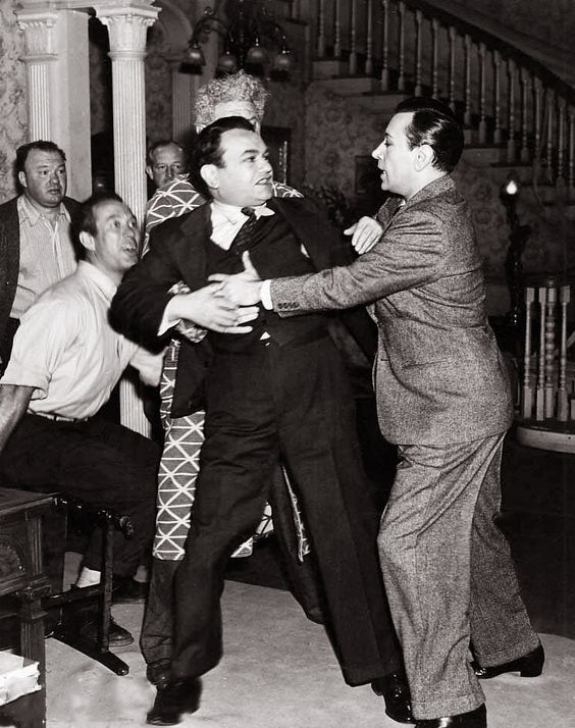
In April 1941, production of Raoul Walsh's Manpower was held up by two incidents involving the film's principal actors Edward G. Robinson and George Raft. During the first incident on 18 April, Raft verbally abused Robinson following a disagreement about a line of dialogue. A week later, on 26 April, Raft again engaged in verbal abuse and also pushed Robinson around on the set, this time witnessed by a photographer from Life magazine whose photo of the incident appeared in Life's May 1941 issue. Raft's feelings of animosity towards Robinson reportedly stemmed from his being third billed Robinson received top billing and leading lady Marlene Dietrich second billing— despite having the largest role in the film. Also, Raft was infatuated with Dietrich and believed he had a rival in Robinson.

This is the picture that appeared in the Life magazine issue from 12 May 1941 under the headline Robinson & Raft Stage Impromptu Fight On Set. Alan Hale (behind Robinson) tries to break up the fight while Ward Bond (sitting left) looks on.


On 30 April 1941, Roy Obringer (head of Warner Bros.' legal department) wrote the following letter to the Screen Actors Guild, giving a detailed description of the two incidents as mentioned above. The dispute between Robinson and Raft was eventually settled by SAG, after which the film was completed. While the two men buried the hatchet years later they would star in one more film together, A Bullet For Joey (1955)— in his 1973 autobiography All My Yesterdays Robinson maintained that Raft was "touchy, difficult and thoroughly impossible to play with."
 
Screen Actors Guild
care, Kenneth Thomson, Executive Secretary,
1823 Courtney Avenue
Los Angeles, California 
April 30, 1941
Gentlemen:
On or about March 24, 1941, the undersigned corporation commenced photography on its motion picture entitled Manpower, with Edward G. Robinson, Marlene Dietrich, and George Raft, as principal players... As production on this motion picture progressed it became apparent to a number of persons engaged in and about the production that a feeling of hostility was being evidenced by Mr. Raft against Mr. Edward G. Robinson... The situation culminated in an unusually heated and disagreeable verbal attack by Mr. George Raft upon Mr. Edward G. Robinson on 18 April, 1941, on the premises of the undersigned Company at Burbank, California, and immediately outside Stage No. 11, on which the production was then being photographed... The controversy at that time appeared to arise over the inclusion or deletion of a certain line of dialogue in the final script covering said photoplay. Apparently, Mr. Raft was of the opinion that the line should not be spoken, although assigned to Mr. Robinson, whereas Mr. Robinson took the view that the line was in the script and was satisfactory to him, and that inasmuch as he considered the line an important one, he preferred to speak the line. Mr. Robinson then said, in substance, to Mr. Raft, "Look, George, you may think the line does not make any sense, but I have to speak it and it is all right with me." Thereupon, in the presence of the persons above named, and perhaps in the presence of other persons engaged on said production, Mr. George Raft directed toward Mr. Robinson a volley of profanity and obscene language with the express purpose and intent of embarrassing and humiliating Mr. Robinson and lowering his professional dignity and standing in the eyes of all those persons with whom he was obliged to work and come in contact in connection with the production of said photoplay.
In the opinion of those persons to whom representatives of the undersigned corporation have talked, the attack on Mr. Raft's part was wholly uncalled for and actually brought about a very serious disturbance in the production of said photoplay. The interruption and disturbance of production of the picture became so serious because of the situation that Mr. Hal B. Wallis, Executive Producer of the undersigned corporation, was called into the controversy, Mr. Edward G. Robinson left the set and went to his dressing room, and the entire production was stopped for several hours, resulting in a great and substantial loss to the undersigned. Several hours after the controversy had been temporarily quieted, production was proceeded with and approximately a week passed and, except as called for by the script and by the Director, Messrs. Robinson and Raft did not speak to one another, although the script proceeded upon the theory that the characters portrayed by Messrs. Robinson and Raft were close friends.
Just prior to twelve o'clock noon on Saturday, April 26th, while the cast in said production was engaged on said Stage 11, Mr. Robinson was rehearsing a scene wherein the script called for him  to be provoked by one of the other characters. The script called for Mr. Robinson to attack this character and during the attack the script required that Mr. Raft, playing the part of "Johnnie" in the production, make his entrance and seek to quiet the disturbance. Instead of conducting himself as called for by the script, Mr. Raft immediately undertook to and did violently rough-house and push the said Edward G. Robinson around the set in an unusually vigorous and forceful manner, with the showing of a great deal of personal feeling and temper on Mr. Raft's part, causing Mr. Robinson to wheel around and say to Mr. Raft, "What the hell is all this?" In reply to Mr. Robinson's question to Mr. Raft, Mr. Raft thereupon told Mr. Robinson to "shut up", and in the immediate presence of the persons hereinafter mentioned, directed toward him a volley of personal abuse and profanity, and threatened the said Edward G. Robinson with bodily harm, and in the course of his remarks directed and applied to Mr. Robinson in a loud and boisterous tone of voice, numerous filthy, obscene and profane expressions. Thereupon, Mr. Robinson walked into his dressing room on the set. A minute or so later Mr. Robinson returned to the set and addressed himself to Mr. Raft, substantially as follows: "George, what a fool you are for carrying on in such an unprofessional manner. What's the use of going on? I have come here to do my work and not to indulge in anything of this nature. It seems impossible for me to continue." Following such remarks Mr Raft directed another volley of profanity and obscene language toward Mr. Robinson, whereupon Director Raoul Walsh, Assistant Director Russell Saunders, and others, fearing further personal violence on the set between the two men, jumped in and separated them, and Mr. Edward G. Robinson left for his dressing room off the set and the entire production was stopped...
As a result of the controversy between the two Principals on Stage 11, all further work involving the two principals was suspended from just prior to noon on Saturday, April 26, 1941, until Monday morning, April 28, 1941, and the general confusion, etc., on the set was such that the undersigned corporation lost an entire day in production, resulting in a large financial loss to the undersigned corporation. The effect of the disturbance was such that Mr. Robinson became highly nervous and such nervous condition affected his voice and made the same husky so that he was unable to properly and clearly speak his lines and otherwise give the artistic and creative performance of which he is capable. The said Edward G. Robinson, by reason of the above-mentioned occurrences, has demanded of the undersigned corporation that it give him full protection on the set from bodily harm and insulting demeanor from Mr. George Raft, making the position of the Company an extremely difficult one in its effort to produce a photoplay of artistic merit under the circumstances shown...
The undersigned feels that the above occurrences are of such serious import that they should be officially called to the attention of the Screen Actors Guild...
Yours very truly, 
WARNER BROS. PICTURES, INC. 
By: Roy Obringer 
Above and below: two scenes from Manpower with its three leading actors Robinson, Dietrich and Raft. The film became a solid box-office success despite the problems on the set. 


Source of the letter: Inside Warner Bros. (1935-1951) (1985), selected, edited and annotated by Rudy Behlmer.